Monday, November 26, 2012

Measuring a Barrel's Twist Rate

When we studied the basics of rifling a while back in this blog, there was mention of a term called "twist rate" for a barrel. The twist rate is defined as the length of the barrel required for a bullet to make one complete turn of the barrel. For instance, a standard M16A2 barrel makes 1 turn for every 177.8 mm. of barrel length. It is very important to match the twist rate based on the weight, diameter and length of the bullet to ensure accuracy. We studied a couple of methods on how to calculate the twist rate for a given bullet using the Greenhill formula and the Miller Twist Rate formula. All this is good in theory, but how do we actually measure the twist rate of the barrel? This post discusses a simple way to do so.

Recall that about 16 months ago, we discussed various tools used for cleaning firearms. Well, people can use some of those very same tools to measure the twist rate of a barrel. All that is needed is a standard cleaning rod with a rotating handle, a jag and a cotton cleaning patch. The user simply attaches the cleaning patch to the jag end of the cleaning rod and then pushes it into the barrel until the cleaning patch engages the rifling of the barrel. The user then takes a piece of sticky tape and attaches it around the back of the cleaning rod near the handle like a tiny flag (or uses a marker and marks a spot on the cleaning rod). The user then measures how much of the cleaning rod is sticking out of the barrel (a ruler measuring the distance from the barrel's base to the start of the flag or mark point should do it). Then the user pushes the cleaning rod into the barrel. Because the cleaning patch has engaged the rifling, the rod rotates as it is pushed into the barrel. When the flag or mark point has made one complete rotation, the user then measures how much of the cleaning rod is sticking out of the barrel again. The difference between the two gives the twist rate. For instance, if the rod initially has 22 inches sticking out the barrel when the first measurement is made and 12 inches sticking out of the barrel when the second measurement is made, this means that the twist rate is 1 in 10 inches.

For those of you who would like to see a video of the process:


Happy viewing!


Sunday, November 25, 2012

Firearm Myths - 4 (More Movie Madness)

Folks, it's time for another edition of firearm myths. We already dealt with this topic previously here, here and here. We will look into some more firearm myths which are prevalent in movies today.

1. If someone gets hit by a bullet, they get lifted off the ground and fly backwards.

In several movies, we have a scene where someone (villain, sidekick, red-shirt guy etc.) gets hit by a bullet shot from a handgun and is lifted clean off their feet and through a plate glass window, all by the force of the bullet hitting the person. Can this actually happen in real life? Well, let's recall some basic physics from middle school here. Newton's third law of motion states that, "For every action, there is an equal and opposite reaction".

Therefore, if there's enough energy in a bullet to send a person flying back 10 feet in the air, there should be an equal amount of recoil energy acting on the firearm, which would send the shooter of the firearm flying backwards 10 feet as well! (assuming that they are both the same weight, of course).

There are firearms that can deliver enough energy to knock a human off his feet (such as a very large caliber bullet or cannon shell), but these firearms are mounted on a weapons platform for a reason and are not carried in someone's pocket.

2. Cocking the pistol/shotgun/revolver to show that someone means business.

This scene is shown in several movies. Hero has a bad guy covered by his pistol and the bad guy is refusing to answer questions. The hero then dramatically pulls back on the hammer to cock the gun (or racks the shotgun's slide) and show the bad guy that he means business and the bad guy immediately starts talking.

In other scenes, the dramatic clicking sound happens when a character walks into a room and announces his/her presence and indicates that he or she is in control of the situation now.

In real life, no one ever walks into a dangerous area without their firearm already cocked and loaded and ready to go at a moment's notice. This is called Condition 0, which we studied a while ago when we were reading about carrying conditions.

Even more amusing is to hear the hammer cocking sound, when the actor is holding a hammerless action pistol, such as a Glock.

3. Firearms exhibiting features that shouldn't happen in real life.

As mentioned above in the previous myth, we often hear cocking noises out of firearms that don't typically make such a noise in real life. One example is the sound of a hammer being cocked back, when the character in question is holding a hammerless pistol, such as a Glock. Another example that is seen in several movies is the sound of a racking slide of a pump-action shotgun, when the character is holding a double-barreled model!

Then there's the scene where someone shoots 15 times without reloading, while holding a 6-shot revolver.

4. It's only a flesh wound.

In the movies, there seems to be a general idea that if someone gets shot in the arm, shoulder or the leg, the person will generally hobble around a bit, but will survive in the end. Then there is the scene where a person will shoot someone in the leg to prevent them from running away and the person getting shot doesn't die. Persons getting shot in the shoulder make a full recovery in the hospital after a couple of days.

In reality, there is no safe place where a person can be shot and be assured of not dying. There are some large arteries in the arms, shoulders and legs that can cause a person to die from blood loss within minutes if these are punctured. The shoulder joint is very complex and is hard to put back together if shattered by a bullet.

Police and soldiers also don't aim to intentionally wing someone. This is because there is a chance that the shot could miss and hit some other innocent person. Therefore, they are trained to aim at the center of mass, so that there is a greater chance of hitting the target. No one in their right mind ever shoots to wing someone, they always shoot to kill.

5. Put down your gun, officer, and step away, or else the hostage dies.

This is the classic scene in several movies. The hero or heroes barge into a room with their guns out, only to find the villain holding a gun pointed at a hostage's head. The villain then tells everyone to throw down their weapons and kick them towards him, or else he'll shoot the hostage. The heroes will do that and then the dramatic music starts.

No one ever wonders why the villain doesn't now just shoot the hero and the hostage and then make his escape. This is why, in real life, police officers and military forces are trained never to put down their guns in a hostage situation.

Tuesday, November 20, 2012

What is a MOA?

When referring to firearm accuracy, several texts use the term MOA a lot. So what is this MOA business anyhow? We aim to study that topic in this post.

MOA stands for Minute Of Arc (though some in the firearm industry call it Minute of Angle). Let's go back to your middle-school geometry classes and recall that a circle is divided into 360 degrees. If we want to measure angles smaller than a degree, we divide 1 degree into 60 minutes (and if we want to go even smaller, we divide 1 minute into 60 seconds). Therefore a circle is 360 degrees or 360*60 = 21,600 Minutes of Arc (MOA). So what does this have to do with firearms accuracy, you ask?

Well, if you have a circle that is 100 yards in radius, the length of one minute of arc at this distance works out to approximately 1 inch (to be precise, it is closer to 1.047 inches). How do we get this value, you ask? Here's the arithmetic behind it:

Radius of circle = r = 100 yards.
We know that the circumference of a circle = 2 * pi * r.
Taking pi = 3.1415927 approximately, we have circumference = 2 * 3.1415927 * 100 = 628.31854 yards
Now we know that 1 yard = 3 feet and 1 foot = 12 inches.
Therefore, circumference of the circle in inches = 628.31854 * 3 * 12 = 22619.46744 inches
Now, we know that a circle has 360 degrees or 21600 minutes of arc.
Therefore, length of 1 minute of arc = circumference / 21600 = 22619.46744 / 21600 = 1.04719756667 inches.

Since target ranges are usually set in multiples of 100 yards, this makes the measurement rather convenient for shooters. For example, if the firearm is shooting about 3 inches to the right of dead center at 100 yards, then we simply need to adjust the sights 3 MOA to the left to make it hit dead center. For greater ranges, we simply scale up the measurements as required: e.g. for 200 yard range, 1 MOA = 2 inches approximately, for 300 yard range, 1 MOA = 3 inches approximately and so on. Most modern telescopic sights are set to be adjustable in 1/2, 1/4 or 1/8th MOA per click, so it makes zeroing the sights very easy, since we know that 1 MOA = approximately 1 inch for 100 yards distance. Quite a few telescopic sights come with an MOA scale printed around the adjustment knobs.

Telescopic sight which measures in 1/4 MOA increments per click of the adjustment knobs.


As we mentioned above, strictly speaking, 1 MOA is about 1.047 inches for 100 yards. Therefore, some people define a separate term called SMOA (Shooters Minute of Arc) which is defined as exactly 1 inch for 100 yards. Some scopes come with an SMOA scale rather than an MOA scale. The difference between true MOA and SMOA is pretty small: for 1 MOA at 1000 yards range, true MOA works out to be 10.47 inches and SMOA works out to be 10 inches, therefore the difference between the two is less than 1/2 inch for 1000 yards distance. However, if one was to make adjustments of say 20 MOA, then at 1000 yards, the difference between the two would be around 9.4 inches! So it is good to know which unit the scope is calibrated to.

So when someone mentions that his/her firearm shoots 1 MOA, that means that under ideal conditions (no wind blowing, match-grade ammunition used, firearm mounted on a bench rest, barrel and chamber are clean etc.) the firearm will shoot groups of bullets inside a 1 inch circle on average at 100 yards distance. Most quality rifle manufacturers will guarantee that their rifles shoot sub-MOA groups with specific ammunition brands. A sub-MOA means that the rifle will shoot groups of bullets in a circle smaller than 1 inch at 100 yards range. With really high end rifles with match grade barrels and quality ammunition, 0.2-0.5 MOA or better is easily achievable. US Army sniper rifle standards from 1988 require the rifles to shoot a 5 shot group with 0.605 MOA accuracy over 300 yards distance when using M118 special ball cartridges and a government approved bench rest. This works out to shooting 5 shots inside a 1.9 inch circle at 300 yards. Any rifles that fail to meet this standard are returned back to the manufacturer.

To give the reader some idea of accuracy of various firearms, a typical assault rifle shoots about 3-6 MOA, a typical sniper rifle (depending on whether it is used by police or military) shoots about 0.25-2 MOA, but a real accurate competition rifle may easily shoot 0.15-0.3 MOA groups. With new advances in metallurgy and machining techniques, several manufacturers are now offering civilian rifles that are guaranteed to shoot 1 MOA or better out of the box, and cost less than $1000 too. Just a few years ago, such accuracy at such a low price would have been unthinkable. People used to pay their gunsmiths hundreds of dollars to bed their stocks and fit precisely machined custom barrels, all in order to get 1 MOA accuracy from their rifles. Now, due to advances in technology, they can now achieve the same accuracy or better from off-the-shelf guns and ammunition.


Monday, November 19, 2012

What is a Boolit?

The term "boolit" may be seen on some forums on the internet these days. Well, what is it, the reader wonders? Well, wonder no more.

The word "boolit" is a made-up word and is not part of the English language. It is a deliberate misspelling of the word "bullet". The origin of this term seems to have come from a forum called castboolits.gunloads.com and spread from there on to many other shooting forums (mostly those with a lot of American members). As per the forum, a boolit is a projectile that is hand cast by a person for use by an individual, whereas a bullet is a machine-made projectile made by a commercial company for mass consumption. Another common difference per the forum members is that a "boolit" is cast from a mold, whereas a "bullet" is a jacketed projectile.

In the good old days, many fire arms came with their own bullet molds.


Some enthusiasts like to make their own bullets, just the same way that their forefathers used to. And quite a few of them refer to their own custom made products as "boolits".

Monday, November 12, 2012

Point Blank Range

When referring to firearms, we sometimes hear the term "point blank range". So what is the meaning of this term and how did it come about.

The popular usage of the term "point blank" usually means shooting a target very close to the muzzle of the firearm. However, in the field of ballistics, the definition is a bit different: "point blank range" is the range between which the user can hit a target without adjusting the elevation of the weapon. This varies depending on the size of the target and what range the firearm was zeroed at.

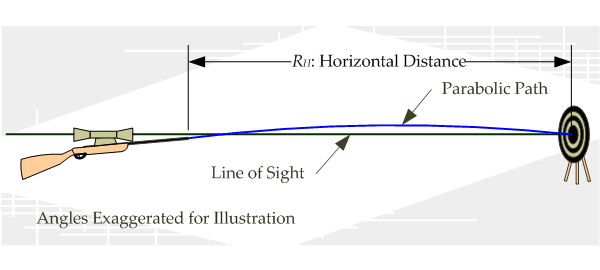
In our discussion about zeroing a sight many months ago, we mentioned that the sights are calibrated for a known distance (e.g. for the M16, the US military recommends zeroing the sights at 300 meters). Remember that bullets travel in a parabolic path, such as the diagram below:

Public domain image from Wikipedia.

As can be seen from the figure above, when the bullet is fired, it comes out of the barrel below the line of sight, then quickly rises above the line of sight and then starts to fall again after it has traveled some more distance. If the rifle is sighted to say, 300 meters, the bullet strikes a point that coincides with the line of sight when the target is at 300 meters distance. If the target is closer than 300 meters, the bullet will fly above the line of sight to the target. If the target is farther than 300 meters, the bullet will strike a point below the line of sight of the target. Say the target is something like 5 inches (12.7 cm.) tall, the rifle is zeroed at 300 meters and when the user shoots at it, the bullet never rises 2.5 inches above line of sight at distances over (say) 275 meters, nor does it fall 2.5 inches below the line of sight for distances below (say) 325 meters. Therefore when we shoot this target by aiming for the center of the target using line of sight, we can't miss it between these two distances. Thus we can say for a 5 inch target, the zero range is 275 meters and the maximum point blank range is 325 meters.

There are multiple reasons given for the origin of the term "point blank". One reason given is that the traditional center of targets is a white circle and the French word for "white" is "blanc".

Another charming reason given for the origin of this name has to do with the famous Italian mathematician, engineer, designer of fortifications and bookkeeper, Niccolo Fontana, known to the world as "Tartaglia". The reason for his nickname has to do with an incident where he was badly wounded in the face by an invading French soldier when he was just a boy. The scars from those wounds affected his ability to speak normally and he picked up the nickname "Tartaglia" ("The Stammerer") as a result. As an adult in the 1500s, Tartaglia proved to be a skillful mathematician and was the first to translate Euclid's Elements from Latin into a popular European language (Italian), so it could be more readily understood by common people (only well educated people spoke Latin). During the 1530s, he started to develop an interest in military fortifications and gunnery. In 1537, he published a study on the science of gunnery and over the next 10 years, he invented an instrument known as a "Gunner's Quadrant" to help gunners aim their artillery properly. Incidentally, he was also the first to demonstrate the path of a bullet is always parabolic.

A Gunner's Quadrant.

It consists of two wooden arms joined together at 90 degree angles to each other, similar to a carpenter's square tool. At the joint between the two arms is attached a thread with a weight at the end, called a "plumb bob". Between the two arms is an arc marked off into 12 divisions, called points. The cannon would then be fired at various angles of elevation and the ranges measured for each angle and noted down in a book called a "gunner's table". To use the device, the gunner would insert the long arm into the cannon barrel and then tilt the barrel up or down until the plumb bob would intersect the point that his gunner's table showed for the distance to the target. When the barrel was near vertical, the plumb bob would cross Point 12 and when it was near horizontal, the plumb bob would cross Point 0.

Using a gunner's quadrant with a cannon. Public domain image.

Remember though that this was 16th century Europe and most people were still using Roman numerals. Therefore the points on the arc were marked using Roman numerals I, II, III, IV .... XI, XII, since most people were used to seeing numbers written like this anyway. The concept of "zero" doesn't exist in the roman numbering system and therefore point 0 was marked with a blank and was called/translated as "Point Blank"!


How to Calculate the Twist Rate - III

In the last couple of posts, we saw the Greenhill formula and the Miller twist rate formula as two methods to calculate the twist rate of barrels. There are also a few computer programs that were written to help calculate the barrel twist rate.

A well known program called McGyro was written by the late Robert L. McCoy in the 1980s. Bob McCoy was a distinguished scientist employed by the Ballistic Research Lab (BRL), now called the Army Research Lab (ARL) at Aberdeen Proving Grounds in Maryland. For nearly 30 years, it was his job to conduct both theoretical and experimental ballistic research on everything from .22 caliber to large cannon shells. During this time, he received 3 of the highest civilian awards from the US government for his work and even wrote a book on the subject called Modern Exterior Ballistics. So this is certainly a person who knew what he was talking about. In the 1980s, he wrote a series of small programs in the BASIC programming language to estimate the twist rate. The most famous of these are McGyro and IntLift. As an item of historical interest, his original programs are available here.

Bob McCoy's programs were later improved by William Davis Jr., who was also another well known ballistic engineer. Bill Davis qualified as an expert shooter in rifle, carbine and pistol when he was enlisted in the US Army during WW-II. After the war, he worked at the above mentioned Ballistic Research Lab (BRL) for a few years and later at Frankford Arsenal and Rock Island Arsenal. He was involved in the development of the 5.56x45 mm. cartridge and the M16 rifle as well (He held the ad-hoc title of 'AR-15 Project Directory' during its development). It was Davis' team that identified many of the early ammunition problems with the M16, including primer sensitivity and cyclic rate issues due to high port pressures; they also diagnosed and offered solutions to the ill-fated change to ball-type propellant. He later went on to found Tioga Engineering in 1980 and was ballistics editor for American Rifleman magazine for several years until his death in 2010. He wrote the NRA's book on handloading ammunition and contributed to the Encyclopedia Britannica for the Ammunition section.

The original programs that these gentlemen developed were programmed in the BASIC programming language, mainly because it was available on practically every home computer model sold in the 1980s and therefore could be run by a wide audience. Unfortunately a BASIC interpreter doesn't come distributed with computers these days, but many free versions can easily be found by using google and searching for "BASIC interpreter". The programs have also been translated into more modern programming languages such as JavaScript and may be found online at several places on the web.

There are also other translations, such as WinGyro, which is McGyro modified to run under a Microsoft Windows environment.

Sunday, November 11, 2012

How to Calculate the Twist Rate - II

In our last post, we looked at the venerable Greenhill formula, first developed in 1879 and refined over the years. In 2005, Don Miller suggested an improved formula to calculate the twist rate, in the March 2005 issue of Precision Shooting magazine. We will look at that formula in this post.

Some of the problems with the Greenhill formula was that it was more suited to bullets from another era, where the bullet shapes were more oblong shaped (like an American football) and largely made of lead alone. Modern bullets are longer (e.g. spitzer or boat-tail shape) and made of multiple materials (such as copper and brass jackets, steel core etc.). The corrected Greenhill formula does work better than expected for modern bullet velocities of 2800 feet/sec, but it doesn't work so well for black powder velocities.

What we studied in the previous post about the Greenhill formula was actually its simplified form. The original Greenhill formula was much more complicated and involved calculating such esoteric items as polar moment of inertia, transverse moment of inertia, pitching moment coefficient, angle of attack, air density etc. To work out the original Greenhill formula, one would need a degree in physics and mathematics to make sense of all these terms, as well as access to some high quality scientific instruments to make the measurements needed to calculate all these items. What Miller did was start with the original Greenhill formula and used some empirical data to simplify the calculations so that one didn't need an advanced degree to do the whole calculation and could use basic instruments to do the measurements. The Miller formula is:

where:
     T = Twist rate in inches per turn
     m = Weight of the bullet in grains
     s = Gyroscopic stabilization factor (see below for how this is evaluated)
     d = Bullet diameter in inches.
      l = Bullet length in calibers, which is calculated as L/d, where L = length of bullet in inches.

With the Miller formula, all the information needed for the calculation (length, diameter and weight of the bullet) can be easily obtained from the manufacturer, or can be easily measured by anyone with access to a vernier caliper and a small weighing scale.

Miller notes that his constant 30 in the equation above was taken assuming a standard temperature of 59 degrees fahrenheit, standard pressure of 750 mm. of mercury at 78% humidity, velocity of bullet at 2800 feet/sec and altitude at sea level. He also notes that under the standard conditions, the gyroscopic stabilization factor s in the equation above runs from 1.3 to 2.0 (for military, it runs from 1.5 to 2.0) and he says 1.75 is a good starting value for it. He also states that cold temperatures significantly affect air density and therefore s as well. Hence, he recommends assuming s = 2.0 to account for usage in low temperature environments for preliminary calculations of twist.

With all this in mind, let us perform a sample calculation for a Sierra bullet with the following specifications:
    m = 180 grains
    L = 1.180 inches
    d = 0.308 inches

First we calculate l = L/d, which gives us l = 1.18 / 0.308 = 3.83117

Then we assume s = 2.0 to account for low temperature conditions and calculate the twist rate T, which works out to about T = 12.081. This means that a twist rate of 1 turn in 12 inches ought to work well for this bullet.

In his paper, Miller says that he used experimental data from the US Army's Ballistic Research Lab (BRL) to verify the validity of his formula.