Showing posts with label Action. Show all posts

Saturday, October 23, 2010

Actions: Gas Operated: Recap

Let us now recap what we've learned about gas operated systems in the last few posts:
  1. Gas operated systems work by utilizing some of the high-pressure gas generated by firing a cartridge, to operate their extraction, reloading and cocking mechanisms.
  2. These are generally used for weapons like rifles and shotguns. For example, most modern self-loading and assault rifles designed during and after World War II use gas operation. Examples include: AK-47 and its descendants, FN FAL, M16 family, M1 rifle and carbine, Valmet, Galil etc.
  3. The two main ways of using a gas operated system is to (a) make the gas act upon a piston, which drives the rest of the system or (b) make the gas directly impinge upon the bolt and bolt carrier.
  4. Main problem with gas operated systems is that the gas tends to leave corrosive deposits on the working parts. Different gas operated systems handle this issue in different ways.
  5. Another problem with gas operated systems is that the heat from the gas causes metal parts to expand. Due to unequal expansion rates of the various components, they must be well lubricated to prevent excess wear and tear.
  6. Because of the weight of the parts moving after the weapon is fired, gas operated systems using pistons lose some accuracy because of the vibrations and shift in balance. This especially significant in the case of automatic firing weapons. This problem is reduced with direct impingement systems because the mass of moving parts is lesser than a piston driven system.
  7. On the other hand, piston driven systems are generally more reliable because the gas only acts on the piston and is not allowed to directly act upon the rest of the mechanism. Direct impingement systems need to be cleaned and maintained more regularly because the gas acts upon much of the mechanism.
As we mentioned above, the hot high pressure gases generated by an exploding cartridge often carry corrosive chemicals with them. Upon cooling, these chemicals deposit upon the operating parts of the action. If the build up is too much, this will lead to jamming and reliability issues. All gas operated systems must therefore have some way to deal with this situation. For example, in piston driven systems, the gas is only allowed to act on a piston, thereby protecting the rest of the parts from heat and corrosion. Additionally, on an AK-47, the piston has sharp edges on its face, which in theory, scrape the built-up deposits from the walls of the cylinder. These scrapings get vented out the next time the weapon fires. In direct impingement systems such as the M-16, some parts such as the gas tube are somewhat self-cleaning and not designed to be user-serviced in the field. Other parts, such as the bolt and carrier are designed for easy access, so that they can be properly cleaned.

Most modern assault rifles and squad automatic weapons (SAW) in use today utilize the gas operated action principle. This shows the popularity and success of this type of mechanism.

Actions: Gas Operated: Gas Trap

In this post, we will study a lesser known gas-operated system known as the Gas Trap system. This was only used for a few rifles in history, but it might be well to mention it now. This system was originally invented in 1909 by Danish firearm designer, Soren Bang, and used in what is known as the Bang M1922 rifle. The Bang rifle was used by both Denmark and the United States.

A similar idea was also used in the early models of the American M1 Garand rifle, but was later dropped in favor of a long-stroke piston system, because of some problems with the gas trap mechanism. Many older M1 Garands were retrofitted to use long-stroke piston mechanisms and original rifles using gas trap actions are now very rare and are highly prized models indeed.

The third user of the Bang design was the German Gewehr 41, which was designed to the Wehrmacht's requirement that the rifle should be gas operated, but there should be no hole drilled in the barrel to tap the gases. With this very tight restriction to be met, both the manufacturers (Mauser and Walther) who submitted entries into the competition ended up using the Bang design. The Gewehr 41 was made by both Mauser and Walther and used the same caliber ammunition, but they had other different design features, to meet some of the other requirements of the Wehrmacht. The Mauser design was not as reliable as the Walther design, so the majority were made by Walther. However, the rifle is also very rare today and is very highly prized by collectors.

In all the previous gas-operated actions we've studied, there is a hole drilled into the barrel, near the breech (closed end of the barrel) or the middle of the barrel. The purpose of this hole is to tap some of the hot expanding gases leaving the rifle. This tapped gas is used to operate the mechanism that extracts the old cartridge, loads a new one and also cocks the weapon. In all the previous gas operated systems we studied, the hot expanding gases push the piston or bolt.

In a Gas Trap or Bang system, there is no hole drilled in the barrel. Instead, some of the gases are trapped by a ring-shaped cone at the end of the muzzle (the open end of the barrel). The gases expand into the gas trap and pull a piston (instead of pushing, like the other gas operated actions). Pulling this piston actuates a mechanism to extract the cartridge and reload the gun.

The idea behind this system is that the mechanism to extract and reload the cartridge starts to work only after the bullet has left the barrel. This enhances the accuracy of the weapon.

The problems with the system largely stem from the extra complexities of the gas trap. The gas trap is composed of some very precisely machined parts, which are prone to fouling and corrosion from dirty gases. This makes the system very hard to clean and maintain under normal operating conditions in the field and prone to jamming issues. In the case of the M1 Garand, there were also issues in trying to fit a bayonet on top of the gas trap. This is why the gas trap mechanism never really gained popularity.

Thursday, October 21, 2010

Actions: Gas Operated: Direct Impingement

In our last two posts, we studied gas operated actions based upon pistons: the short-stroke piston action and the long-stroke piston action. Now we will study another modern gas-operated action, the direct impingement action. This action was originally invented in 1901, but the first successful rifle to use this action was the French MAS-40, which was commissioned in 1940. Since then, the most famous rifle to use this action is the American M16 family.

Recall that in the two piston driven systems we studied earlier, some of the gases generated by the burning propellant are tapped from the barrel and used to push a piston enclosed within a separate cylinder. The piston in turn acts upon the bolt carrier and bolt and causes them to cycle the rest of the action.

In a direct impingement system, there is no piston, piston rod or cylinder at all. Instead, some of the high-pressure gas is tapped out via a gas tube and piped directly onto the bolt and bolt carrier. The bolt and/or the bolt carrier are fitted tightly into the chamber of the weapon and act as a piston. In the case of the M16 family, the bolt has piston rings fitted to the back in order to provide the tight seal.

Click image to enlarge.
Image is taken from "US Army FM23-9, M16A1 Rifle and Rifle Marksmanship", which is in the public domain.

The bolt and bolt carrier move back due to the gas pressure. While moving backwards, the bolt extracts the fired cartridge case and ejects it via a side port. A return spring pushes the bolt and bolt carrier forward and the bolt picks up a new cartridge from the magazine on the way forward.

The following animation gives a good idea of how this mechanism works:


There are some advantages to such an action. Since there is no piston, piston rod or separate cylinder for the piston and piston rod, therefore the overall weight of the weapon is reduced. Fewer parts also means reduced costs of manufacturing. Since there are fewer and lighter moving parts on the weapon, balance does not shift as much and therefore the accuracy of the weapon is increased compared to piston driven weapons, especially in automatic mode. The gas tube is smaller and lesser mass than a cylinder containing a piston and hence it does not affect the natural resonance of the barrel as much, which also contributes to greater accuracy. Since the moving parts are in the same axis as the barrel of the rifle, this also helps performance when firing rapidly.

The disadvantages of this action are chiefly caused by the hot gases acting directly on most of the operating parts (bolt, bolt carrier, firing pin, springs, extractor etc.). The gases contain some dirty residues, which deposit on the bolt and bolt carrier and will cause reliability issues, if not cleaned frequently. This means that people need to spend more time cleaning and maintaining weapons with direct impingement actions. This also makes the weapon more sensitive to the quality of propellant used in the cartridges. The hot gases also cause the operating parts to expand. Since the parts are tightly fitted and expand at different rates, this could cause jamming and acceleration of wear and tear of the moving parts. Heat from the gases can change the physical properties (hardness, elasticity, brittleness etc.) of the metal parts and cause excess wear. The heat also evaporates the lubricant in the mechanism and this could cause the moving parts to jam up as well.

An infamous case of this is the early problems that the M16 rifles faced. When the original rifle was designed, the ammunition used for testing used a certain type of propellant (a nitrocellulose based powder). However, when the rifle was put into production and sent to the first combat units, the military found that Dupont Inc. could not produce the propellant in sufficient quantities to the specifications demanded. Hence, the ammunition was changed to use a different propellant (a mixture of nitroglycerine and nitrocellulose) which was easier to produce and met the pressure specifications. Unfortunately, this new propellant was dirtier and generated more residue than the one used in the development prototypes. Also to save manufacturing costs, the chrome-lining in the chamber, which was in the prototype design, was removed in the early production models. The early production models were also issued with no cleaning kits or maintenance instructions. These three issues caused many of the early M16s to jam unexpectedly and the rifle earned a very poor reputation during the Vietnam war. After a congressional investigation, the chrome lining was put back and cleaning kits and maintenance instructions were issued and the frequent jamming issues were resolved. While the reliability issues were solved and the M16 had better accuracy than most other competing rifles, the early bad reputation that was earned by the M16 took years to disperse.

Sunday, October 17, 2010

Actions: Gas Operated: Long Stroke Piston

In our last post, we studied the gas operated, short stroke piston action. During this post, we will study the other gas operated action that uses pistons, the long stroke piston. This is a mechanism that was used by the American M1 Garand rifle (not the carbine, which uses a short stroke piston), the Soviet AK-47 family (and its various derivatives made in other countries, such as the Israeli Galil, Finnish Valmet etc.), the Belgian FN FAL assault rifle etc.

Like the short stroke piston we've already studied, when the cartridge is fired, hot high pressure gases are generated which push the bullet out of the barrel. Most of these hot gases also escape behind the bullet, but some of it is tapped out and used to operate the extraction and reloading mechanism to eject the spent cartridge and load the next cartridge.

Click to enlarge image
Original file licensed under GNU Free Documentation License version 1.2 by user Thuringius, on en.wikipedia.org

In the above image, (1) is the gas port from which a portion of the hot gases leaving the barrel are tapped. (2) is the head of the piston and (3) is the piston rod. (4) is the bolt that holds the cartridge in place in the breech and (5) is the bolt carrier that moves the bolt. (6) is the return spring.

Initially, the bolt holds the cartridge in place in the breech chamber. When the trigger is pulled, it releases the hammer (not shown in the image above), which strikes the base of the firing pin (not shown in the image above). The other end of the firing pin strikes the base of the cartridge, which detonates its primer. The primer in turn, causes the propellant of the cartridge to burn and generate hot, high pressure gases. The generated gases expand and push the bullet out of the barrel.


Click to enlarge image
Original file licensed under GNU Free Documentation License version 1.2 by user Thuringius, on en.wikipedia.org

As the bullet is pushed out of the barrel, some of the high pressure gases generated by the exploding cartridge are tapped via the port (1) and enter the tube containing the piston. The high pressure gases act upon the piston head (2) and push it backwards. Since the piston rod (3) is connected to bolt carrier (5), they move backwards, compressing the return spring (6). At the same time, the bolt carrier (5) also picks up bolt (4) and moves it backward at the same time. The bolt has an extraction pin that picks up the spent cartridge case and pulls it out of the breech. As the spent cartridge moves backwards, it is ejected out of the gun via a side port. The piston, bolt carrier and bolt continue to move backwards and re-cock the gun. Meanwhile the high pressure gases acting on the piston head (2) are dissipated via a vent hole in the tube. When the bolt carrier moves backwards to its maximum, the compressed return spring (6) pushes it forwards again. This moves the piston, bolt and bolt carrier forward again and on the way forward, they pick up a new cartridge from the magazine and push it into the breech chamber. Now the weapon is ready to fire again.


In the above animation, you can observe clearly how the mechanism works (including the hammer and firing pin, which were not present in the images above).

The main difference between the long stroke piston action and the short stroke piston action is that in a short stroke action, the piston moves back violently only a short distance (usually less than its own diameter) and then it is stopped by a projection. The bolt carrier then separates from the piston and continues to move backwards due to momentum. As a result of this, a short stroke piston action generally taps gases from closer to the breech (closed end of the barrel). In a long stroke action, the piston moves a distance greater than the length of the cartridge. In fact, the piston stays attached to the bolt carrier throughout the operation. This causes the piston to have greater dwell time and therefore, long stroke piston weapons generally tap their gases closer to the front end of the barrel (the muzzle). It also means that the operating parts are longer and therefore heavier than that of a short stroke piston action.

The advantages of this type of action are many. Like the short stroke piston action, the hot, high pressure gases only act upon the piston head and therefore, the other operating parts (the bolt, bolt carrier, trigger assembly, hammer, firing pin, return spring etc.) are not exposed to the hot gases or the dirty residue at all. These weapons can therefore accept a wide variety of cartridges using different quality propellants, since the dirty residue from low-quality propellants does not have a chance to contact most of the key operating parts of this action. This means a more reliable action and ease of maintenance of the weapon. The extra weight of the piston rod acting on the bolt carrier means more positive extraction, chambering and locking of the cartridges.

There are also some disadvantages. The main one is that the mass of the moving parts alter the center of gravity of the weapon and thereby make it harder to keep the weapon pointed on target, especially when firing in automatic mode. The abrupt stops and starts of the bolt carrier, piston and bolt at either end of the cycle also contribute to the shaking. Also, because the operating parts are longer, the overall weight of weapons that use this action are a bit heavier than short stroke piston actions.

Thursday, October 14, 2010

Actions: Gas Operated: Short Stroke Piston

The first gas operated mechanism we will study today is called the short stroke piston. This is the mechanism that is used in rifles such as the American M1 carbine and M14 rifle, the Belgian Fabrique Nationale SCAR assault rifle, the British SA80 assault rifle and the German Heckler & Koch G36 assault rifle.

When a gas operated weapon is fired, the cartridge generates hot gases, which push the bullet out of the barrel. Most of the gas also leaves the barrel behind the bullet, but a portion of the gases are tapped out and used to operate the extraction and reloading mechanism, to eject the old cartridge and load a new one.

The basic idea behind a short stroke piston mechanism is that when the cartridge is fired, some of the expanding gases are tapped by a port close to the firing point or the middle of the barrel. This means that the gas here is at relatively high pressure (compared to if the gas was tapped close to the open end of the barrel). This high pressure gas is then allowed to act upon a piston. The other end of the piston touches the bolt carrier of the rifle. When high pressure gas acts upon the piston face, it pushes the piston back very rapidly, which in turn pushes the bolt carrier back. The piston moves back for a very short distance (generally, a distance that is less than its own diameter) and is then abruptly stopped, either by a projection, or by a gas cut-off. The bolt carrier separates from the piston and continues to move back on its own, due to the kinetic energy imparted to it by the piston. The bolt carrier drags the bolt backwards, which extracts the fired cartridge out and ejects it via a side port. They continue moving backwards and cock the rifle again, ready to fire. When the bolt carrier reaches its most backward position, a return spring pushes it forward again. On its way forward, the bolt picks up a new cartridge from the magazine and pushes it into the firing chamber. As it reaches its forward most position, the bolt locks and the weapon is ready to fire again.


The animation above shows the mechanism of the LWRC short stroke piston mechanism. It only shows the movement of the piston and not the bolt-carrier or bolt, but you can get a good idea of how it works. Note how the hot gases are vented out close to the middle of the rifle.

There are some advantages of the short stroke piston system. Like all gas-operated piston systems, the hot gases only impinge on one side of the piston and the other end of the piston rod pushes the rest of the mechanism. This means that all the hot gases and carbon residue are kept away from the rest of the operating mechanism, which improves reliability and life of the operating parts. Also, since the piston is stopped very quickly, the total mass of recoiling parts is smaller and therefore this makes the weapon easier to control. The other advantage is that shorter barrels can be used with short stroke piston systems.

Sunday, October 10, 2010

Actions: Gas Operation: Basics

In the last few posts, we've studied some modern firearm actions such as those that utilize the blowback principle and the recoil operated action. We will now study another family that is also heavily used in modern day weapons, the Gas Operated Action.

The basic principle of this family of actions is as follows: When a cartridge is fired, the propellant material burns and produces pressurized gas. The pressurized gas expands and pushes the bullet out of the front of the barrel. After the bullet is forced out of the barrel, the gas also leaves through the same exit. In a gas operated action, some of this pressurized gas is tapped out from the barrel via a port and used to operate a mechanism to remove the old cartridge, re-cock the weapon and chamber a new cartridge automatically.

The pressurized gas operates the mechanism in one of the following ways:
  1. The pressurized gas operates upon a piston, which is forced to move by the expanding gases. The other end of the piston pushes the mechanism that ejects the old cartridge and loads a new one in. The two main types of piston actions are short and long stroke pistons. Piston operated mechanisms are used with weapons such as the M1 Garand, the AK-47 rifle family, the Bren LMG etc. Since the hot high-pressure gas operates upon the piston only, the rest of the mechanism is kept relatively cooler and cleaner, which makes the mechanism much more reliable to operate.
  2. Gas trap: This works similar to long stroke piston mechanisms, but uses lower pressure gas to operate. This is a relatively rarer mechanism and was used with the German G41 rifle in World War 2, as well as some early Garands.
  3. Direct impingement: Instead of the gas to push a piston, which in turn operates the mechanism, in a direct impingement action, the gas directly acts upon the bolt and carrier. Since there is no piston, this reduces the weight of the weapon and lowers the manufacturing cost. On the other hand, the firing mechanism becomes fouled more quickly and hot gases may also cause the different parts of the mechanism to expand at different rates and thereby lose accuracy. Lubricants in the mechanism also dries up and may cause malfunctions. This is the mechanism used by the M-16, AR-15 and M4 rifles.
Compared to blowback and recoil operated actions, which are used for lower powered pistols mostly, the gas operated action family is primarily used for automatic and semi-automatic rifles.

The first mention of a gas operated action was due to a Mexican General named Manuel Mondragon, who used it in a rifle design called the Mondragon rifle in 1887. It was the world's first semi-automatic and automatic rifle. Due to poor production facilities in Mexico at that time, he tried to get some US manufacturers to make the weapon, but could not garner enough interest at that time. However, he managed to convince the Swiss firm Schweizerische Industrie Gesellschaft (SIG) to manufacture this weapon for him. Excess stock of these weapons from SIG were bought up and used by Germany in World War I and World War II.

The next patent for a gas operated action was filed by the redoubtable American designer, John Moses Browning, who invented a gas operated action in 1889. Browning later licensed his design to Colt in 1892 and it was used to make weapons in a number of calibers.

In the next few days, we will study the various gas operated actions in some detail.

Sunday, September 19, 2010

Actions: Recoil Action: Muzzle Booster

A muzzle booster is a device that is sometimes used with some short recoil operated actions. It is used to add extra force to the recoil action. This helps boost reliability and increased rate of fire. The idea behind a muzzle booster is to tap some of the expanding propellant gases to add to the force acting on the recoiling parts.

A muzzle booster was first used on a Vickers machine gun of 1912. During World War II, it was used by the German MG-42 as well as the later MG-3 machine gun.

The basic example, as used on the Vickers machine gun consists of a flared cup attached to the end of the barrel. There is also an outer tube that surrounds the barrel as well. The outer tube is aligned very precisely so that it has an exit hole for the bullet to pass through after it emerges from the barrel. The outer tube also has other perforations to allow gases to escape.

When the bullet is first fired, it comes out of the barrel along with some burnt propellant gases. As it passes through the hole in the outer tube, it temporarily prevents gas from escaping out of the barrel. Therefore, the pressure in the outer tube rises and the gas moves backwards and pushes on the flared cup attached to the end of the barrel. This provides additional force to move the barrel backwards. The excess gas then escapes through some perforations on the outer tube. The animation below shows how this works (click on the image to view the animation).

Click on the image to view the animation.
Image licensed under Create Commons Attribution-Share Alike 2.5 Generic, 2.0 Generic and 1.0 Generic license
Created by user GraemeLeggett at en.wikipedia.org

Muzzle boosters are also used when attaching silencers (or, to give the correct name, "suppressors") to short recoil operated pistols (i.e.) most modern semi-automatic pistols. Since the barrel and bolt are the recoiling parts of a short recoil operation, adding a silencer to the barrel increases the barrel weight. The extra weight may interfere with the recoil operation since more force is now needed to push the barrel backwards fully. Using a muzzle booster provides the extra force to counteract the extra weight added. This muzzle booster is sometimes referred to as a Nielsen device.

The same idea is also used for some blank firing adapters (BFA). During ceremonial occasions and military demonstrations, users are provided with blank cartridges that only contain the propellant, but not the bullets. Blank cartridges have lesser power than normal cartridges that contain bullets. Therefore, firing a blank cartridge produces much less recoil force, which means that it may prevent a recoil operated action from working properly. By screwing on a special muzzle booster (the blank firing adapter) to the end of the barrel, the extra force required to cycle the action is generated.

Saturday, September 18, 2010

Actions: Recoil Action: Inertia Recoil Operation

In the last two actions that we studied previously, the short recoil operated action and the long recoil operated action, the common feature to both is that the bolt and barrel are allowed to recoil, while the rest of the firearm remains immobile. Today we will study another type of recoil action called the Inertia Recoil Operated Action.

In this type of action, unlike the other two types, the bolt is held immobile initially and the rest of the firearm is allowed to recoil around it. This means that the recoiling parts form a greater mass than in the other two types of recoil actions that we studied previously. That implies that this action is suitable to be used by firearms with heavier loads, such as large bore shotguns. The original design for the inertia recoil action was done by Bruno Civolani in 1967. He tried to sell the design to several manufacturers, but was not successful until he approached an Italian firm named Benelli. Until then, Benelli was largely a moped and motorcycle manufacturer, but they were also exploring the business of firearms and they produced their first firearm using this action in 1969. The action became somewhat popular due to its fast rate of fire (about 5 rounds/sec). Since then, Benelli has manufactured a number of shotgun models that use this design and has also licensed the design to a few other manufacturers such as Franchi (Italy) and Stoeger (Turkey). Currently, the Benelli, Franchi and Stoeger brands are now all owned by Beretta S.A. of Italy.


Block diagram of the Inertia Recoil Operated Action. Public domain image.

In the above diagram, at step 1, bolt body A and barrel B are initially locked together and C is the frame of the weapon. The bolt body and barrel are joined together by a inertial spring. After it is fired (step 2), the bolt body A remains stationary while the firearm recoils into the shooter's body. As a result of this, the parts B and C move backwards and compress the inertial spring between A and B. Then in step 3, the inertial spring that was compressed in step 2 begins to expand and push bolt A backwards. At this point, the bolt A is unlocked and allowed to be pushed fully backwards as shown in step 4. The bolt has an extractor that pulls out the old spent cartridge case backwards and ejects it at this stage. The bolt moves backwards fully and compresses a recoil spring (not shown) at the back of the weapon and also re-cocks the weapon. Then in step 5, the recoil spring pushes the bolt forwards again and it picks up a new cartridge and the bolt is locked to the barrel and the cycle begins again.

The reader may be interested in an animated video of the above action, to get a better understanding of how it works.

The inertia operated system is known for its simplicity, since there are only 3 primary parts in the action: the bolt body, inertia spring and rotating bolt head. This also means the weapon is fairly light weight as well. Compared to gas operated actions, this action requires less cleaning since the fired gases do not enter the working mechanism and hence there is no carbon buildup. However, they generally have transmit a bit more recoil to the user than a gas operated system. As mentioned above, this is an extremely fast action compared to a long recoil operated action. It is also very versatile as it is capable of firing various types of cartridges of different firing powers, without re-adjusting the action at all.

As a demonstration of the speed of shooting an inertia action weapon, here's a video of a world class exhibition shooter, Tom Knapp, demonstrating how to shoot 10 clay targets with a single throw. Note that he mentions that his shotgun is a stock off-the-shelf model with only two extra accessories: a magazine extension to hold more rounds (the Benelli shotgun model he is using only holds 3 + 1 rounds without the extension) and his fiber-optic sight.


Benelli, Franchi and Stoeger are all known for their quality shotguns. The Benelli M3 shotgun in particular, is a favored weapon carried by SWAT teams.

Monday, September 13, 2010

Actions: Recoil Action: Long Recoil Operation

In the last few posts, we talked about a particular type of recoil action called the short recoil operated action. In this post, we will talk about another type of recoil action, the long recoil operated action.

This action is actually one of the older recoil operated actions in existence, being over 100 years old at least. It is commonly used in naval guns or artillery, but not as mucsh seen with small arms. When it comes to small arms usage, it is mostly used by some well known semi-automatic and automatic shotgun designs. The long recoil action shotgun was originally designed by the famous gun designer, John Browning in 1898 and patented in 1900. This action is very rarely used for pistols and there is only one (Frommer pistol) that used it for a pistol.

In a long recoil operation, the bolt and barrel are allowed to recoil, similar to that of a short recoil operation. At the point when the bullet is fired, the bolt and barrel are locked together. As the weapon fires, the bolt and barrel move back together due to the recoil. They continue to move together backwards until they reach the back of the receiver and recock the hammer. At this point, the bolt is held in the back of the receiver by a catch. The barrel is then pushed forward by a barrel spring and returns completely forward, during which time the spent cartridge case is ejected. When the barrel has reached its fully forward position, the bolt is then released from the back and pushed foward by another spring. As the bolt moves forward, it picks up a new cartridge from the magazine and pushes it into the barrel chamber.


As you can see in the illustration above, the first image shows the bolt and barrel right after the bullet has been fired. Note that the bolt and barrel each have their own individual recoil springs. The second image shows the bolt and the barrel moving backwards due to the recoil until they reach the end of their travel, whereupon the bolt hooks on the catch and is left held there. Meanwhile, the barrel recoil spring uncompresses and pushes the barrel forward, as shown in the third image. When the barrel reaches its forward position, it releases the catch that is holding the bolt back in the third image and the bolt is then pushed forward by the bolt recoil spring.

Compared to the blowback actions we've studied previously, this type of action can handle much heavier loads.

Compared to the short recoil operated action, there are some significant differences.
  1. When the weapon is fired, the bolt and barrel move back together initially, just like in a short recoil operated action. However, in the short recoil operation, the two move back together only a few mm. at most, before the barrel stops while the bolt continues to move backwards. In the long recoil operated action, the separation of the bolt and barrel happen much later. In fact, in a long recoil operation, the bolt and barrel move all the way backwards until they reach the end of their travel in the back of the receiver.
  2. Short recoil actions tend to have only one return spring. Long recoil actions have separate return springs for the barrel and the bolt.
Since the bolt and barrel are much heavier than the bullet and since they move backwards together a long way compared to a short recoil operation, the cycle time of shooting and reloading is much slower compared to a short recoil action or a blowback action. On the other hand, the longer cycle time leads to slower, smoother operation.

The long recoil operated action was used in the John Browning designed Auto-5 shotgun, which was the first semi-automatic shotgun. This shotgun was originally designed in 1898. The Browning Auto-5 model was designed with the intention of making it suitable for mass production and the design was licensed out to various manufacturers, such as FN, Remington, Savage arms, Franchi etc. and remained in production until 1999. This makes this model one of the most successful shotguns in history.

Remington Model 11 shotgun, which uses the Browning designed long recoil action.
Public domain image.

When John Browning had originally designed the Auto-5, he intended to sell the design to the Winchester arms company, since he had already sold several designs to them previously. However, Winchester was not prepared to pay the amount of royalty that Browning demanded, so he went to Remington next. Tragically, the Remington deal fell through, as the president of the Remington company died of a heart attack during the negotiation period. Hence, John Browning went to Europe and licensed the design to Belgium's Fabrique Nationale (FN). Later on, Remington licensed the design again and used it with their Model 8, Model 11 and Sportsman model shotguns. The design was also later licensed to Savage Arms of the US, Franchi and Breda of Italy and Tula State Arsenal (TOZ) of Russia. The French designed Chauchat light machine gun of World War I also used a version of the Browning long recoil action mechanism. While the Chauchat was mostly a failure, the shotguns remained in use for a very long time indeed.

Thursday, September 9, 2010

Actions: Recoil Action: Short Recoil Operation - II

In our last post, we studied the basics of a Short Recoil Operated Action, as well as some different weapons that use it. In this post, we will study one more variant of the short recoil operated action, the toggle lock recoil action. This variant of the short recoil operated action was originally used by the world's first machine gun, the Maxim. It was later used in some small arms, notably the Hugo Borchardt designed C93 pistol and later on by the Luger pistol.

The C93 pistol was one of the first successful commercial semi-automatic pistols. Hugo Borchardt was a German born inventor, who later emigrated to the United States, became an American citizen and worked for several well known American firearms manufacturers, including Colt, Winchester and Remington. He later emigrated back to Europe and was employed by the Ludwig Loewe company when he invented his pistol in 1893.

Source: http://www.adamsguns.com
The copyright holder of this file allows anyone to use this image for any purpose, provided the copyright holder is properly attributed.

The pistol was fairly successful, despite the fact that it was mechanically complicated, expensive to produce and hard to handle. Note the almost vertical grip and the big, ugly, semi-circular mainspring hanging out of the back of the weapon. These two features make it harder to aim the pistol quickly and affect the overall balance.

Hugo Borchardt was an easily offended man by nature and he believed that his design was perfect and couldn't be improved. As a result, another employee of the Loewe company, Georg Luger, was tasked with improving the design, which he succeeded in doing in 1896. The Luger design started with the basic Borchardt designed mechanism, but had an angled grip that made it easier to point, added a new grip safety, removed the C93's mainspring and replaced with a leaf spring, improved the balance, redesigned the cartridges used etc. The new pistol was originally adopted by the Swiss army in 1900 and was later adopted by the Germans in 1908. Since the Germans adopted it in 1908, they named it as Pistole-08 or P-08 for short. The words for "zero eight" in German are "null acht", hence this pistol was also known in Germany as the "null acht". The pistols originally used 7.65x22 mm. cartridges, but Luger invented a different sized cartridge for the German army and redesigned the pistol to use this new cartridge: the famous 9x19 mm. parabellum cartridge, also popularly known as the "9 mm. Luger" cartridge. The 9x19 mm. cartridge is still with us today and is the most common military handgun cartridge in use currently.

The Luger was used heavily by the Germans in World War I, produced by both Erfurt Arsenal and DWM (the Loewe company had been renamed to Deutsche Waffen und Munitions Fabriken (DWM) by this time). After the war, the allies restricted production of most weapons for a while, until a German company called Simson was allowed to manufacture Lugers after 1925. Ironically, the Nazis later forced the Simson company to close before World War II, because the owners happened to be Jewish! The Mauser company continued to manufacture Lugers until the end of World War II. Lugers were later replaced in military service by more modern designs, but there are still some private manufacturers making Lugers to this day.

The most distinctive feature of a Luger (and its C93 predecessor) is its toggle lock mechanism. It works similar to the principle of a human knee. Note that a human leg can withstand a lot more pressure when the knee is straight and locked, but once the knee is bent, the leg suddenly becomes much easier to bend after that. The toggle lock mechanism works very similarly. When the weapon is initially fired, the toggle lock mechanism is straight. The recoil causes the barrel and toggle lock initially move back together on rails. Due to the toggle being straight, it doesn't move backwards easily initally. After a little bit of movement, the toggle part begins to ride over a pair of cams that bend the toggle at the joint. Once the toggle lock is no longer straight, it bends much more freely, allowing the bolt to accelerate backwards and recock the weapon. An extractor at the end of the toggle pulls out the old cartridge and ejects it. A recoil spring then pushes the bolt forwards again, whereupon it strips a new round from the magazine and pushes it in the chamber, ready to fire. The movies below show how this works:


This design had a few disadvantages though. For one, it was a fairly complicated mechanism and required precisely fitted parts to work properly. The tolerances required for this design are very tight and parts often had to be hand-fitted for it to work right. These tolerances contributed greatly to the accuracy of the weapon, but took away the reliability. In fact, small amounts of dirt on the exposed firing mechanism parts, especially on the left hand side, could cause the weapon to jam. The Luger was expensive to produce, even for its time, and it was competing in the civilian market with the Colt M1911, which was cheaper to produce and more reliable in operation.

This is why there are no other modern weapons that use this particular variant of the short recoil action mechanism.

Tuesday, September 7, 2010

Actions: Recoil Action: Short Recoil Operation

In our previous post, we studied the basics of recoil operated actions. In this particular post, we will study one of the types of recoil operated actions, i.e. the short recoil operation.

This action type has a long history, being the action that was used in the first machine gun ever invented, i.e. the Maxim machine gun. It is also the action of choice for most semi-automatic and automatic pixels that use 9 mm. Luger (9x19 mm.) cartridges or bigger. Smaller and lower powered cartridges are used with blowback actions that we studied last month, but once the cartridges get beyond a certain size and power, a blowback action cannot be used any more and most modern pistols therefore use a short recoil operation.

As we noted in our previous post, one of the key differences between a blowback action and a recoil operated action is that a recoil operated action has the bolt (i.e. the metal block that holds the cartridge in the chamber before firing) is locked at the point of firing, whereas a blowback action merely has it held under spring pressure. This enables the recoil operated action to fire heavier cartridges. Also, as we noted previously, in a recoil operated action, some parts of the weapon are allowed to recoil backwards, whereas other parts are held stationary relative to the recoiling parts. In a short recoil action, the parts that are allowed to recoil are the barrel and the bolt.

At the point when the bullet is fired, the barrel and the bolt are locked together and move backwards due to recoil. After a short distance of travel (a few mm. in the case of pistols and a few caliber lengths in the case of machine guns), the bolt and the barrel disengage from each other. How this is achieved is what differentiates various short recoil operation systems. In some cases, the barrel is slowed down, in other cases, the bolt is accelerated. In either case, the barrel stops moving, whereas the bolt continues to move backwards and compresses a recoil spring and also extracts the old cartridge case at the same time, which is ejected via a side port. The recoil spring then pushes the bolt forwards and as the bolt moves forwards, it picks up the new cartridge from the magazine and pushes it and the barrel forwards. When the barrel reaches its forward position again, the bolt and barrel lock again and the weapon is ready to be fired.

As was mentioned above, in some systems, the barrel is slowed down to separate the barrel from the bolt. Weapons that use this include the classic Colt M1911 pistol designed by John Browning, all Glock pistols, Smith & Wesson, FN Browning, SIG Sauer etc.

In the case of the Browning designed Colt M1911, the bolt, barrel and slide all move backwards together initially, but then a barrel link tilts the barrel downwards. As the barrel tilts, the barrel locking lugs unlock themselves from the slide recesses. The bolt and slide continue to move backwards and an extraction claw on the slide also pulls the spent cartridge out of the chamber.


An ejector strikes the back of the spent cartridge and pushes it out of the extraction port, as the slide and bolt continue to move backwards. When the slide and bolt reach the back of the pistol, the recoil spring pushes them forward and during the forward motion, the slide locks back into the barrel and the three pieces then move back together. The two animated movies below show how this works.


In the case of Glock, SIG Sauer and most recently designed automatic pistols, this mechanism is even more simplified. There is a downward inclined ramp attached to the back of the barrel. As the barrel and slide move backwards, the ramp contacts a fixed stud on the pistol's frame. This causes the back of the barrel to move down (and the front to tilt up), which moves it out of engagement with the slide. The rest of the action is similar to what was described earlier. The animation below shows exactly how this works:


In the above three animations, the one thing is common is that the bolt and barrel initially move backward together and are then separated by slowing down the barrel while leaving the bolt and slide free to continue moving backwards.

Another way to achieve this separation is by accelerating the bolt after they both move back together. This mechanism is most commonly used today in the 7.62 mm. and 12.7 mm. M2 machine guns invented by (surprise, surprise) John Browning! The 12.7 mm. M2 is still used in the famous Abrams tank, as well as most other western tanks, which shows the reliability and timelessness of this design. In the M2 machine gun, the barrel and bolt initially recoil together about 10 mm. backwards and then a rotating cam in the receiver disconnects the bolt from the barrel. The barrel has an extension in the back and bottom of the barrel. After the bolt and barrel are disconnected, this extension then strikes a short, curved lever. The lever is pivoted so that it has a mechanical advantage and therefore it pushes and accelerates the bolt rearward. A fixed stud stops the barrel extension, which also halts the barrel, while the bolt continues rearward. As before, we have an animation to show how it works:


We will continue studying short recoil operations tomorrow, where we will deal with some more historical short-recoil operated weapons such as toggle-bolt short recoil actions. It'll be interesting reading!

Sunday, September 5, 2010

Actions: Recoil Action

In the previous month, we made a detailed study about the Blowback Action and various ways to utilize this principle. In the next series of posts, we will study an action called the Recoil Operated Action.

The basic principle behind a recoil operated action is Newton's third law of motion. In simple terms, it says "For every action, there is an equal and opposite reaction." Thus, when the bullet leaves the barrel, there is a recoil by the firearm in the opposite direction. Due to the law of conservation of momentum:
mass of bullet * velocity of bullet = mass of firearm recoiling parts * velocity of firearm recoiling parts.

The velocity of the bullet is high, but since the mass of bullet is much smaller than the mass of the firearm, therefore the velocity of the recoiling firearm is correspondingly smaller than the velocity of the bullet.

In recoil operated firearms, the entire firearm doesn't recoil when the bullet is fired. Instead, only a portion of the firearm is allowed to recoil, while the rest of the firearm remains motionless relative to the recoiling parts. The recoiling parts and non-recoiling parts are connected together by a spring, which is used to return the recoiling part back to its original position. Unlike blowback operated firearms, the bolt is held locked at the time of firing. This means heavier cartridges can be used with recoil operated firearms.

Similar to the blowback action, it is desirable for the bolt to start moving only after the bullet has left the barrel and the gas pressure in the chamber has fallen to safe levels. This is because: (a) a tight gas seal must be maintained until the bullet has left the barrel for greater range. If the bolt moves back early, it will reduce the gas pressure in the chamber and barrel and reduce the force propelling the bullet out of the barrel (b) It is not good for high pressure gas to blow through the internal mechanisms of the gun and rearrange everything on the way out.

As we've seen previously, in a blowback action, this effect is achieved by using the inertia of the bolt and spring pressure to hold the bolt in place at the moment the weapon is fired. The bolt is not locked in any form of blowback action. In all recoil actions, this effect is achieved by locking the bolt to the chamber and delaying the unlocking until after the bullet has left the barrel.

There are three major types of recoil operated firearms:
  1. Long Recoil Operation: This is mostly used in automatic shotguns.
  2. Short Recoil Operation: This action dominates in automatic machine guns and semiautomatic pistols.
  3. Inertia Operation: This is a newer action that is used in some bigger shotguns.
In the next few posts, we will study these various actions in some detail.

Wednesday, August 25, 2010

Action: Blowback: Other Systems

In our last few of posts, we've studied the basic principles of a blowback action and the reason why we want to delay the blowback action. In some of our last posts, we saw that mechanical means can be used to delay the movement of the bolt, as well as a method that uses friction and one that uses some of the generated gas to slow down the bolt. In this post, we will look at some other ways to delay the backward movement of the bolt

Chamber Ring Delayed
When a metallic cartridge is fired, the cartridge case expands slightly and seals off that side of the chamber and prevents gas escaping that way. Therefore, in all breechloading guns, the diameter of the firing chamber is slightly larger than the unfired cartridge case's diameter, so that the cartridges are easier to load. In a chamber ring delayed action, the back of the firing chamber has a ring around it on the inside, which makes the front of the firing chamber have a slightly larger diameter than the back of the chamber. So when the cartridge is fired, it expands to fill the chamber. However, since the front of the chamber has wider diameter, the front of the cartridge expands more than the back. Now when the cartridge is being pushed backwards by the expanding gases, the front of the empty case, which is now expanded to a larger diameter, rubs against the ring and slows down due to friction. Since the case is the one pushing the bolt back, slowing down the backwards movement of the empty case also delays the bolt motion correspondingly. This mechanism can usually only be used by really compact weapons, such as weapons made by L.W. Seecamp Co.

Seecamp LWS .32 ACP Semi-automatic pistol.
Image created by BillyTFried and used under the terms of GNU Free Documentation License version 1.2.

Off Axis Bolt
The next mechanism was invented by the famous firearms designer, John Browning. In this action, the motion of the bolt is not along the same axis as the barrel. Hence, when the bolt moves backwards, it moves along an inclined place placed at an angle compared to the barrel and thereby has more resistance to backward motion without increasing the bolt's weight correspondingly. This allows the weapon to have less recoil and less muzzle climb when firing in automatic. This mechanism was used in the 1938 French made MAS-38 submachine gun, has been used in some modern firearms as well, such as the US made TDI Vector submachine gun manufactured in 2009 and the Finnish Jatimatic submachine gun made in the 1980s. None of the firearms using this action have seen widespread popular use though.

Hesitation Locking
This is another design by the famous Danish-born US firearms designer John Pedersen, who we already encountered when discussing lever-delayed blowback actions. The Hesitation Lock action was designed by him when he was working for Remington and has only been used in one firearm model ever, the Remington 51 pistol, first made in 1917.

In this design, when the cartridge is fired, the empty cartridge case pushed back on the bolt, which causes the bolt to move backwards along with the slide. The cartridge case, bolt and slide initially all move back together for a short distance. Then the cartridge case and bolt stop moving because the bolt is stopped in place by a projecting locking shoulder, but the slide continues to move on backwards. This gap between the bolt/partially extracted cartridge and the chamber allows a little of the expanding gases to escape through the back, while most of it goes out through the front, along with the bullet. Meanwhile the slide continues to move on backwards and impacts a cam which rotates and releases the locking shoulder, which now allows the bolt and cartridge case to now freely move backwards. Meanwhile the bullet has already exited the barrel and most of the high pressure gas has also exited in that direction, so the pressure in the chamber has now dropped to a safe level. The empty cartridge case and bolt now continue backwards and the cartridge case is ejected via an ejection port. When the bolt goes to the maximum distance backwards, it is then pushed forward by the recoil spring and picks up a new cartridge from the magazine, just like a straight blowback action.

Due to the locking shoulder, this weapon can handle higher powered cartridges than a straight-blowback action. It also has lower recoil and less muzzle climb when firing. Remington also made the model 53, which used the same action, but was chambered for a .45 ACP cartridge. The Remington 53 had less recoil and muzzle climb and was deemed to have a simpler mechanism, lighter and more accurate than a Colt M1911 pistol, which was the standard sidearm of the US military at that time. However, when it came to getting a military contract, Remington wanted too much money up front and then World War I started and the United States military decided to continue with the M1911, since they already had a large investment in machinery and tooling for the Colt pistol. The Remington 53 never really found enough sales in the civilian market and so Remington went back to making the model 51, which they continued to do until 1928.

Tuesday, August 24, 2010

Actions: Blowback Action: Advanced Primer Ignition

In our last few of posts, we've studied the basic principles of a blowback action and the reason why we want to delay the blowback action. In some of our last posts, we saw that mechanical means can be used to delay the movement of the bolt, as well as a method that uses friction and one that uses some of the generated gas to slow down the bolt. In this post, we will look at another way to delay the movement of the bolt -- the Advanced Primer Ignition Blowback or API Blowback method. This is a method that is used on a number of submachine guns, the most famous of them being the Israeli Uzi.

The history of the Advanced Primer Ignition mechanism started in the middle of World War I, where it was used for the Becker Autocannon (invented by Reinhold Becker) used on several German aircraft. It was later used in World War II in such guns as the MP-38, MP-40 and MP-44 and afterwards by Suomi M31, Uzi etc.

To understand the action, first we must realize that the word "advanced" has many connotations in the English language. However, the context in which "advanced" is used here is in the sense of "ahead of". So "Advanced Primer Ignition" must mean that the primer is ignited ahead of some other event happening. So what exactly happens here?

To answer that question, let us revisit what happens in a straight blowback action. In here, the cartridge is initially in the chamber and the bolt is holding it in place via spring pressure. When the user pulls the trigger, it releases a hammer, which strikes the back end of the firing pin at the end of the bolt. The front end of the firing pin strikes the cartridge, which then ignites the primer and propellant. The generated gases then push the bullet out of the weapon and also try to push the bolt backwards. However, since the bolt is much heavier than the bullet, it does not move right away because of inertia and only moves by the time the bullet has already left the barrel. The bolt then travels backwards along with the fired cartridge case, which is ejected in a side port. The backward moving bolt also recocks the hammer along the way and moves back till it reaches its backward-most position. After that, it is pushed forward by a spring and it picks up the new cartridge from the magazine on the way forward and pushes it into the chamber and it is now ready to fire the next cartridge. Such a mechanism is called a closed bolt because the bolt is normally holding the cartridge in place in the chamber before the trigger is pulled.

Now consider a slightly different mechanism. In this mechanism, the bolt is already held in its backward most position by a sear spring and there is no separate hammer. The bolt itself has a fixed firing pin. Such a bolt is called an open bolt because the chamber is open by default. When the trigger is pressed, the bolt is released and moves forward due to force from the spring in the back. On the way forward, it picks up a cartridge from the magazine and moves it into the chamber. When the cartridge is rammed into the chamber, the firing pin detonates it and the force of the explosion pushed the bolt back whereupon it moves back to the very back of the mechanism and is held in place again by the sear, ready to be fired again. Again, if the weight of the bolt is heavy, it will not move back immediately after the cartridge is fired, due to the inertia of the bolt.

Of course, in both these situations, the bolt is much heavier than the bullet to ensure that the bolt doesn't move back immediately after the cartridge is fired. Also, the cartridge is lower powered because if it was more high-powered, the bolt and recoil spring would need to be correspondingly heavier and therefore make the whole weapon impractical to use by most users.

Now imagine a slight variation of the open-bolt scenario we described above. What if the cartridge is ignited before it is fully pushed into the chamber by the bolt. In that case, the generated gas not only has to push the bullet out of the barrel, it needs to stop the forward momentum of the bolt completely before it can push the bolt backwards. This means the bolt is delayed from moving backward for a little bit more time. By the time the expanding gases start to push the bolt backwards, the bullet has already left the front of the barrel. This means that the bolt and recoil spring can be much lighter in this scenario than if it was using straight blowback. This is the advanced primer ignition method (i.e.) the primer of the bullet is ignited before the bolt has stopped moving forward completely.

Therefore, we answer the question posed a few paragraphs above: "advanced ignition" refers to the fact that the cartridge is fired in advance of being chambered fully.

In most submachine guns that use this principle, this effect is achieved by making the firing chamber's length very slightly shorter (typically, a few thousands of an inch) than the overall cartridge length. This causes the firing pin to ignite the cartridge a little before the bolt slams into the face of the chamber.

In larger caliber guns (such as some anti-aircraft cannon and anti-tank rifles), this effect is achieved by making an "extended" chamber (i.e. one that is longer than the cartridge length), which allows the cartridge to slide within the chamber and supports the cartridge during firing via the chamber walls. The cartridge often has a rim that is smaller than the overall diameter of the cartridge (vs. firearms using other principles, where the rim is usually the same diameter as the cartridge case), in order to allow the extractor to hook to it within the extended chamber.

There are some advantages to using API blowback. Because the bolt can now be much lighter, it makes the weapon easier to manage than one using straight blowback. API blowback also lessens the recoil as well as the muzzle climb of the weapon. The weight savings can be recycled to make a heavier barrel which means it can fire more powerful cartridges than a straight blowback action as well.

There are also some downsides to this action. The moment of ignition of the primer is more critical in API systems because if the primer is ignited too early (i.e.) before the cartridge is adequately seated in the chamber, the cartridge case could burst. If it is ignited too late, the weapon and cartridge case may be damaged, especially when firing higher velocity cartridges. Also, API blowback can only be used with open bolt weapons. Unfortunately, open bolt weapons are more inaccurate than closed bolt weapons, just by the nature of how they work. API blowback also makes the weapon very dependant on strength of cartridge, weight of bolt, length of chamber and rate of fire. In an API blowback design, the variables "rate of fire" and "muzzle velocity" are generally mutually exclusive of each other, so if you want a high rate of fire, the muzzle velocity of each bullet must be slower and vice versa.

Actions: Blowback Action: Gas Delayed

In our last few of posts, we've studied the basic principles of a blowback action and the reason why we want to delay the blowback action. In our last couple of posts, we saw that mechanical means can be used to delay the movement of the bolt, as well as a method that uses friction. In this post, we will look at another way to delay the movement of the bolt -- a method that uses some gas from the cartridge to delay opening the bolt, the Gas Delayed Lock.

In a Gas Delayed lock (as opposed to a gas operated weapon), when the cartridge has just been fired, the case of the fired cartridge tries to push the bolt backwards (all blowback pistols have a common property that the bolt is not locked at the moment of firing). However, some of the gas generated by the cartridge is bled off to a separate chamber that contains a piston and a spring. This piston offers extra resistance to the movement of the bolt and does not allow the bolt to move immediately. This allows the bullet to exit through the front of the barrel, taking most of the high pressure gas out of the chamber via the same exit. When the pressure in the chamber drops sufficiently, the bolt is now free to move backwards.

Public domain image. Click on image to enlarge.

In the above example, there is a hollow cylinder under the barrel which has a piston in it. The other end of the piston is attached to the front end of the slide. When the cartridge is fired, the gas pressure acts on the bullet and pushes it out of the barrel. The pressure also acts on the fired cartridge case, which attempts to move backwards and push on the bolt. However, some of the gas in the chamber is siphoned off and enters the cylinder underneath the barrel and pushes upon the piston. Since the other end of piston is attached to the front end of the slide, the slide now has two forces acting upon it: a force acting on the empty cartridge case that is trying to push it to the right, and a force acting on the piston, trying to push the slide to the left. As a result, the slide and the bolt don't move much at all. When the bullet exits the barrel, most of the high pressure gas leaves via that exit and the lower cylinder loses its pressure as well. As a result, the slide and bolt can now move backwards by momentum. This opens the breech and ejects the fired cartridge case.

The first use of this mechanism in a weapon was in the Volksturmgewehr 1-5 ("People's Assault Rifle"), also known as the VG 1-5. It was designed in 1944 by Karl Barnitzke towards the end of World War II, to be used by the Volksturm (a.k.a. "People's Militia"), which was a secondary force consisting of people in Germany between 16 and 60 years old, who were not already serving in the military in World War II. This weapon was designed to be cheap and easy to produce and used some parts in common with the StG 44 assault rifle.

The Barnitzke design was later used in the Swiss W+F 47 prototype pistol, the Steyr GB pistol, the Heckler & Koch P7 pistol and the Norinco M-77B pistol. In the case of the Norinco pistol, the M-77B is a bigger version of the M-77 and uses a bigger round. The gas delayed blowback system allows it to reduce the recoil of the weapon.

Sunday, August 22, 2010

Actions: Blowback Action: Blish Lock

In our last few of posts, we've studied the basic principles of a blowback action and the reason why we want to delay the blowback action. In our last couple of posts, we saw that mechanical means can be used to delay the movement of the bolt. In this post, we will look at another way to delay the movement of the bolt -- a method that uses static friction, the so-called Blish lock. The Blish lock is used in one of the most famous weapons invented in the early 20th century, the weapon that gave rise to the term "submachine gun", the one and only Thompson submachine gun, a.k.a the "tommy gun".

The Blish lock was invented by John Bell Blish, a career officer in the US Navy. While he was serving aboard a US Navy warship, he noticed a very interesting fact about naval guns. The guns in question were breech loading with screw on type breech blocks. He noticed that if a gun was fired with a normal round with a full load of gunpowder, the breech block would hold in place perfectly, but if it was fired with a training round which has a lot less gunpowder in it, the breech block would tend to unscrew itself and the case would fall out. After a lot of analysis about this phenomenon, he came to the conclusion that certain dissimilar metals tend to stick to each other if very high pressure is applied. This principle of metal-to-metal adhesion is now known as the "Blish principle." This adhesive force is really due to static friction between the two metallic surfaces. While he was not entirely certain about the physics behind the phenomenon, he did nevertheless note down that it happened and applied it to designing a wedge shaped blowback action that he patented in 1915. The action consisted of two diagonally sliding dissimilar metal wedges on the back of the bolt. Due to the pressure of the gases and the Blish principle, these two metals would adhere to each other initially. This extra resistance slows down the backward movement of the bolt. It was noticed much later that the Blish lock was not as effective as proclaimed, and the same effect could be obtained by merely increasing the weight of the bolt by one ounce and making it work on the principle of straight blowback.

While the Blish lock patent itself went nowhere initially, the next development came due to a retired US Army General, John T. Thompson, and the onset of World War I. The standard US military rifle at that time was the venerable bolt action M1903 Springfield rifle and the standard pistol was the Colt M1911. Interestingly, Gen. Thompson had earlier served as the chief of the Small Arms Division of the Ordinance department and had supervised the development of the Springfield M1903 rifle and approved the selection of the Colt M1911 pistol.

During World War I, trench warfare became the standard method of fighting and it became clear that there was a need for a weapon with a high rate of fire that could be used to clear a trench of enemies. General Thompson was looking to replace the bolt action rifle with an auto-loading one, a concept he called the "trench broom." He was aware of gas operated and recoil operated actions in his day, as these were in use for medium and heavy machine guns, but these used many heavy moving parts and were not as reliable then. He researched the straight blowback actions of the day, which were only suitable for really low powered ammunition. While he was studying various blowback actions, he came across the Blish patent and decided to use it instead. Accordingly, he arranged a meeting with John Blish and offered him some stock in the new weapons company he was planning to form, in exchange for the manufacturing rights of the Blish patent.

With Blish as a partner, Thompson secured some venture capital and formed the Auto-Ordnance Corporation in 1916. He also managed to hire Theodore Eickoff, who was once Thompson's assistant when he was running the Army Ordnance department. He also found an unemployed railroad fireman with mechanical aptitude called George E. Goll and hired him to be Eickoff's assistant. These two men were the principal designers of the Thompson submachine gun. Later on, Oscar Payne also joined and added some key Tommy gun features, such as the self-oiling mechanism and its distinctive drum magazine.

The original plan was to develop an auto-loading rifle using the military .30-06 round, which is the same round that the Springfield M1903 rifle uses. However, a series of problems were discovered with the Blish lock. For one, it could not handle such a powerful round and would wear out prematurely. Worse, the extraction of the fired cartridge case would not work unless the cartridges were lubricated. Eickoff did some research and found that the only military cartridge that would work reliably with the Blish lock was the .45 ACP cartridge, which is the cartridge used for the Colt M1911 pistol. Eickoff dreaded telling Thompson the bad news, but to his surprise, Thompson took the news very well and said "Very well, we will put aside the rifle for now and instead build a little machine gun. A one-man, hand held machine gun. A trench broom!" Thompson had realized what many European generals of the era hadn't, that nineteenth century warfare tactics didn't mix very well with twentieth century weapons. The traditional cavalry offensive charge was no match for heavy machine guns in trenches and the war had stalled with heavy casualties and little progress. While machine guns of the day were great for defense, they were too large and too heavy to be used for offensive actions. What Thompson visualized was a hand-held weapon with enough firepower, that could be used for hit-and-run tactics to clear enemy trenches. Accordingly, he directed Eickoff to develop a class of firearms that had never existed before then.

By the summer of 1918, all problems had been solved and the new class of weapon was called the "Annhilator Mark I". The first batch of weapons destined for Europe was delivered to the New York harbor on November 11th 1918, the very day that the armstice was signed in Europe, signalling the end of World War I. Suddenly, Thompson was stuck with a weapon that didn't have any demand! However, he was not a man to be let down by this setback and directed Auto Ordnance to redesign it for civilian use, which they did by 1919. Seeking a new name that could be used to distinguish it from its larger and heavier machine gun ancestors, he came up with names like "Autogun" and "Machine pistol", before coining the term "submachine gun". The rest, as they say, is history.


Two views of the Blish lock (note the brass content). Note the wedges along the center and the sides of the H shaped lock.

Bolt, Blish lock and actuator of a Tommy Gun. Note the dissimilar metals used
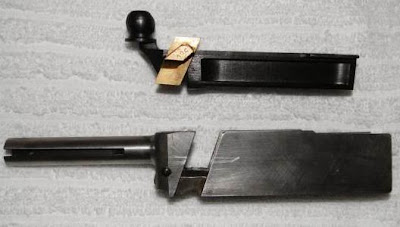
Disassembled Blish Lock, Bolt and Actuator

Tommy Gun with straight box magazine

Tommy Gun with rotary drum magazine

The Tommy gun was initially marketed to the police. The improved model M1921 was also offered for sale to the general public. It was a very finely machined weapon with high quality components and consequently commanded a high sale price of $200 (for contrast, a Ford car of that era cost only $400). It really came into the public eye during the Prohibition era, when both gangsters and law enforcement began to heavily use it. It acquired such nicknames as the "Tommy Gun", "Chicago Piano", "Typewriter", "Chicago Typewriter", "Chopper", "Broom" etc. Due to its notoriety, it was the main reason for the passage of the National Firearms Act of 1934 in the US. It was also used by the US marines in several smaller conflict and was adopted by the US military in 1938. It was used in World War II, Korea, Vietnam and beyond. It still turns up in some present day conflicts occasionally, such as the Bosnian war of the 1990s.

Actions: Blowback Action: Toggle Link Blowback

In our last few of posts, we've studied the basic principles of a blowback action and the reason why we want to delay the blowback action. In our last couple of posts, we saw that mechanical means can be used to delay the movement of the bolt. One way is by putting it at a mechanical disadvantage by using a couple of rollers (i.e.) the roller delayed blowback action. Another way is to use a lever mechanism to put the bolt at a mechanical disadvantage, the lever delayed blowback action. In this post, we will study another similar method called the toggle link blowback action.

Image taken from wikipedia.org, uploaded by user Hmaag under a Creative Commons Attribution-Share Alike 3.0 license.

The bolt of this weapon has a hinge joint attached to the middle of it. The back of the crank is attached to a rear of the receiver via a fixed pin. Initially, the crank is at a near horizontal position. When the cartridge is fired, it pushes back on the bolt, which in turn applies its force to the front part of the crank. At this point, the crank pivots upwards until is is nearly vertical and provides significant mechanical resistance to the backward movement of the bolt because of the mechanical disadvantage applied. This resistance is enough to delay the movement of the bolt until the bullet has left the front of the barrel, along with most of the high pressure exhaust gases. When the crank reaches its near vertical position, the resistance to backward motion significantly decreases and the bolt can now move backwards. The empty cartridge case follows the bolt and is ejected via a side port. The bolt moves back and recocks the weapon automatically. When the bolt reaches the rearmost part of its travel, it is pushed forward by the recoil spring at the end. The bolt moves forward and picks up another cartridge from the magazine and it is now ready to fire.

This mechanism was used in only a couple of weapons: the Schwarzlose machine gun and the Pedersen rifle, designed by noted American designer John Pedersen.

The above image is a patent application by John Pedersen for his Pedersen rifle.