Showing posts with label Dueling Pistol. Show all posts

Monday, December 6, 2010

Pistols: Modern Single Shot Pistols

While most pistols started to become multi-shot weapons in the 1800s, there were some pistol models that were still single-shot models well into the 1900s. Many of these models use bolt-action firing mechanisms. Examples include Remington XP-100, Savage Striker, Wichita, Weatherby Mark V CFP etc.

There is one more interesting single shot pistol which saw a lot of production during World War II. This was the FP-45 Liberator, which was produced in the United States during WW-II.
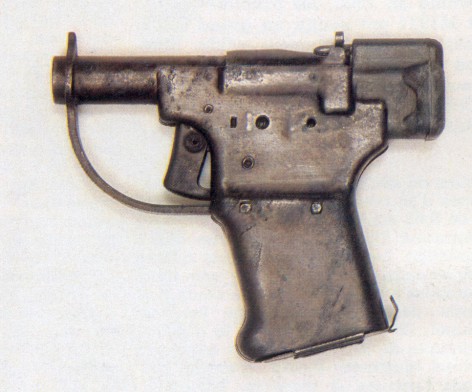

This pistol was designed in 1942 and hence it also has the designation M1942. The purpose of this design was to make a basic pistol that was very cheap to manufacture and easy to mass-produce and could be dropped in large quantities over Europe to arm the resistance forces. The Liberator was also designated as "Flare Projector" Caliber .45 (FP-45). The .45 was because it fired a standard 45 caliber pistol bullet (the same as that used by the Colt M1911 automatic pistol). The "Flare Projector" designation was deliberate misinformation, to disguise the purpose of this project and the fact that this weapon was mass-produced. The original design documents also had mislabeled parts to hide the true purpose of this device. For instance, in the original design documents, the barrel is called "a tube", the trigger is called "yoke, the firing pin is a "control rod" and trigger guard is a "spanner".

The pistol had only 23 parts, most of which were stamped or turned steel components, which made it very easy to manufacture. The barrel was completely unrifled, so it wasn't accurate beyond 10 meters or so. The pistol was packaged in a cardboard box along with 10 bullets and a comic-book style instruction sheet on how to use the weapon. There was also a wooden dowel included in each box to push out the fired cartridge case. It took approximately 10 seconds to load this pistol. Extra bullets could be stored in the handle of the pistol.

This weapon was never designed with regular troops in mind. It was designed to be mass produced and cheap, so that large quantities could be dropped over occupied Europe. It was also designed to be concealable. The idea behind this weapon was that a resistance fighter could use it at close range to surprise and shoot an enemy soldier and then take his weapons.

Manufacturing was outsourced to the Guide Lamp Division of General Motors. Guide Lamp Co. used to be an independent headlight manufacturer before it was bought by General Motors in 1928. During World War II, the Guide Lamp division also produced small arms, notably the famous M3A1 "Grease Gun" submachine gun. General Motors produced over one million of these pistols over a 6 month period, at an average cost of $2.40 per weapon (or about $30 in 2010 dollars). Actual production time in the 6 month period when this pistol was made was actually only 11 weeks and the entire weapon was produced at a rate of one every 7 seconds or so. This meant that this weapon had the dubious distinction of having a faster production time than the time taken to load it!

Despite its original intention, the weapons were not mass-dropped over Europe. More of these were dropped into China and the Philippines during World War II. The same concept was revived during the Vietnam war, when the Deer Gun (another low cost weapon made of Aluminium) was designed in 1964 for similar purposes. The Deer Gun was never distributed in large quantities though.

Even though the Liberator originally cost $2.40 to produce and there were over a million of them manufactured, it is something of an expensive weapon today in auction houses. In fact, a Liberator in its original box with instruction sheet can cost over $2000 at current day prices!

Friday, December 3, 2010

Pistols: Dueling Pistols

Physical confrontation between individuals has been as old as humankind. In the western world, many societies drew up rules for physical confrontations between two individuals. In these societies, if the rules of a duel were properly followed, no one would be accused of murder. The procedures to be followed for a duel to take place were often very elaborate and ritualistic. In the 17th century, while duelling was officially forbidden by many countries, it did happen unofficially and a victor's social status was often raised as a result.

In the early days of duelling, the weapons of choice were weapons like swords, spears etc. and a stronger man generally had a huge advantage over a weaker one, which many bullies used to their advantage. The introduction of duelling pistols in the 17th century became a huge equalizer for weaker individuals, since they didn't need to rely on physical strength as much.

Gunsmiths were employed to build weapons that were accurate and deadly, but also reliable. Purpose built dueling pistols were manufactured for gentlemen and London became the center for the finest dueling pistol manufacturers - Manton, Durs Egg, Purdey, Nock, Wogdon & Barton etc. Robert Wogdon was already known in England for the quality of his dueling pistols, even before he went into partnership with John Barton. In fact, duels in England were sometimes referred to as "Wogdon affairs". Other fine dueling pistols were also manufactured in France and Germany.

Dueling Pistols made by Purdey

Dueling pistols were traditionally single-shot muzzle loading weapons using flintlock firing mechanisms (and later, percussion lock mechanisms) and fired a ball-shaped bullet made of lead. They were sold in pairs that were matched as closely as possible and usually came in an elaborate case, complete with a variety of cleaning tools and a bullet mold. Caliber was fairly large with 11 mm. (0.45 inch) being one of the more common types, which meant that these bullets carried a lot of punch to them.

Traditional flintlock weapons have a noticeable delay between when the trigger is pulled and when the bullet is discharged. In order to make the delay as short as possible, while still retaining reliability against misfires, dueling pistols would often feature platinum touch holes and light triggers. While hair triggers were unofficially looked at as unsporting, quite a few people had modified their weapons to have extremely light trigger actions. Joseph Manton, the founder of the famous Manton firm, observed several duels and noticed that the firing of the large caliber pistol produced a kick that forced the forearm of the user to bend upwards at the elbow. His solution was to increase the weight of the front of the barrel to counter this kick and therefore made his dueling pistols more accurate. The weight of the pistols were much lighter than average to facilitate faster aiming and the barrels were blued or browned to reduce glare and make aiming easier.

Rifling in the barrels was considered unsporting and officially frowned upon. However, certain manufacturers, such as Manton were known for making pistols with very hard-to-detect rifling grooves for that extra edge in a duel. Similarly, sights were also originally frowned upon, but gradually became acceptable to have.

Dueling slowly faded out by the mid 1850s or so, replaced by boxing as a method of settling arguments, which led to the decline of manufacture of such pistols. However, the pistols themselves still managed to make it to the early 20th century, when Dueling Pistols was an event in the 1912 Olympic games!