Showing posts with label pinfire cartridge. Show all posts

Wednesday, July 1, 2015

Wacky Non-Functional Firearms

In today's post, we will look at an unusual object, something that is designed to look like a firearm, but actually isn't. We will look at something called a "scare pistol".

First, we will look at the origins of such a wacky invention. This class of "weapon" dates back to the 1880s. During this time period, the streets of Paris, France, were a dangerous place to be. Several criminals were roaming the streets and committing muggings and assaults, especially on women. Many women were urged to carry a small firearm with them, as a means of self-defense. However, some of these ladies did not wish to pull the trigger on another person. Seeing an opportunity, some French and Belgian manufacturers began to make "scare pistols" for these ladies.

A Scare Revolver from the 19th century. Public domain image.

The above looks like a commonly available Lefaucheux pinfire revolver model of that time period. This particular model is even made of brass and beautifully enameled and gold-plated. However, a closer look at the revolver reveals some interesting details. For one, the trigger cannot be pulled and is merely screwed on to the frame. The cylinder and hammer are non-functional as well. In fact, the only part of this so-called "revolver" that works or even moves, is the lanyard ring at the back of the handle!!

The idea behind manufacturing such a useless weapon was that even the sight of a firearm would be sufficient to scare off your average mugger (at least, that was the theory at that time). Therefore, for people who would hesitate to pull a trigger on another person, they could walk around with a non-functional, but realistic looking firearm.

The contents of a so-called "scare revolver" model. Public domain image.

In the above image, we have another so-called "scare pistol", Pulling back on the hammer causes this "revolver" to break at the cylinder. Inside is a mirror, a pair of functioning scissors, some needles, a thimble, two spools of thread and a crocheting hook. The front of the cylinder is a functioning pin-cushion and what looks like the shell extractor rod is actually a pencil. The butt of this "revolver" contains a small bottle to store perfume. This device is actually a scare revolver that also doubles as a functional sewing kit for carrying out minor repairs on clothes!

Tuesday, May 4, 2010

Cartridges: Pinfire Cartridge

In our last post, we studied the cartridges of the needle gun. We've also studied how shock-sensitive materials such as fulminates make percussion locks work. We've also studied how the breech-loader loading mechanisms work. In our studies of the needle gun's cartridges, it was noted that one of the defects of this weapon was that the needle tended to break off often. The next type of cartridge we will study is the Pinfire cartridge.

The pinfire cartridge was originally developed around the same time as the needle gun's cartridge. However, unlike the needle gun, where the long needle is part of the gun's firing mechanism, a pinfire cartridge has a firing pin as part of the cartridge.
Public domain image courtesy of wikipedia.com

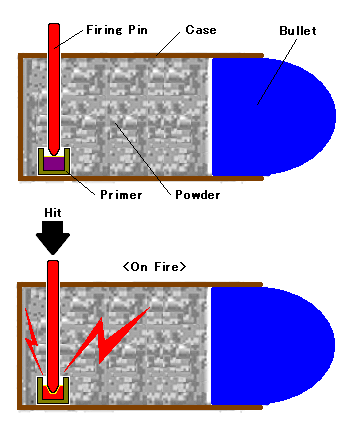
It consists of a cartridge with a metallic case. On one side of the cartridge is a protruding firing pin. The other end of the pin touches a small copper cap containing a pressure sensitive primer explosive such as mercury fulminate or potassium chlorate. The rest of the case is filled with gunpowder and there is a lead bullet at the end.

To ignite the gunpowder charge, one applies a sharp blow to the pin. The other end of the pin then strikes the primer which then ignites and then burns the main gunpowder charge.

To load the weapon, the user opens the breech of the gun and drops in a cartridge. There is a slot at the top of the barrel so that the pin can protrude out of the slot. The user then cocks the hammer against spring pressure. When the user pulls the trigger, the hammer is released and the spring force drives the hammer onto the pin, thereby firing the weapon.

Pinfire revolvers also work on similar principles. There is a slot cut into compartment of the revolver's cylinder, so that the pin can protrude out of it. The hammer of the revolver strikes the top of the pin and thereby fires the weapon.

A little history on the pinfire gun: The original mechanism was developed in 1828 by a Frenchman named Casimir Lefaucheaux. By the mid 1840s, guns using this mechanism grew very popular in France, but had limited success in England, chiefly because they were suspicious of breech-loaders in England and also because they didn't trust a French inventor. It was only past the 1850s that the English began to look at breech-loaders and they didn't use the pin-fire cartridge with their weapons. Hence, the pin-fire cartridges were never really popular in English speaking countries. On the other hand, they were very popular in France and other neighboring countries (Spain, Italy, Switzerland etc.)

The pinfire cartridge was one of the reasons for the decline of muzzle-loading weapons. It was much quicker and easier to load a breech-loading weapon using pinfire cartridges. The cartridge was also relatively gas-tight compared to the needle gun, which made the shooting a bit more efficient. It must be noted however that it wasn't as gas tight as some later cartridges working on other principles. The pinfire cartridges were the first metallic cartridges and also responsible for the decline of paper cartridges as well. All future cartridges with metal cases owe some history to the pinfire.

The problems with the pinfire were that, with the protruding pin, it took a little longer to load than the future centerfire and rimfire cartridges, since the pin needs to be aligned to the slot before the gun can be closed. Rough handling could sometimes accidentally trigger the pin and cause the cartridge to detonate. The pin-fire cartridge, while it was an improvement over the needle gun cartridge, was also not very gas-tight and often, a bit of the expanding hot gas would push the pin up and escape that way. These days, the only weapons that use pinfire cartridges are either antiques from the 1800s, or weapons with really small caliber bullets (e.g. 2 mm bullets), where a rimfire or centerfire cartridge would not work.