Showing posts with label single action. Show all posts

Friday, May 29, 2015

What is the difference between Single Action, Double Action Only and Double Action/Single Action

In our last post, we studied the differences between hammer fired and striker fired weapons. In today's post, we will study a related topic, the difference between Single Action (otherwise called SA), Double Action Only (otherwise called DAO) and Double Action/Single action (otherwise called DA/SA or SA/DA). 

The differences between these three has to do with what happens when you pull the trigger of the weapon.

In a single action weapon, only one thing happens when you pull the trigger: it releases the hammer or striker to fire the weapon. This mechanism was used by early revolvers, such as the Colt Paterson, Walker Colt, Colt Single Action Army (a.k.a. the Peacemaker) revolver etc. and is still used by many modern rifles, shotguns and semi-automatic pistols.

Colt Single Action Army revolver. Click on the image to enlarge. Public domain image.

To fire a weapon like the example above, the user first cocks the hammer by pulling on the spur at the back of the hammer with the thumb, until it locks into position. Then, when the user pulls the trigger, it releases the hammer, which then falls back down towards the cylinder with considerable force, due to a spring connected to the hammer, and thereby fires the weapon. If the hammer is already down, then pulling the trigger does nothing. To fire another round with this revolver, the user needs to re-cock the hammer back again before pulling the trigger. The key thing to note with single actions is that if the hammer (or striker) is down, then pulling the trigger does nothing.


The above video from hickok45 shows a Colt single action revolver being used. Notice how he pulls back the hammer before every shot, to cock it. Also note that the act of pulling back the hammer also rotates the cylinder to bring the next cartridge under the hammer. The user cannot fire this weapon by only pulling on the trigger.

Some semi-automatic pistols like the Colt M1911 and Springfield XD are also single action weapons. The Colt M1911 is hammer fired and the Springfield XD is striker fired, but they are both single action.
In such weapons, the user first inserts the magazine and then either pulls back the hammer manually with the thumb, or racks the slide, which chambers the first round and also cocks the hammer or striker. When the trigger is pulled, it releases the hammer or striker, which fires the weapon. Then, the weapon uses some of the recoil energy to move the bolt and slide backwards, which ejects the old cartridge, loads a new cartridge from the magazine and most importantly, it also cocks the hammer or striker automatically, so the user doesn't need to do that again manually. Then, all the user has to do to fire another shot is to pull the trigger again, as the weapon is already cocked and so on, until the weapon is empty. However, if the user decides to lower the cocked hammer (or striker) manually (some weapons have a special decocking lever to do this), then pulling on the trigger after this will do nothing, because a single action weapon only does something if the hammer or striker is cocked first. Therefore, to resume firing again, the user has to pull back the hammer manually once, before pulling the trigger.

Most modern rifles and shotguns are also single action.

Since the weapon is already cocked, the trigger pull force required to discharge it is typically small and a force of around 3 to 4.5 lbs. (about 1.3 - 2 kg.) is enough to release the hammer or striker.

With a Double Action Only (DAO) weapon, pulling the trigger does two things: it first pulls the hammer (or striker) back to cock it and then pulling the trigger further releases the hammer or striker. Therefore, two actions happen on the same trigger pull, which is why it is called double action. The force required to operate the trigger is much higher than single action weapons, typically about 10 to 12 lbs. (about 4.5 to 5.5 kg.). This is because the trigger has to cock the hammer or striker against spring pressure and more force is required to do this.

The first example of a double action only weapon was the Adams revolver invented in 1851.
An Adams revolver. Click on the image to enlarge.

Note that the Adams revolver has no spur on the hammer, therefore the user cannot pull it back with the thumb. The good news is that the missing spur means that it cannot get snagged by accident on anything and it is also possible to fire this revolver much faster than the Colt single action revolver, since there is no need to cock it each time before pulling the trigger. The bad news is that the trigger is harder to pull and due to the larger force needed, there is a tendency to shake the revolver when pulling the trigger, which makes it less accurate.

Some modern day semi-automatic weapons and revolvers still use a DAO action, Examples include the SIG P250 pistol, the Ruger SP101 revolver, the Taurus 24/7 pistol, Smith & Wesson Bodyguard revolver etc.


Notice how there is no spur at the back of this revolver, so the only way to cock this weapon is to pull the trigger. At around 1:00 of the video, you can clearly see the hammer being moved backwards initially as the trigger is being pulled and then released as the trigger is pulled further along.

From all the above, we see that double action weapons only need one trigger pull to both cock and fire the weapon, thereby being faster to fire, but they need more pull force on the trigger than single action weapons, which leads to the weapon shaking more when the trigger is pulled. Therefore, there is another alternative, which combines the best of both: the double action/single action also known as DA/SA, single action/double action or SA/DA.

With a double action/single action firearm, it can be fired in both modes. One of the first examples of this was the Beaumont-Adams revolver, which was invented in 1865 by Lieutenant Fredrick Beaumont of the British Army. He was a veteran of the Crimean war and had used the Double Action Only Adams revolver there. After the war, he decided he was going to improve the Adams design and invented his revolver.

A Beaumont-Adams reovlver Click on the image to enlarge. Public domain image.

With this design, the user has two options. When the hammer is down, the user can pull the trigger, which cocks the hammer and then releases it, just like a double action only revolver. Doing this takes more trigger pull force, as expected. The user also has the option to cock the hammer by pulling the spur at the back of the hammer, just like a single action weapon. In this case, there is less force required to pull the trigger, as the hammer is already cocked,

A DA/SA weapon combines the best features of both the single action and the double action weapons and gives the user a choice of which mode to fire the weapon with. Some modern weapons that use this system include the Beretta M9 pistol, which is the standard sidearm of the US military, the Colt Python revolver, SIG Sauer P-220 pistol, the Heckler & Koch USP pistol, the Czech CZ 75 pistol etc.

Heckler & Koch USP pistol. Click on the image to enlarge.
Image licensed under the Creative Commons Attribution-Share Alike 3.0 license by Miroslav Pragl

When the trigger is pulled with the hammer down, it requires a force of something like 10.5 lbs (4.5 kg.) to discharge the firearm, but if the hammer is already cocked, it requires a force of only about 4.5 lbs (2 kg.) to do it.

With a semi-automatic weapon like the pistol above, if the weapon is not cocked after the magazine is loaded, the first trigger pull will be heavier, since it has to cock the weapon first. But after the first cartridge is fired, the weapon uses some of the recoil force to cock itself automatically, which means the subsequent trigger pulls do not require as much force. The user can also cock the hammer manually using the thumb to pull it back, or cock it by pulling back on the slide, in which case the first trigger pull will be lighter since the weapon is already cocked. Many pistols also have a de-cocking lever to safely lower the hammer back down to double-action mode.

Some people like to carry the weapon de-cocked, because the first trigger pull needs much more force and therefore, it is less likely to be pulled accidentally when the user is carrying the weapon in a holster. Other people find the fact that the first pull needs more force than the others a little confusing, so they carry the weapon cocked and enable the weapon safety devices instead.

Finally, we have some weapons that cannot be exactly classified as either double-action or single-action. Examples of this would be Glock and Kahr pistols. As we saw in our previous post, which showed an animated image of a Glock pistol in action, when the slide is pulled back, it pulls the striker back and locks it at an intermediate position where the spring is only at partial tension. Pulling on the trigger pulls the striker back first (so the spring reaches full tension) before releasing the striker, much like a double action weapon does. However, unlike a double action weapon, if the striker is not cocked at the intermediate position first, pulling on the trigger does nothing (behaving exactly like a single action weapon).

A Glock 17 pistol. Click on the image to enlarge.

As you have probably already guessed, the trigger pull force for a weapon like this is between that needed for a single action and a double action weapon. For instance, a standard Glock trigger requires about 5.5 lbs (2.5 kg.) to operate it and a Smith & Wesson M&P needs about 6.5 lbs (2.95 kg.).

The video below contains some good examples that show the differences between the various mechanisms:


Happy viewing!


Friday, July 2, 2010

Revolver: Other Firing Mechanisms

In the last few posts, we've studied various types of single-action and double action revolvers. These were not the only types of revolver mechanisms though.

Click image to enlarge

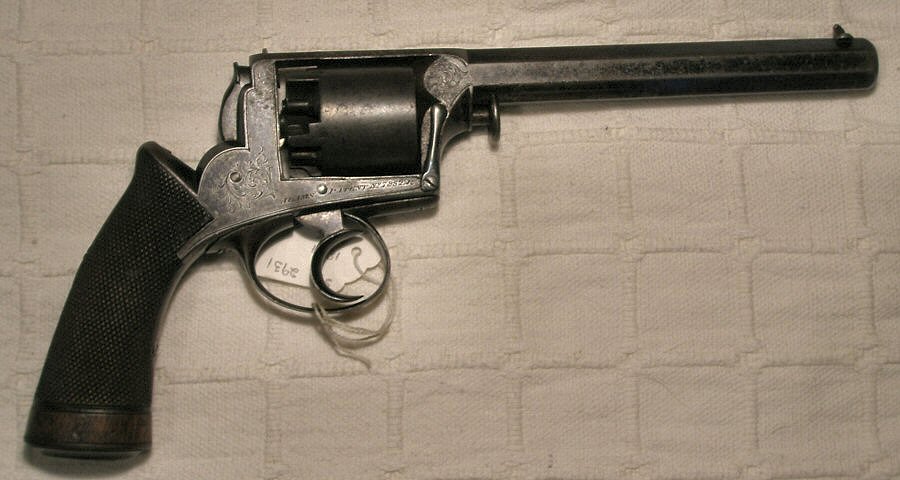
The above image is a Tranter revolver invented by William Tranter. William Tranter used to manufacture the Adams double-action revolver under license and in 1853, he came up with his own invention, a double-trigger, double action revolver. Notice that the distinguishing feature of his revolver is the double trigger. The lower trigger sticks out below the trigger guard and is pulled with the middle finger. When the lower trigger is pulled, it cocks the hammer and rotates the cylinder. Then the user pulls the upper trigger with the forefinger to release the hammer and fire the weapon. If the user decides to fire rapidly, then he/she can pull both triggers simultaneously.

During the US civil war, the Confederates did not have any firearms factories in their territory and hence were forced to import their firearms from other countries. Many Tranter revolvers were imported by them, along with other revolvers such as the Adams and Beaufort-Adams. The Tranter revolvers gained popularity among the Confederates because of their reliability. Tranters were also carried by detectives of the famous Pinkerton detective agency. Pinkerton's men were responsible for the safety of US government officials before the creation of the Secret Service.

William Tranter made a sizable fortune from the sale of various firearms (including his revolvers) and later went on to co-found the Birmingham Small Arms company. This company later moved into manufacturing bicycles, motorcycles and cars. It was once the largest motorcycle manufacturer in the world and its bicycle brand was sold to India's Tube Investments Limited in 1957. Tube Investments still manufactures bicycles in India under the BSA brand.

Another unusual revolver mechanism was invented by the Iver Johnson company of the US. Between 1940 and 1947, they manufactured a revolver with a very special action. If the hammer was down, pulling the trigger would cock the hammer and rotate the cylinder. If the hammer was already cocked, then it would release the hammer and fire the weapon. Therefore, to fire the weapon when the hammer is down, the user would pull the trigger twice.

Another development that has been used since around 1901 or so is the automatic revolver. Basically, the disadvantage of a double action revolver is that it has a longer trigger pull than a single action revolver, because the trigger pull on a double action serves to cock the hammer, rotate the cylinder and release the hammer on a single pull, whereas a single action trigger merely releases the hammer when the trigger is pulled. This leads to a heavier trigger pull and therefore, less accuracy from double-action revolvers.

With an automatic revolver, some of the recoil force from the just fired cartridge is utilized to re-cock the hammer and rotate the cylinder. This results in a revolver that can fire with the speed of a double-action, but with the softer trigger pull of a single-action revolver. The Webley-Fosbury pistol of 1901 had this feature, but it was soon replaced by semi-automatic pistols, which were less expensive. In 1997, a company called Mateba invented the Mateba Unica Auto-revolver that uses the same concept.

Tuesday, June 29, 2010

Revolver: Colt Single Action Army a.k.a. The Peacemaker

In the last post, we saw the history of the first Colt six-shooter, the Walker Colt model, followed by the Colt Dragoon family and the rise of machine-made interchangeable parts and innovations in machining technology.

Colt went on to make a lot of weapons during the civil war, such as the Colt Navy 1851 pistol and Navy 1861 models. Some of the famous users of the 1851 Navy model included Wild Bill Hickok, Doc Holliday, Sir Richard Burton, Ned Kelly and General Robert E. Lee. These models sold very well and made the Colt company a lot of money.

However, it must be noted that the Colt revolvers were still using percussion cap technology well into the 1860s, even though metal cartridge technology and the center-fire cartridge has already been invented. The reason for this is because Smith & Wesson held the patent for bored through revolver cylinders and Colt didn't want to pay royalties. So Colt elected to wait until 1869, when the patent ran out, before they started work on a new revolver. This revolver competed successfully in the US Army trials of 1873 and was adopted as the new standard military revolver. It remained as the official service revolver until 1892 and has continued to be manufactured all the way to the present day. The Colt Single Action Army Revolver was nicknamed the "Peacemaker" and the "Equalizer" (because it made all men equal!) and it was known as the "gun that won the west".

Public domain image from wikipedia.com. Click to enlarge.

The picture above shows a Colt Peacemaker made in 1956 (the "second generation" model!). The Colt Peacemaker is a classic weapon seen in many western movies. It was the weapon of choice for Wyatt Earp, Bat Masterson, General George S. Patton and Lawrence of Arabia. In fact, Lawrence of Arabia considered it his lucky weapon because he was once attacked by an Arab bandit in pre WW-I Mesopotamia. The bandit seized Lawrence's revolver and was threatening to shoot him with it, but could not do so because he did not understand its mechanism. Since then, Lawrence always carried one for good luck.

Like the previous Colt models before it, this is also a single action revolver. However, it uses a centerfire cartridge instead of percussion caps and black powder. Loading is accomplished by opening a loading gate on the side and dropping cartridges, one at a time into the revolver. Although six cartridges can be loaded into it, most people load five chambers and leave the chamber which is facing the hammer empty as a safety precaution. This way, the weapon cannot fire if it is dropped accidentally. To fire, the user simply pulls the hammer back, which cocks the hammer back and also rotates the cylinder to the next chamber. Then the user pulls the trigger to fire the weapon. The user can also fire rapidly by holding down the trigger with one hand and repeatedly pulling the hammer back with the other palm in a fanning motion. While this is not considered a safe way to fire, it is the image of a gunfighter thanks to Hollywood movies.

The Colt Peacemaker was originally manufactured to fire a .45 caliber Colt cartridge for the army and it was initially priced at the low cost of $17. Various civilian versions were soon manufactured in other calibers as well. For instance, the Colt Frontier models were designed to use the Winchester .44-40 and .32-20 cartridges because many western frontiersmen, cowboys and lawmen owned a rifle as well as a revolver. Since Winchester rifles were commonly used at this time, Colt designed the revolver to use the same cartridges as the rifles, so that the user only needed to carry around one type of ammunition. It was also certified in the 1900s to use the new smokeless powders instead of black-powder. Other popular calibers followed in the 1900s as well, including the .357 magnum, .38 special etc.

The first generation of the Peacemaker was made between 1870 and 1941, in a variety of calibers from .22 rimfire to .476 Eley cartridge, totalling about 30 separate calibers, which gives a measure of this weapon's popularity. There were approximately 357,000 first-generation revolvers of this model made. The second generation model, like the one pictured above, was made between 1956 and 1974 and about 73,000 were made. In 1976, the third generation was issued and this one featured a different thread pitch in the rifling of the barrel and a redesigned cylinder bushing. The third generation model was made until 1982 and 20,000 were made. In 1994, production of the third generation model restarted (sometimes called the fourth generation) in a number of popular calibers.

Colt still makes this weapon and lists it in its catalog, as do a host of other manufacturers who also make near copies of it. This weapon was the inspiration for a number of other modern revolvers and is truly "the gun that won the west."

Sunday, June 27, 2010

Revolver: Walker Colt & Colt Dragoon Revolvers

In our last post, we discussed the Paterson Colt, which was the first weapon to bear the term "revolver". As we noted in our previous post, the model was a failure in most places, except in the Republic of Texas, where they bought up enough models in .36 caliber that the .36 caliber version began to be called the "Texas Paterson." Many of the users of Paterson Colt models were members of the Texas Rangers.

Captain Samuel Walker of the Texas Rangers, was one of the officers that was highly impressed by the Colt weapons, but he wanted a few improvements made to it. In 1846, he collaborated with Samuel Colt to make a new weapon for use with the Rangers. At that time, the Texas Rangers were using a single shot close range pistol made by Aston Johnson which could be put in a holster on the saddle. What Walker wanted was a new handgun that was extremely powerful at close range and could be carried in a saddle holster like the pistol. However, this weapon would have to be a revolver to allow the rider to fire multiple shots without reloading. He persuaded Samuel Colt to increase the caliber of the weapon from .36 to .44 or .45, so that it could not only be used to kill enemies, but also the horses that they were riding on. The newly designed weapon was called the "Walker Colt" in honor of Captain Walker.

Public domain image from wikipedia.com. Click to enlarge

The new revolver was designed to fire a .454 inch (11.5 mm.) diameter bullet. The Walker Colt retained the single-action design of the Paterson Colt, along with the hinged loading lever and capping window design of the 1839 model Paterson Colt. Unlike the Paterson Colt though, this weapon could carry six bullets at one time. This meant that the Walker Colt was the original "six-shooter". Also, this weapon had a fixed trigger and a trigger guard unlike the Paterson colt which had a folding trigger that would drop only when the hammer was cocked and no trigger guard.

The weapon was heavy (2 kg. when empty) for a handgun, as it was meant to be carried in a saddle holster. It was also more powerful than any other handgun then in existence, since it used almost twice the gunpowder charge of any handgun in each of its chambers. Matter of fact, the standard amount of gunpowder used per chamber was 3.9 gm. which was about the same used in some muskets! Despite the fact that it used black-powder for its gunpowder, the Walker Colt was the most powerful handgun in existence between 1847 and the 1935, when the first .357 magnum was introduced. Walker wrote that this gun was "as effective as a rifle at 100 yards and superior to a musket at 200 yards." In practice, it was more useful at a range of 50-100 yards.

The original order of the Walker Colt models from Texas asked for 1000 of them to be delivered, along with accessories. At this point though, Samuel Colt was without a factory, due to the failure of the earlier Paterson Colt model and the Patent Arms Manufacturing Company being taken over by his creditors. Hence, he subcontracted the actual manufacture of these weapons to Eli Whitney Blake who had a gun factory in Whitneyville, Connecticut. Eli Whitney Blake was the nephew of the senior Eli Whitney, the inventor of the cotton gin. Eli Whitney Sr. was not only the inventor of the cotton gin, he'd also invented an early milling machine. He was a pioneer in adopting power tools for manufacturing, invented the modern assembly line and promoted the concept of interchangeable parts. His talented nephew, Eli Whitney Blake, helped him build the gun factory at Whitneyville and took over after he'd passed away. Samuel Colt asked Eli Whitney Blake to build him 1100 revolvers, 1000 for the Texas order and 100 to be used for private sale and promotional gifts. The ordered revolvers were shipped out in mid-1847. These original 1100 models are now extremely rare and worth at least $150,000 each, with one going on sale in 2008 for $920,000.

Due to the huge success of the Whitneyville built Walker Colts, the Colt reputation was made and it enabled him to later build his own Colt factory. Sadly, Captain Walker, after whom the weapon was named, was killed in action in October 1847 and legend has it that at the time of his death, he was carrying two Walker Colt models presented to him by Samuel Colt, which had only arrived a few days before. Nevertheless, the huge success of this weapon in the hands of the Texas Rangers was noticed by the United States government and Colt was given an order to deliver more weapons to the United States Mounted Militia (Dragoons), based on the Walker Colt model.

Some of the problems of the early Walker Colt models included a tendency for the cylinders to rupture due to too much gunpowder being loaded into them and also primitive metallurgical techniques of that time. Another problem was an inadequate catch for the loading lever which would cause it to fall out due to the firing recoil and interfere with the action of the weapon. Some of the users of the Walker Colt fixed this loading lever issue by binding the lever to the barrel with a leather band.

The Colt Model 1848 Percussion Army Revolver fixed these issues by making a smaller chamber that allowed about 15% less gunpowder (3.25 gm. instead of 3.9 gm.) to reduce the problem of ruptured cylinders. The falling catch problem was solved by redesigning the catch to hold the loading lever even with heavy recoil. The size of the barrel was also reduced from 9 inches to about 7.5 inches to make the weapon slightly lighter and more manageable. Since this weapon was originally ordered for the United States Mounted Militia (known as "Dragoons"), this model was called the Colt Dragoon. This new weapon was a huge success among civilians as well and Colt produced three separate variations of these weapons between 1848 and 1860.

GFDL licensed image from wikipedia.com. Click to enlarge.

The above image is of a Colt Dragoon third variant model. The three variants can be told apart mainly by the shape of the trigger guard (squared edges in the first two variants and rounded edges in the third variant) and the shape of the cylinder notches (oval in the first variant, rectangular in the other two variants). The third model variant also has some instances with different sights and provisions to attach a shoulder stock.

Other variations included a smaller version called the 1849 Baby Dragoon and the 1851 Pocket Navy and Pocket Police versions. The Baby Dragoon was marketed to civilians and was extremely popular during the California Gold Rush.

Almost 20,000 of these weapons were produced for sale in the United States and an additional 750 were produced for the British market between 1848 and 1860 before the Colt Dragoon was replaced by the Colt Model 1860. Colt Dragoons are still being sought by collectors today and an original model still fetches high prices.

Due to the success of his weapons, Colt managed to build his own factory in 1851 in England, the first American manufacturer to do so. In 1855, he opened a new factory in Hartford Connecticut, which incorporated the latest technologies at that time and was capable of building 5000 handguns in its first year of production. Knowledgeable in the advances in machining technology and interchangeable parts, about 80% of his parts were made by the most up-to-date precision machinery of the mid 19th century. By 1856, the factory was producing 150 weapons a day and the reputation of Colt for accuracy, reliability and workmanship quality had spread throughout the world.

It must be mentioned also that a large part of Colt's success in machining technology was due to the efforts of an extraordinary individual. Around 1849, when Samuel Colt was building his new factory in Connecticut, he managed to lure away a mechanic by the name of Elisha K. Root from the Collins company, which made axe-heads. Elisha Root already had a name as a mechanic and inventor and was making machines to manufacture axe-heads more efficiently, when Samuel Colt lured him away, by taking the simple route of paying him twice what Collins was paying him at that time, and making his supervisor of Colt's new factory. Mr. Root set about changing the way that Colt manufactured firearms by building about 400 machines (state-of-the art drop hammers, boring machines, jigs and fixtures etc.) to make interchangeable parts, that made the Colt factory the leading model of efficiency in the world. It was when working at Colt that he invented a new Universal Milling Machine. This milling machine was manufactured for Colt by a subcontractor called the Lincoln Iron Works and later became called the "Lincoln Miller". About 150,000 of these machines were sold by the 1890s and it became the most common machine tool in America and made the United States the world leader in the design and production of machine tools. Elisha Root also attracted many other star employees to work for Colt. When Samuel Colt died in 1862, Elisha Root took over as the president of the Colt company.

Due to the amount of research into machining technology, the area around the Colt factory became a hot-bed for mechanical innovation (sort of a Silicon Valley of its time). For example, one employee at Colt's plant was William Mason, who secured 125 patents for machinery that made guns, power looms and steam pumps. Yet another inventor in Colt's factory was Christopher M. Spencer, who invented the world's first automatic turret lathe. Another Colt employee was Charles E. Billings, who invented the drop hammer used for metal forgings. Charles Billings also invented the copper commutator, a key piece of technology for electric motors and generators. Two other employees were Francis A. Pratt and Amos Whitney, who improved the Lincoln miller, invented a thread boring machine and later went on to found Pratt & Whitney. Simon Fairman invented the chuck that holds the workpiece on a lathe and his son-in-law, Austin F. Cushman invented the first self-centering chuck called the Cushman Universal Chuck.

Copies of the Walker Colt and the Colt Dragoon are still being made today, especially by the Uberti company of Brescia, Italy.

Revolvers: Colt Paterson

After our discussions about early proto-revolvers such as pepper-boxes, it is time to start talking about true revolvers. In fact, we will start off with a discussion on the weapon that was the first to be described with the term "revolver". This honor belongs to the Colt Paterson revolver invented by Samuel Colt in 1836. The name "Paterson" comes from the fact that the factory that produced this weapon was located in Paterson, New Jersey.

Company lore has it that Samuel Colt originally got the idea for its mechanism during a sailing trip between Boston and Calcutta aboard the brig Corvo in 1830. He observed the ratchet-and-pawl mechanism used by the ship's steering wheel and noted how each spoke in the steering wheel came in contact with a clutch that could hold it in place if needed. He was inspired enough to carve a wooden model of a revolver on this voyage. A few years later, he applied for patents in the US, England and France and received his patents in 1836. He then built the Patent Arms Manufacturing Company in Paterson, New Jersey, to manufacture this weapon.

The Paterson revolver was the first repeating firearm that consisted of a revolving cylinder with multiple chambers that aligned to a stationary barrel. Until then, repeating firearms had multiple barrels. This revolver was a 5-shot model with a single action mechanism using percussion cap technology. A single-action mechanism means the user has to manually pull back the hammer to cock it. The act of pulling the hammer back also rotates the cylinder to bring the next chamber in line with the barrel and also locks it in place. When the user pulls the trigger, the hammer is released and strikes the percussion cap of the chamber that happens to be on top of the weapon, thereby discharging it.

Public domain image from wikipedia.com (click to enlarge)

The above picture contains two models of Paterson Colts. The smaller model is an original model from 1836 and the two crossed revolvers are the 1839 models. The astute reader might note that the triggers appear to be missing on the two crossed revolvers and that none of the revolvers have a trigger guard. This is in fact a feature of the Paterson Colt models. The trigger is actually a folding one. When the user pulls the hammer back, not only does the cylinder rotate, but the trigger also drops out of the frame in firing position. This is why there is no trigger guard.

The astute reader may also have noted that the 1839 models have a lever under the barrel that the 1836 model doesn't have. We will study what that lever does in a little bit. First, let us understand how to reload the 1836 model revolver which will go into explaining the strange lever. The 1836 model revolver had a somewhat cumbersome reloading procedure that required the user to disassemble the gun. The procedure went as follows:
  1. Put the hammer at half-cock. This frees up the cylinder and allows it to be removed.
  2. Push the barrel wedge which is under the barrel and holding it in place.
  3. Now pull the barrel and cylinder from the revolver's frame.
  4. Load each of the chambers of the cylinder with enough gunpowder, leaving enough room to seat a lead ball into each chamber
  5. Push a lead ball into each chamber with a special ramrod tool. This took a bit of effort in the early models.
  6. Push the cylinder and barrel back into the revolver's frame and push the barrel wedge back into place.
  7. Place percussion caps on each of the nipples around the cylinder using the special Colt capping tool that comes with the revolver.
Since Colt often supplied spare cylinders with the revolver, many people would walk around carrying loaded and capped spare cylinders in their pockets for faster reloading. That way they could quickly pull out the barrel and cylinder, pull a fully loaded new cylinder from their pocket and put the revolver back together and ready to go. This practice was not very safe in case the loaded cylinders were accidentally dropped.

With a view to improving the loading time, Colt improved the model and the 1839 models featured an integrated loading lever and capping window. As the reader may have noted in the picture above, the 1839 models have a feature that the 1836 model doesn't have. Under the barrel is a hinged ramrod lever that is missing in the 1836 model. This way, the user could not lose the ramrod and ramming the lead balls into the chamber also became easier. Therefore, the 1839 model did not require the user to disassemble the weapon for reloading. This hinged loading rod feature was an innovation that was widely copied in future revolvers as well.

The Paterson revolver was sold with different barrel lengths from 2.5 inches to 12 inches long, with 7.5 and 9 inch barrels being the most common. The barrels were all rifled, so as to improve accuracy. Calibers varied from the original .28 caliber to the .31, .34 and the very popular .36 caliber. The barrels have a small projecting blade sight in front and the rear sight is a notch cut into the hammer lever, which aligns with the front sight when the hammer is cocked.

Despite being an innovative weapon, the Paterson revolver was not a success. It was expensive for its time, costing around $40-50 per piece. Colt managed to sell a few to the United States Army and they saw limited use, but the US Army considered them too fragile and prone to malfunctioning. However, the Republic of Texas (which was still not a part of the United States then) bought a number of them for their army and navy. The Texas Rangers found these weapons especially useful against the Comanche tribes and some of their key commanders such as Colonel Jack Hayes and Captain Samuel Walker began to push for military contracts to acquire more of them, especially in .36 caliber. This associated the name "Texas Paterson" to the .36 caliber model of these revolvers.

Due to the commercial failure of the Paterson revolver, the Patent Arms Manufacturing Company was forced to stop manufacturing in 1842. A creditor named John Ehler then acquired the factory and continued manufacture until 1847, when he was forced to close it down as well. However, the design was influential and innovative enough that its ideas were used in future models as well. Captain Walker, in particular, thought that the Paterson could be improved and therefore submitted several design improvement ideas to Colt. Therefore, when Colt opened a new factory in 1846, the new model was called the Walker Colt revolver. We will study the Walker Colt in the next post.

Saturday, June 26, 2010

Revolvers: Basics

A revolver is a weapon that allows the user to fire multiple times without stopping to reload. While there are some other weapons, such as double barrel shotguns, that also allow a user to fire more than once, a characteristic of revolvers is that the firing chambers of a revolver turn about an axis (i.e. they "revolve") and this is the origin of the name.

Early revolvers were called pepper-boxes and they had multiple barrels which revolved about an axis and a common firing mechanism. The earliest ones exist from 1597 (a revolving arquebus) and use matchlock mechanisms. In the 1700s, James Puckle invented the "Puckle Gun" which had multiple firing chambers and one common barrel and firing mechanism. A hand crank rotated the firing chambers and brought each one in line with the barrel and firing mechanism. Elisha Collier of Boston, patented a popular revolver model in 1818, which used the flintlock firing mechanism. He also produced revolving shotguns and rifles. In 1819, John Evans of London bought Collier's patent and produced several weapons which were used by British soldiers stationed in India.

Many big developments in revolver technology were by Samuel Colt. In 1836, he patented his first revolver model. It was manufactured in Colt's factory in Paterson, New Jersey, and hence it is popularly called the "Paterson revolver." While Colt's name is the most famous one associated with revolvers, he never claimed to invent the concept. In fact, the Paterson revolver was an improved variant of the concept invented by Collier. Some of Colt's big innovations dealt with applying concepts of mass production, interchangeable parts and assembly line techniques to revolver production and this reduced the price of revolvers. He was also an excellent salesman and promoter and his weapons became extremely popular with the public. One of his later models was nicknamed "Peacemaker" and "Equalizer". A popular saying of the time went "Abe Lincoln may have freed all men, but Sam Colt made them all equal!"

Colt's first revolvers all used a ratchet and pawl mechanism to hold the cylinders in place. They were also "single action" mechanisms, i.e. the user must cock the weapon manually. The act of pulling back the hammer to cock the weapon also rotates the cylinder. Once the weapon is cocked, the user can pull the trigger to fire it.

Later on in 1851, a British gunsmith named Robert Adams invented the first "double action" revolver. In this mechanism, pulling the trigger halfway automatically rotates the cylinder and cocks the hammer. Pulling the trigger back some more releases the cocked hammer. Thus, the user can fire the weapon with just one trigger pull. The Adams revolver was hand-crafted, which made it more expensive than Colt's design. It also had a few flaws in the hammer and frame. This could only fire in double-action mode and was hence called a "DAO revolver" (i.e.) Double-Action Only. Improvements to the Adams model were made by Lieutenant Frederick E.B. Beaumont, a veteran of the Crimean war and the resulting model was called the Beaumont-Adams revolver. This new model could be operated in both single-action or double-action mode and was such a huge success that Samuel Colt had to shut down their factory in England as a result. Mechanisms that operate in both single and double-action mode are called DA revolvers (DA standing for "Double Action").

Most modern revolvers to this day are double-action. They are still used by law-enforcement around the world and remain popular among many private gun-owners. In fact, it is said by many that the best way to teach a new handgun enthusiast about shooting basics is to start with a revolver first.

Some of the advantages of revolvers over other multiple firing mechanisms (notably the automatic pistol) are:
  1. Simpler mechanism, which is less prone to jamming.
  2. Ease of use: With a double action revolver, all one has to do is pull the trigger. With a single-action revolver, one cocks the hammer and then pulls the trigger. Unlike a pistol or an automatic rifle, there are no additional safety mechanisms that need to be meddled with.
  3. More powerful cartridges can be used: Due to the robust design of the revolver, bigger magnum cartridges can be used with one. In fact, the biggest handgun cartridges are mostly designed for revolvers.
  4. Much easier and faster to reload than a pistol. Anyone who has loaded a pistol or rifle magazine knows that the first few cartridges go in easy, but the last 3 or 4 cartridges take considerable effort to push into the magazine. With a revolver, one merely opens the chamber and drops cartridges into it.
  5. Works with greater range of ammunition types: Revolvers can be used with blanks, wad-cutters etc., which do not work with automatic pistols.
  6. Easier cleaning and maintenance: Since revolvers have fewer moving parts than automatic pistols and rifles, they don't require disassembly and are therefore much easier to clean and maintain.
On the other hand, pistols generally hold more ammunition, are lighter and slimmer profile, and also use cheaper ammunition than revolvers.

One of the reasons that revolvers are/were popular with Indian police has to do with poor quality of ammunition available to them. If a pistol misfires due to faulty ammunition, the user has to pull back the slide and extract the faulty cartridge before it can be fired again. This takes a bit of time to accomplish. With a revolver, if one cartridge is faulty and does not fire, the user can simply pull the trigger again and the cylinder automatically rotates and brings up the next round ready to fire.

In the next few posts, we will look into various types of revolvers.