Monday, December 6, 2010

Pistols: Modern Single Shot Pistols

While most pistols started to become multi-shot weapons in the 1800s, there were some pistol models that were still single-shot models well into the 1900s. Many of these models use bolt-action firing mechanisms. Examples include Remington XP-100, Savage Striker, Wichita, Weatherby Mark V CFP etc.

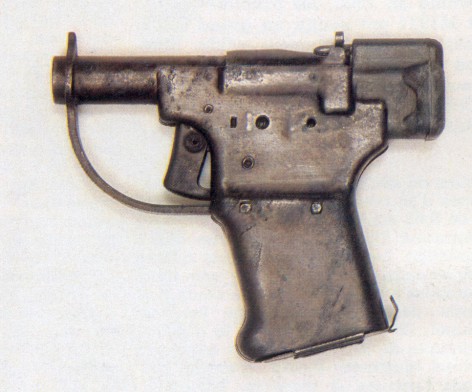
There is one more interesting single shot pistol which saw a lot of production during World War II. This was the FP-45 Liberator, which was produced in the United States during WW-II.


This pistol was designed in 1942 and hence it also has the designation M1942. The purpose of this design was to make a basic pistol that was very cheap to manufacture and easy to mass-produce and could be dropped in large quantities over Europe to arm the resistance forces. The Liberator was also designated as "Flare Projector" Caliber .45 (FP-45). The .45 was because it fired a standard 45 caliber pistol bullet (the same as that used by the Colt M1911 automatic pistol). The "Flare Projector" designation was deliberate misinformation, to disguise the purpose of this project and the fact that this weapon was mass-produced. The original design documents also had mislabeled parts to hide the true purpose of this device. For instance, in the original design documents, the barrel is called "a tube", the trigger is called "yoke, the firing pin is a "control rod" and trigger guard is a "spanner".

The pistol had only 23 parts, most of which were stamped or turned steel components, which made it very easy to manufacture. The barrel was completely unrifled, so it wasn't accurate beyond 10 meters or so. The pistol was packaged in a cardboard box along with 10 bullets and a comic-book style instruction sheet on how to use the weapon. There was also a wooden dowel included in each box to push out the fired cartridge case. It took approximately 10 seconds to load this pistol. Extra bullets could be stored in the handle of the pistol.

This weapon was never designed with regular troops in mind. It was designed to be mass produced and cheap, so that large quantities could be dropped over occupied Europe. It was also designed to be concealable. The idea behind this weapon was that a resistance fighter could use it at close range to surprise and shoot an enemy soldier and then take his weapons.

Manufacturing was outsourced to the Guide Lamp Division of General Motors. Guide Lamp Co. used to be an independent headlight manufacturer before it was bought by General Motors in 1928. During World War II, the Guide Lamp division also produced small arms, notably the famous M3A1 "Grease Gun" submachine gun. General Motors produced over one million of these pistols over a 6 month period, at an average cost of $2.40 per weapon (or about $30 in 2010 dollars). Actual production time in the 6 month period when this pistol was made was actually only 11 weeks and the entire weapon was produced at a rate of one every 7 seconds or so. This meant that this weapon had the dubious distinction of having a faster production time than the time taken to load it!

Despite its original intention, the weapons were not mass-dropped over Europe. More of these were dropped into China and the Philippines during World War II. The same concept was revived during the Vietnam war, when the Deer Gun (another low cost weapon made of Aluminium) was designed in 1964 for similar purposes. The Deer Gun was never distributed in large quantities though.

Even though the Liberator originally cost $2.40 to produce and there were over a million of them manufactured, it is something of an expensive weapon today in auction houses. In fact, a Liberator in its original box with instruction sheet can cost over $2000 at current day prices!

Friday, December 3, 2010

Pistols: Dueling Pistols

Physical confrontation between individuals has been as old as humankind. In the western world, many societies drew up rules for physical confrontations between two individuals. In these societies, if the rules of a duel were properly followed, no one would be accused of murder. The procedures to be followed for a duel to take place were often very elaborate and ritualistic. In the 17th century, while duelling was officially forbidden by many countries, it did happen unofficially and a victor's social status was often raised as a result.

In the early days of duelling, the weapons of choice were weapons like swords, spears etc. and a stronger man generally had a huge advantage over a weaker one, which many bullies used to their advantage. The introduction of duelling pistols in the 17th century became a huge equalizer for weaker individuals, since they didn't need to rely on physical strength as much.

Gunsmiths were employed to build weapons that were accurate and deadly, but also reliable. Purpose built dueling pistols were manufactured for gentlemen and London became the center for the finest dueling pistol manufacturers - Manton, Durs Egg, Purdey, Nock, Wogdon & Barton etc. Robert Wogdon was already known in England for the quality of his dueling pistols, even before he went into partnership with John Barton. In fact, duels in England were sometimes referred to as "Wogdon affairs". Other fine dueling pistols were also manufactured in France and Germany.

Dueling Pistols made by Purdey

Dueling pistols were traditionally single-shot muzzle loading weapons using flintlock firing mechanisms (and later, percussion lock mechanisms) and fired a ball-shaped bullet made of lead. They were sold in pairs that were matched as closely as possible and usually came in an elaborate case, complete with a variety of cleaning tools and a bullet mold. Caliber was fairly large with 11 mm. (0.45 inch) being one of the more common types, which meant that these bullets carried a lot of punch to them.

Traditional flintlock weapons have a noticeable delay between when the trigger is pulled and when the bullet is discharged. In order to make the delay as short as possible, while still retaining reliability against misfires, dueling pistols would often feature platinum touch holes and light triggers. While hair triggers were unofficially looked at as unsporting, quite a few people had modified their weapons to have extremely light trigger actions. Joseph Manton, the founder of the famous Manton firm, observed several duels and noticed that the firing of the large caliber pistol produced a kick that forced the forearm of the user to bend upwards at the elbow. His solution was to increase the weight of the front of the barrel to counter this kick and therefore made his dueling pistols more accurate. The weight of the pistols were much lighter than average to facilitate faster aiming and the barrels were blued or browned to reduce glare and make aiming easier.

Rifling in the barrels was considered unsporting and officially frowned upon. However, certain manufacturers, such as Manton were known for making pistols with very hard-to-detect rifling grooves for that extra edge in a duel. Similarly, sights were also originally frowned upon, but gradually became acceptable to have.

Dueling slowly faded out by the mid 1850s or so, replaced by boxing as a method of settling arguments, which led to the decline of manufacture of such pistols. However, the pistols themselves still managed to make it to the early 20th century, when Dueling Pistols was an event in the 1912 Olympic games!

Thursday, December 2, 2010

Pistols: Highland Pistol

In the history of firearms, there is a particularly interesting type called the Highland Pistol or the Scottish Pistol. We will discuss it here in this post.


These pistols were all single-shot type with a flintlock firing mechanism. Note the all-metal construction of this pistol, the lack of a guard around the trigger and the unique shape of the butt of this pistol. These are all distinguishing features of Highland pistols.

Pistols of this type originated in Scotland, specifically around the village of Doune in Stirlingshire county, which became a hot-spot for pistol manufacture in Scotland. Doune was originally a small village near the city of Stirling, which was once the capital of Scotland. In those days, Doune was located at an intersection of roads used by cattle herders to take their cattle from the Highlands to Stirling and other major cities, and many Highlanders would buy their goods in Doune on their way back to the homes. Firearms, mostly made by continental manufacturers, were some of the items available in the Doune markets.

Then, in 1647, a refugee Flemish blacksmith named Thomas Caddell settled in Doune, by way of the village of Muthill in Strathearn district of Scotland. While he was originally a blacksmith by trade, he soon began to make pistols as well and his art reached such a level of proficiency that he became famous in Scotland. These pistols used flintlock firing mechanisms, similar to those made by other manufacturers at that time. However, these weapons had certain features that made them completely different from weapons made anywhere else:
  1. Unlike other manufacturers of weapons, Caddell used pattern-welding techniques to make his steel. These techniques were originally used 700 years earlier by the Vikings to manufacture their swords. This meant his steel was of a higher quality than many of his competitors.
  2. Due to a shortage of suitable wood in Scotland to make stocks for firearms, Caddell made his weapons completely out of steel.
  3. Caddell's pistols featured no trigger guard or safety catch, for quicker firing.
  4. There was an long steel ramrod stored under the barrel. Users would use this to push the ball (bullet) and gunpowder into the barrel, when loading the weapon.
  5. The butts of his pistols were shaped like a ram's horns or a flared heart-shaped piece. This not only gave them an artistic touch, but also made them easier to pull out quickly.
  6. The center ball shaped knob at the butt could be unscrewed out. The knob had a thin pricking pin at the end, which could be used to clean out the touch-hole of the flintlock firing mechanism. This made these weapons more suitable for rough conditions.
Even though Caddell's pistols were more expensive than his competitors, their quality and reputation for reliability was so high that Highlanders saved up to buy his products over other foreign manufacturers.

The factory founded by Thomas Caddell became a family business, carried on by five generations of this family (interestingly enough, the founder's son, grandson and great-grandson were all named Thomas Caddell as well!). Other pistol factories were also opened up in the area, many founded by people who had served as apprentices at the Caddell factory, such as Murdoch, Christie, Campbell, Macleod etc. Some of the pistols manufactured by these factories were heavily ornamented with elaborate engravings and inlays made of gold and silver and cost over 50 guineas and were proudly carried by nobility.


Click on images to enlarge. The last two images are pistols made of blued steel with silver and gold inlays.

Pistols like these were highly sought after, especially by Highland officers in the 1730s and 1740s. Later pistols were even made of other materials such as brass or bronze.


Click on image to enlarge. Pistols made by various manufacturers such as Campbell, Murdoch, Caddell, Macleod.

Pistols like these were used by Highland regiments in the 1700s. Allegedly, a pistol made in Doune was the first weapon fired in the American war of Independence (i.e.) the weapon that fired the shot heard around the world, was fired by Major Pitcairn, a British soldier. George Washington was also presented with two Doune made pistols by his staff, which he bequeathed after his death to Major-General Lafayette.

Highland pistols soon started to be manufactured by makers in England as well. Many of the pistols used by the 42nd Highland regiment (the famous "Black Watch" regiment) during the French and Indian wars were actually manufactured by a Birmingham maker named Issac Bissell.

By around 1795, many Highland regiments had largely abandoned pistols. Due to competition from other European manufacturers, the factories in Doune had also closed by the early 1800s, as it was no longer economical to produce them there. The buildings for the original Caddell and Murdoch factories still exist in Doune, but they are preserved as historical buildings and no manufacturing happens there these days. However, many high quality replicas of Highland pistols are still being manufactured in other countries.


The above fine example is not made in Scotland, but in India! In fact, India is one of the major sources of replica Highland pistols these days.

Wednesday, December 1, 2010

Pistols: Early Troops

In the early days of firearms history, some people would carry pistols mainly for self-defense and close range fighting. However, these people were often just a few within a group of armed men. The first dedicated unit carrying pistols were the German Reiters, who were a cavalry unit that carried pistols as part of their standard armament.

The word "Reiter" literally means "rider" or "horse rider" in German. The term is a contraction of "Schwarze Reiter" (literally "Black Rider"), which is what they were originally called, because of their distinctive black armor. These units were first formed in the 1530s or so and the first Reiter units that were deployed in offensive action were in 1554 in the Battle of Renty. At that time, there was no country named Germany, but there were various small states of German speaking people in Europe and the Reiter units were composed of mostly people from these small states. Such units not only served the German states, but also served as mercenaries in other armies such as Sweden, France, Netherlands, Poland, Russia etc.

Until the time of the Reiter units, most European cavalry consisted of knights equipped with a lance as a primary offensive weapon and a sword as a backup weapon. The lance is a very heavy weapon and consequently, it was cumbersome to use by a mounted man. The Reiters were the first units to replace the lance with firearms as the primary offensive weapons. An armed Reiter would carry at least two or more pistols and a sword. The pistols were single-shot muzzle-loading type weapons with either a snaphaunce or wheel lock firing mechanism. The snaphaunce mechanism was cheaper and was therefore more common, whereas wheel locks were used by people who were generally financially better off and could afford the more reliable devices. Some Reiters were also equipped with a carbine weapon.

Public domain image. Click on image to enlarge.

The size of a typical Reiter squadron was about 300-350 horsemen. The tactic used by such a unit was to form into close blocks of riders of up to 10-20 ranks deep and charge towards a large body of enemy soldiers. As each rank would come into range with the enemy, they would all simultaneously turn the horses to one side, shoot the first pistol, then turn the horses to the other side, shoot the second pistol and then they would break off and ride to the rear of their formation, while the next rank would ride forward into firing range. Meanwhile the first rank would ride to the back of their formation, reload their pistols and then await their turn to ride forward into battle again. This meant that the unit as a whole could keep up a relatively continuous stream of fire. Once the enemy unit was sufficiently softened up, the Reiters could also charge in and use their swords at close range. The Reiter units were used against enemy infantry units mostly, as an enemy cavalry unit could easily break it up with a sudden counter-charge.

Typical pistol type used by a Reiter

In the above picture, we see an example of a pistol that was used by a Reiter. The above pistol is a muzzle loader with a more expensive wheel lock mechanism and also has some very decorative carvings on it, indicating that this is a superior quality weapon for its time. Also interesting is the ball at the end of this pistol butt. This ball serves multiple purposes. First, it serves as a counterweight to the heavy pistol barrel and therefore improves the balance of the pistol and makes it easier to aim. The second purpose is to improve the grip of the weapon and prevent the user's hand from accidentally sliding off the back and dropping it. Bear in mind that the armored cavalryman would typically wear heavy chain mail or plate gloves and having a ball at the end of the pistol butt made it easier to hold the pistol and draw it out of its holster. In addition, the user could also reverse the pistol and use the ball-butt in an emergency as a miniature club or mace and hit people on the head with it.

As more and more armies began to drop the lance and adopt firearms, Reiter units were no longer regarded as special cavalry units and were integrated as part of the generic cavalry in most armies. Later mounted troops were equipped with longer carbines instead of pistols. Based on the type of armor and equiment that they carried, such units were usually classified as Dragoons or Cuirassiers. Mounted cavalrymen carrying firearms lasted until World War I and these days, the surviving units serve in ceremonial roles alone.

There is also one more contribution that the Reiters made, which still exists in the present day. During a dressage competition, some horse riders execute an artistic movement called a "caracole", where they demonstrate their horse's training and ability to make a tight half turn either to the right or the left. This maneuver was originally invented by the Reiters and was the movement that they would execute right before they discharged their pistols!

Tuesday, November 23, 2010

Pistols: Basics

While we've discussed several firearm topics in this blog, one major omission so far has been on the topic of pistols. So we will study these in the following posts.

A pistol is a class of firearm that falls under the category of "handgun" (i.e.) weapons that are small enough to be fired with one hand. While revolvers also fall under the category of "handgun", the main difference between pistols and revolvers is that pistols have a chamber that is part of the barrel, whereas revolvers have multiple chambers that rotate about an axis. Pistols are actually an older class of weapon than revolvers, in fact, the first pistols were made in the 1500s, whereas revolver designs didn't appear until the 1800s. In fact, the early revolver class weapons, such as the pepperbox were originally called "pepperbox pistols" and it was only in the mid 1800s that the term "revolver" came into use, to distinguish it from "pistol".

The earliest pistols were developed in the 1500s, for use at close ranges and by mounted horsemen. The term is believed to be from the Czech word "pistole" which refers to a small flute or pipe, or from Pistoia, a town close to Florence, Italy, where some of the early pistols were made. Allegedly, the first inventor was a citizen of this town, one Caminellio Vitelli, who made several pistolese (Italian for "from Pistoia"). In those early days, the term pistolese was interchangeably used for both firearms and small daggers.

The first pistols were single-shot weapons. In effect, the user simply held a burning match cord to the touch hole of firearm to set it off. In other words, they were merely portable cannons.

Later pistols used a variety of firing mechanisms: matchlock, wheel-lock, snaphaunce, flintlock, percussion caps and finally, the modern cartridge. The example in the image above is an early German made pistol from about 1515 or so. It has a file lock, where a rough piece of serrated steel is dragged over a flint, which drops sparks into the firing pan, which then lights and discharges the weapon.

In the following posts, we will study pistols throughout history.

Thursday, November 18, 2010

What is the difference between a rifle, SLR, submachine gun, carbine etc.?

A very common question among newbies to firearms history is "What is the difference between a rifle, a sub machine gun, a machine gun, a carbine, SLR, assault rifle etc." This post attempts to point out the differences and name famous weapons of each type.

Rifle: The name "rifle" originally comes from the fact that the barrel of such weapons is "rifled". This means that the barrel has grooves in it to impart spin to the bullet as it comes out of the barrel. This spin helps to stabilize the bullet as it travels through the air and gives it a predictable drift (e.g.) a particular rifle may fire bullets that travel 1-2 cm. to the right every 100 meters on a windless day. This feature allows the user to reasonably predict where a bullet will hit and gives the rifle its accuracy. Earlier firearms, such as muskets, had smooth barrels. Smooth bore weapons were much easier to manufacture than rifles, but lacked in accuracy, as the bullets didn't have stability in the air and deviated in a random direction from the intended target. Therefore, the standard strategy for European armies of that period was to line up men in parallel lines and tell them to all simultaneously open fire at the enemy, because almost no one could reliably hit the enemy that he was actually aiming for. This massed fire strategy worked because some enemy would be hit, even if they weren't the ones that were originally targeted. These days, most modern firearms, even small ones, such as revolvers and pistols, have rifled barrels. Therefore, in modern times, the word "rifle" by itself, implies a firearm that has a rifled barrel, is designed to be fired from the shoulder, is manually fed (i.e. after each shot fired, the user has to manually operate a lever to feed a new cartridge into the weapon) and carries a small number of cartridges internally (say 1 to 5 cartridges). Examples of modern rifles from the early 20th century would be the famous American .30-06 M1903 rifle, the British 0.303 Lee-Enfield, the Mauser M98 etc.

Assault Rifle: In the early part of the 20th century, it was realized by some military forces that most conscripted troops, who were hastily trained in wartime conditions, had less than a 50% chance of hitting a target beyond 300 meters. It was also realized that most infantry encounters occurred at less than 500 meters and rate of firepower was also an important factor in these encounters. It was therefore reasoned that there was no need to give such soldiers a weapon and ammunition capable of hitting targets at 2000+ meter ranges, since most soldiers could not hope to hit a target that far away in the first place. Instead, it was reasoned that it was better to give troops lesser powered (and therefore, smaller and lighter) ammunition to suit the actual ranges that most infantry engagements occurred at and a correspondingly lighter weapon suited to fire this ammunition. With lighter ammunition and weapon, the soldier could carry more ammunition and therefore use a weapon with a higher rate of fire. While the concept was around before World War II, it was the German StG 44 (Sturmgewehr 44) that really popularized the concept. The word Sturmgewehr was coined by Adolf Hitler and literally translates to "Storm Rifle" (the word "storm" being used in the context of "storming a castle" or "assaulting a castle") and the term "assault rifle" is actually a translation of "Sturmgewehr". Even though there were earlier weapons that could be classified as assault rifles, many historians consider the StG 44 as the first to form the concept of modern assault rifles. In these times, an assault rifle is a weapon with the following characteristics:
  • Has a rifled barrel (as in the case of the rifle described in the previous section).
  • Has provision to be fired from the shoulder, just like a rifle.
  • Uses an intermediate powered cartridge. This means that the cartridges are smaller than those used by a regular rifle, but larger than the cartridges used by a pistol. This is one of the key differences between an assault rifle and a regular rifle.
  • Is capable of selective fire modes. This means it allows the user to select between firing different numbers of shots each time the trigger is pulled. In semi automatic mode, the weapon will shoot one bullet each time the trigger is pulled. The weapon automatically chambers the next cartridge to fire, but the user needs to let go of the trigger and pull it again to shoot it. In burst mode, the weapon will fire a preset number of cartridges (say 2 or 3) with each trigger pull. In fully automatic mode, the weapon will continue to keep firing as long as the trigger is pulled and there is ammunition. The ability to switch between various modes of fire is a key feature that distinguishes an assault rifle from other types.
  • Has a detachable magazine. Most modern assault rifle magazines carry 20 to 30 cartridges or so.
Examples of assault rifles include the AK-47 family, the M16 family etc.

SLR: This is an acronym for "Self Loading Rifle". The term "SLR" is usually used in commonwealth countries. This has some common features with the assault rifle described above. Like the assault rifle, this is also a weapon that has a rifled barrel and is designed to be fired from the shoulder. It also uses an intermediate powered cartridge and has a detachable magazine like the assault rifle concept. The one key difference between assault rifles and SLRs is that SLRs have only one firing mode, the "semi-automatic mode". This means that each time the user pulls the trigger, the weapon will fire only one cartridge. It will automatically eject the fired cartridge, load the next cartridge and prepare the weapon to fire, but the user has to let go of the trigger and then pull it again to fire the next cartridge. This is unlike an assault rifle, which has multiple firing modes and allows the user to switch between them. Examples of SLRs would be weapons like the American AR-15 and the Indian Ishapore 1A1 SLR. The AR-15 is a semi-automatic version of the M16 rifle and the 1A1 is a semi-automatic version of the Belgian FN FAL assault rifle.

Carbine: This is a term used for weapons that are versions of rifles or assault rifles, but with a shorter barrel and lighter weight. Carbines are bigger than pistols, but smaller versions of rifles. In the days of the Wild West, mounted riders preferred a shorter and lighter firearm because these were easier to operate than full sized firearms, when riding. In more modern times, people inside moving vehicles or in close quarter jungle combat, preferred shorter weapons for the same reason. Since carbines have shorter barrels, they lack in accuracy compared to full sized rifles or assault rifles. While they use the same cartridge as their full sized cousins, the shorter barrel also means reduced velocity bullets. Many assault rifles also come in a carbine version. For example, the American M4 (a carbine version of the M16 assault rifle), the Israeli Galil SAR (a carbine version of the Galil assault rifle), Steyr AUG carbine ( based on Steyr AUG assault rifle. The carbine form uses a 16 inch barrel, whereas the assault rifle uses a 20 inch barrel) etc.

Submachine Gun: This is a weapon that shares some similarities with assault rifles, but one key difference is that submachine guns are designed to fire pistol cartridges instead of intermediate cartridges. As a result of this, submachine guns are generally lighter and smaller than assault rifles and are about the same dimensions or smaller than carbines. Since they use pistol ammunition, they also have less recoil and therefore can be fired from either the shoulder, the hip, or even holding it like a pistol. The first weapon to use the term "submachine gun" was the famous Tommy Gun that we studied about earlier. This is a fully automatic weapon that fires .45 ACP cartridges, the same cartridge used by the Colt M1911 pistol. Another famous submachine gun from the World War II era is the British Sten gun, which is also a fully automatic weapon. Modern submachine guns such as the Heckler and Koch MP-5 are capable of selecting multiple firing modes. Submachine guns are more preferred for close-range combat in urban environments because, with lower powered pistol cartridges, there is less risk of bullets penetrating through walls and hitting innocents on the other side

Machine Gun: This generally denotes a weapon that is capable of rapid, fully automatic fire and carries a large supply of ammunition. Fully automatic fire means that the weapon will keep firing as long as the trigger is pulled and there is a supply of ammunition available to it. Most machine guns fire either full sized or intermediate sized ammunition, similar to rifles and assault rifles. Machine guns generally carry a large supply of ammunition in ammunition belts, drum magazines or box magazines. This means that they generally have hundreds of cartridges available to them, unlike the 20-30 cartridge magazines used by assault rifles. They are also generally heavier than rifles and assault rifles. Examples of machine guns would be the Gatling Gun, the Gardner Gun, the Bira gun etc. Modern machine guns include the Browning Automatic Rifle (BAR), the British Bren gun, the American Stoner 63, the Belgian FN Minimi etc.
Tuesday, November 16, 2010

Shooting: Compensators and Muzzle Brakes

When shooting a firearm, one may notice that there is a tendency for the muzzle to rise up in the air after the shot is fired. This effect is called muzzle climb or muzzle rise. The cause of this is basic physics. Look at the two images below:

When a firearm is discharged, there are multiple forces acting upon it. The gases generated by the burning propellant of the cartridge, pushes the bullet out the barrel and also pushes back on the firearm. This force acts on the centerline axis of the barrel. Let this force be represented by A in the two diagrams above. Now, the user of the firearm is also resisting the kick, by holding the firearm with his hands. Let these forces be represented by B in the diagrams above. Note that for the assault rifle, there are two points where force B acts upon (i.e.) at the stock and at the grip. Also note that in both diagrams, force A is acting at a higher point than force B. This causes the rotational torque C, which causes the front of the firearm to rise.

This effect is more visible for heavier caliber weapons or when multiple shots are fired rapidly. There must be some way to prevent this muzzle climb for happening, because no one wants their weapon to act as though it is on anti-aircraft duty, when they're trying to shoot at a target on the ground!

One way to reduce this effect is if A and B are in the same axis (or fairly close to the same height), then the torque C is minimized. Another way to reduce this is to use devices such as a compensator or a muzzle brake.

Public domain image. Click on image to enlarge

In the above picture, we observe that the gentleman in the front of the picture is firing an AKM assault rifle. Notice that the tip of the barrel has a slanted tip and is slightly tilted to the right as well (it is more visible in the enlarged image). This slanted tip is not due to wear and tear or poor maintenance of the weapon -- it is actually a feature. That device is called a slant compensator. What it does is direct some of the escaping gases upwards, thereby pushing the muzzle down. This counteracts the torque trying to push the muzzle up and thereby makes it easier to keep the weapon pointed at the target. The AKM also has a tendency to move to the right, which is why the compensator is also slightly tilted that way, so that it pushes the muzzle to the left to counteract that movement as well. When the Russians decided to make an improved AK-47 version (the AKM), this was one of the standard features added to the AKM model. This simple device could also be retrofitted to older AK-47 models, simply by screwing on this device to the tip of the barrel.

Another device that is similar is called a muzzle brake. Basically, this consists of a small tube that has a number of perforations along its sides, which is attached to the end of the muzzle. These perforations allow the gases to escape at an angle to the muzzle, which not only helps reduce the muzzle climb, but also reduces the recoil felt at the back of the weapon.

Muzzle brake at the tip of an M16 assault rifle.


Yet another way to reduce recoil is called porting. Basically, this involves drilling precise holes near the end of the barrel, which allows some of the gases behind the bullet to escape upwards as the bullet is exiting the barrel, thereby pushing the barrel down.

Public domain image. Springfield Armory XD-40 pistol with ported barrel.


The advantage of such devices is that they reduce muzzle climb as well as felt recoil. This improves the accuracy of the user. It also reduces the load felt by the user during long shooting sessions.

There are also a few disadvantages of such devices. One is that the noise level of the weapon increases by a few decibels. They also increase the flash seen at the end of the barrel. Some muzzle brakes redirect some of the gases towards the user to reduce recoil, but this could cause some of the pressure wave to be redirected to the user as well as extra noise and flash, thereby causing some discomfort. Additionally, if the shooter is firing from a prone position, the redirected gases could throw up some extra dust towards the shooter, which could impair visibility and give away the user's position. Finally, the extra weight at the tip could affect the overall balance and handling of the weapon.