Monday, July 2, 2012

Firearm Myths - 3 (Hollywood Edition)

We already looked at some firearm myths several months ago here and here. We will look at some more myths in this post. The class of myths we will look at in this post generally have movies to thank for spreading the myths.

1. If you drop a pistol, it will go off when it hits the ground.

You've probably seen this scene enacted in several movies. Someone accidentally drops a pistol and it automatically goes off with a bang when it hits the ground, usually killing some villain's sidekick while it does so. For example, there's the scene in the movie, True Lies, where Jamie Lee Curtis drops her gun down the stairs and ends up shooting a whole bunch of people.

You want the truth? The probability of this happening was certainly higher with older model pistols, so it might make sense if it happened in a cowboy movie. With more modern designs, this is much less likely to happen, especially with models manufactured since the 1980s or so. This is because there are devices called drop safety devices that are designed, precisely to prevent this from happening. In fact, we discussed these devices in posts here, here and here last year. And most modern pistol designs include one or more drop safety devices built in. As a matter of fact, the US military as well as NATO and some other countries' militaries require pistols to pass several drop tests before acceptance. SAAMI standards which are followed by most manufacturers in the US (as well as some foreign manufacturers selling products in the American market) also require pistol models to pass several drop tests. As do some states in the US (for example, California and Massachusetts, though the test standards for each state are different). The US Federal Gun Control Act of 1968 also introduced drop tests for imported gun models. On top of that, most reputable manufacturers add drop safeties to their designs, because they don't like lawsuits.

Why do we still hear news reports of people getting shot accidentally by dropped firearms then? Well, in the majority of such cases, the firearm in question usually turns out to be an older model firearm, which doesn't have drop safety devices built in. In extremely rare cases, the firearm has a malfunctioning drop safety device.

2. Handling one gun is good, handling two is even better.

In quite a few movies, we see the hero or heroine bursting out from a door with two guns, one in each hand. This scenario is also played out in certain videogames (such as the Tomb Raider series with the Lara Croft character). Sometimes the character aims them both at the same target and sometimes they are pointing at different targets.

Angelina Jolie playing Lara Croft in the movie Tomb Raider. Click on image to enlarge..

Keanu Reeves playing Neo in the movie The Matrix. Click on image to enlarge. 
Note that Neo doesn't even bother to look where he's shooting!

In fact, director John Woo has made it his trademark and the scene appears in several movies that he has directed, often starring Chow Yun-Fat.


Click on images to enlarge.

In fact, in the movie Hard Boiled directed by John Woo and starring Chow Yun-Fat, the commanding officer says, "Give a guy a gun and he's Superman, give him two guns and he's God!"

So what is the truth here? Well, it looks pretty awesome in the movies, but it isn't such a good idea in real life. For one thing, each firearm requires one eye to aim it properly, so while it is hard enough to aim when the two firearms are pointing mostly parallel to each other, it is pretty darn hard to do it when the two are spread apart and pointing at different targets! On top of that, most modern shooting stances, such as the Weaver Stance, Chapman Stance, Isoceles Stance etc. emphasize using both hands to aim a single firearm, in order to stabilize it better.

3. The hero or villain doesn't know that his pistol is empty.

This scene has been replayed in several movies that it is almost a cliche: One character aims his pistol at  another person and squeezes the trigger and then all you hear is "click". Curses, the character had fired off so many shots that he didn't realize that his pistol was out of ammunition. For even more drama, the character usually pulls the trigger several times while the other person laughs at him.

Classic scene from the James Bond movie Dr. No, starring Sean Connery as James Bond.

So what is the truth here? The image below shows what really happens to a pistol after you have fired the last round in the magazine:
Click on image to enlarge

After the last shot is fired, the slide locks back in the rear of the pistol, the barrel is exposed and the ejection port is left open and it stays open until the user inserts a new magazine in and releases the slide back manually. In many pistols, you can't even pull the trigger when it is open like this. It becomes pretty obvious to the user, as well as everyone around him/her, that the pistol is out of ammunition.

As you can see in the movie clip of the movie Dr. No shown above, the character of Professor R.J. Dent pumps six bullets into the pillow on the bed and then his pistol slide correctly locks open at around 0:09 into the movie clip when he runs of of ammunition. Then after a little while, when he attempts to shoot Mr. Bond a second time at around 1:02, his pistol slide seems to have returned back as though it was loaded, thanks to a little Hollywood movie magic. In reality, the slide should have stayed open and it would have been fairly obvious to him as well as James Bond that he was out of ammunition.

Wednesday, June 27, 2012

Best Gun - 2

In our previous post, we looked at the term "best gun". As we found in our previous post, this is a term that is used to refer to a high-quality double barreled shotgun with some very specific features in it. Quite a few of these are manufactured by British firms, especially London based ones, but they are not the only ones. W.W. Greener and Westley Richards, both from Birmingham, also manufacture "best guns", as do firms from other countries around the world.

Italy also has some well-known best gun makers, such as Piotti, Fabbrica Armi d'Abbiatico e Savinelli (FAMARS), Beretta, Fabbri, Benelli etc. Their products (and prices) are comparable to some of the finest British firms. These firms are usually located in Northern Italy, which was a traditional firearms manufacturing center for centuries. The town and region of Brescia was known for its fine firearms for at least 500 years and before that, it was a hotbed for production of swords for the Roman legions.

A best gun made by Piotti of Italy. Click on image to enlarge.

A best gun made by Fabbri of Italy. Click on image to enlarge.

The above two examples show the fine work of their manufacturers. The model made by Fabbri sells for over $250,000!

Not to be outdone, we have manufacturers from Spain and Belgium as well. The Spanish city of Eibar in the Basque Country region is a traditional gunmaking town from the middle ages, as is the town of Liege in Belgium. Predictably enough, the well known manufacturers of best guns come from these regions as well. Spanish best gun manufacturers such as Pedro Arrizabalaga, Armas Garbi, Grulla Armas etc. have a good reputation in the market.

A best gun made by Pedro Arrizabalaga. Click on image to enlarge 

A best gun made by Armas Garbi. Click on image to enlarge.

Spanish best guns are generally priced well below their English or Italian counterparts, but they are still very high-quality firearms.

The city of Liege in Belgium was also a traditional hotbed of firearms manufacturing since the 1400s or so. The various manufacturers based around this city used to produce firearms of varying qualities: see our discussion on spurious firearms for some low quality specimens. It has also produced some very high-quality products as well. Most of the manufacturers in and around Liege have gone out of business at the present time, but there are a few small manufacturers still in business and also the 800 lb. gorilla, Fabrique Nationale (FN), which continues to make best guns along with military rifles, pistols, revolvers etc. These guns normally retail for about $15,000- $80,000 or so.

Germany also had a few best gun manufacturers in history, mostly located around the town of Suhl, which (surprise, surprise) has a long history of gunmaking. After World War II, the town of Suhl went to East Germany and thus, the firearms industry in that town went into decline, as the communist government strongly discouraged private arms manufacturers. After German reunification, the town has recovered some of its former glory -- the school of firearms engraving and the Guild of Master Gunsmiths are now both located here. The only major manufacturer still in Suhl is the firm of Merkel, but some of the other well known German manufacturers such as J.P. Sauer & Sohn, Krieghoff etc. moved to West German towns after World War II and are still in business. J.P. Sauer & Sohn, founded in 1751, is well-known for their SIG Sauer line of pistols, but they also manufacture best guns.

German best guns tend to be heavier than their English or Italian counterparts and tend to be very strongly built. They also tend to have deeper engraving. Because their style is different from the "London Best" style followed by British, Italian and Spanish manufacturers, the demand is lower and hence they are lower priced. However, they have very good strength and quality of workmanship.

Finally, we have the United States. At one time, there were many best gun manufacturers in the good ol' USA: Remington, Parker, Winchester, Lefever, Ithaca etc. Most American best guns are heavier than their English, Italian or Spanish counterparts because they are designed to fire stronger American shotgun cartridges. American best guns are generally built for mass production, hence many lack some of the characteristics of the very best British, Italian or Spanish guns. However, the quality of engraving, checkering and finish are excellent on the high-grade guns and are comparable to other best gun products from other manufacturers. There are still manufacturers in the US that are building replica models of some of the finest shotguns made in the last couple of centuries.

Sunday, June 24, 2012

What is a Best Gun?

Some readers may have heard the term "best gun" being used sometimes, especially in older books. So what is this "best gun" and what is it better than? We will study all about that in this post.

It turns out that the term "best gun" doesn't necessarily mean what you think it means. It is actually used to describe a very specific type of firearm in the industry. A "best gun" is a double barreled shotgun usually with side lock actions, a specific style of stock, intercepting sears etc. It should have a high quality of workmanship and finish and is usually a top-grade gun model that is offered by the manufacturer. It is intended to compete with other manufacturers products in factors such as quality, workmanship and finish, not on price. Many of these "best guns" are custom made for a particular customer, as can be seen in the video we saw earlier in the making a custom shotgun post. Such customers are willing to pay the extra price to have a high quality product made by highly skilled craftsmen. They are not only high quality products, but literally works of art as well.

Some of the most famous "best guns" were made by British manufacturers, such as Holland & Holland, J. Purdey & Sons, W.W. Greener, Westley Richards, Boss & Co., Joseph Lang etc. These manufacturers pioneered the standards in the mid 1800s for what is regarded as a "best gun" today and many of them are still in business currently. To this day, a "London Best" quality firearm is regarded as one of the highest quality firearms made and is usually one of the most expensive shotguns around, some costing more than the latest Ferrari or Lamborghini sports car! Even used "London Best" shotguns are expensive.

A "best gun" manufactured in 1925 by Boss & Co.

The above example is a shotgun manufactured by Boss & Co. in 1925. The gun is a 12 gauge double barrel shotgun with barrels arranged one over the other (known as "Over/Under" or "O/U" type). This is currently worth about $50,000 today.

A recent "best gun" made by J. Purdey & Sons.

The next example we have above is a modern shotgun made by J. Purdey & Sons. While they used to produce different grades of firearms over the years, they currently concentrate on producing very high-end firearms mainly. Purdey's basic price for a entry level shotgun is $52,000 and a double barreled "best gun" starts at $90,000 or so and additional engraving and inlays such as those in the image above can add tens of thousands of dollars to the price. The current master engraver, Ken Hunt,who started as an apprentice at Purdey in the 1950s and is now an independent artist, charges $90,000 for his work alone and only does 4 guns a year currently. The fit is incredibly precise to about 1/1000th of an inch tolerance. It takes 500 hours or more to produce one shotgun and Purdey produces only about 100 guns a year currently.

While London is known for its "best guns", they are also made in other places around the world. We will take a look at these in future posts.

Thursday, June 21, 2012

Spurious Guns - 3

In our last couple of posts, we examined the subject of spurious guns. We will study the topic further in this post.

As we saw in the last couple of posts, many of these firearms were stamped with names very similar to those of well-known and reputable manufacturers. Since trademark laws weren't as strict then as they are now, it was considered completely legal in some jurisdictions. The same idea is now seen in China these days, where they sell knock-off goods with names similar to well-known companies ("Sorny" instead of "Sony", "Polystation" instead of "Playstation", "iPed" instead of "iPad", "Pizza Huh" instead of "Pizza Hut" etc.)

So why did they do it? For this, we go to W.W. Greener's The Gun and Its Development, 9th edition, which is now in the public domain. In his words:

From the affluent position most of these dealers and getters-up of spurious guns enjoy, makers of reputation prefer to suffer rather than engage in what they know must be a disagreeable and very probably a most disastrous prosecution. The author believes that he alone has instituted criminal proceedings for this species of forgery; the result being the imprisonment of the offender. And although the method of procedure is distasteful and expensive, the author appeals to those who have been deluded into the purchase of a forged Greener gun to communicate with him at once, in order that an effort be made to stop this nefarious trade.


What this means is that trademark laws weren't strong enough at that time to prevent this practice and many reputable manufacturers didn't think that they could win the case. Note that the author mentions that he won one of the cases, not that he won multiple cases. Therefore, offenders could use this method of evading trademark laws without much fear of consequences.

However, this wasn't the only way that many people skirted trademark laws. Mr. Greener also goes on to mention another deceitful practice:

There is another more subtle form of deceit commonly practiced in Liege and on the Continent. It consists of engraving the gun conspicuously with the name of the patentee of one of the parts of the mechanism. The most notable instances are "Greener" upon cross-bolt guns, and "S&W" upon the Smith & Wesson type of revolver. In a case tested before the Belgian courts the defense advanced was that the weapons were of the type associated with the plaintiff's name, and that the name was intended to refer to the system, not to the maker, of the weapon. When "Greener" is put in bold gilt letters on the top rib, and other words, if any, in small insignificant characters, the name is certainly misleading, whatever the intention; but unfortunately there is no way of stopping the practice.


In Great Britain, under the new Merchandise Marks Act, makers of spurious guns may now be prosecuted; and the sooner the chief clauses of this Act are made international law, the better it will be for foreign sportsmen. In the British colonies, the sportsman is fairly protected by law: but probably the most flagrant instance of trading in spurious guns occurred at Melbourne, where a Jewish firm of gun importers, in a very large way of business, selling to all the Australian colonies, had long practiced a most impudent fraud. If a customer inquired for any well-known make of gun, an unnamed Belgian gun was forthwith stamped with the name of the maker demanded, and usually a sale completed. For making such unwarrantable use of the author's trade name an action was brought, in the year 1895, and the author was awarded £5,500 damages; but it is doubtful whether this covered more than a fraction of the real  injury wrought, and was, of course, no reparation to the sportsmen who had been deluded into purchasing spurious weapons. Unfortunately the defendants appealed against the verdict, and litigation proceeded for more than a year afterwards. The evidence obtained showed that many of the best-known firearms manufacturers had been victimized by this one firm, four members of which were subsequently prosecuted criminally and sentenced to various terms of imprisonment.


This method of evading trademark laws is no longer possible in most westernized countries these days, as the trademark laws have become more strict.

Spurious Guns - 2

In our last post, we looked at some spurious guns that were sold as though they were products manufactured by reputable British manufacturers. We will continue the discussion in this post.

Reputable British manufacturers were not the only ones harmed by unscrupulous manufacturers. The practice also covered some US manufacturers as well. For instance, Parker shotguns were a well-known American brand from the 1870s to 1942 and their products were once described as "America's finest shotguns". The company was founded by one Charles Parker in Connecticut. However, any shotguns marked "C. Parker" are not made by the Parker company, but are actually cheap Belgian fakes.

A "C.Parker" shotgun. Click on image to enlarge

Similarly, the Henry repeating rifle gained a lot of fame during the American civil war and was one of the first reliable lever-action rifles and a precursor to the Winchester Model 1866 repeating rifle. The Henry rifle was made by the New Haven Arms Company of Meridien, Connecticut, which was later renamed to Winchester Repeating Arms Company, when they started making the Model 1866. However, firearms labelled "Henry Arms" had nothing to do with either of these companies. The "Henry Arms" firearms were either manufactured by Crescent Firearms of Norwich, Connecticut, or by Belgian manufacturers such as Anciens Establissments Pieper or F. Dumoulin.

A "Henry Arms" rifle. Click on image to enlarge. 

In the same category, we have brands like Sam Holt (sounds like Sam Colt), T. Barker, Barker Bros (both intended to be confused with Parker Bros) etc., all of which were made by Belgian manufacturers.

Such firearms were often called "trade name firearms" or "trade name guns". Large firearm manufacturers would mass produce cheap models and stamp them with any brand name requested by  hardware stores, large distributors, mail-order businesses etc. Belgian companies like Ancient Establissments Pieper or F. Dumoulin and US manufacturers such as Crescent Arms Co., Iver Johnson Arms and Cycle Works, Harrington and Richardson Arms Co., Stevens Arms Co. etc. were known to produce the firearms and these were sold by well known retailers such as Sears Roebuck & Co., H&D Folsom, Montgomery Ward etc. Some of the brand names used to sell such firearms include Henry Arms Co., Premier Arms Co., Bayard Arms Co., Eagle Gun Works, J. Manton & Co., T. Barker Co., Sam Holt Arms Co. etc.

Some of these firearms are quite reasonable quality, but they're definitely not high-end firearms and will also not hold up to pressures generated by modern gunpowder loads.

Tuesday, June 19, 2012

Spurious Guns - 1

While we have dwelled on the manufacturing process and cost of manufacture of firearms, there is another interesting related topic that we will study today: spurious guns. Our note on spurious guns comes from W.W. Greener's "The Gun and its Development", a book that was published a long time ago and is in the public domain. In one of its chapters, he devotes a small section to spurious guns.

During the latter half of the 19th century, as some English firearm manufacturers were becoming famous worldwide for their quality of product, fake copies of their products also began to hit the market. Many of the fake manufacturers were based in Belgium, though some were based in England as well.

In W.W. Greener's words:
The spurious gun may be either a gun represented as being of quality it is not, or as the production of a maker other than the real one.  After taking all into consideration, it is the first class which is the most dangerous to the unwary buyer. The vapid platitudes of the salesman spread a glamour over the transaction, and the sportsman purchases a gun which will trouble him more and more as he gets to know it.  Against the purchase of this class of gun the sportsman must always be on his guard.


The second class of gun is simply a forgery.  Belgian guns are sent to England to be proved, or the English proof marks are imitated; "English fine twist" is engraved upon the rib, or any maker's name is put on to the order of the importer.


Some makers do not scruple to state in their lists that they will put upon their productions "made in London, or in Eibar, or in Brescia," or in any other town whose manufacturers have a better reputation that their own. Never buy a gun without the maker's name upon it.


All the leading makers or their retailers now advertise, so that the exact name of the maker wished is easily obtained; see that the gun bears this name, and rightly spelled, for the change of a letter is often made, the maker of the forgery thereby thinking that his liability is lessened, and foreign forgers make dreadful havoc with English names, whereas probably no careful maker has ever turned out a gun wrongly or incorrectly named, so far as his name goes.  As to the more general forgeries, they will be found to be changes run upon the name of a maker of reputation.  No one would forge "Smith" or "Jones", and happy the gunmakers who possess such names; but names as "Greener" will be spelled "Greenen," "Purdey" as "Purdy," "W.C. Scott & Son" as "J.N. Scotts Son," whilst of the imitations of "Westley Richards" the name is legion. The alteration in initials, or the Christian name, or the address is more frequent, and all "Horace Greener," "Albert Greener," J.H., W.H., A.H., and other H. Greener guns are practically forgeries.


Let us now look at some of these forgeries. First up, we have a Greener imitation shotgun, made in Belgium:


Click on images to enlarge.

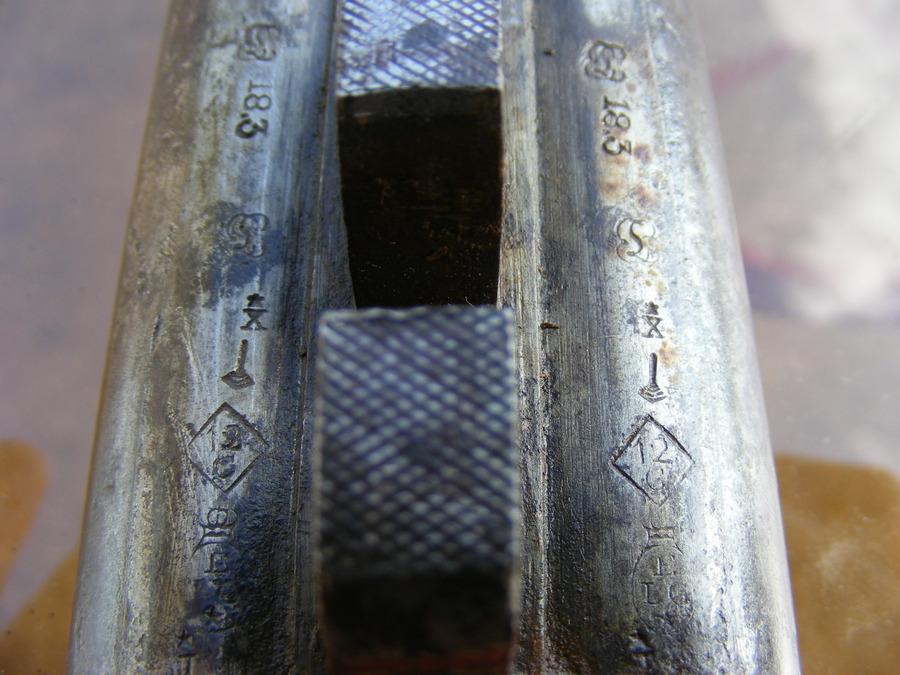
First thing to notice in the first image is that the name of the maker is "C. Greener", not "W.W. Greener". Secondly, there is no address on the top rib: A genuine W.W. Greener of that era would have been marked with the manufacturer name AND address (e.g. "W.W. Greener 68 Haymarket London & St. Mary's Square, Birmingham."). The second big giveaway is in the second picture. Those are Belgian proof marks, not English, the oval with the letters "ELG" and the other mark that looks like a pole standing on a pyramid show that it was proved in Belgium. But W.W. Greener was an English manufacturer, so it would have had marks of either the Birmingham or London proof houses if it was genuine. These proof marks are normally hidden by the stock when the gun is in an assembled state (as the proof marks were usually put there in order to not mar the beauty of guns), so the buyer would not necessarily notice them until much later on.

The next image we will look at is a fake Westley Richards:
Click on image to enlarge

This one is pretty tricky because the engraving on the plate says "W. Richards". However, a real Westley Richards shotgun would say "Westley Richards", not "W. Richards." To complicate matters, there was a genuine firm named William Richards based in Liverpool, who manufactured shotguns under the name "W. Richards". This company made some quality shotguns and is still in business to this present day. However, there were also many more Belgian made "W. Richards" fakes made during the late 1800s. Usually, guns with barrels marked "London Fine Twist" are fakes.

The problem got so bad that in 1887, the British magazine, "Shooting", conducted interviews with genuine English manufacturers to identify the markings of genuine guns. As per that article, some of the details are:
W. Richards, Liverpool: "All my guns have 'W. Richards Old Hall Street' on the barrels, 'W. Richards' on locks, Guards are numbered."
W. Richards, Preston, Lancashire: (Editor's note: This is another branch of the same firm above. At one point, they had a branch in Preston as well as Liverpool) "All my guns have 'W. Richards, 44 Fishergate, Preston', on the top rib, 'W. Richards' on the lock plates, all guards are numbered."
Westley Richards, London and Birmingham: "'Westley Richards' and appropriate address on rib (or Westley Richards & Co on lower grade guns). All guns have 'Westley Richards' on lock plates and bear the 'Westley Richards triangle' trade mark."

Therefore, a gun that doesn't have some of the details above is likely a fake.

Many of the fake Belgian-made W. Richards guns were imported into the US by H&D Folsom Arms Co. of New York, which was a large American sporting goods retailer in the late 1800s until the 1950s or so.

Now, we will look at some more fake Westley Richards products:


Click on images to enlarge

As we can see in the first picture, the lock has the word "Richard" instead of "Westley Richards". In the second picture of the same firearm, we can see Belgian proof marks, as in the fake Greeners above (i.e. The letters "ELG" in an oval and the pyramid with a pole on top).

Now for a whole slew of fake Westley Richards products:


Click on images to enlarge

As was mentioned by W.W. Greener above, the imitations of Westley Richards are legendary. Observe the variants of the brand name on the lock plates: "W. Richard of Belgium", "A. Richard", "Rikard" and "Rickard".

In our next post, we will study more spurious guns and the strategies developed by unscrupulous manufacturers in trying to sell them.

Monday, June 18, 2012

The Cost of Manufacturing

So the reader goes to their local gun dealer's shop and decides to purchase a firearm. Say, this dealer's shop has a brand new firearm with a manufacturer suggested retail price (MSRP) of $1000. So what is the cost of manufacturing such a firearm and what justifies such a high price, the reader asks?

Here's how the cost breakdown is in the firearms industry. The MSRP is typically around 40% above what the local dealer got it for, therefore it means that the price that the dealer must have purchased it for works out to about $715.

Instead of selling it to the customer for the MSRP price of $1000 though, the dealer may sell it at a "street price", which is around 15-20% of what he paid for it. So the customer may only pay something between $820-860 or so, instead of paying $1000. However, the dealer still makes a profit of 15-20% here. The profit that the dealer makes goes to pay the rent, employees, electricity, gas etc. + a little profit for the owner. Gun dealers also make money from selling used firearms (where the margins are around 30-35%), ammunition, extra magazines, accessories, cleaning supplies etc. (which may sell at 50% margins or so), so that's how they manage to stay in business.

Now, we've figured out the dealer purchased the firearm for around $715 from a wholesale distributor. The wholesaler in turn, purchases the firearm from the manufacturer and sells it to your local dealer at 25-35% margin. Therefore, working backwards from $715, we calculate that the wholesaler purchased them from the firearm manufacturer for about $530-$570 each. Some of the profit they make goes into paying for warehouses, shipping to local dealers, advertising in trade shows, paying employees etc.

So, the wholesaler gets the firearms for $530-$570 each, but the firearms manufacturer sells them to the dealer with around 2x the cost for them. Again, working the math backwards, this means that it costs the firearms manufacturer about $265-$285 to manufacture the firearm. This cost includes not only the cost of the raw materials, but also cost of tools, research and development costs, factory cost, employee pay etc. Some of the profits go into advertising, paying lawyers, rent, future research and development, paying stockholders etc. If we count just the cost of raw materials and components, it is typically around 50% of the manufacturing cost, which works out to about $130-$145 for just the raw materials alone.

So, we calculate that for a cost of around $265-$285 to manufacture, the MSRP is $1000, which means the manufacturing cost is around 1/4th to 1/3rd of the MSRP. This ratio is also about the same as that of many other manufacturing industries as well.

Of course, these are just rough guesses, so what does the price look like for a real manufacturer. From a 2003 article in Forbes magazine, we find that a Glock pistol that retailed for about $500 then cost Glock GmBH only about $75 to manufacture. Which means that the sell price was over 6x the manufacturer cost! Remember though that Glock was actually wanting to retail for cheaper, except that a marketing guy persuaded the company to sell for higher margins, otherwise the gun would appear too cheap and not be taken seriously! Also, they sell very large volumes of products, so the unit cost is significantly reduced because of this.