Sunday, December 20, 2015

Famous Guns: Lucretia Borgia

Take a look at the two rifles in the image below:

Click on the image to enlarge.

The one we are going to study today is the one at the bottom. "Wait a minute", the reader says. "The rifle at the bottom seems badly damaged. Heck, it is even missing part of its stock!" Well, there is a bit of history associated with this particular firearm, which is why we are going to read about it today. First, here's another close up of this rifle:

Click on the image to enlarge.

It is a Springfield Model 1866 trapdoor rifle, otherwise known as the Springfield 2nd Model Allin Trapdoor Conversion Rifle, firing a .50-70 black powder cartridge. As you can see, there is extensive damage and wear or the rifle and the barrel is even a little bent. However, that doesn't mean that this rifle is worthless. In fact, it may be more valuable than the one above it, because of the fame of its original owner. Here's a picture of the person that owned this rifle in the past:

Public Domain Image

Yes, that is the famous American legend, William Cody, a.k.a Buffalo Bill Cody, holding the same rifle when it was in much better condition.

Even though this rifle is a single shot model, Buffalo Bill preferred using this to the faster firing lever action .44 Henry Rifle and the Sharps 'Big Fifty' rifle. Buffalo Bill Cody never revealed how he came upon the rifle, but it is believed that he was issued the rifle when he served in the US Army during the Civil war and took it with him when his service ended. This is certainly possible, as thousands of Springfield Model 1866 rifles were issued to US troops during that time.

Buffalo Bill used this rifle in many encounters with Native American tribes, as a scout and as a commercial hunting rifle, when he worked as a contractor to supply meat to the railroad workers. It was used in a famous shooting contest between him and William Comstock, to see who could shoot the most buffalo in a given time. After this contest, people began calling William Cody as "Buffalo Bill".

So, why the name "Lucretia Borgia"? Well, the real Lucretia Borgia (or Lucrezia Borgia) was a famous Italian lady, from the powerful Borgia family, who were very politically connected and even had a few members serving as popes and cardinals in the Vatican. The Borgia family had origins in Spain and became prominent during the Renaissance period in Italy. Lucretia Borgia was known as a beautiful woman, with a reputation for being deadly (she was alleged to have poisoned several people). Many stories were written about her, including a famous play by French playwright, Victor Hugo, called Lucrezia Borgia. This play was staged at various places during the US Civil War, including Leavenworth, Kansas, where Buffalo Bill is alleged to have seen it.

For hundreds of years, it has been common tradition for men to bestow female names to their favorite tools and possessions, and Buffalo Bill was no exception in this regard. Buffalo Bill saw his rifle as beautiful, but deadly. So, when it came to naming his rifle, he named it after a famous woman who was known to be beautiful and deadly: Lucretia Borgia! In fact, he had the name inscribed in the lock plate of his rifle, where it may still be seen today. This seems to have been his favorite rifle as he mentioned this rifle in several interviews and in his autobiography and has even been photographed with it.

As to how part of its stock disappeared, there are a couple of stories associated with it. One story is that Buffalo Bill had shot an elk or a bison with his rifle and tried to finish it off with a blow to the animal's head, but the stock broke when he did this. Another story says that when he was employed as a hunting guide to Grand Duke Alexis of Russia, he loaned this rifle to the Grand Duke to use. Apparently, the Grand Duke got a little excited after shooting a buffalo during the hunt and threw his rifle in the air to celebrate, but failed to catch it on the way down and his horse stepped on it after it hit the ground.

Lucretia Borgia may be seen today on display at the Buffalo Bill Center of the West Museum in Cody, Wyoming.


Sunday, December 13, 2015

High Quality Winchester Model 1873 Rifles

A long time ago, we studied lever actions and one of the most famous lever action weapons was the Winchester Model 1873 rifle.

Winchester Model 1873. Click on the image to enlarge. Image courtesy of http://www.adamsguns.com/

This rifle was extremely popular with settlers and cowboys in America and became known as "the gun that won the west". It was manufactured for 46 years between 1873 and 1919 and during this time, 720,610 rifles were made. Bear in mind that the entire population of the United States was around 70 million people at that time, so this means it was an extremely popular rifle.

The reader should note that this was not a long-range rifle at all. The cartridges it used weren't very powerful and accuracy was not the best -- your average Model 1873 rifle couldn't put 5 shots into a dinner-plate sized target at 100 yards. So what was good about this rifle that made it so popular then? Well, it was a rugged design, and it used the same cartridges as revolvers, so that the user only needed to carry one type of cartridge for both weapons. Also, many users didn't need pin-point accuracy and the rifle was powerful and accurate enough to be used to hunt deer or for self-defense. The lack of accuracy and power was more than made up for by its ability to shoot rapidly and the large capacity of its magazine. It was also relatively cheap.

However, in 1875, Winchester began to offer higher grade versions of the Model 1873 for sale. Every Winchester rifle barrel was test-fired in the factory, as part of the manufacturing process. Rifle barrels that shot with exceptional accuracy were set aside for special orders. These exceptionally accurate barrels were then handed over to the best workmen in the factory, to make customized models of the Model 1873. These rifles were made with set triggers, case hardened parts, extra-fine quality of finish, high quality walnut stocks with checkering, fancy engravings on the metal parts etc. The best quality barrels were engraved with the lettering "One of One Thousand", or "One of 1000". The second best quality barrels were engraved with the lettering "One of One Hundred".

Three Winchester "One of One Thousand" rifles and a "One of One Hundred" rifle.

Winchester catalogs from that period were quoted as follows:
"The barrel of every sporting rifle we make will be proved and shot at a target, and the target will be numbered to correspond with the barrel and be attached to it. All of these barrels that are found to make targets of extra merit will be made up into guns with set-triggers and extra finish and marked as a designating name, "One of One Thousand," and sold at $100.00. The next grade of barrels, not so fine, will be marked "One of One Hundred" and set up to order in any style at $20.00 advance over the list price of the corresponding style of gun."

The price of an ordinary Winchester Model 1873 rifle around 1880 was around $20. The "One of One Thousand" rifles were sold at a list price of $100 each and the "One of One Hundred" models were sold for around $40 each. Considering that the price of one acre of best quality farmland in Kansas was $11, these higher quality firearms were quite expensive and only rich people could afford to buy them.

While the fine walnut stock with checkering, case hardened parts and set triggers were standard with these higher-end rifles, the factory also offered custom upgrades for extra. For instance, a person could add special upgraded walnut stocks, long range sights, silver or gold finish, custom engravings and monograms etc. Since many of the owners of these higher-quality rifles were quite rich, these rifles were often upgraded with these extra options.


Winchester only manufactured 132 rifles of "One of One Thousand" quality (some sources say 133 or even 136 rifles.) The "One of One Hundred" rifles are even rarer, only 8 were ever produced, as per the Winchester factory records.

In 1950, Hollywood produced a popular western movie called "Winchester '73" starring James Stewart, where the story involves a "One of One Thousand" rifle. As part of marketing this movie, Universal Pictures published advertisements in many papers, for a contest to find the remaining "One in One Thousand" model rifles. Due to their efforts, 61 "One of One Thousand" rifles of Model 1873 and 6 more of the Model 1876 have been located. Of the "One of One Hundred" rifles, only 6 of the 8 that were manufactured, have been found.

When the "One of One Thousand" rifles hit the market, they were priced at $100 each. Today, one of such rifles could easily sell for over $100,000 or more. The "One of One Hundred" models are even more expensive, since only 8 were ever made, therefore the selling price of one of these is much more. By contrast, an ordinary Winchester M1873 from that period sold for around $20 then and would sell for around $3,000 - $4,000 today.


Thursday, December 10, 2015

5.56mm vs. .223 Ammunition Revisited

Many months ago, we studied the differences between the 5.56mm. and the .223 cartridges. In that article, it was mentioned that the dimensions of the 5.56x45mm. NATO cartridge and the .223 Remington cartridge are almost identical. One reader of this blog, Mr. Mark Rohrer, recently commented in that article that he did the math and found out:
.223 in. and 5.56 mm are NOT the same diameter; .223 in. maths to 5.6642 mm and that is a significant difference of 0.1042 mm.
And if you do the calculations yourself, you'll notice that he's right (click here to verify, or you can calculate it yourself by knowing that 1 inch = 25.4 mm., therefore .223 inches = .223 * 25.4 = 5.6642 mm.). Also, if you do the calculations to convert 5.56 mm. to inches, you'll find that it is approximately .219 inches, not .223 inches.

So what is going on here? If .223 inches is bigger than 5.56 mm., how are the dimensions of the two cartridges nearly equal? This article explains everything about this mystery.

First, we go back to another article from a couple of years ago, where we studied how cartridges get their names. It was mentioned there that in the US, we tend to name cartridges after the groove diameter of the rifle barrel, rather than the diameter of the bullet, at least since around 1950 or so. On the other hand, in Europe (except in the UK), they tend to name their ammunition after the bore diameter of the rifle barrel. Since the specifications of the 5.56x45mm. cartridge came from Belgium, that means that the 5.56 part refers to the bore diameter of the barrel. And since the .223 was developed in the US off of a Remington cartridge, .223 refers to the groove diameter of the barrel.

So what is the bore diameter of a rifle (e.g. M16) that fires the .223 cartridge. Well, it just happens to be .219 inches, which translates to about 5.56 mm. when you convert it to millimeters. And the groove diameter of the same rifle barrel is .223 inches. So now we see where the 5.56 and .223 figures come from.

Now if you look at the specifications of the bullet in a .223 cartridge, the diameter of the bullet is actually specified as slightly larger than the groove diameter of the barrel. In fact, the diameter of the bullet is specified as .224 inches (or 5.70 mm. in metric). Now look at the actual dimensions of the two cartridges as specified by C.I.P standards. First, we have the specifications for a .223 cartridge:

Dimensions of a .223 cartridge per the C.I.P standards. Click on the image to enlarge.
Image licensed under the Creative Commons Attribution 3.0 Unported License by Francis Flinch.

The dimensions of this cartridge are specified in mm., in the above image, so we can easily compare it to the next image, which happens to show the specifications of a 5.56x45mm. cartridge per the C.I.P standards:

Dimensions of a 5.56x45 mm. cartridge per the C.I.P standards. Click on the image to enlarge.
Image licensed under the Creative Commons Attribution 3.0 Unported License by Francis Flinch.

As you can see, the external dimensions of the two cartridges are almost identical. In particular, note the diameter of the bullet (marked in both images as ⌀G1), which happens to be 5.70 mm., which translates to .224 inches (actually, both images show it as "5,70", but in some European countries, they use the comma where we use the decimal point and vice versa, so they write "5,70" where we write "5.70". Also, in engineering drawings, the convention is to use the diameter symbol (i.e.) ⌀, to denote the diameter of the object at that location.)

From the above images, the reader can see that not only are the bullet diameters identical, so are the external dimensions of most other parts of the two cartridges as well. The differences between the two really have to do with the internal dimensions, case thickness and pressures generated, as this article that we studied previously explains.


Sunday, December 6, 2015

Early Cartridge Technologies: Skin Cartridges

In our last post, we looked at tinfoil cartridges, which was one way to make cartridges more resistant to water. In today's post, we will look at another material that was also used to make cartridges more water resistant: animal skin. We will study skin cartridges today.

Skin cartridges

First, the name is somewhat misleading because skin cartridges were not really made of skin. They were actually made of animal gut, mostly cattle, sheep and pig intestines. The intestines were first soaked in a weak solution of potassium hydroxide (i.e. lye solution), which would remove the fat and inner mucous membrane from the gut and prevent further putrefaction. The intestines were then beaten thin and stretched over formers made of wood or metal to dry out. After drying out, the intestines would form seamless cases that could be filled with black powder. The cases were formed as conical shapes, so that they could be easily dropped into the chambers of a revolver or a rifle for faster loading. The cases were then treated with combustible chemicals such as potassium nitrate, so that they would burn during ignition and leave very little residue behind in the chamber. After filling the cases and adding the bullets, the cartridges were then treated with a little shellac varnish to make them water resistant.

Skin cartridges were used mainly in Colt revolvers and also in the Sharps rifle. They were famously used by Colonel Berdan's sharpshooters during the Civil war.

Skin cartridges made by D.C. Sage. Click on the image to enlarge.

Two inventors, William Mont Storm and Julius Hotchkiss developed separate patents to improve skin cartridges. An example of cartridges made using Hotchkiss' patent is shown above. The Mont Storm patent shows an improved way to make cases, as well as using gutta-percha dissolved in rectified naphtha or chloroform, instead of shellac to provide the waterproof varnish. The Hotchkiss patent uses a different technique to improve the toughness of the animal gut so that it doesn't split easily and it also dispenses with the thread wrapping that was sometimes used by others to strengthen their cases.

Over in England, Captain John Montagu Hayes of the Royal Navy received British patent # 2059 of 1856, for a skin cartridge. The patent specification reads in part, "A skin or membrane (prepared from the gut of animals, as pigs, or birds, or reptiles) is used instead of paper for cartridges, which are made without a seam. A covering or network of thread may be used to strengthen the cartridge." (this thread wrapping is what was improved by the Hotchkiss patent in the previous paragraph)

 A skin cartridge of British manufacture, made by Eley Brothers. Click on the image to enlarge.

The above images shows a skin cartridge made by the British cartridge manufacturer, Eley Brothers, who we learned about in our last post. Like the tinfoil cartridges we studied previously, this cartridge partly uses the Colt-Eley patent: it has an outer wrapper made of paper, with a tape to quickly pull the cartridge out of its outer paper wrapper. The paper wrapper is clearly visible in the image and the skin casing is inside it.


The above image shows five American made skin cartridges for .36 caliber revolvers. From left to right, we have cartridges for Remington, Savage, Colt Navy, Colt Navy and Colt Pocket revolvers. 

In America, major manufacturers of these cartridges were Johnston & Dow, Hazard Powder Company, Elam O. Potter and D.C. Sage.


Skin cartridges made by different American manufacturers. Click on the images to enlarge.

Like the other combustible types of cartridges, skin cartridges rapidly fell out of fashion when the first metallic cartridges were invented.


Saturday, November 28, 2015

Early Cartridge Technologies: Tinfoil Cartridges

In our last post, we studied linen cartridges. In today's post, we will study cartridges made of a more exotic material: tinfoil. Yes, there really were tinfoil cartridges made at one point.

Tinfoil cartridges were originally made by Samuel Colt for his revolvers. During this period, paper cartridges were common, but if the paper got wet, it would ruin the black powder. The idea behind using tinfoil was to make a cartridge that was not affected by water as much.

At the time that Colt first started working on tinfoil cartridges, his first company that he had set up to manufacture Colt Paterson revolvers was not doing so well (it soon went bankrupt in 1842, due to lack of sales.) He initially experimented using rubber as the material, before switching to tinfoil. Soon after, the US Government got interested in his developments. In April 1840, the Secretary of War and the Secretary of the Navy asked a mixed board of officers from the Army, Navy and Marine Corps to make experiments and evaluate Colt's tinfoil cartridges. The officers were: Colonel G. Croghan of the Army, Captain C.S. McCauley of the Navy and Lieutenant J.G. Reynolds of the Marines. They met at Washington Arsenal and performed several experiments and wrote a report of the results, an abridgement of which is below:

The board relying upon the correctness of the experiments as above recited, are unanimously of the opinion that in reference to the usual incidents of our service, naval as well as military, the cartridge now in use is greatly to be preferred to the tin-foil cartridge submitted by Mr. Colt. It appears evident from the facts set forth by the foregoing experiments that the tin-foil is entirely unsuited for cannon service; yet from its imperviousness to water, the tin-foil cartridges for small arms might be found useful in certain cases. The board would, therefore, recommend the partial adoption of the tin-foil cartridge for small arms.

The tests that they performed for these cartridges may be of interest to readers:

"Experiment 1, April 10, 1840: Twenty six cartridges of tin-foil and as many of paper, were fired from well cleaned muskets, no difference was perceptible."

"Experiment 3, April 20, 1840: Four 6-pounder and thirty musket cartridges, all of tin-foil, which had been immersed in water from the 10th instant, were taken therefrom; two of the 6-pounder cartridges appeared to have been injured by accident, the other two were fired and appeared not to have been injured by the water; a dry sponge was used in these firings, and it was burned each time by the contents left in the gun. The musket cartridges were then examined; sixteen of them were selected for firing, seven of which only could be discharged"

"April 21: In order to test the relative strength of the tin-foil and cartridge paper, strips of each were tested; the foil could not support a weight of forty pounds, whilst the paper did not break with the weight of eighty pounds"

Most of the remaining tests correspond to use in cannon and the tin-foil cartridges left more residue globules in cannon, which is why the board recommended to only use the cartridges for small arms and only partially.

The US Army purchased a few thousand more tinfoil cartridges for further evaluation and in 1843, they placed a large order for 250,000 tinfoil musket cartridges, for the purpose of trying them in field service. This large order was an unexpected gift for Colt, since his revolver manufacturing factory in Paterson had gone bankrupt shortly before in 1842. The funds from the US Army were used by Colt to fund research for his "New and improved revolver" and he attempted to start a new Colt's Patent Manufacturing Company with this money. He also used some of the money to produce a waterproof telegraph cable for his friend, Samuel Morse (the inventor of Morse code and inventor of the single-wire telegraph). Then came the order from Samuel Walker for the Walker Colt revolver and the profits were large enough for Colt to go back into the firearms manufacturing business in 1847. A few years later, Colt also established a factory in London in 1853.

While Samuel Colt was in London, he met a gentleman named William T. Eley, who was in the business of making cartridges in England. William T. Eley was the son of William Eley and nephew of Charles Eley, who had founded the Eley Brothers cartridge manufacturing company in London in 1828 (Eley Brothers later became the largest ammunition manufacturer in the world and the brand name is still used for cartridges today). Together, they developed a new tinfoil cartridge that was granted British patent #1324 in 1855.


The powder container was made of tinfoil and the lap joint sealed with waterproof cement. The case was then filled with powder and the bullet was inserted to the top and then the end of the tinfoil case was crimped into the base groove of the bullet and then greased, to produce a waterproof cartridge. The cartridge was then enclosed in a paper wrapper, from which it could be easily removed before loading. Due to the shape of the bore of the nipple in Colt's revolvers, the flame from a percussion cap would pierce the foil and ignite the powder, without the need to tear open the foil.

In the above image, the cartridge on the right is of .31 caliber. The one on the left is also a .31 caliber cartridge, but it is enclosed in an additional protective paper case. The one in the middle, is a .28 caliber cartridge in a sectioned case. The case has a tape to pull the cartridge out, which was later copied by other ammunition makers. The side of the case visible to us says "COLT'S" and has a picture of a colt in the bottom, the other side has the word "PATENT".

Another image of a Colt tinfoil cartridge is shown below:


To manufacture these cartridges in the US, Colt set up a separate building, situated about a half mile away from his other factory in Hartford. In this cartridge manufacturing factory, no fire was allowed anywhere near it and the factory was heated by piping in steam, which was generated in a different building outside.

Women doing the dangerous work of assembling Colt's gunpowder cartridges at the Cartridge Works. From United States Magazine, 1857
Click on the image to enlarge. Public domain image.

Most of the labor in this factory was performed by women, with the only men around being a foreman, an engineer and a charger.

In our next post, we will study more cartridges made of other materials.


Sunday, November 22, 2015

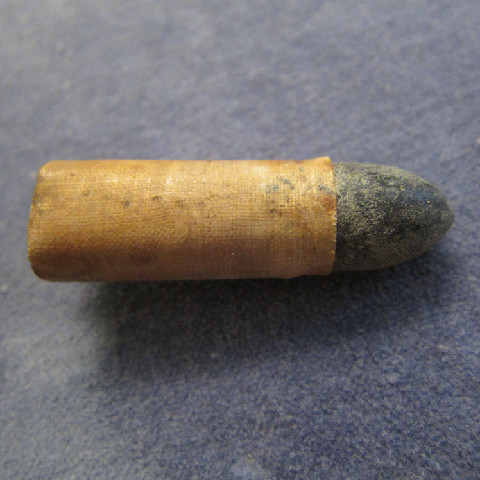
Early Cartridge Technologies: Linen Cartridges

A few weeks ago, we began to study an early form of cartridge: the paper cartridge. Where we left off, paper cartridges had advanced to the point where the paper was treated with chemicals to make it more combustible.

The main problems with paper cartridges are that they aren't very water resistant and the paper is somewhat fragile. As the bullet could be rather heavy, the weight of the bullet could cause the paper to tear as well. There was a need for a cartridge to be made of a more durable material and that's when the linen cartridge was born.

A .52 caliber linen cartridge for a Sharps rifle. Click on the image to enlarge.

In 1852, American inventor Christian Sharps invented a linen cartridge, to go with his Sharps rifle (which was earlier invented in 1848). The linen cartridge was a great improvement over the paper cartridge because it could withstand rough handling better, without breaking open. A linen cartridge also held its shape better than a paper cartridge could. The back of the linen cartridge had a piece of nitrated flash paper (which we studied in the last post) to provide the ignition. The linen used to make the cartridge body was treated with starch to make it stiffer. Linen cartridges were also treated with chemicals to make the linen more combustible, similar to that of paper cartridges that we studied earlier. Like the paper cartridges, the bullet was glued on top with sodium silicate glue.

For a while, cartridges were made for the Sharps rifle with both paper and linen, but the linen cartridge gradually started to find some backers. In the words of a Major W.A. Thornton:

"The making of Sharps Cartridges with paper must be abandoned and linen must be used in the formation of the cylinder. More care cannot be given in the making of cartridges than is bestowed in our laboratory. The fact is that the ball is too heavy for the paper, and worse than that -- the paper is sometimes softened by the lubric which causes it to break by the weight of the ball. From this date, I will make no more of paper, but I will make the powder cylinder of linen."

What the Major is describing are two flaws of the paper cartridges used by the Sharps rifles. The first is that the weight of the bullet is so great that a paper cartridge cannot hold its shape and often tears open by itself, due to the weight of the bullet. The second problem is that the lubricant (spelled in his letter as "lubric") also softens the paper and weakens it, thereby causing the paper to break. Since the lubricant is necessary to reduce the fouling inside the barrel, a stronger material must be used for the case body and this is why linen was used.

Linen cartridges were used by both the Sharps rifle and the Starr carbine during the Civil War.

In our next post, we will study another durable material that was also used to make cartridges during that period of time.


Monday, November 16, 2015

The Pencil Test

Imagine you're looking at a used pistol with an intent to purchase it. If it has been well used, chances are that some parts may be worn out or broken. One part, in particular, is the firing pin, which may be broken, bent, blunted etc. Another part of interest is the mainspring, which may have lost some of its strength. Or perhaps you stripped your pistol in order to clean it, and you aren't sure if you put it back together properly. There is a simple test to verify that the firing pin and mainspring are working satisfactorily and this test is the pencil test, which we will study about today. The only tool you'll need to conduct this test is a pencil with an eraser tip on one end:

A standard #2 size pencil. Click on the image to enlarge. Public domain image.

  1. First, make sure the pistol is empty.
  2. Cock the pistol, making sure that it is still empty.
  3. Insert a pencil with the eraser end first into the barrel and push it as far as it will go (do not force it, just push it in gently). For best results, use a new wooden pencil (such as a standard #2 size pencil, like the one pictured above), with the eraser in good condition
  4. Hold the pistol vertically, with the barrel end aimed upwards.
  5. Make sure that the pistol is indeed empty, then pull the trigger.
  6. If the firing pin and mainspring are working correctly, the pencil will move noticeably. In many pistols models, the pencil will actually come shooting out of the barrel. If the pencil doesn't move, or only moves weakly, there may be a problem with the firing pin or mainspring.
This test works on various pistol models, both hammer-fired and striker-fired types. Of course, the distance that it comes shooting out of the barrel depends on the model of pistol and also the wear and tear of the parts. For 1911 pistols in good condition, the pencil should come flying out and go at least a few feet up in the air. Glock pistols will also propel the pencil out a good amount of distance, but generally not as far as a 1911. Of course, the test also depends on the shape of the firing pin and the hardness of the eraser. For instance, in some models of M&P pistols, the firing pin may pierce the eraser instead of shooting it up. In such cases, if the pencil is put in with the unsharpened end in first, it may come flying out better. Alternatively, a plastic ballpoint pen, such as a Bic, may be used. In general, hammer fired pistols tend to propel the pencil out farther than striker fired models.

For pistols that are equipped with decocking levers (such as Sig Sauer, Ruger P95, Beretta M9 etc.), a similar test may be used to ensure that the decocking safety mechanism is working properly. As before, the pistol is cocked and the pencil is pushed in as before and the pistol is held vertically. Then, instead of pulling the trigger, the decocking lever is pushed instead. If the decocker is working correctly, the pencil should not move at all. If it moves, that means the decocker is not working properly and the firing pin is contacting the eraser.

Now on to some videos, so that you can see what it looks like.

The first video is from user Sadie Thorne on youtube and shows a quick test with a 1911 type pistol.


This video comes with no explanation, but shows the test very nicely. Notice how far the pencil comes flying out of the barrel, when the trigger is pulled.

The next video is by stdlfr11 and shows the same test done using a CZ-75 pistol.


This video has the user giving an explanation of the test, as it is being done. Note that while the pencil moves noticeably, it doesn't move as far as the one in the previous video. The reason for this becomes clear when the user pulls the pencil out as you can clearly see the indentation that the firing pin made on the eraser, which could explain why it didn't fly out as much. If the eraser had been harder or if the user had put the pencil in with the unsharpened end first, it would probably have flown out of the barrel much better. The test does show that the firing pin is functional and is not broken.

So there you have it, a simple test using a pencil ensures that the firing pin and mainspring are working satisfactorily.