Monday, April 18, 2011

History and Development of the Assault Rifle - V

In the last few posts, we have been studying the developments of the AK rifle family designed in the Soviet Union. In the next few posts, we will study the development of the M16 assault rifle in the US.

We start our study around 1948, right after the end of World War II. An official US Army historian, Colonel (later Brigadier General) S.L.A ("Slam") Marshall was beginning to study the effects of combat on men and eventually authored several books on the subject. One of the most well known books was titled Men Against Fire, in which he claimed that during World War II, when US soldiers who were engaged in direct combat, 75% of them never fired their weapon directly at an enemy even when they were in combat. Per his research, there appeared to be a deep reluctance to kill another human being even at the risk of being killed. While some of SLA Marshall's research methods and conclusions were questioned much later on, in the 1950s and 1960s, he could do no wrong and was regarded as the ultimate authority. Other studies by the US army showed that people armed with automatic weapons were more likely to fire them in combat, because they were less likely to think about the consequences of killing another human. Still other analysis by the US army determined that most infantry combat occurred at relatively close ranges and that the side with the most firepower tended to win most engagements. The number of casualties of the enemy was found to be directly proportional to the number of bullets fired.

All these studies pointed to the fact that infantry soldiers should be provided with automatic weapons. However, this meant that the soldiers would use up ammunition more rapidly and would need to carry more of it into combat. This meant that the size and weight of the ammunition would have to be reduced in order to avoid overburdening the soldier. A research team in the US Army's Aberdeen Proving Ground facility in Maryland, was tasked with researching the effects of smaller calibers. They found that a .223 caliber (5.56 mm.) bullet moving at higher velocities had the same effects as larger rifle rounds in many combat situations and requested further funding from the US military to perform more experiments.

At the time that the US army was experimenting with smaller calibers, a division of Fairchild Aviation called ArmaLite was formed in 1954, to investigate uses of new materials and new designs for the firearms industry. It was a very small company at that time and the ninth employee was a talented weapon designer and Marine, who had served during World War II, Mr. Eugene Stoner. They produced an innovative rifle for the 7.62x51 mm. NATO cartridge that was in use at that time, called the AR-10. The AR-10 had several new features that were later featured in the M16. It used a direct impingement gas-operated action, unlike other piston and cylinder driven firearms (such as the AK family) used at that time. The direct impingement action didn't have a moving piston and hence was lighter and easier to keep pointed on target, especially when firing in fully automatic mode. Another feature, which was borrowed from the German FG-42 and Johnson LMG was the idea of a straight-line stock (i.e. the rifle stock is in line with the barrel), which serves to reduce muzzle climb. Previously, rifles would have a bend in the stock, so that the sights would be at eye level, while the recoil could be transferred to the shoulder of the user. With the stock inline with the barrel, a lot of the muzzle climb is significantly reduced (read the article on muzzle-climb linked above for why) and therefore, Armalite increased the height of the sights to compensate and the rear sight was mounted as part of the carrying handle.  The receiver was hinged (a feature also found on the FN FAL), but unlike most other rifles, it was constructed of aluminum alloy, which made it lighter than other rifles of its class. The bolt locking mechanism was also innovative for its time. The AR-10 was much lighter, smaller and easier to control in automatic fire than any of its competitors. However, against the wishes of Eugene Stoner, the president of Armalite wanted the barrel to also be made of aluminum/steel composite, which made the rifle's barrel weaker. Hence, when they submitted it for army evaluation, it burst under a torture test and was rejected. Armalite quickly replaced the barrel with an all-steel model, but the damage was done and the US army rejected the rifle. However, the improved model was used by a number of other forces around the world.

Meanwhile, a US general named Willard Wyman received the funding request from the Aberdeen Proving Ground facility and he formed a team to develop .223 caliber (5.56 mm.) firearms for testing. The finalized requirement asked for a firearm capable of selective fire, to be under 6 pounds (2.7 kg.) when loaded with 20 rounds. The bullet had to penetrate a standard US steel helmet of that time period from 500 yards, while exceeding the wounding properties of a .30 carbine. General Wyman had also seen the AR-10 trials and was impressed by some of its innovative features, so he personally asked Armalite to design a weapon using the 5.56 mm. cartridge. The result was a scaled down AR-10 model called the AR-15:

AR-15 assault rifle. Click on image to enlarge. Public domain image.

The AR-15 entered the design competition and the weird thing was that it entered with very little competition, because the main competitor (Springfield Arms) did not feel like diverting resources because they wanted to concentrate on M14 production, which the US military was already using. The only other competitor was an entry from Winchester called the LMR.

During the testing, it was found that rainwater could accumulate in the AR-15's barrel (as well as in the Winchester's barrel), due to the smaller diameter and capillary action. When such a rifle was fired, it could cause the barrel and action to burst. See myth #3 for the reason why. History buffs may also like to read a declassified report of the issue. The rifle was not as accurate in arctic conditions either. However, its lightness and rate of fire meant that an 8 man team could have the same firepower as a 11 man team using the M14 rifle.

In the next post, we will look into the adoption of the AR-15 and how it morphed into the M16

Sunday, April 17, 2011

History and Development of the Assault Rifle - IV

In the last post, we studied the origins of the AK-47 and the beginning of the AKM. The AKM featured several improvements over the AK-47, mostly geared towards improving the production rate. In the initial AK-47 design, they had attempted to make the receiver out of stamped parts to speed up production, but the Soviets lacked the proper technology to do so and had issues with the resulting product. Hence, they resorted to machining the receiver from a block of metal, which was a slower process. However, in the 1950s, they used several captured German technicians to teach them metal stamping technology and hence the AKM featured a stamped receiver. Among the many improvements that the AKM had over the original AK-47:

  • Replacement of the milled receiver with a receiver made out of stamped sheet steel. Machining is a lot slower process than using a press to stamp parts. Hence, use of stamped parts made it much faster to produce AKMs.
  • Using rivets instead of welds on the receiver, in order to speed up production.
  • Improvements to barrel, gas ports etc. to speed up manufacturing and enhance reliability
  • Weight reduction of approximately 1 kg. (2.2. pounds)
  • Retains the chrome lined barrel and chamber of the AK-47 Type-2 variant, but the barrel is pressed and pinned to the receiver, instead of the AK-47 which has a threaded barrel that is screwed into the receiver.
  • The barrel is the first in the AK family to have a slant compensator to reduce rifle climb, when shooting in automatic mode.
  • Gas relief ports are moved forward to the gas block, instead of the gas tube.
  • Bolt carrier was lightened slightly. The wooden stocks were also hollowed out as well, in order to reduce more weight.
  • Sights on an AKM are calibrated to go up to 1000 meters, whereas AK-47s are only calibrated to go up to 800 meters.
  • Changes to the metal treatment applied. The AKM is parkerized instead of blued like the AK-47.
  • Uses modified spring and trigger assembly for better safety. The AKM fires in automatic mode only when the bolt is fully locked. The new trigger assembly also reduces "trigger bounce" and has a hammer release delay device to delay the release of the hammer by a few microseconds in automatic firing mode. The hammer release delay mechanism is sometimes incorrectly called a "rate reducer" by some people, but it doesn't appreciably change the cyclic rate of fire. Instead it allows the bolt group to settle in the forwardmost position after returning into the battery.
The Soviets made millions of AKMs and they weren't shy about handing out the plans to other co-operating countries, so that they could make their own as well. This is why AKMs are so widespread around the world.

AKM assault rifle. Click on image to enlarge. Public domain image.

The basic AKM design also has a number of variants. Some of these are:
  • AKMS - This is one of the commoner variants of the base AKM. The AKMS features a metal stock, which is foldable.
  • AKMP - This variation uses tritium front and rear sights for better visibility in low light conditions
  • AKML - This variant has a side mounting rail to mount a night vision device.
  • AKMLP - Same as AKML, but also has tritium sights as a backup.
  • AKMSP - Same as AKMS, but fitted with tritium sights
  • AKMSN and AKMSNP - Same as AKMS (i.e. foldable stock), but also has a side mounting rail to attach a night vision device. The AKMSNP version also has tritium sights.

Thursday, April 7, 2011

History and Development of the Assault Rifle - III

In this post, we will look at the history of one of the most famous assault rifles in history, the AK-47. The AK family is pretty widespread around the world these days, but there are widespread myths about its origins. The Soviet propaganda machine liked to portray that it was an original design entirely invented by a self-taught Russian peasant named Mikhail Kalashnikov. The real truth is actually somewhat different. We will study the history of this firearm in the following series of posts.


In the last post, we saw how the concept of the assault rifle was successfully used by the Germans. Their assault rifle was used against the Soviet Union with great success. The Soviets, in turn, analyzed some captured weapons and decided that it was a pretty good idea. Another major influence was the American M1 Garand rifle, which was also supplied to the Soviets in large quantities by the US and the Soviets decided that they must also have a reliable weapon that fires intermediate power cartridges. They quickly established a factory to manufacture 7.62x41 mm. ammunition, but needed a rifle to go with it. The initial requests for new rifle designs were sent to various Soviet bureaus in late 1943 and by the spring of 1944, at least ten designs were submitted by different groups. The Soviets adopted a design by one Mr. Sudayev and his design was called the AS-44. A limited run of the AS-44 was produced just after WW-II ended and the troops were generally happy with these weapons as they were better than what they had previously. However, the AS-44 was just too heavy and thus the Soviets opened another design competition in 1946.

Meanwhile, in a little known battle, called the Battle of Bryansk in 1942, a certain Russian T34 tank commander named Mikhail Kalashnikov was wounded in combat and made it to the hospital on foot, to receive medical treatment. During his recovery period, he vowed that he would make sure that his country would never be defeated again. While he was lying in bed, he overheard some other soldiers complaining about the quality of the Soviet rifles and his own experiences with the standard Soviet infantry rifles of that period also were similar. Hence, he began to design his own firearm, a sub-machine gun. While his sub-machine gun design was rejected because it was over-complex, his talents as a designer were noticed and he was reassigned to the Red Army's Small Arms Research division. Here, he designed a carbine, which was heavily influenced by the American M1 Garand  rifle's piston driven gas-operated system (if the reader looks at an AK, it uses a gas-operated system almost identical to the Garand, except that the AK has the gas tube mounted on top of the barrel whereas it is below the barrel in an M1 Garand.) While this carbine also was not successful, it was the basis of a new assault rifle that was submitted to the Soviet design competition of 1946, the AK-1 (otherwise known as the AK-46). There were 16 other competing designs originally, with the old AS-44 acting as the benchmark standard and after the first round of trials, the AK-46 was chosen along with entries by A.A. Demetyev (the AD-46 rifle) and F. Bulkin (AB-46 rifle). In the second round of trials, the AK-46 was actually rejected because it did not perform as well as its other rivals, but Mikhail Kalashnikov managed to pull enough strings in the selection committee to continue work on his design and submit a new entry for the next round of trials. He went back to the drawing board with his assistant, Alexandr Zaitsyev, and decided to incorporate design features from other weapons (including some from his competitors, the AB-46 and AD-46!). The design of the AK-46's gas operated systems was already heavily influenced by the M1 Garand and the idea of the long stroke piston attached to the bolt carrier and return spring design were lifted from the AB-46 and the idea of large clearances came from the AS-44 and the safety lever mechanism was from the John Browning designed Remington 8 etc.  The new design was dubbed the AK-47.

The other two designers were also given an opportunity to make design improvements for the next set of trials held in 1947. In the next round of trials, the F. Bulkin design (AB-47/TKB-415) was actually the most accurate of the three weapons and the AK-47 was last.  However, the AB-47 had issues with parts wearing out quickly and the AK-47 beat out the other two handily in tests for durability and reliability. The selection committee made the decision that it is better to have a not-so-accurate-but-durable-and-reliable firearm than wait for an indefinite period for an accurate-and-reliable weapon and hence the AK-47 was chosen over its two competitors. The first version of this was deployed to limited troops between 1947 and 1948.

Initially the design called for a stamped steel receiver pinned at the front, for quicker manufacturing time. However, Soviet machine technology was not advanced enough to do this reliably and there were a large number of rejected receivers. Hence, the decision was made to manufacture the receivers using various machining operations. This made the manufacturing processes slower, but at least they could make reliable receivers this way. Therefore the AK-47 Mark I featured a machined receiver.

Meanwhile, a designer named German A. Korobov began to make an improved assault rifle design himself. Korobov had actually submitted a bullpup assault rifle design (the TKB-408) for the original design competion of 1946, but it was rejected after the first round of testing. Nevertheless, he continued to experiment with other bullpup and traditional rifle designs. By 1952, he switched to using the lever-delayed blowback action invented by Hungarian designer, Paul Kiraly. This led to more accuracy and simpler production for his design. In 1955, the Soviets started another design competition and the improved Korobov design (TKB-517) was submitted to the competition.

Meanwhile, the AK guys were not sitting idle either. They recruited several captured German engineers, including the renowned Hugo Schmeisser (the designer of the StG44) and learned mass production techniques from them. Their new design submission for the 1955 competition was the AKM (AK Modernizirovanniy, the Russian word for "Modernized").

Believe it or not, the TKB-517 pretty much beat the AKM on almost all counts. It was more accurate (especially in full automatic mode), significantly lighter and about 1/3rd cheaper to manufacture. So why did the Soviets adopt the AKM then? Because the selection committee decided that since the troops were already familiar with the AK-47, it would not be a good idea to replace it with a firearm that uses an entirely new design. Hence, the less-reliable, but more familiar AKM beat out the more accurate, but new design, TKB-517.

In the next post, we will look at further developments of the AK-47.

Monday, March 21, 2011

History and Development of the Assault Rifle - II

When World War I started, the French introduced a light machine gun called the Chauchat. While it was capable of selecting both single and automatic firing modes, this firearm used full sized cartridges, unlike an assault rifle. It was also a notoriously unreliable weapon, because it did not function well under muddy conditions and jammed frequently because the slots cut into the magazine would let in dirt and mud. The .30-06 version also frequently jammed after a few shots once the gun became hot. In fact, it has the dubious distinction of being dubbed "worst machine gun ever" by several firearms experts. Still, it was not only used by the French, but also other allies such as Belgium and the United States. Captured Chauchats were even used by the Germans because they didn't have any comparable automatic firearms.

Chauchat Machine Gun. Click on image to enlarge.

Due to the Chauchat's unreliability under battlefield conditions, US troops turned to the redoubtable John Browning for help and he delivered the M1918 Browning Automatic Rifle (BAR) design in 1918. This weapon was introduced rather late in the war, but was very effective when it was used during this short time. The first time it was used was September 13th 1918 and one of the people demonstrating its use against the enemy was John Browning's son, Val Allen Browning.

Browning Automatic Rifle. Click on image to enlarge. Public domain image.

The BAR was so successful that the French ordered 15,000 of them to replace their own Chauchats! The BAR remained in production until the 1950s.

Note that both the Chauchat and BAR use full-size rifle cartridges. There were also automatic weapons designed during World War I, that used pistol ammunition. The most famous of these was the Thompson submachine gun, the so called "Tommy gun" that we studied about previously, when we studied the Blish lock mechanism. Both the Tommy gun and the BAR were designed rather late in the war though and the Tommy gun never saw action in World War I, but saw plenty of action in the hands of mobsters.

During the peace time period of World War I, several people argued for a new intermediate cartridge that was smaller than existing rifle cartridges, but bigger than pistol cartridges, and a suitable weapon to fire this new cartridge. The Swiss designer Furrer made an intermediate 7.65x35 cartridge for a carbine in 1921 and one Hauptmann Piderit of the German Rifle Testing Commission also advocated a shorter cartridge and a rifle to fire it. Colonel Fedorov, who we studied in the previous post, was also arguing for a smaller cartridge. There were also experiments made in Denmark and the US.

It was however, Germany, where some of the major new development took place. The Germans had observed that a small group of soldiers could easily overcome a larger group, provided that they had superior firepower. It was also observed that most infantry combat happened at less than 400 meters or so. By the 1930s, at least 5 German companies (Geco, DWM, RWS, Rheinmetall and Polte Patronenfabrik) were experimenting with intermediate rifle cartridges. It was Polte that was officially awarded the contract to design a new intermediate cartridge by the German military and after some experiments, came out with the 7.92x33 mm. "kurz" (German for "short") cartridge in 1938.

Contracts to design a new rifle for this cartridge were sent to both Walther and Haenel GmbH. Haenel's chief designer was Hugo Schmeisser and his design won out over the Walther design and was designated as the Maschinenkarabiner 1942 (after 1942, the year it was adopted) or MKb 42 for short. It underwent some minor design modifications, as requested by the German military. The Haenel design originally used an open bolt mechanism, but after a few trials, it was requested to make a closed bolt design similar to the Walther entry.

As it turned out, Adolf Hitler was strongly opposed to the new intermediate cartridge and demanded that more submachine guns be built instead. However, the German armament office secretly kept working on this new firearm and to avoid raising suspicions, they christened the weapon as MP 43 (MP = Machine Pistol). Hitler later asked for it to be renamed the MP 44, after some official tests in April 1944, unaware that it was not a machine pistol at all. In July 1944, Hitler held a conference with his generals on the Eastern Front and asked them what they needed most. A general who had no idea that the German armament office had disobeyed Hitler's orders, replied, "We want more of those new rifles!" and a thoroughly confused Hitler asked, "What new rifles?" and the cat was out of the bag. Some people thought they would be executed for disobeying Hitler's direct orders, but once Hitler was given a chance to test-fire the new MP 44 for himself, he became very impressed and enthusiastically gave it the name Sturmgewehr, which is German for "Storm (Assault) Rifle" ("Storm" as in storming a castle or assaulting a castle). This is where the term "Assault Rifle" comes from. Because of this new official name, the MP 44 was rechristened the StG 44.

Sturmgewehr 44 (StG 44), the first firearm to be called "Assault Rifle". Click on image to enlarge. Public domain image.

The StG 44 was heavily used in the Eastern Front and found extremely useful by soldiers. It was also very reliable in the extreme cold conditions of the Russian winter. It had a longer range than the Russian submachine guns, but a comparable rate of fire, switchable firing mode from single shot to full automatic mode, pretty decent accuracy and decent controllability even in fully automatic mode.

The StG 44 is now generally accepted as the world's first successful mass produced assault rifle. It was an encounter with one of these that prompted a Russian tank mechanic to invent his own assault rifle, which would later become one of the most famous designs world wide. But that is the subject of another article.

Saturday, March 19, 2011

History and Development of the Assault Rifle - I

In the next series of posts, we will study the evolution of the modern assault rifle.

First let us go back a few centuries in time and study how infantry warfare worked in the 1600s, 1700s and part of the 1800s. Back in those days, most firearms were smoothbore muskets, such as the famous Brown Bess, which was in service with the British military for over 100 years. Since muskets had no rifling, accuracy was somewhat limited. Also, since these firearms were muzzle loaders using mostly flintlock firing mechanisms, they were slow to load and use. Therefore the standard military strategy of the day was to line up three lines of troops  about 50-100 meters away from the enemy. The first line would fire their weapons and immediately retreat to the rear. The second line would then step forward and in turn discharge the weapons and then retreat to the rear and the third line would repeat the same process. Meanwhile, this would hopefully give the first line enough time to reload their firearms so they could fire another volley. Each line was coordinated by an officer so that all the men in one line would fire at approximately the same time. This strategy also maximized the firepower of the unit. Since the firearms weren't very accurate, it was hoped that the massed fire would hit at least some of the enemy troops. In fact, Colonel George Hanger of the British Army famously said, "A soldier's musket, if not exceedingly ill-bored (as many are), will strike a figure of a man at 80 yards; it may even at a hundred; but a soldier must be very unfortunate indeed who shall be wounded by a common musket at 150 yards, providing his antagonist aims at him; and as to firing at a man at 200 yards with a common musket, you may as well fire at the moon and have the same hope of hitting him. I do maintain and will prove…that no man was ever killed at 200 yards, by a common musket, by the person who aimed at him."

In the 1800s, with the advent of rifled firearms, massed fire tactics and tight formations began to fade away. As accuracy was improved, it was no longer practical for soldiers to fire at each other from standing positions over a plain. It took a while for military planners to realize that massed fire tactics were obsolete though, as can be witnessed by the huge casualties in the American Civil War, where men still shot at each other in tight formations at distances less than 100 yards apart. The final death knell of the massed formation strategy came in World War I, where the machine gun, trenches and artillery rendered this method obsolete. Instead, troops took pot shots at each other from longer ranges and from trenches.

In 1890, an Italian officer named Amerigo Cei-Rigotti invented an rifle, which was capable of selective fire (single shots or burst mode). The rifle was designed to fire 6.5x52 mm. ammunition from a detachable magazine. Incremental modifications were made to the rifle until 1900 before it was dropped from consideration. While this was the first real "assault" rifle, it wasn't very popular because it was extremely unreliable and had a very high rate of misfiring and jamming. That is why it was never adopted by any military anywhere.

The next development was the Fedorov Avtomat from Russia, in 1916. This particular firearm was developed by Vladimir Fedorov. This firearm was relatively lighter weight than other firearms of its time, had a large detachable magazine, had capability to switch firing mode from single shot to automatic mode and used an intermediate powered cartridge (smaller than a rifle cartridge, but larger than a pistol cartridge). The cartridge used for this was originally a custom designed 6.5 mm. cartridge, but it was later switched to use a 6.5x50 mm. Japanese designed Arisaka cartridge because it was available in quantity already. While this cartridge appears big compared to modern cartridges, remember that ammunition was not as powerful in those days, so it could be considered as an intermediate power cartridge. The Fedorov Avtomat was not produced in great numbers, but it was popular with Russian troops until World War II.

Federov avtomat assault rifle. Click on image to enlarge. Image is in the public domain.

The Fedorov Avtomat was influential because it was the first practical assault rifle that was adopted by a military anywhere. Incidentally, its inventor, Colonel Fedorov, also invented the concept of the infantry weapon family, where carbine, assault rifle, light machine gun, medium machine gun etc. would all share some commonality of parts (e.g.) action, receiver, trigger assembly etc.

Sunday, March 13, 2011

Utility Firearms: Line Throwing Gun

In maritime history, there have been several cases where a ship has foundered close to shore and no one could be rescued because a rescue rope could not be sent to the ship. Therefore, in the 1800s, work began in the development of tethered projectiles that could be used to pass a rope to a ship.

The same need is also encountered in civil engineering projects when one needs to pass a rope over a chasm.

Even though development had started in the early 1800s, the first practical development to solve this problem didn't happen until 1850, when Captain David A. Lyle, a West Point and MIT graduate, sat down to solve the problem. He designed a short barreled cannon using a custom designed shot and special waterproof braided linen line. The cannon was named the Lyle gun in his honor.

A Lyle gun in use. Click on image to enlarge. Public domain image.

The Lyle gun had a range of about 700 yards. It also had huge recoil and hence, it was mounted on a small cart. The Lyle gun stayed in use until 1952 and similar models were also made by several other companies.

While the Lyle gun was technically a cannon, there were other hand-held line throwing guns being made as well.
Click on image to enlarge. Public domain image.

The above image shows a gun made by the English gunmaker, W.W. Greener, capable of throwing a line about 150 yards or so.

William Schermuly, a British inventor of Dutch origin, came up with the idea of using rocket propulsion to toss the line, instead of using gunpowder. While his early experiments of 1897 just consisted of a rocket in a tube with a line attached to it, he began to work on a better device that could be small, light, accurate, have a long shelf life, safe and simple enough for a child to operate. In 1927, he came up with the concept of a rocket fired from a hand-held pistol, the SRPA (Schermuly Rocket Pistol Apparatus):

Click on image to enlarge.

This device had very little recoil, was not affected by cross-winds, weatherproof and the path of the rocket was visible so that people could easily correct their aim if needed. On top of that, it was light and simple enough that Schermuly got his 8-year old grandson to demonstrate its use to members of the British parliament.


By the time William Schermuly died in 1929, it became compulsory for any vessels over 500 tons to carry line throwers. The company was carried on by his sons and produced many other rocket based products, such as grappling hooks, rescue apparatus and flares during World War II.

Line throwing guns are still in use and they're still being made by some companies, such as Naval Gun Company Inc., which makes the official CG85 Bridger Line Throwing Gun Kit for the US Coast Guard.

H&R Bridger Line throwing gun made by the Naval Gun Company Inc. Click on image to enlarge.

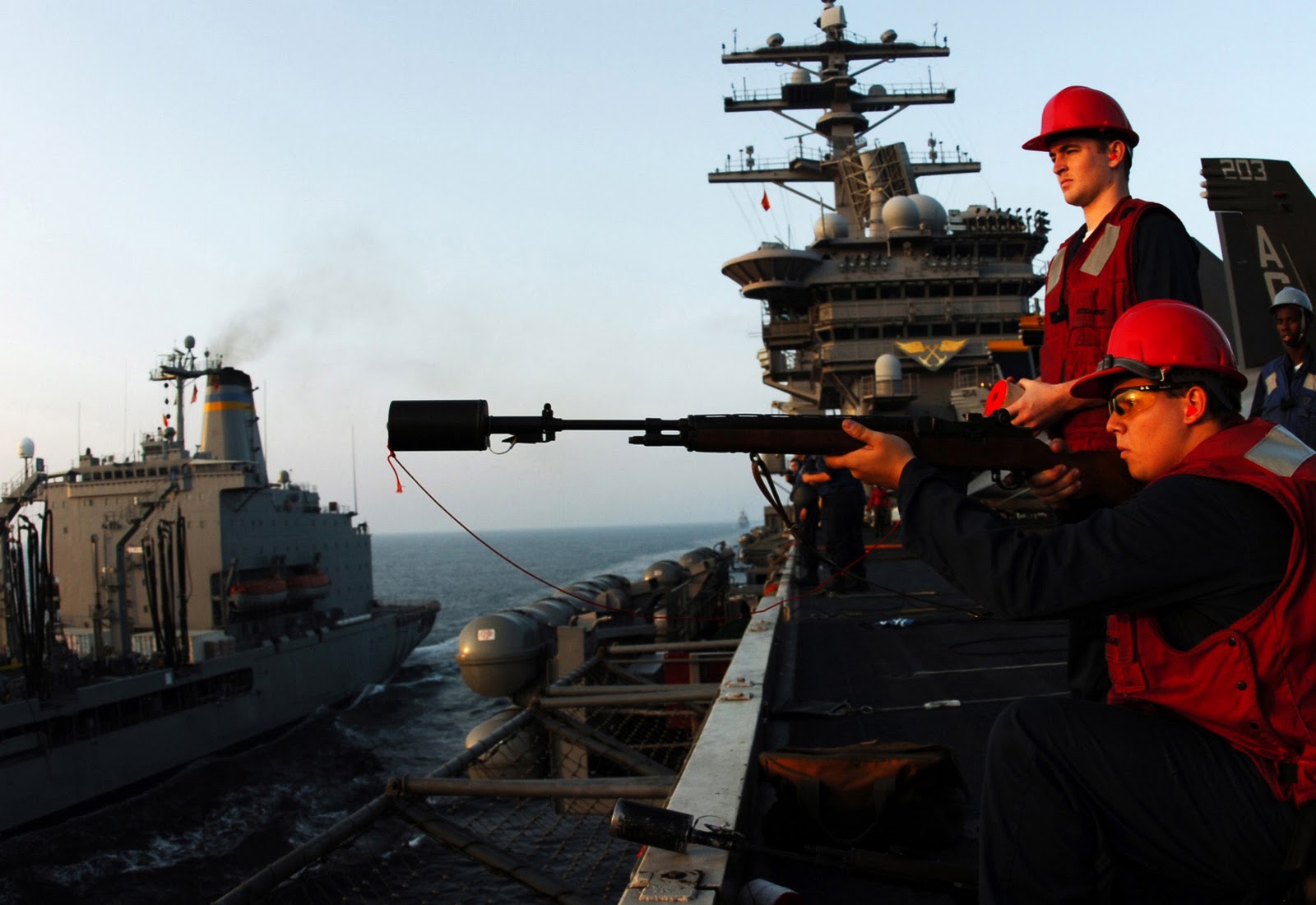
A US Navy sailor aboard the aircraft carrier USS Dwight D. Eiserhower prepares to shoot a line to USNS Tippecanoe. 
The line will be used to set up a bigger line and perform refueling and replenishment at sea.

Such apparatus are used by coast guard, navy, firefighters, construction companies, offshore drilling rigs, commercial fishing fleets, tugs, barges etc.

Utility Firearms: Drill Rifle

Many of us have watched military units performing rifle drills in parades. The USMC's Silent Drill platoon is one of the more well known units here in the US. How many of you know that the rifles they use are inert? That is the subject of today's post: the Drill Rifle.

A drill rifle is based on a normal rifle, but it has one key difference: it cannot actually be fired. So why make a firearm that cannot be fired? It can be used to train cadets on the use of a rifle, before they go out and fire the real thing. It can also be used safely for drill demonstrations. It cannot be used by a disgruntled cadet to take shots at a crowd or a chief guest (yes, this has happened in the past in some countries). In the UK, the Lee Enfield L59A1 Drill Rifle was specifically developed because there was some concern about the Army Cadet Corps and Combined Cadet Corps having their equipment stolen by the IRA.

Modifications from a standard rifle include clipping the firing pin short so that it can't impact a round in the chamber, welding the barrel shut, welding the striker hole in the bolt shut, welding the barrel to the receiver so that it can't be removed and fitted with another barrel, removing locking lugs, cutting part of the barrel internally, removing sights  etc.

The end result: a rifle that looks very close to the real thing, but is incapable of firing and needs a large number of modifications before it will ever come close to firing anything. The USMC Silent Drill platoon uses inert versions of the M1 Garand rifle and US Navy uses inert versions of the M1903A3 Springfield rifle for their drill purposes.