Sunday, June 21, 2015

Modern Pentathlon

In our last post, we studied the Biathlon, a winter sport that has shooting as one of the events. In today's post, we will study a summer sport, where shooting also plays a part. The sport we will study today is the Modern Pentathlon.

The Modern Pentathlon has its origins in the modern Olympic games. You see, in the ancient Olympic games, there used to be a sport called the Pentathlon, where athletes competed in running, long jump,  wrestling, throwing the javelin and throwing the discus. These five events were based on skills that were useful in battles of that era, therefore the athletes participating in this sport were considered very elite soldiers as well.

When the modern Olympic games started in 1896, the founder, Baron Pierre de Coubertin, wanted a similar event in the modern Olympic games. However, since warfare tactics had changed since the ancient Olympic games, his idea was  to create the modern Pentathlon, based on skills that were useful to a soldier of the late 19th century, specifically cavalry soldiers. He imagined a situation where a cavalry officer was trapped behind enemy lines and had to escape back to his own lines. To do so, a cavalry man must be able to run over a cross country course, swim, ride an unfamiliar horse through an obstacle course, fight with a sword and shoot with a pistol. The first modern pentathlon event was held in the 1912 Olympic games in Stockholm, Sweden.

Interestingly, for many years, the Olympic games were only open to amateur athletes. Why? Some people claim that this was because Baron de Coubertin thought that ancient Greek athletes were amateurs and wished to copy the same principle in the modern Olympics. This is not true, because it was a well known fact that the winners of ancient Olympic events were paid huge sums of money and were set up for life. The uncomfortable truth was that Baron Pierre de Coubertin was an aristocrat and a bit of a snob. At a time when most people worked hard for a living, it was generally the wealthy upper classes that could afford to devote training time to sports, as "amateurs". Working class people found it hard to compete in the highest levels of sport, because of the need to go to work all week. However, as sports became more popular and attendances to sporting events increased, some competitions began to award monetary prizes, which made it attractive for working class athletes to skip work and concentrate on sports full time. This led to the first professional sports people of that era (e.g. professional baseball players and professional soccer players played for factory teams, professional runners competed against horses etc.). Baron de Coubertin didn't like the idea of a lower class professional athlete beating the pants off an upper class "amateur" aristocrat. Therefore, he made the restriction that the Olympic games were only open to amateurs. Over the years, many countries made a mockery of this restriction (for instance, most sportsmen from the Soviet Union, East Germany, China etc. were amateurs only in name, because they were full time athletes with the state supporting them, while they were officially enlisted in the military and were therefore considered as "amateurs") and in the late 1970s, the Olympic games slowly started to allow professional athletes in some events (e.g. the "Dream team" in Basketball for the 1992 Olympics).

In the 1912 Olympic games, when the first modern pentathlon event was held, the amateur athlete rule was very much enforced. Only officers were allowed to compete in the event, not ordinary cavalry troopers. This was the case until the 1952 Olympic games, because ordinary cavalry troopers were considered as professional athletes, as they rode horses for a living! On the other hand, most cavalry officers of that era were from upper class backgrounds, and so they were considered "amateurs".

The athlete who participated in the modern pentathlon event in the 1912 games for the US, was a young Army cavalry officer named George S. Patton.

Olympic athlete and Army General,  George S. Patton. Click on the image to enlarge. Public domain image.

In case you think that name sounds familiar, yes, this same officer later rose to fame as one of the most famous generals in America!

Patton did pretty well in the Olympic games, finishing fifth in the overall events (the top four finishers were all Swedish. Sweden was the host country of the 1912 Olympics). Interestingly, the event he did the worst in was one of his stronger skills: shooting. He finished 21st in this event. However, there is some controversy associated with his performance in the shooting event. As it turns out, competitors were allowed to bring their own firearms and many of them chose .22 caliber pistols. Patton, on the other hand, brought a revolver chambered in .38 caliber. This was because the standard US military revolver of that era was the M1892 revolver chambered in .38 Long Colt (the .45 caliber Colt M1911 pistol had just been adopted the previous year and was not delivered in large numbers to the US military yet). Patton claimed that the first few shots from his .38 caliber bullets produced large holes on the paper and some of the later shots passed through these large holes and the judges decided that he'd missed the target completely and subtracted points from his score. If his claim is true, it was agreed that he would have received an Olympic medal. Nevertheless, the judges ruling was upheld and Patton accepted their decision as a sign of good sportsmanship. In modern times, the background behind the target moves, so that the judges can specifically track multiple shots through the same hole. Patton was also selected to represent the US in the 1916 Olympic games, but they were cancelled due to World War I.

These days, the modern pentathlon event has changed a bit. The shooting part was changed to use a small caliber air pistol and in 2009, they combined the shooting and running events, so athletes now have to run three 1000 meter laps, each prefaced by taking shots with a pistol until they successfully hit five targets. Once five targets have been hit, the athlete can resume running the next lap and so on. In 2011, the pistols were changed to use lasers instead of actual bullets, with an electronic device to provide a small delay between pulling the trigger and firing the laser, to simulate a pellet leaving the muzzle (the use of laser pistols instead of real pistols has created some controversy). Since 2013, the athletes shoot until they hit five targets and then run an 800 meter lap and repeat this four times. Unlike biathlons (which we studied in the previous post), athletes do not carry their pistols with them while they are running. Missed shots are not penalized and the only requirement is that the athlete should make five successful hits to the target before running again. The winner is the one that first crosses the finishing line.

The modern pentathlon is still considered part of the Olympic games (at least until 2020) and there are annual world championship events held as well.


Tuesday, June 9, 2015

Biathlon

A long while ago, we had studied a shooting sport called "silhouette shooting". A couple of years ago, we studied "clay pigeons", just before the London Olympics. As a theme, we will study sports where shooting plays a part, in the next few posts. Today,we will study the Biathlon, a sport that is played in cold weather and is part of the Winter Olympics.

The sport of biathlon is a mixture of cross-country skiing and rifle shooting. It has its origins in military exercises in Scandinavian countries, in the 18th and 19th centuries. Each competitor has to ski through a cross-country course, while carrying a rifle and a small amount of ammunition. At different stages of the course, the competitor has to stop at a shooting range and shoot five shots at targets, at a range of 50 meters (160 feet). There may be two or four shooting ranges throughout the course and half of these are shot at in the prone position and the other half in the standing position. The size of the targets depends on the position used to shoot them: prone position has targets of diameter 4.5 cm. (1.8 inches) and the standing position has targets of 11.5 cm. (4.5 inches). Depending on how many targets are left standing after five shots, extra penalties are given to each competitor. The penalty is in the form of extra time (1 minute per missed target) added to the competitor's time, or extra distance (150 meters (490 feet) per missed target) that the competitor must ski through. The winner is the one with the shortest time through the course.

In competitions between 1958 to 1965, high-powered military cartridges such as .30-06 Springfield and 7.62x51 mm. NATO were used, along with military rifles. After 1965, some competitors began to use smaller calibers and lighter rifles, and by 1978, the .22 LR cartridge was adopted as the standard. Separate contests in Norway still use large-caliber military rifles though.

These days, modern biathlon rifles are precision instruments, which are crafted to very high standards.

A modern Biathlon rifle. Click on the image to enlarge. Image courtesy of Eberlestock.

The rifle must weigh at least 3.5 kg. (7.7 lbs.) without ammunition and magazines. It must use .22 LR cartridges and magazines should contain 5 cartridges. Some events allow carrying 3 extra cartridges in the stock, which must be loaded manually, should the competitor miss some shots. The rifle must use bolt action or straight-pull bolt action and no automatic or semi-automatic rifles are allowed. The sights are manual peep sights and no telescopic sights are allowed. The rifle may have a flip up cap at the muzzle, which can be flipped to prevent snow and rain entering the barrel, while the competitor is skiing. The sling of the rifle may be attached to a cuff on the competitor's arm before shooting, to provide extra stability. The stock is lightweight and very adjustable to each competitor's requirements.

Each competitor carries the rifle, ammunition and magazines through the entire course. The rifles are only loaded at each shooting range and unloaded before leaving. In competitions before 1978, the target distances were much longer. Before 1966, each range would have a different distance to the target: 100 meters (330 feet), 150 meters (490 feet), 200 meters (660 feet) and 250 meters (820 feet). In 1966, the distance was reduced to 150 meters (490 feet) for all the ranges in the course. In 1978, the distance was further reduced to 50 meters (160 feet) for all ranges, which is the standard currently. Some competitions in Norway still use larger-caliber military rifles and longer distances to target, as per the original sport rules (with some competitions consisting of shooting various targets at unknown distances.)

Rifles are zeroed before the competition starts, but since it takes place outdoors, the wind and temperature may alter where the rifles shoot, and each competitor needs to adjust the sights accordingly. To make things even more complicated, since there are multiple shooting ranges through the course, a competitor might arrive at one range and find severe wind blowing, but travel to the next range and find no wind blowing there, all in the same course. Each shooting range has flags that flap in the wind, so a competitor can look at these and estimate how hard the wind is blowing and its direction and compensate accordingly.

As each missed shot counts as a penalty and adds more time to the competitor's total, it is vital to hit as many targets as possible at each shooting range. This is difficult to do after skiing through a long distance, as each competitor's heart is racing and lungs are pumping due to the exertion of skiing and the cold weather. The racing heart and aching muscles could cause the rifle to shake while aiming at the targets. Therefore, one of the strategies that many competitors use is to slow down as they are entering into each shooting range. This allows them to focus on controlling their breathing and relaxing their muscles a little, before they enter the range. A world-class competitor can enter a range, shoot all 5 targets and then leave in as little as 19-20 seconds or so.

There are still contests held in Norway, that use older standards (such as using military caliber cartridges, different distances to various targets, longer distances, carrying a military pack, skiing through trees etc.) These are true to the original purpose of the biathlon, which was to provide military training to people, for the purposes of national defense in times of war.

Here's a little video that explains the sport of biathlon for beginners. It appears that the person explaining stuff here is not entirely familiar with firearm terminologies, as she refers to clips instead of magazines and bullets instead of cartridges, but the video does explain the basics pretty well.


Happy viewing!

Saturday, June 6, 2015

Snubnose Revolvers a.k.a. Belly Guns

In today's post, we will look at a class of weapon called snubnose revolvers, also sometimes called "belly guns" or "snubbies".

A snubnose revolver is a handgun that is designed for self-defense at short distances. In general, the term is used to refer to any revolver with a barrel that is 3 inches long or shorter. They were designed to fulfill the requirement of a small repeating handgun that could be concealed easily and drawn out quickly. The term "belly gun" might have come about because many people carried these weapons concealed in the trouser waist band, close to the belly. Other think that they're called belly guns because of the method of use: placing the barrel into the belly of the opponent and pulling the trigger.

One of the early revolvers of the snubnose type was the Colt Shopkeeper Special model, which was based off the Colt M1877 Lightning model. This was a double action revolver designed for .38 Long Colt cartridge and the Shopkeeper Special model had a smaller barrel and no ejector rod, to keep the size compact.

A Colt Shopkeeper Special revolver. Click on the image to enlarge. Public domain image.

In those days, Colt revolvers were side-loaders. In 1894, Smith & Wesson invented a revolver where the cylinder is mounted on a crane which can swing outward for unloading or loading the revolver, with an attached push rod and star ejector to easily extract the cases. This design, along with the double action mechanism is what we see today in many modern revolvers.

In 1927, Colt introduced their Colt Detective Special revolver model. It was based on their Colt Police Positive Special model, which was a six-shot revolver designed to fire the .38 Special cartridge. The Colt Detective Special used the same frame and six-round cylinder as the Positive Special model, but had a small 2 inch barrel (or in some models, the barrel was 3 inches long).

A Colt Detective Special, courtesy of http://www.adamsguns.com/. Click on the image to enlarge.

The new weapon immediately found popularity among police detectives who were tasked with missions that required them to dress like civilians. Soon after this, Colt discovered that there were a number of people that wanted a small concealed weapon. Therefore, they started making other models as well. For instance, the Colt Banker's model was based on the earlier Colt Police Positive revolver. The Colt Police Positive was designed for smaller cartridges (.32 Colt and .38 S&W) than the Colt Police Positive Special (which took .38 Special) and the Colt Banker's model was designed for the smaller cartridge, with the reasoning that weaker bankers wouldn't be able to handle the recoil of a .38 special cartridge.

The nice thing about such small revolvers is that they are easy to carry around in a pocket or a purse and have repeating capability. Another reason that many people preferred these to the larger models was because of the speed that these could be pulled out. Anyone who has used a full sized revolver from a holster knows that the gun is relatively heavy and the long barrel has to be pulled clear of the holster before shooting. The snubnose equivalent is much easier to pull out from the same holster.

After cheap semi-automatic pistols started becoming widely available in the early 1980s, the popularity of these revolvers declined in the US, mainly because pistols hold much more ammunition that revolvers do. Then, in 1994, the Federal Assault Weapons Ban passed for 10 years, which limited the availability of pistol magazines holding more than 10 rounds and suddenly, the popularity of these snubnose revolvers increased again, until the ban expired in 2004.

There are some advantages to snubnose revolvers:

  1. Ability to conceal: These revolvers can easily be stored in a pocket or a purse. The curved grip is much easier to conceal than the straight grip of a semi-auto pistol and it doesn't look like a gun when placed inside a pocket.
  2. Easy to pull out: Due to its smaller weight and size, it is easier to pull one of these out of a holster than the equivalent full sized revolver model.
  3. Simplicity of use: It is much easier to teach someone to use a revolver than to use a semi-automatic pistol. Limp wristing is not a problem with revolvers, so even someone with a weak grip can use one. Revolvers are also less likely to malfunction than semi-automatics. If a revolver doesn't fire due to a bad cartridge, the procedure to clear it is to simply pull the trigger again. 
  4. Heavy Double Action trigger: We saw a few posts ago that double-action triggers are harder to pull when placed in double-action mode. Therefore, it is not likely to go off, if it gets snagged in clothing, which provides extra safety.
  5. Better at close quarters: Not only is it faster to pull a snubnose revolver out, the shorter barrel means that an attacker can't grab on to it and try to wrestle it away. Also, unlike a semi-automatic pistol, a revolver can't be easily knocked out of battery.
  6. Can fire different types of ammunition.
On the other hand, there are some disadvantages as well:
  1. Capacity: Most modern snubnose revolvers have a 5-round capacity, whereas even a pocket sized semi-automatic pistol carries 6+1 rounds. Of course, there are those that argue that 5 rounds is more than enough in most cases.
  2. Higher recoil: Because of the smaller size and weight, the felt recoil force is much more on a snubnose revolver.
  3. Sights: Due to shorter barrels, the distance between the front and rear sights is smaller and therefore the sight radius is short. The longer the sight radius, the more accurately a weapon can be aimed. 
  4. More time taken to reload a revolver.
Due to their shorter barrel lengths, snubnose revolvers are perceived to have less accuracy than weapons with longer barrels. This is not entirely true, as they can be used pretty effectively to about 20 meters (22 yards) by most people and some people can even hit torso-sized targets up to 50 meters (55 yards) away.

These days, Colt no longer manufactures snubnose models (such as Detective, Cobra or Python), but Smith & Wesson still makes snubnose models (e.g. Bodyguard, Model 19 etc.), as does Ruger (SP101 and LCR).


Sunday, May 31, 2015

Carrying Magazines "Jungle Style"

In today's post, we will study a method of configuring weapon magazines, which is popularly called "Jungle Style". We will see what this is all about.

Polish Soldier armed with an AKMS rifle. Click on the image to enlarge. Public domain image.

In the above image, we see a Polish soldier carrying an AKMS assault rifle. Notice that at the bottom of the rifle, there appears to be multiple magazines, which are held together by using some green tape. This is what carrying magazines "jungle style" is all about.

The reason for the name is that the practice of taping multiple magazines together originated with US forces in the Pacific campaign and fighting in the jungles. US soldiers who were armed with the M3 Grease gun and the Thompson Submachine gun (a.k.a Tommy gun) in the jungles of Asia, needed a way to quickly change magazines, especially since early Thompson submachine guns only came with 20-round magazines.

Some genius figured out that if multiple magazines were attached together with some sticky tape or rubber bands or clamps, the result is much easier and faster to change, as the new magazine is already attached to the old one. Since this technique was extensively used when fighting in thick jungles, this idea of taping magazines together began to be called "jungle-style" and the name stuck.

In the beginning, many soldiers improvised by tying two or more magazines together with rope, duct tape, rubber bands etc. So many American soldiers attached magazines together for their M1 carbines that the US military took notice and introduced the "T3-A1 Magazine Holder", which was a metal clamp that could hold two 30-round M1 magazines together, without any tape.

Later on, some companies (e.g. SIG, Heckler & Koch etc.) began to manufacture magazines with built in studs, so that multiple magazines could be stacked without using rubber bands or tape.

A SIG 550 magazine. Click on the image to enlarge.
Image licensed under the Creative Commons Attribution-Share Alike 2.0 France license by Rama

In the above image, we see a box magazine designed for the SIG 550 rifle. Note that the magazine has two protruding studs on the outside of the magazine. The other size of the magazine has two U-shaped slots to accept the studs. This design allows multiple magazines to be stacked side-by-side, without using any tape, twine, rubber bands or clamps.


Carrying magazines "jungle style" certainly helps speed up the reloading process, as the loaded magazines are attached to each other and can be easily swapped out.

On the other hand, they have a few disadvantages as well. For one, they alter the balance of a weapon. There is also an increased risk of weapon stoppages because while one magazine is inserted into the weapon, the other magazine lips are open and exposed to dirt and dust.


Friday, May 29, 2015

What is the difference between Single Action, Double Action Only and Double Action/Single Action

In our last post, we studied the differences between hammer fired and striker fired weapons. In today's post, we will study a related topic, the difference between Single Action (otherwise called SA), Double Action Only (otherwise called DAO) and Double Action/Single action (otherwise called DA/SA or SA/DA). 

The differences between these three has to do with what happens when you pull the trigger of the weapon.

In a single action weapon, only one thing happens when you pull the trigger: it releases the hammer or striker to fire the weapon. This mechanism was used by early revolvers, such as the Colt Paterson, Walker Colt, Colt Single Action Army (a.k.a. the Peacemaker) revolver etc. and is still used by many modern rifles, shotguns and semi-automatic pistols.

Colt Single Action Army revolver. Click on the image to enlarge. Public domain image.

To fire a weapon like the example above, the user first cocks the hammer by pulling on the spur at the back of the hammer with the thumb, until it locks into position. Then, when the user pulls the trigger, it releases the hammer, which then falls back down towards the cylinder with considerable force, due to a spring connected to the hammer, and thereby fires the weapon. If the hammer is already down, then pulling the trigger does nothing. To fire another round with this revolver, the user needs to re-cock the hammer back again before pulling the trigger. The key thing to note with single actions is that if the hammer (or striker) is down, then pulling the trigger does nothing.


The above video from hickok45 shows a Colt single action revolver being used. Notice how he pulls back the hammer before every shot, to cock it. Also note that the act of pulling back the hammer also rotates the cylinder to bring the next cartridge under the hammer. The user cannot fire this weapon by only pulling on the trigger.

Some semi-automatic pistols like the Colt M1911 and Springfield XD are also single action weapons. The Colt M1911 is hammer fired and the Springfield XD is striker fired, but they are both single action.
In such weapons, the user first inserts the magazine and then either pulls back the hammer manually with the thumb, or racks the slide, which chambers the first round and also cocks the hammer or striker. When the trigger is pulled, it releases the hammer or striker, which fires the weapon. Then, the weapon uses some of the recoil energy to move the bolt and slide backwards, which ejects the old cartridge, loads a new cartridge from the magazine and most importantly, it also cocks the hammer or striker automatically, so the user doesn't need to do that again manually. Then, all the user has to do to fire another shot is to pull the trigger again, as the weapon is already cocked and so on, until the weapon is empty. However, if the user decides to lower the cocked hammer (or striker) manually (some weapons have a special decocking lever to do this), then pulling on the trigger after this will do nothing, because a single action weapon only does something if the hammer or striker is cocked first. Therefore, to resume firing again, the user has to pull back the hammer manually once, before pulling the trigger.

Most modern rifles and shotguns are also single action.

Since the weapon is already cocked, the trigger pull force required to discharge it is typically small and a force of around 3 to 4.5 lbs. (about 1.3 - 2 kg.) is enough to release the hammer or striker.

With a Double Action Only (DAO) weapon, pulling the trigger does two things: it first pulls the hammer (or striker) back to cock it and then pulling the trigger further releases the hammer or striker. Therefore, two actions happen on the same trigger pull, which is why it is called double action. The force required to operate the trigger is much higher than single action weapons, typically about 10 to 12 lbs. (about 4.5 to 5.5 kg.). This is because the trigger has to cock the hammer or striker against spring pressure and more force is required to do this.

The first example of a double action only weapon was the Adams revolver invented in 1851.

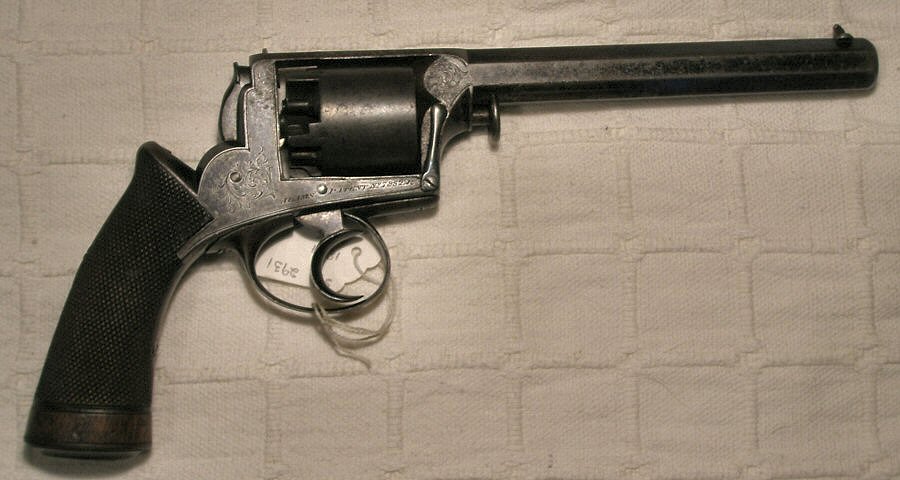
An Adams revolver. Click on the image to enlarge.

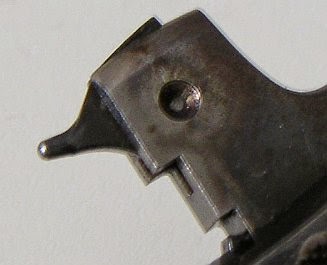
Note that the Adams revolver has no spur on the hammer, therefore the user cannot pull it back with the thumb. The good news is that the missing spur means that it cannot get snagged by accident on anything and it is also possible to fire this revolver much faster than the Colt single action revolver, since there is no need to cock it each time before pulling the trigger. The bad news is that the trigger is harder to pull and due to the larger force needed, there is a tendency to shake the revolver when pulling the trigger, which makes it less accurate.

Some modern day semi-automatic weapons and revolvers still use a DAO action, Examples include the SIG P250 pistol, the Ruger SP101 revolver, the Taurus 24/7 pistol, Smith & Wesson Bodyguard revolver etc.


Notice how there is no spur at the back of this revolver, so the only way to cock this weapon is to pull the trigger. At around 1:00 of the video, you can clearly see the hammer being moved backwards initially as the trigger is being pulled and then released as the trigger is pulled further along.

From all the above, we see that double action weapons only need one trigger pull to both cock and fire the weapon, thereby being faster to fire, but they need more pull force on the trigger than single action weapons, which leads to the weapon shaking more when the trigger is pulled. Therefore, there is another alternative, which combines the best of both: the double action/single action also known as DA/SA, single action/double action or SA/DA.

With a double action/single action firearm, it can be fired in both modes. One of the first examples of this was the Beaumont-Adams revolver, which was invented in 1865 by Lieutenant Fredrick Beaumont of the British Army. He was a veteran of the Crimean war and had used the Double Action Only Adams revolver there. After the war, he decided he was going to improve the Adams design and invented his revolver.

A Beaumont-Adams reovlver Click on the image to enlarge. Public domain image.

With this design, the user has two options. When the hammer is down, the user can pull the trigger, which cocks the hammer and then releases it, just like a double action only revolver. Doing this takes more trigger pull force, as expected. The user also has the option to cock the hammer by pulling the spur at the back of the hammer, just like a single action weapon. In this case, there is less force required to pull the trigger, as the hammer is already cocked,

A DA/SA weapon combines the best features of both the single action and the double action weapons and gives the user a choice of which mode to fire the weapon with. Some modern weapons that use this system include the Beretta M9 pistol, which is the standard sidearm of the US military, the Colt Python revolver, SIG Sauer P-220 pistol, the Heckler & Koch USP pistol, the Czech CZ 75 pistol etc.

Heckler & Koch USP pistol. Click on the image to enlarge.
Image licensed under the Creative Commons Attribution-Share Alike 3.0 license by Miroslav Pragl

When the trigger is pulled with the hammer down, it requires a force of something like 10.5 lbs (4.5 kg.) to discharge the firearm, but if the hammer is already cocked, it requires a force of only about 4.5 lbs (2 kg.) to do it.

With a semi-automatic weapon like the pistol above, if the weapon is not cocked after the magazine is loaded, the first trigger pull will be heavier, since it has to cock the weapon first. But after the first cartridge is fired, the weapon uses some of the recoil force to cock itself automatically, which means the subsequent trigger pulls do not require as much force. The user can also cock the hammer manually using the thumb to pull it back, or cock it by pulling back on the slide, in which case the first trigger pull will be lighter since the weapon is already cocked. Many pistols also have a de-cocking lever to safely lower the hammer back down to double-action mode.

Some people like to carry the weapon de-cocked, because the first trigger pull needs much more force and therefore, it is less likely to be pulled accidentally when the user is carrying the weapon in a holster. Other people find the fact that the first pull needs more force than the others a little confusing, so they carry the weapon cocked and enable the weapon safety devices instead.

Finally, we have some weapons that cannot be exactly classified as either double-action or single-action. Examples of this would be Glock and Kahr pistols. As we saw in our previous post, which showed an animated image of a Glock pistol in action, when the slide is pulled back, it pulls the striker back and locks it at an intermediate position where the spring is only at partial tension. Pulling on the trigger pulls the striker back first (so the spring reaches full tension) before releasing the striker, much like a double action weapon does. However, unlike a double action weapon, if the striker is not cocked at the intermediate position first, pulling on the trigger does nothing (behaving exactly like a single action weapon).

A Glock 17 pistol. Click on the image to enlarge.

As you have probably already guessed, the trigger pull force for a weapon like this is between that needed for a single action and a double action weapon. For instance, a standard Glock trigger requires about 5.5 lbs (2.5 kg.) to operate it and a Smith & Wesson M&P needs about 6.5 lbs (2.95 kg.).

The video below contains some good examples that show the differences between the various mechanisms:


Happy viewing!


Monday, May 25, 2015

Hammer Fired vs. Striker Fired

In the world of modern firearms which use centerfire cartridges, there are two major types of mechanisms used to trigger the cartridge primer. One uses a hammer and another uses a striker. Therefore, mechanisms that use a hammer are called hammer-fired and the ones that use a striker are called striker fired. As you can guess, each mechanism has its own group of supporters. In today's post, we will study what this all means.

In a hammer fired mechanism, the hammer is a heavy piece that is allowed to rotate about a pivot point. When the hammer is cocked, it compresses a spring. When the trigger is released, the spring pushes the hammer and forces it to rotate forward. The end of the hammer strikes the back end of a firing pin, which is a thin steel pin with a hardened tip. The front end of the firing pin strikes the primer of the cartridge, thereby detonating it. The image below shows how this works.


In some revolvers, the firing pin is attached to the hammer directly.

Firing pin attached to the hammer of a Smith & Wesson Model 13 revolver.
Image licensed under Creative Commons Attribution-Share Alike 3.0 Unported license.

In either case, the key part of the mechanism is a rotating hammer mechanism. Here's another animation showing the same concept.

The main thing that we conclude after looking at all the images above is that a hammer-fired weapon is a rotating type mechanism.

In contrast to this, striker fired systems operate in linear fashion. The striker is a part that is a bit heavier than a firing pin and it is directly connected to a spring. When the firearm is cocked, the striker is moved against a linear spring and held in position. When the trigger is released, the spring forces the striker forward with enough energy to detonate the primer upon impact. The animated image below shows how this works.


The striker is the long part in the back of the gun that looks like this:


It should be noted that the animation example for a striker fired weapon shows the firing mechanism of a Glock pistol. When a Glock is cocked, the striker is moved back and held under partial spring compression by the trigger mechanism and safety devices. As the trigger is pulled, the striker is initially pulled back till the spring reaches full compression and then the striker is released. In other pistol models, such as Springfield XD or Smith & Wesson M&P models, the striker is already held at full spring pressure when it is cocked. Pulling the trigger in such firearms merely releases the striker and allows it to fly forward

From the above images, we see that hammer fired mechanisms use a rotational force to detonate the primer, whereas striker fired mechanisms use a linear force to do it.

Striker fired mechanisms tend to have fewer parts than hammer fired mechanisms and are therefore simpler. However, they take up a bit more room. This is why firearms that don't have bolts, such as revolvers, use a hammer-fired action. Revolver and many types of single-shot action firearms generally don't have the room to accommodate a striker mechanism.

Strikers are commonly found in many modern semi-automatic pistols, bolt action weapons and shotguns. In fact, the first striker fired weapon invented was a shotgun invented by Daniel LeFever in 1878. Another example of a striker fired weapon is the Czech vz.58, which we studied earlier (contrast this with the similar looking AKM rifle, which uses a hammer fired mechanism). Striker fired pistols started becoming popular in the 1980s, when Glock started using them on their pistols. However, it must be noted that Glock weren't the first to use it on pistols either: John Browing used it in the .25 caliber Model N pistol and the H&K P7 is striker fired as well. Nevertheless, once Glock started becoming popular, other manufacturers also started using the same idea on a larger scale and now you have several pistol models, such as Smith & Wesson M&P, Springfield XD, Ruger SR9 etc. However, there are some famous pistol models that use a hammer fired mechanism instead. Examples include the Colt M1911, Browning Hi-Power, Beretta M9 etc.

A striker fired mechanism doesn't have an exposed hammer, so it cannot get caught in clothing, shrubs etc. The fact that it has fewer parts means easier maintenance as well. Another positive is that it has a consistent trigger pull for every shot (in contrast to double action/single action hammer fired mechanisms, where the trigger pull force is different depending on whether the firearm is working in single action mode or double action mode). Striker fired mechanisms generally have a consistent trigger reset as well.

On the other hand, if there is a malfunction on a striker fired weapon because the primer didn't detonate, the only option is to eject the cartridge and try the next one. With a hammer fired firearm, it may be possible to try again on the same cartridge (on models that provide this second-strike capability). Hammer fired guns also generally impact primers harder than strikers do, thereby giving a better chance to detonate them. It is for these reasons that many military forces prefer hammer fired weapons. For example, the US military's choices of weapons: Colt M1911 pistol, Beretta M9 pistol, M1 Garand, M14 rifle, M16 rifle, M4 carbine etc. are all hammer-fired.

The video below shows some of the advantages and disadvantages of each system:


As you can see, each mechanism has its own group of fans that argue about which is better. Happy viewing.

Thursday, May 7, 2015

Weapons of Pirates

In our last post about Queen Anne pistols, we mentioned that they were carried by some pirates, notably the famous pirate captain, Edward Teach, better known to the world as "Blackbeard". In today's post, we will study the world of the pirates and the weapons they carried.

First, pirates have been around practically since man learned to build boats. Pirates have been mentioned in ancient Babylonian and Egyptian texts dating back to 1400 BC. The Greeks and Romans battled pirates in the Mediterranean sea. In fact, the word "pirate" is from the Greek word, pieraomai which means "attempt" (i.e. "attempt to rob for personal gain"), which morphed to the Greek word pierates which means "bandit" or "brigand", from which we get the Latin word pirata, from which we get the English word "pirate".  In the middle ages, the Vikings roamed the northern seas, but also sailed as far south as North Africa and Italy and sailed up rivers all the way up to the Black sea. The South China sea and the area between Malaysia and the Indonesian islands have had incidents of piracy since about 900 AD. In modern times, we have pirates off the coast of Somalia and in the strait of Malacca.

However, we will concentrate mainly on the weapons used by pirates during the so-called "Golden Age of Piracy", which happened around 1650-1730 AD. This was around the time that various European powers were competing with each other to build colonies and trade routes around the world. During this time, several notorious pirates were based off the Caribbean islands, but there were others who sailed around the coast of Africa and even as far as India. In fact, the biggest robbery ever made during the Golden Age of Piracy was by English pirate Henry Every (also called Henry Avery or Long Ben Every), who captured a couple of the Indian Mughal emperor Aurangzeb's ships in the Arabian sea, sailing back from Mecca to India loaded with jewels. With this single act of piracy, Henry Every became the richest pirate captain in the world, but he is not as well known as other pirates such as Blackbeard, Calico Jack Rackham, Bartholomew Roberts (a.k.a Black Bart), Henry Morgan, Captain Kidd etc. We will study the weapons used by pirates living in this era. By the way, not all pirates were English. Many were Dutch, French, Spanish, Portuguese, Danish, Swedish, Irish, Scottish, Welsh, German, American, Italian, Moors, Algerians, Africans, Turks, Arabs, Native Americans, Chinese, Malays etc.

It may come as a surprise to readers to find out that during the Golden Age of Piracy, many pirate ships actually operated more democratically than most countries. Every man on board a pirate ship had an equal vote and the pirate captain was elected by the members of the ship. If the pirate captain didn't perform his duties well, he could be voted out of his position as well. The quartermaster was also voted into power by the crew. One more interesting thing was that the pirate captain only commanded the ship when they were in combat. If they were not in combat, it was the quartermaster and not the captain, that decided where the ship would sail next. Pirate crews were generally promoted based on merit (unlike European navies, where most officers bought their positions). Pirates also came from different countries, races and religions, but they all had an equal right to vote and an equal share of the treasure. At a time where most people worked as slaves or as indentured servants, pirates actually signed work contracts when they joined a pirate ship. The contracts specified how much share of the plunder each man would receive (skilled sailors received more than unskilled men, as did specialized jobs such as captain, quartermaster, carpenter, surgeon, navigator, boatswain, gunner etc.), compensation to be paid in case a man was injured  or killed while performing his duties (workman's injury compensation in the 17th century!), how prizes were to be divided, awarding of bonuses for good work, the rules of conduct expected of each man and the penalties that would occur, if a man was to break the rules.

In many Hollywood movies, we see pirates fighting each other with sabers and showing some real fancy sword fighting skills. And while pirate ships are approaching merchant ships, they engage in heavy gun battles with cannons until the pirates can swing over to the other ship on ropes. So, is what we see in Hollywood movies really how pirates fought? The answers are very different.

Some of the laws and rules followed by pirates have been recorded by historians. From the contract signed by pirates who sailed under Bartholomew Roberts, we have the following section:

Article V - Every man shall keep his piece, pistols and cutlass at all times, clean and ready for action.

So what does the above sentence mean, particularly the three words in bold font? It gives us a clue as to what weapons pirates actually used. Notice that the cutlass (a short sword) comes third in the list, while "piece" is listed first. We will see what this means in the next few paragraphs.

First, let's deal with the question of swords. Pirate ships and merchant ships were very crowded at all times, with boxes and ropes all over the deck. Therefore a long sword was usually not very useful in combat aboard a ship, because there was usually no room to swing a long sword properly. Secondly, it takes a long time to train a person to use a sword well and only members of the aristocracy could afford to take sword fighting lessons (i.e. fencing lessons). Only a rich person could afford to buy a high quality long sword anyway. Third, long swords are heavy and can make a man tired much more quickly. Therefore, real pirates usually carried a short sword, such as a cutlass, which was much more suitable for fighting in close quarters. Alternatively, they carried axes or knives, since both were cheaper than swords and could also be used well in crowded spaces. However, none of these bladed weapons were usually their first choice of weapon either.

Now let's talk about cannon on ships. Most pirate ships were relatively small and could therefore carry small cannon only. Pirates would usually try to capture ships with as little damage as possible, so that they could take the captured ship and its supplies for themselves. So when they fired cannon at merchant ships, they usually fired small caliber shot to try and disable the crew, or fired chain shot to try and destroy some of the sails, to slow the ship down. They would also shoot warning shots away from the target, to try to get the merchant ships to surrender quietly. They usually never shot large solid cannon balls directly at ships, because this could cause the ship to sink before they captured it. If possible, pirates preferred to capture ships as undamaged as possible, so that they could use them in their own fleets.

Now let's talk about the word "piece" that we saw earlier. The word "piece" refers to a "fowling piece" or a "hunting piece", i.e. a musket used for hunting birds and animals. In general, a "piece" in pirate language, could refer to any long arm, whether musket, rifle, arquebus or blunderbuss. These were usually the first weapon of choice for pirates.

The musket was generally available to the common man during the Golden Age of Piracy era, so it was pretty easy for pirates to get their hands on them. A well trained pirate crew could injure or kill several defenders from longer ranges, so that there would be less resistance by the time they boarded the ship. They would target officers, sailors operating the sails and those near the gun ports. Well aimed musket fire in volleys could inflict maximum damage to their opposition, without sinking their ship, which is why pirates preferred using muskets to cannon.

A typical flintlock musket. Click on the image to enlarge. Public domain image.

These muskets were originally designed to hunt bird and animals and were pretty sturdy, with long heavy barrels. While many of them were originally smoothbore, they were still capable of relatively accurate fire. Pirates would sometimes load them with one larger ball about the size of the barrel bore and two smaller balls about half the bore size. This was done to increase the probability of hitting the target. Successful pirate crews carried multiple muskets for each pirate, up to four or five per pirate, and they would all be loaded and ready to go, as they approached their prey. This allowed the pirates to keep shooting rapidly at their prey as they approached it. They would also work in teams, where one pirate would fire muskets, while the other pirates would reload them.

The musketoon is a shorter barreled version of the musket and were more preferred, because they were easier to handle in confined spaces, such as those found on ships. Some musketoons had flared barrels like the next weapon, the blunderbuss, although the blunderbuss was generally even shorter.

A Blunderbuss. Note the flared muzzle.

The original term for this weapon was donderbuss and this name appears to be Dutch. The word "donder" means "thunder" and "buss" means "pipe" in Dutch and German languages. They were generally made with brass or bronze barrels, since these resisted corrosion from seawater better than iron barrels. The flared muzzle allowed the user to quickly pour powder and shot down the barrel and load the weapon easier on a moving platform. Pirates would load blunderbusses with multiple shot pellets, scrap nails, rocks etc., and use them at closer ranges. On a crowded deck, a single shot could disable a group of enemies, so they were used to clear a path so that the pirates could board.

As they boarded their enemy's ship, pirates often carried multiple pistols with them. Many of these were single shot flintlock models and quite a few of them were built with flared barrels like a blunderbuss. to enable quicker reloading.


These pistols often had decorations around the muzzle that looked like a dragon's mouth and hence, these pistols were called "dragons". Military troops that carried such pistols were called "dragoons" and the pistols were then referred to as "dragoon pistols".

There were also general purpose flintlock pistols that many pirates carried, as these were also easily available.

A typical British flintlock pistol designed for naval service. Click on the image to enlarge. Public domain image.

In addition to these, some pirates also carried Queen Anne pistols, which we saw in the previous post. This is because Queen Anne pistols were designed to hold the ball inside the barrel without any wadding and there was much less risk of the ball or powder falling out of the pistol.

These pistols were used practically at point-blank range. Since they were all single shot models, pirates usually carried several of them, either tied around their necks with short pieces of rope, or tucked into a belt. The butt of the pistol handle was often a heavy brass plate (as the two examples above show), so after the pistol was fired, the user could turn it around and use it as a club.

In some cases, they would carry multi-barrel pistols. Some of these were just pistols with multiple barrels and separate triggers to fire each barrel separately. Other models featured a single trigger and multiple barrels that could be turned into position as needed.

A pistol with two separate barrels, two flintlocks and two triggers. Click on the image to enlarge.

An over under pistol with two barrels, two pans, but a single flintlock and single trigger. Each barrel was rotated into position by hand and then fired.

There were also volley fire weapons that could fire multiple pellets in different directions simultaneously, so as to spread the damage with a single shot. An example of such a pistol is shown below.

A duckfoot pistol. Click on the image to enlarge. Public domain image.

The example shown above is a duckfoot pistol using a flintlock firing mechanism. It is called a "duckfoot" because it resembles the foot of a duck. In general, multi-barrel pistols were less reliable than single barrel pistols and therefore, they were not frequently used.

Finally, there was the pirate short sword, the cutlass. This was usually the third weapon of choice and pirates usually didn't use them unless they really needed to. Forget the long drawn out sword battles shown in Hollywood movies, real pirates kept the fighting time down to a minimum. Real pirates would carry a cutlass with one hand and a pistol with the other. The cutlass would be used to block the opponents sword, while the pirate's other hand would fire the pistol at point-blank range. Sometimes, the pirate would use a combination weapon that combined a cutlass and pistol together.

A combination of cutlass and pistol. Click on the image to enlarge.

This allowed the pirate to both shoot and cut with a single arm, while the other arm could carry another pistol or a grenade or some such object.

Besides these three weapons, pirates often carried axes, knives, grenades, stink pots etc. However, most pirates preferred using (in order of preference): long guns (such as muskets, rifles and arquebuses), close range powerful shotgun type weapons (musketoons, blunderbusses), pistols and finally swords, axes and knives. Therefore, the Hollywood myth of pirates preferring to use swords and fighting long duels on decks with swords is completely false. They preferred using firearms to bladed weapons.

Now, let us look at a curious paragraph in the contracts signed by pirates that sailed with the pirate captains Edward Low and George Lowther around 1720 AD.

Article VIII - He that sees a sail first, shall have the best Pistol or Small Arm aboard of her.

As you can see, the contract clearly states that the first pirate to see the sail of a merchant ship, would be rewarded with the best firearm found on the captured ship, not the best sword. Therefore, they clearly valued firearms more than swords.