Showing posts with label double action. Show all posts

Friday, May 29, 2015

What is the difference between Single Action, Double Action Only and Double Action/Single Action

In our last post, we studied the differences between hammer fired and striker fired weapons. In today's post, we will study a related topic, the difference between Single Action (otherwise called SA), Double Action Only (otherwise called DAO) and Double Action/Single action (otherwise called DA/SA or SA/DA). 

The differences between these three has to do with what happens when you pull the trigger of the weapon.

In a single action weapon, only one thing happens when you pull the trigger: it releases the hammer or striker to fire the weapon. This mechanism was used by early revolvers, such as the Colt Paterson, Walker Colt, Colt Single Action Army (a.k.a. the Peacemaker) revolver etc. and is still used by many modern rifles, shotguns and semi-automatic pistols.

Colt Single Action Army revolver. Click on the image to enlarge. Public domain image.

To fire a weapon like the example above, the user first cocks the hammer by pulling on the spur at the back of the hammer with the thumb, until it locks into position. Then, when the user pulls the trigger, it releases the hammer, which then falls back down towards the cylinder with considerable force, due to a spring connected to the hammer, and thereby fires the weapon. If the hammer is already down, then pulling the trigger does nothing. To fire another round with this revolver, the user needs to re-cock the hammer back again before pulling the trigger. The key thing to note with single actions is that if the hammer (or striker) is down, then pulling the trigger does nothing.


The above video from hickok45 shows a Colt single action revolver being used. Notice how he pulls back the hammer before every shot, to cock it. Also note that the act of pulling back the hammer also rotates the cylinder to bring the next cartridge under the hammer. The user cannot fire this weapon by only pulling on the trigger.

Some semi-automatic pistols like the Colt M1911 and Springfield XD are also single action weapons. The Colt M1911 is hammer fired and the Springfield XD is striker fired, but they are both single action.
In such weapons, the user first inserts the magazine and then either pulls back the hammer manually with the thumb, or racks the slide, which chambers the first round and also cocks the hammer or striker. When the trigger is pulled, it releases the hammer or striker, which fires the weapon. Then, the weapon uses some of the recoil energy to move the bolt and slide backwards, which ejects the old cartridge, loads a new cartridge from the magazine and most importantly, it also cocks the hammer or striker automatically, so the user doesn't need to do that again manually. Then, all the user has to do to fire another shot is to pull the trigger again, as the weapon is already cocked and so on, until the weapon is empty. However, if the user decides to lower the cocked hammer (or striker) manually (some weapons have a special decocking lever to do this), then pulling on the trigger after this will do nothing, because a single action weapon only does something if the hammer or striker is cocked first. Therefore, to resume firing again, the user has to pull back the hammer manually once, before pulling the trigger.

Most modern rifles and shotguns are also single action.

Since the weapon is already cocked, the trigger pull force required to discharge it is typically small and a force of around 3 to 4.5 lbs. (about 1.3 - 2 kg.) is enough to release the hammer or striker.

With a Double Action Only (DAO) weapon, pulling the trigger does two things: it first pulls the hammer (or striker) back to cock it and then pulling the trigger further releases the hammer or striker. Therefore, two actions happen on the same trigger pull, which is why it is called double action. The force required to operate the trigger is much higher than single action weapons, typically about 10 to 12 lbs. (about 4.5 to 5.5 kg.). This is because the trigger has to cock the hammer or striker against spring pressure and more force is required to do this.

The first example of a double action only weapon was the Adams revolver invented in 1851.
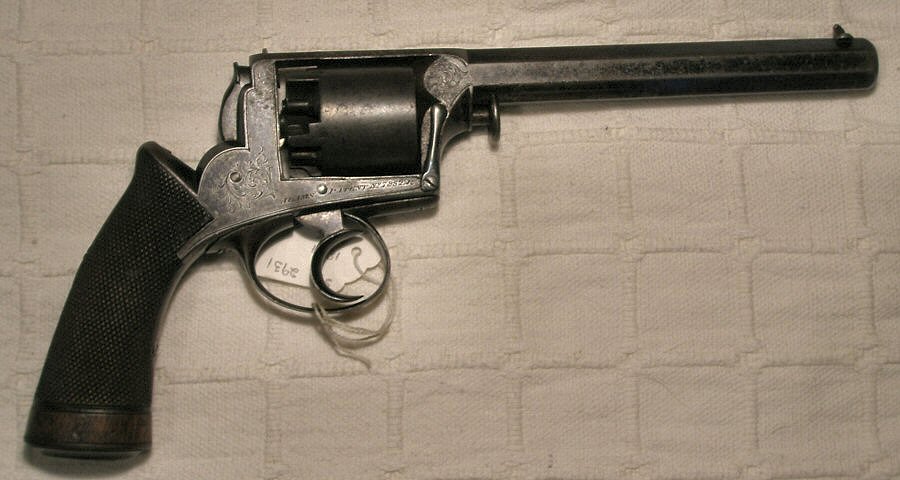
An Adams revolver. Click on the image to enlarge.

Note that the Adams revolver has no spur on the hammer, therefore the user cannot pull it back with the thumb. The good news is that the missing spur means that it cannot get snagged by accident on anything and it is also possible to fire this revolver much faster than the Colt single action revolver, since there is no need to cock it each time before pulling the trigger. The bad news is that the trigger is harder to pull and due to the larger force needed, there is a tendency to shake the revolver when pulling the trigger, which makes it less accurate.

Some modern day semi-automatic weapons and revolvers still use a DAO action, Examples include the SIG P250 pistol, the Ruger SP101 revolver, the Taurus 24/7 pistol, Smith & Wesson Bodyguard revolver etc.


Notice how there is no spur at the back of this revolver, so the only way to cock this weapon is to pull the trigger. At around 1:00 of the video, you can clearly see the hammer being moved backwards initially as the trigger is being pulled and then released as the trigger is pulled further along.

From all the above, we see that double action weapons only need one trigger pull to both cock and fire the weapon, thereby being faster to fire, but they need more pull force on the trigger than single action weapons, which leads to the weapon shaking more when the trigger is pulled. Therefore, there is another alternative, which combines the best of both: the double action/single action also known as DA/SA, single action/double action or SA/DA.

With a double action/single action firearm, it can be fired in both modes. One of the first examples of this was the Beaumont-Adams revolver, which was invented in 1865 by Lieutenant Fredrick Beaumont of the British Army. He was a veteran of the Crimean war and had used the Double Action Only Adams revolver there. After the war, he decided he was going to improve the Adams design and invented his revolver.

A Beaumont-Adams reovlver Click on the image to enlarge. Public domain image.

With this design, the user has two options. When the hammer is down, the user can pull the trigger, which cocks the hammer and then releases it, just like a double action only revolver. Doing this takes more trigger pull force, as expected. The user also has the option to cock the hammer by pulling the spur at the back of the hammer, just like a single action weapon. In this case, there is less force required to pull the trigger, as the hammer is already cocked,

A DA/SA weapon combines the best features of both the single action and the double action weapons and gives the user a choice of which mode to fire the weapon with. Some modern weapons that use this system include the Beretta M9 pistol, which is the standard sidearm of the US military, the Colt Python revolver, SIG Sauer P-220 pistol, the Heckler & Koch USP pistol, the Czech CZ 75 pistol etc.

Heckler & Koch USP pistol. Click on the image to enlarge.
Image licensed under the Creative Commons Attribution-Share Alike 3.0 license by Miroslav Pragl

When the trigger is pulled with the hammer down, it requires a force of something like 10.5 lbs (4.5 kg.) to discharge the firearm, but if the hammer is already cocked, it requires a force of only about 4.5 lbs (2 kg.) to do it.

With a semi-automatic weapon like the pistol above, if the weapon is not cocked after the magazine is loaded, the first trigger pull will be heavier, since it has to cock the weapon first. But after the first cartridge is fired, the weapon uses some of the recoil force to cock itself automatically, which means the subsequent trigger pulls do not require as much force. The user can also cock the hammer manually using the thumb to pull it back, or cock it by pulling back on the slide, in which case the first trigger pull will be lighter since the weapon is already cocked. Many pistols also have a de-cocking lever to safely lower the hammer back down to double-action mode.

Some people like to carry the weapon de-cocked, because the first trigger pull needs much more force and therefore, it is less likely to be pulled accidentally when the user is carrying the weapon in a holster. Other people find the fact that the first pull needs more force than the others a little confusing, so they carry the weapon cocked and enable the weapon safety devices instead.

Finally, we have some weapons that cannot be exactly classified as either double-action or single-action. Examples of this would be Glock and Kahr pistols. As we saw in our previous post, which showed an animated image of a Glock pistol in action, when the slide is pulled back, it pulls the striker back and locks it at an intermediate position where the spring is only at partial tension. Pulling on the trigger pulls the striker back first (so the spring reaches full tension) before releasing the striker, much like a double action weapon does. However, unlike a double action weapon, if the striker is not cocked at the intermediate position first, pulling on the trigger does nothing (behaving exactly like a single action weapon).

A Glock 17 pistol. Click on the image to enlarge.

As you have probably already guessed, the trigger pull force for a weapon like this is between that needed for a single action and a double action weapon. For instance, a standard Glock trigger requires about 5.5 lbs (2.5 kg.) to operate it and a Smith & Wesson M&P needs about 6.5 lbs (2.95 kg.).

The video below contains some good examples that show the differences between the various mechanisms:


Happy viewing!


Friday, July 2, 2010

Revolver: Other Firing Mechanisms

In the last few posts, we've studied various types of single-action and double action revolvers. These were not the only types of revolver mechanisms though.

Click image to enlarge

The above image is a Tranter revolver invented by William Tranter. William Tranter used to manufacture the Adams double-action revolver under license and in 1853, he came up with his own invention, a double-trigger, double action revolver. Notice that the distinguishing feature of his revolver is the double trigger. The lower trigger sticks out below the trigger guard and is pulled with the middle finger. When the lower trigger is pulled, it cocks the hammer and rotates the cylinder. Then the user pulls the upper trigger with the forefinger to release the hammer and fire the weapon. If the user decides to fire rapidly, then he/she can pull both triggers simultaneously.

During the US civil war, the Confederates did not have any firearms factories in their territory and hence were forced to import their firearms from other countries. Many Tranter revolvers were imported by them, along with other revolvers such as the Adams and Beaufort-Adams. The Tranter revolvers gained popularity among the Confederates because of their reliability. Tranters were also carried by detectives of the famous Pinkerton detective agency. Pinkerton's men were responsible for the safety of US government officials before the creation of the Secret Service.

William Tranter made a sizable fortune from the sale of various firearms (including his revolvers) and later went on to co-found the Birmingham Small Arms company. This company later moved into manufacturing bicycles, motorcycles and cars. It was once the largest motorcycle manufacturer in the world and its bicycle brand was sold to India's Tube Investments Limited in 1957. Tube Investments still manufactures bicycles in India under the BSA brand.

Another unusual revolver mechanism was invented by the Iver Johnson company of the US. Between 1940 and 1947, they manufactured a revolver with a very special action. If the hammer was down, pulling the trigger would cock the hammer and rotate the cylinder. If the hammer was already cocked, then it would release the hammer and fire the weapon. Therefore, to fire the weapon when the hammer is down, the user would pull the trigger twice.

Another development that has been used since around 1901 or so is the automatic revolver. Basically, the disadvantage of a double action revolver is that it has a longer trigger pull than a single action revolver, because the trigger pull on a double action serves to cock the hammer, rotate the cylinder and release the hammer on a single pull, whereas a single action trigger merely releases the hammer when the trigger is pulled. This leads to a heavier trigger pull and therefore, less accuracy from double-action revolvers.

With an automatic revolver, some of the recoil force from the just fired cartridge is utilized to re-cock the hammer and rotate the cylinder. This results in a revolver that can fire with the speed of a double-action, but with the softer trigger pull of a single-action revolver. The Webley-Fosbury pistol of 1901 had this feature, but it was soon replaced by semi-automatic pistols, which were less expensive. In 1997, a company called Mateba invented the Mateba Unica Auto-revolver that uses the same concept.

Thursday, July 1, 2010

Revolver: Double Action Revolver

In the last few posts, we have been studying single action revolvers, such as the Paterson revolver, the Colt Dragoon and the Peacemaker. With a single action revolver, the trigger only serves to release the hammer. To operate the weapon, the user manually pulls the hammer back, which cocks the weapon and rotates the cylinder to the next chamber. Then the user pulls the trigger to fire.

In the 1850s, another mechanism called the "Double Action" was invented. It all started with the Adams revolver from England. The inventor was one Robert Adams, who was a manager for a London based manufacturer called George & John Deane. He invented a revolver where pulling the trigger cocked the hammer, rotated the chamber and then released the hammer, all with a single trigger pull.


The revolver uses a percussion cap firing mechanism and has a cylinder that has 5 chambers in it. As you may notice, this revolver's hammer does NOT have a spur at the back, so the user cannot thumb the hammer back manually to cock it. Instead, pulling the trigger cocks the hammer back and then releases the hammer to fire it. This means, it has a longer (and harder) trigger pull than a single action revolver like the Colt and Smith & Wesson products of this period. On the other hand, rate of fire is much higher than a single action revolver, because the user doesn't need to cock the hammer separately before pulling the trigger.

The Adams sold fairly decently in England, and was actually approved by the British Small Arms Committee and also for the East India Company as well. In fact, the Deane company even went to the extent of making Adams a partner of the company and renamed themselves from Deane & Deane to Deane, Adams and Deane.

While it was a highly regarded weapon, the revolvers were essentially hand-made. Thus, production was slow and more expensive and quality was also somewhat uneven. This made it lose out to the Colt in the American market. Since the parts were hand fitted in the end, interchangeability was not a strong point for the Adams. It also had no recoil shield in the back of the cylinder, so the user could get their hands dirty caused by blowback from the chambers. The nipples that the percussion caps sat on were also not hardened, so they could sometimes explode prematurely. This revolver was strictly a DAO (Double Action Only) as opposed to a pure double-action revolver. Since it was double-action only, that means the user couldn't pull back the hammer manually. In fact, it even dropped extension on the hammer to prevent users from pulling the hammer back manually. This meant it had a longer trigger pull than a single-action revolver and this led to less accuracy.

The British Ordinance Board studied the Adams revolver along with a few other competing products in 1853, with the view of adopting one for general military use. While there was no firm conclusion, a number of officers bought one as an unofficial standard side-arm and these saw some use in the Crimean War.

The Crimean war saw the first competition between single-action (mostly Colt Navy 1851 model) and the double-action Adams revolver in a real conflict. It was found that the single action Colt was more rugged and reliable than the Adams revolver. However, in the type of fighting experienced in Crimea, the slower thumb-cocking method of the single-actions was seen as less useful compared to the rapid fire capability of the double-action revolvers.

J.G. Crosse of the 88th Regiment of Foot wrote a personal letter to Adams: "I had one of your largest sized Revolver Pistols at the bloody battle of Inkermann, and by some chance got surrounded by the Russians. I then found the advantages of your pistol over that of Colonel Colt's, for had I to cock before each shot I should have lost my life. I should not have had time to cock, as they were too close to me, being only a few yards from me; so close that I was bayoneted through the thigh immediately after shooting the fourth man."

One of the veterans of the Crimean war was Lieutenant Frederick E. B. Beaumont of the Royal Engineers. During the war, he came up with a design that improved the flaws of the Adams revolver. After he was granted a patent, he went to the firm of Deane, Adams and Deane, the makers of the Adams revolver and offered them the rights to manufacture his improved design. The resulting revolver was the Beaumont-Adams revolver.
Like the previous Adams revolver, this one also has a cylinder that holds 5 bullets. It also fires by merely pulling the trigger, which cocks the hammer, rotates the cylinder to the next chamber and then releases the hammer. Unlike its predecessor, this one also has a spur on the back of the hammer. This allows the user to use their thumb to pull back the hammer to cock the weapon, which also rotates the cylinder. Pulling the trigger then releases the hammer. This weapon was the first true double-action revolver as we know it. The Beaumont-Adams also fixed some of the other issues with the Adams, such as hardening the percussion cap nipples. This weapon was adopted as the official revolver of the British Army in 1856.

During the Indian Mutiny, the effectiveness of the Adams and the Beaumont-Adams revolvers came to the forefront again, where not only was the Colt's slowness called into question, but also its perceived lack of stopping power versus the British revolvers. A damning report was submitted by Lt. Col. George Vincent Fosbery: "An officer, who especially prided himself in his pistol shooting, was attacked by a stalwart mutineer armed with a heavy sword. The officer, unfortunately for himself, carried a Colt's Navy pistol of small caliber and fired a sharp-pointed bullet of sixty to the pound and a heavy charge of powder, its range being 600 yards, as I have frequently proved. This he proceeded to empty into the sepoy as soon as he advanced, but having done so, he waited just one second too long to see the effect of his shooting and was cloven to the teeth by his antagonist, who then dropped down and died beside him. My informant told me that five out of the six bullets had struck the sepoy close together in the chest, and all had passed through him and out of his back." Reports like these commonly emerged from the Indian Mutiny and it wasn't long before the double action British revolvers began to grow in popularity because of their rapid firepower and superior stopping power. By the end of 1857, Colt had to close down their factory in London due to dropping sales.

Robert Adams later split from Deane & Deane and went on to found the London Armory company which made several Beaumont-Adams revolvers in calibers like .442, .479, .50, .338, .32 etc. Some were also license-made in the US by the Massachusetts Arms Company, which made holster and pocket-sized models. So many were imported and used by both sides of the Civil war, that the most common double-action revolver used was the Beaumont-Adams.

One of the issues of the Beaumont-Adams was that it still used percussion cap technology. Its replacement in 1880 was the Enfield Mark-I which used centerfire cartridges filled with black-powder. However, the Beaumont-Adams was a revolutionary weapon because it was instrumental in developing the modern double-action, which is still the mechanism of choice in today's revolvers.

Saturday, June 26, 2010

Revolvers: Basics

A revolver is a weapon that allows the user to fire multiple times without stopping to reload. While there are some other weapons, such as double barrel shotguns, that also allow a user to fire more than once, a characteristic of revolvers is that the firing chambers of a revolver turn about an axis (i.e. they "revolve") and this is the origin of the name.

Early revolvers were called pepper-boxes and they had multiple barrels which revolved about an axis and a common firing mechanism. The earliest ones exist from 1597 (a revolving arquebus) and use matchlock mechanisms. In the 1700s, James Puckle invented the "Puckle Gun" which had multiple firing chambers and one common barrel and firing mechanism. A hand crank rotated the firing chambers and brought each one in line with the barrel and firing mechanism. Elisha Collier of Boston, patented a popular revolver model in 1818, which used the flintlock firing mechanism. He also produced revolving shotguns and rifles. In 1819, John Evans of London bought Collier's patent and produced several weapons which were used by British soldiers stationed in India.

Many big developments in revolver technology were by Samuel Colt. In 1836, he patented his first revolver model. It was manufactured in Colt's factory in Paterson, New Jersey, and hence it is popularly called the "Paterson revolver." While Colt's name is the most famous one associated with revolvers, he never claimed to invent the concept. In fact, the Paterson revolver was an improved variant of the concept invented by Collier. Some of Colt's big innovations dealt with applying concepts of mass production, interchangeable parts and assembly line techniques to revolver production and this reduced the price of revolvers. He was also an excellent salesman and promoter and his weapons became extremely popular with the public. One of his later models was nicknamed "Peacemaker" and "Equalizer". A popular saying of the time went "Abe Lincoln may have freed all men, but Sam Colt made them all equal!"

Colt's first revolvers all used a ratchet and pawl mechanism to hold the cylinders in place. They were also "single action" mechanisms, i.e. the user must cock the weapon manually. The act of pulling back the hammer to cock the weapon also rotates the cylinder. Once the weapon is cocked, the user can pull the trigger to fire it.

Later on in 1851, a British gunsmith named Robert Adams invented the first "double action" revolver. In this mechanism, pulling the trigger halfway automatically rotates the cylinder and cocks the hammer. Pulling the trigger back some more releases the cocked hammer. Thus, the user can fire the weapon with just one trigger pull. The Adams revolver was hand-crafted, which made it more expensive than Colt's design. It also had a few flaws in the hammer and frame. This could only fire in double-action mode and was hence called a "DAO revolver" (i.e.) Double-Action Only. Improvements to the Adams model were made by Lieutenant Frederick E.B. Beaumont, a veteran of the Crimean war and the resulting model was called the Beaumont-Adams revolver. This new model could be operated in both single-action or double-action mode and was such a huge success that Samuel Colt had to shut down their factory in England as a result. Mechanisms that operate in both single and double-action mode are called DA revolvers (DA standing for "Double Action").

Most modern revolvers to this day are double-action. They are still used by law-enforcement around the world and remain popular among many private gun-owners. In fact, it is said by many that the best way to teach a new handgun enthusiast about shooting basics is to start with a revolver first.

Some of the advantages of revolvers over other multiple firing mechanisms (notably the automatic pistol) are:
  1. Simpler mechanism, which is less prone to jamming.
  2. Ease of use: With a double action revolver, all one has to do is pull the trigger. With a single-action revolver, one cocks the hammer and then pulls the trigger. Unlike a pistol or an automatic rifle, there are no additional safety mechanisms that need to be meddled with.
  3. More powerful cartridges can be used: Due to the robust design of the revolver, bigger magnum cartridges can be used with one. In fact, the biggest handgun cartridges are mostly designed for revolvers.
  4. Much easier and faster to reload than a pistol. Anyone who has loaded a pistol or rifle magazine knows that the first few cartridges go in easy, but the last 3 or 4 cartridges take considerable effort to push into the magazine. With a revolver, one merely opens the chamber and drops cartridges into it.
  5. Works with greater range of ammunition types: Revolvers can be used with blanks, wad-cutters etc., which do not work with automatic pistols.
  6. Easier cleaning and maintenance: Since revolvers have fewer moving parts than automatic pistols and rifles, they don't require disassembly and are therefore much easier to clean and maintain.
On the other hand, pistols generally hold more ammunition, are lighter and slimmer profile, and also use cheaper ammunition than revolvers.

One of the reasons that revolvers are/were popular with Indian police has to do with poor quality of ammunition available to them. If a pistol misfires due to faulty ammunition, the user has to pull back the slide and extract the faulty cartridge before it can be fired again. This takes a bit of time to accomplish. With a revolver, if one cartridge is faulty and does not fire, the user can simply pull the trigger again and the cylinder automatically rotates and brings up the next round ready to fire.

In the next few posts, we will look into various types of revolvers.