During the latter half of the 19th century, as some English firearm manufacturers were becoming famous worldwide for their quality of product, fake copies of their products also began to hit the market. Many of the fake manufacturers were based in Belgium, though some were based in England as well.
In W.W. Greener's words:
The spurious gun may be either a gun represented as being of quality it is not, or as the production of a maker other than the real one. After taking all into consideration, it is the first class which is the most dangerous to the unwary buyer. The vapid platitudes of the salesman spread a glamour over the transaction, and the sportsman purchases a gun which will trouble him more and more as he gets to know it. Against the purchase of this class of gun the sportsman must always be on his guard.
The second class of gun is simply a forgery. Belgian guns are sent to England to be proved, or the English proof marks are imitated; "English fine twist" is engraved upon the rib, or any maker's name is put on to the order of the importer.
Some makers do not scruple to state in their lists that they will put upon their productions "made in London, or in Eibar, or in Brescia," or in any other town whose manufacturers have a better reputation that their own. Never buy a gun without the maker's name upon it.
All the leading makers or their retailers now advertise, so that the exact name of the maker wished is easily obtained; see that the gun bears this name, and rightly spelled, for the change of a letter is often made, the maker of the forgery thereby thinking that his liability is lessened, and foreign forgers make dreadful havoc with English names, whereas probably no careful maker has ever turned out a gun wrongly or incorrectly named, so far as his name goes. As to the more general forgeries, they will be found to be changes run upon the name of a maker of reputation. No one would forge "Smith" or "Jones", and happy the gunmakers who possess such names; but names as "Greener" will be spelled "Greenen," "Purdey" as "Purdy," "W.C. Scott & Son" as "J.N. Scotts Son," whilst of the imitations of "Westley Richards" the name is legion. The alteration in initials, or the Christian name, or the address is more frequent, and all "Horace Greener," "Albert Greener," J.H., W.H., A.H., and other H. Greener guns are practically forgeries.
Let us now look at some of these forgeries. First up, we have a Greener imitation shotgun, made in Belgium:


Click on images to enlarge.
First thing to notice in the first image is that the name of the maker is "C. Greener", not "W.W. Greener". Secondly, there is no address on the top rib: A genuine W.W. Greener of that era would have been marked with the manufacturer name AND address (e.g. "W.W. Greener 68 Haymarket London & St. Mary's Square, Birmingham."). The second big giveaway is in the second picture. Those are Belgian proof marks, not English, the oval with the letters "ELG" and the other mark that looks like a pole standing on a pyramid show that it was proved in Belgium. But W.W. Greener was an English manufacturer, so it would have had marks of either the Birmingham or London proof houses if it was genuine. These proof marks are normally hidden by the stock when the gun is in an assembled state (as the proof marks were usually put there in order to not mar the beauty of guns), so the buyer would not necessarily notice them until much later on.
The next image we will look at is a fake Westley Richards:

Click on image to enlarge
This one is pretty tricky because the engraving on the plate says "W. Richards". However, a real Westley Richards shotgun would say "Westley Richards", not "W. Richards." To complicate matters, there was a genuine firm named William Richards based in Liverpool, who manufactured shotguns under the name "W. Richards". This company made some quality shotguns and is still in business to this present day. However, there were also many more Belgian made "W. Richards" fakes made during the late 1800s. Usually, guns with barrels marked "London Fine Twist" are fakes.
The problem got so bad that in 1887, the British magazine, "Shooting", conducted interviews with genuine English manufacturers to identify the markings of genuine guns. As per that article, some of the details are:
W. Richards, Liverpool: "All my guns have 'W. Richards Old Hall Street' on the barrels, 'W. Richards' on locks, Guards are numbered."
W. Richards, Preston, Lancashire: (Editor's note: This is another branch of the same firm above. At one point, they had a branch in Preston as well as Liverpool) "All my guns have 'W. Richards, 44 Fishergate, Preston', on the top rib, 'W. Richards' on the lock plates, all guards are numbered."
Westley Richards, London and Birmingham: "'Westley Richards' and appropriate address on rib (or Westley Richards & Co on lower grade guns). All guns have 'Westley Richards' on lock plates and bear the 'Westley Richards triangle' trade mark."
Therefore, a gun that doesn't have some of the details above is likely a fake.
Many of the fake Belgian-made W. Richards guns were imported into the US by H&D Folsom Arms Co. of New York, which was a large American sporting goods retailer in the late 1800s until the 1950s or so.
Now, we will look at some more fake Westley Richards products:

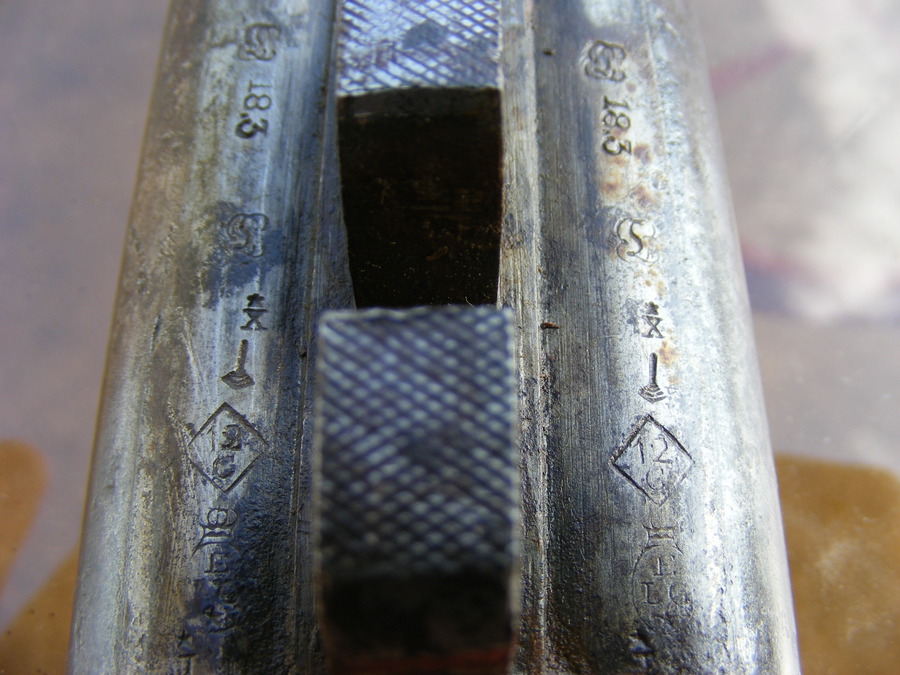
Click on images to enlarge
As we can see in the first picture, the lock has the word "Richard" instead of "Westley Richards". In the second picture of the same firearm, we can see Belgian proof marks, as in the fake Greeners above (i.e. The letters "ELG" in an oval and the pyramid with a pole on top).
Now for a whole slew of fake Westley Richards products:


Click on images to enlarge
As was mentioned by W.W. Greener above, the imitations of Westley Richards are legendary. Observe the variants of the brand name on the lock plates: "W. Richard of Belgium", "A. Richard", "Rikard" and "Rickard".
In our next post, we will study more spurious guns and the strategies developed by unscrupulous manufacturers in trying to sell them.


