Showing posts with label Miscellany. Show all posts
Showing posts with label Miscellany. Show all posts
Saturday, July 11, 2015
Off For a Few Weeks
To the faithful readers of this blog... I'll be heading off to Europe on a much-needed vacation for a few weeks. Fear not though, I plan to carry my camera when visiting museums and historic sights and perhaps I'll find something interesting to talk about. See you guys and gals next month!

Monday, August 19, 2013
What the heck is an "Arshin"?
Imagine you are now the proud owner of a classic Russian Mosin-Nagant M-91 rifle and are excited to try it out for the first time. So you take it out to the range, adjust the iron sights for a target 400 meters away and shoot at it. Upon shooting a few times, you examine the target and notice that you're not hitting where you're aiming at. Is there something wrong with the rifle? Actually, the answer may have to do with your misunderstanding about how the sight works.


In the above image, we see a Mosin-Nagant rifle sight called the Konovalov type. This sight acts as both a tangent sight (for shorter ranges, marked as 4-12) and a ladder sight (for longer ranges, marked as 13-32). Note that the sight is sort of curved, as seen in the first image. Older Mosin Nagants have a flat shaped sight using the same idea.
The mistake that some people make is assume that these settings are in meters (e.g. 4 = 400 meters, 6 = 600 meters etc.) For Mosin-Nagants manufactured before 1930, this is not true -- in fact, these are calibrated in a unit called "Arshin" (plural: "Arshins" in English, "Arshiny" in Russian). So what the heck is an "Arshin" then?
To answer this question, we must go back to 16th century Russia, where this unit of length first originated. This unit was the Russian equivalent of the English "yard" measurement. Its actual length varied over the years, until Peter the Great standardized it in the 18th century to be about 27.95 inches long (or about 71.1 cm. or 0.78 yards). This continued to be how distances were measured in Russia until some time in 1925, when the Soviet Union officially adopted the metric system throughout the country. Konovalov type sights calibrated in arshins continued to be manufactured for some years after, until 1929.
Therefore, with older Mosin-Nagant rifles built before 1930, the sights were actually calibrated in arshins. Hence, when the slider is pushed to 4, the sights are set to aim at a distance of 400 arshins, not 400 meters. 400 arshins is approximately 285 meters, which explains why the rifle might not be shooting where the user expects it to!
Edit: The editor is indebted to Mr. Bernard Samartsev for his comments and corrections to the original article noted below.

A Konovalov type Mosin-Nagant adjustable iron sight.
In the above image, we see a Mosin-Nagant rifle sight called the Konovalov type. This sight acts as both a tangent sight (for shorter ranges, marked as 4-12) and a ladder sight (for longer ranges, marked as 13-32). Note that the sight is sort of curved, as seen in the first image. Older Mosin Nagants have a flat shaped sight using the same idea.
The mistake that some people make is assume that these settings are in meters (e.g. 4 = 400 meters, 6 = 600 meters etc.) For Mosin-Nagants manufactured before 1930, this is not true -- in fact, these are calibrated in a unit called "Arshin" (plural: "Arshins" in English, "Arshiny" in Russian). So what the heck is an "Arshin" then?
To answer this question, we must go back to 16th century Russia, where this unit of length first originated. This unit was the Russian equivalent of the English "yard" measurement. Its actual length varied over the years, until Peter the Great standardized it in the 18th century to be about 27.95 inches long (or about 71.1 cm. or 0.78 yards). This continued to be how distances were measured in Russia until some time in 1925, when the Soviet Union officially adopted the metric system throughout the country. Konovalov type sights calibrated in arshins continued to be manufactured for some years after, until 1929.
Therefore, with older Mosin-Nagant rifles built before 1930, the sights were actually calibrated in arshins. Hence, when the slider is pushed to 4, the sights are set to aim at a distance of 400 arshins, not 400 meters. 400 arshins is approximately 285 meters, which explains why the rifle might not be shooting where the user expects it to!
Edit: The editor is indebted to Mr. Bernard Samartsev for his comments and corrections to the original article noted below.
Monday, November 12, 2012
Point Blank Range
When referring to firearms, we sometimes hear the term "point blank range". So what is the meaning of this term and how did it come about.
The popular usage of the term "point blank" usually means shooting a target very close to the muzzle of the firearm. However, in the field of ballistics, the definition is a bit different: "point blank range" is the range between which the user can hit a target without adjusting the elevation of the weapon. This varies depending on the size of the target and what range the firearm was zeroed at.
In our discussion about zeroing a sight many months ago, we mentioned that the sights are calibrated for a known distance (e.g. for the M16, the US military recommends zeroing the sights at 300 meters). Remember that bullets travel in a parabolic path, such as the diagram below:
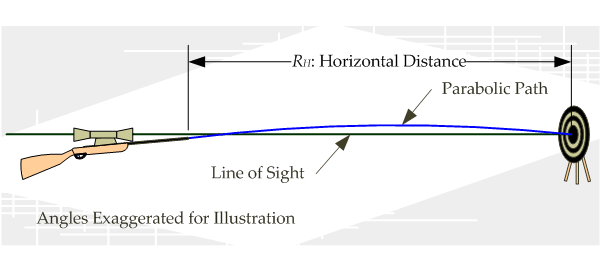
As can be seen from the figure above, when the bullet is fired, it comes out of the barrel below the line of sight, then quickly rises above the line of sight and then starts to fall again after it has traveled some more distance. If the rifle is sighted to say, 300 meters, the bullet strikes a point that coincides with the line of sight when the target is at 300 meters distance. If the target is closer than 300 meters, the bullet will fly above the line of sight to the target. If the target is farther than 300 meters, the bullet will strike a point below the line of sight of the target. Say the target is something like 5 inches (12.7 cm.) tall, the rifle is zeroed at 300 meters and when the user shoots at it, the bullet never rises 2.5 inches above line of sight at distances over (say) 275 meters, nor does it fall 2.5 inches below the line of sight for distances below (say) 325 meters. Therefore when we shoot this target by aiming for the center of the target using line of sight, we can't miss it between these two distances. Thus we can say for a 5 inch target, the zero range is 275 meters and the maximum point blank range is 325 meters.
There are multiple reasons given for the origin of the term "point blank". One reason given is that the traditional center of targets is a white circle and the French word for "white" is "blanc".
Another charming reason given for the origin of this name has to do with the famous Italian mathematician, engineer, designer of fortifications and bookkeeper, Niccolo Fontana, known to the world as "Tartaglia". The reason for his nickname has to do with an incident where he was badly wounded in the face by an invading French soldier when he was just a boy. The scars from those wounds affected his ability to speak normally and he picked up the nickname "Tartaglia" ("The Stammerer") as a result. As an adult in the 1500s, Tartaglia proved to be a skillful mathematician and was the first to translate Euclid's Elements from Latin into a popular European language (Italian), so it could be more readily understood by common people (only well educated people spoke Latin). During the 1530s, he started to develop an interest in military fortifications and gunnery. In 1537, he published a study on the science of gunnery and over the next 10 years, he invented an instrument known as a "Gunner's Quadrant" to help gunners aim their artillery properly. Incidentally, he was also the first to demonstrate the path of a bullet is always parabolic.

It consists of two wooden arms joined together at 90 degree angles to each other, similar to a carpenter's square tool. At the joint between the two arms is attached a thread with a weight at the end, called a "plumb bob". Between the two arms is an arc marked off into 12 divisions, called points. The cannon would then be fired at various angles of elevation and the ranges measured for each angle and noted down in a book called a "gunner's table". To use the device, the gunner would insert the long arm into the cannon barrel and then tilt the barrel up or down until the plumb bob would intersect the point that his gunner's table showed for the distance to the target. When the barrel was near vertical, the plumb bob would cross Point 12 and when it was near horizontal, the plumb bob would cross Point 0.

Remember though that this was 16th century Europe and most people were still using Roman numerals. Therefore the points on the arc were marked using Roman numerals I, II, III, IV .... XI, XII, since most people were used to seeing numbers written like this anyway. The concept of "zero" doesn't exist in the roman numbering system and therefore point 0 was marked with a blank and was called/translated as "Point Blank"!
The popular usage of the term "point blank" usually means shooting a target very close to the muzzle of the firearm. However, in the field of ballistics, the definition is a bit different: "point blank range" is the range between which the user can hit a target without adjusting the elevation of the weapon. This varies depending on the size of the target and what range the firearm was zeroed at.
In our discussion about zeroing a sight many months ago, we mentioned that the sights are calibrated for a known distance (e.g. for the M16, the US military recommends zeroing the sights at 300 meters). Remember that bullets travel in a parabolic path, such as the diagram below:
Public domain image from Wikipedia.
As can be seen from the figure above, when the bullet is fired, it comes out of the barrel below the line of sight, then quickly rises above the line of sight and then starts to fall again after it has traveled some more distance. If the rifle is sighted to say, 300 meters, the bullet strikes a point that coincides with the line of sight when the target is at 300 meters distance. If the target is closer than 300 meters, the bullet will fly above the line of sight to the target. If the target is farther than 300 meters, the bullet will strike a point below the line of sight of the target. Say the target is something like 5 inches (12.7 cm.) tall, the rifle is zeroed at 300 meters and when the user shoots at it, the bullet never rises 2.5 inches above line of sight at distances over (say) 275 meters, nor does it fall 2.5 inches below the line of sight for distances below (say) 325 meters. Therefore when we shoot this target by aiming for the center of the target using line of sight, we can't miss it between these two distances. Thus we can say for a 5 inch target, the zero range is 275 meters and the maximum point blank range is 325 meters.
There are multiple reasons given for the origin of the term "point blank". One reason given is that the traditional center of targets is a white circle and the French word for "white" is "blanc".
Another charming reason given for the origin of this name has to do with the famous Italian mathematician, engineer, designer of fortifications and bookkeeper, Niccolo Fontana, known to the world as "Tartaglia". The reason for his nickname has to do with an incident where he was badly wounded in the face by an invading French soldier when he was just a boy. The scars from those wounds affected his ability to speak normally and he picked up the nickname "Tartaglia" ("The Stammerer") as a result. As an adult in the 1500s, Tartaglia proved to be a skillful mathematician and was the first to translate Euclid's Elements from Latin into a popular European language (Italian), so it could be more readily understood by common people (only well educated people spoke Latin). During the 1530s, he started to develop an interest in military fortifications and gunnery. In 1537, he published a study on the science of gunnery and over the next 10 years, he invented an instrument known as a "Gunner's Quadrant" to help gunners aim their artillery properly. Incidentally, he was also the first to demonstrate the path of a bullet is always parabolic.
A Gunner's Quadrant.
It consists of two wooden arms joined together at 90 degree angles to each other, similar to a carpenter's square tool. At the joint between the two arms is attached a thread with a weight at the end, called a "plumb bob". Between the two arms is an arc marked off into 12 divisions, called points. The cannon would then be fired at various angles of elevation and the ranges measured for each angle and noted down in a book called a "gunner's table". To use the device, the gunner would insert the long arm into the cannon barrel and then tilt the barrel up or down until the plumb bob would intersect the point that his gunner's table showed for the distance to the target. When the barrel was near vertical, the plumb bob would cross Point 12 and when it was near horizontal, the plumb bob would cross Point 0.
Using a gunner's quadrant with a cannon. Public domain image.
Remember though that this was 16th century Europe and most people were still using Roman numerals. Therefore the points on the arc were marked using Roman numerals I, II, III, IV .... XI, XII, since most people were used to seeing numbers written like this anyway. The concept of "zero" doesn't exist in the roman numbering system and therefore point 0 was marked with a blank and was called/translated as "Point Blank"!
Tuesday, February 28, 2012
Apologies for hiatus and tardy updates
Sorry about the hiatus and tardy updates folks. I spent most of August, September and October house hunting, talking to my realtor and loan agent, getting my paperwork done etc. and finally moved in November and spent most of that month packing, moving and then unpacking all my worldly possessions. After that, I fell very ill and was in the hospital under close observation for a few weeks. Will be more regular with my posts, I promise! Hope you guys had a great 2011 and here's looking forward to a great 2012. Thank you to all my readers, without whom, this blog would not exist.
Sunday, September 11, 2011
Saturday, October 9, 2010
Apologies for Small Hiatus
As you may have noticed, I stopped posting for a little while. The reason was that I was selected to serve on a jury for the last few weeks and it was quite an involved court case. For non-American readers of this blog, in the US court system, members of the public are randomly picked to serve as potential jurors for court cases. I've been called for jury service before, but this is the first time that I was actually picked as a juror. The judge told us at the beginning of the trial to not post anything about the case in blogs/websites during the duration of the trial. As the trial involved firearms, I decided to take a little time away from posting, just in case I accidentally posted something that could cause a mistrial to be declared.
I'm happy to say that I've finished my jury obligations and therefore I'm free to post again.
Sunday, August 1, 2010
Which has more range, Ak-47 or M-16?
Was recently browsing a forum where this question came up? Which has more range, an AK-47 or an M-16. One poster noted that an AK-47 has 7.62 mm diameter barrel whereas an M-16 uses 5.56 mm. diameter barrel and therefore concluded that higher caliber rounds (meaning, the AK-47) has better range. Another forum poster opined that a TV show he watches has repeatedly mentioned that the M16 bullet has lesser punch than an AK-47, but has greater range and accuracy. So which of these is really true, the reader asks? Let us examine the facts scientifically.
First, bullet caliber has very little to do with range, otherwise civil war era bullets would have much longer range than either of the two rifles. So what does really matter for bullet range? There are a number of factors, such as:
- Weight of the bullet (which affects momentum and how fast a bullet travels)
- Amount of propellant in the cartridge.
- Quality of propellant in the cartridge. Smokeless powders provide more thrust than the equivalent amount of black powder, for instance.
- Shape of the bullet (ball, spitzer bullet etc.)
- Amount of rifling or spin imparted on the bullet (which affects the stability of the bullet in the air) and its aerodynamics.
With that said, let us now compare two cartridges, both of which were designed for use with the M16. The first is the M193 cartridge which came out with the original M16 A1 model and the second is the M855 cartridge that came with the improved M16 A2 model. Both cartridges are of the same length (44.70 mm.) The M16 A2 model has a barrel with more rifling, which means the bullet coming out of it spins a lot more than a bullet coming out of an M16 A1 barrel. The M16A1 barrel has a 1 in 12 twist, whereas a M16A2 has a 1 in 7 rifling twist. Even though the bullets of both cartridges are of the same diameter (5.70 mm.), the length of the bullets differ. The bullet from the M193 cartridge is shorter and it weighs about 3.56 gm. whereas the bullet from the M855 is longer and weighs about 4.0 gm. The overall length of both cartridges is the same though at 44.70 mm.
Now let us compare the performance of these two cartridges from the table below:
         5.56 NATO Ball Ammunition Ballistic Comparison
              based on Aberdeen Proving Ground Data
  velocity (fps)    trajectory (in.)  drop (inches)  drift (inches)*
range   M193   M855       M193  M855      M193   M855     M193    M855
(meters)
 0      3,200  3,100     -2.5   -2.5       0.0    0.0      0.0     0.0
100      2,774  2,751     +2.8   +4.4      -2.2   -2.3      1.3     1.1
200      2,374  2,420     +2.7   +5.8      -9.9  -10.2      5.8     4.9
300      2,012  2,115     -4.9    0.0     -25.1  -25.3     14.2    11.8
400      1,680  1,833    -23.0  -15.0     -50.8  -49.5     27.6    22.4
500      1,373  1,569    -56.2  -42.9     -91.6  -86.7     47.5    38.0
600      1,106  1,323   -113.1  -88.2    -156.1 -141.3     76.4    59.5
700        995  1,106   -206.8 -156.1    -257.3 -220.9    113.5    88.4
800        927  1,010   -339.9 -267.7    -398.0 -339.2    156.1   124.9

                                              * Drift for 10 mph wind.
M193 Ball ammunition fired in M16A1 rifle with 250 meter battle sight zero.
M855 Ball ammunition fired in M16A2 rifle with 300 meter battle sight zero.
First thing we notice from the table above is that the bullet from an M193 cartridge initially comes out flying at a faster velocity than the M855 cartridge (3200 fps vs. 3100 fps), which is to be expected, since it is a lighter bullet, and also because the bullet from the M855 is spinning about its axis a lot faster since the rifling on an M16 A2 is more than on an M16 A1. Therefore, a naive person might conclude that the M193 bullet has greater range since it is travelling faster.
However, this is not the end of the story. Look at the velocities once the bullets have passed 200 meters. Suddenly the M855 bullet is moving faster. What is the cause of this? It is because of the spin on the bullet. The M193 bullet is spinning about its axis less and therefore starts to wobble and lose stability in the air earlier. Hence, it encounters more air turbulence and starts to lose its velocity faster. In fact, by the time the bullets have traveled 200 meters, it has lost so much of its velocity that it is now moving slower than the M855 bullet. The situation only gets worse as it travels 300 meters, 400 meters etc. Suddenly, it looks like the M855 bullet may have greater range.
Also observe the drop columns for the two cartridges. Note that up to a distance of 300 meters, there is little difference in the height that these two bullets drop. However, at 400 meters, the bullet from the M193 has dropped 50.8 inches to the M855's 49.5 inches, which is a difference of over an inch. By 500 meters, the difference is almost 5 inches, by 600 meters, the difference is almost 15 inches and at 700 meters, the difference is over 36 inches! So why does one bullet drop to the ground more than the other? Again, this has to do with the bullet velocity. The M193 bullet takes a longer time to reach 500 meters distance than the M855 bullet, because it is moving slower. That means that the force of gravity has a longer time to act on it. Think about it this way: say that it takes 1 second for the M855 bullet to reach 500 meters and 1.1 seconds for the M193 bullet to reach the same distance, since it is moving slower. Now the same force of gravity is acting on both bullets and pulling them towards the earth at the same rate. However, since gravity has only acted for 1 second on the M855 bullet, whereas it has acted for 1.1 seconds on the M193 bullet, therefore the M193 bullet will be pulled closer to the ground. What this means is that if both bullets are fired from the same initial height, beyond 300 meters or so, the M193 bullet will strike the ground first and therefore have lesser range.
Also note the drift columns on the right of the table. Due to the greater spin of the M855 bullet, it is more stable in the air and tends to drift a lot less than the M193 bullet and therefore has more accuracy.
Now let us get back to the initial question about which has greater range, the AK-47 or the M-16. Now these are rifles of different calibers. Let us say that for the sake of argument, we will assume an M16 A2 which uses the M855 cartridge we examined earlier. We will also assume that the AK-47 uses the M43 cartridge, which is one of the more common cartridges used for this weapon. As we know, the AK-47 has a 7.62 mm. diameter barrel, compared to the M-16's 5.56 mm. diameter barrel, therefore the AK-47's bullet has a larger diameter and is also a heavier bullet. The M43 cartridge is 39 mm. long and has a bullet diameter of 7.92 mm. The bullet also weighs between 8 gm. and 10 gm. depending on type of bullet, which means it is much heavier than the M855 bullet, which tops out at 4 gm. The two bullets also have different amounts and types of propellants, which means the velocities of the respective bullets will be affected by this factor as well.
When the M43 bullet is fired, it carries greater momentum than an M855 bullet. This is because of its greater mass. This means that the M43 bullet packs a bigger punch than an M855 bullet because of more momentum. Remember though that momentum = mass * velocity. Even though the M43 bullet has greater momentum, it actually comes out of the barrel slower than an M855 bullet (710 meters/sec. vs. 940 meters/sec.) This means that it initially appears that the bullet from an M855 will travel further than the M43 bullet. But as we've seen previously, initial velocities don't necessarily tell the whole tale. So let us examine what happens after the bullets from both rifles travel a bit of distance.
Unfortunately, after the bullets have travelled about 300 meters, things begin to actually get worse for the M43 bullet. Due to its aerodynamics, it travels slower than an M855 bullet. This means it will hit the ground sooner than an M855 bullet fired from the same height off the ground, which means lesser range.
Therefore, even though the AK-47 bullet has greater momentum and packs a bigger punch than an M16 A2 bullet, it travels a lot slower and hits the ground at a lesser distance than the M16 A2 bullet. Hence the M16 has a greater range than an AK-47.
Subscribe to:
Posts (Atom)


