Showing posts with label Full automatic. Show all posts

Sunday, August 2, 2015

How do Firing Mechanisms Work - II

In our last post, we saw a movie showing how a firearm could implement a mechanism to shoot in semi-automatic and full automatic modes. Of course, the video showed one particular way to achieve this, but there are other ways as well.

In today's post, we will study another mode of firing: burst mode. Burst mode is an intermediate between semi-automatic and full automatic firing modes. In semi-automatic mode, the weapon will fire one round per trigger pull and the user has to release and pull the trigger again to fire the next shot. In full automatic mode, the weapon will continue to fire automatically as long as the trigger is held down and there is ammunition available in the magazine. While full automatic firing provides a lot more firepower than firing in semi-automatic mode, it also tends to waste a lot more ammunition, especially if soldiers are inexperienced and hold down on the trigger for longer than necessary. The recoil from firing in full automatic mode also leads to inaccuracies. Burst mode provides a compromise between these two firing modes. When a firearm selector is set to fire in burst mode, it will fire up to a set number of rounds (usually 2 or 3 rounds) per trigger pull. After that, the user has to release and pull the trigger again to fire the next set of rounds and so on.

In Vietnam, the US military found that new soldiers often ran out of ammunition in combat, because they had set their M16 rifles in full automatic mode and shot their entire supply of ammunition in a few seconds (and often without hitting their targets). Therefore, they requested that the M16A2 model remove the full automatic mode option and implement a burst mode instead. Their studies showed that a three-round burst provides the best balance between firepower, accuracy and conservation of ammunition. This is why the M16A2 and M16A4 models and the M4 carbine models have a three-round burst mode.

A person named "Stealth the Unknown" has prepared a great video showing how these different firing modes were implemented on the M16 family of rifles:


In the case of M16 models, the burst mode is implemented by a rotating cam. The same video also describes how the mechanism works for semi-automatic and full automatic modes.

The same author also prepared a second video answering some follow-up questions about this mechanism.


For instance, in a M16, if the user releases the trigger before a three round burst is complete, then the next trigger pull will only fire 1 or 2 rounds. This is because the M16's cam mechanism does not reset when the trigger is released. In some other firearms, the mechanism resets every time the trigger is released and therefore the next trigger pull will fire the full number of rounds. The author of the video also goes into an interesting theoretical design where he designed a selector with multiple burst firing modes as well as a semi-automatic and full automatic modes.

Happy viewing.


Saturday, August 1, 2015

How do Firing Mechanisms Work - I

Hello everyone, I'm back from my long vacation and it was simply awesome. I'll publish some pictures of firearms that I took while I was visiting various places in Europe in a few days, after I do some editing. Until that happens, let's study how various firing mechanisms work, with the aid of some movies.

In today's post, we will look at an interesting movie about how semi-automatic and fully automatic weapons work. This movie was prepared by the US Army for training purposes sometime around the World War II period.


Note that this film depicts one way to achieve semi-automatic and fully-automatic fire. There are also other mechanisms, which we will study in subsequent posts.

Until then, happy viewing!


Sunday, August 15, 2010

Bira Gun

One of the variants of the Gardner Gun is an interesting weapon called the Bira gun. This was invented by a Nepalese General, Gehendra Shamsher Jang Bahadur Rana and named after the reigning Nepalese monarch of the time, King Prithvi Bir Bikram Shah. It has the distinction of being the last mechanically cranked machine gun ever manufactured.

The history of the Bira has to do with the political situation between Nepal and British India at that time. Under a Nepalese-British agreement, the Nepalese government allowed the British to trade with Nepal and Tibet and allow recruitment of Gurkhas in the British Indian army. In turn, the British agreed to sell firearms and ammunition and a wide variety of armaments to the Nepalese. However, despite Nepalese requests to purchase machine guns, the British declined to do so, because they feared that the Nepalese would clone these (which they already did with some other British origin firearms) and then they would have too many automatic weapons and could challenge British power in India.

Undaunted, the Nepalese set upon building their own machine gun design around 1896-97. Without a background in firearms design, it was decided to start by borrowing a design from somewhere else, in this case, a British model of the American Gardner machine gun. The firing mechanism was essentially the same as the Gardner gun, but there were some other significant differences.


The first difference is that the caliber of this weapon is different from the Gardner gun. Since the Nepalese had already built up a large supply of ammunition for Martini-Henry rifles, it was decided to make their machine gun use the same cartridges as the Martini-Henry (i.e.) the 0.577-450 cartridge.

Unlike the Gardner gun is that the Bira doesn't have a vertical magazine for holding ammunition. Instead, it uses an drum magazine mounted horizontally on top of the barrel. The flat circular drum magazine can be clearly seen in the picture above. The drum magazine could hold up to 120 rounds, in 60 rows of 2 rounds each, one on top of the other. The magazine weighs around 14 kg. when empty and about 19 kg. when fully loaded with ammunition.

Biras were mostly made of iron and steel parts, but the wheels were made of teak wood and brass was used for the wheels controlling the vertical elevation and horizontal traverse, as well as the gearing used for these.

The Bira has twin barrels very much like the Gardner gun, but there is no cooling water jacket around the barrels.

One more curious difference is that the crank is turned backwards (i.e. counter-clockwise) instead of forwards. This was done because the General opined that it was easier to pull instead of push and since pulling is a more natural movement, it is easier to operate the weapon for longer periods without fatigue.

Since Nepal did not have any modern factories during this time, each gun was hand-made. This meant that they could not interchange parts at all. In fact, in some cases, individual screws on a Bira were marked to fit in specific holes! Similarly, the magazines were also numbered to match the serial numbers of specific guns, since they were hand-fitted individually and would only fit in a particular gun. In the above picture, you can see the serial number plate of the gun: it is the oval yellow plate located between the crank and the drum magazine.

Due to the hand-made nature of manufacturing, only 50 or so Bira guns were ever manufactured. These were put into storage and none of them ever saw any wartime service. By then, the Maxim machine gun had been invented and the Bira became obsolete almost as soon as it was made. In the late 1970s, some Bira guns were put on sale in the market and acquired by collectors in the United States. When one was fired in 2009, it was found that it was still pretty accurate once the sights were dialed in. It was also found that in spite of one of the extractors of the gun being damaged, the gun could still fire due to its rugged design!

Gardner Gun

One of the earliest automatic weapons was the Gardner Gun, invented by one William Gardner of Toledo Ohio. Mr. Gardner had served on the Union side during the US Civil war and had witnessed the power of the Gatling gun. He soon came up with his own design of a machine gun in 1874 and made a hand-made prototype. Having no funding available to him, he sold the manufacturing rights to the newly formed firm of Pratt and Whitney of Hartford, Connecticut under the condition that they would pay him a royalty fee for every weapon sold. As we've seen before, Francis Pratt and Amos Whitney were two experienced engineers who had met when they both worked in Samuel Colt's firearms factory, inventing machines to manufacture firearms quickly. They set to work automating the process of building the Gardner gun and within a year, had turned it into a design that could be presented to a military selection committee.The design consists of a single or a twin barrel gun (such as the one shown above). The barrels are encased within an outer cylindrical jacket that can be filled with water, to prevent the barrels from overheating. A vertical magazine at the rear of the weapon contains cartridges ready to be loaded into the weapon. The hand crank on the side of the case operates the weapon. The barrels are loaded, fired and unloaded alternately with a single turn of the hand crank.

To facilitate faster loading, centerfire cartridges are placed into a wooden block with their rim ends protruding. The wooden block is moved so that the rim ends of the cartridges align with the feed slots (which are T-shaped) of the magazine. Then the wooden block is removed and leaves behind the cartridges with their rims inside the feed guide slots.


To fire the weapon, one man fills the feed slots with new ammunition and another one aims the weapon and turns the crank. As ammunition is used up, the first man can continue refilling the magazine from the top as needed.

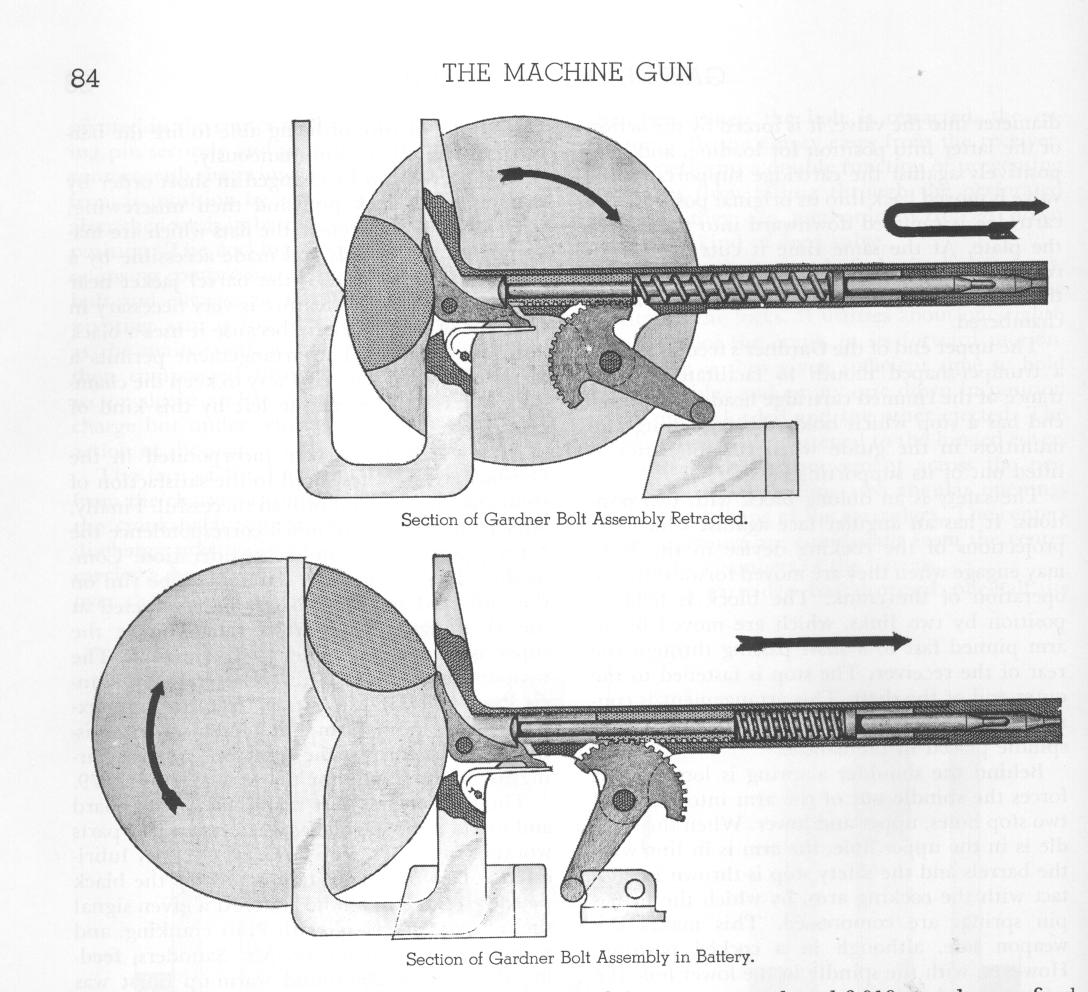
A couple of improvements were made by Pratt and Whitney, which were not part of the original Gardner design: The feed system was improved using cams and levers to take a round and move it positively into place, instead of the earlier gravity feed. They also improved the extractor device and added features to cock the firing pin very slowly to prevent accidental discharges. They also added a safety mode that allowed users to run ammunition through the weapon without firing. An illustration of the firing mechanism is shown below.


The Gardner gun was demonstrated successfully to the US Navy board by Francis Pratt and Amos Whitney themselves. The Navy adopted this weapon and purchased a limited number of them. Unfortunately, the US Army was less interested in this weapon. However, a presentation made in front of the British Navy was much more successful and they bought a license to produce the gun in Europe. One of the major advantages of the Gardner gun over its rivals was that it was a lot lighter than its competitors (various Gatling gun models) and had a higher rate of fire. The British Navy purchase was soon followed by another British order for all branches of their military and they used the weapon in a few African wars in Sudan and the Upper Nile.


Actions: Automatic and Semi-automatic actions

So far, we've studied a number of different actions and weapons that allow users to fire multiple times without stopping to reload. Now we will discuss the actions of modern weapons, mainly semi-automatic and automatic actions.

In the actions we've studied earlier, such as bolt-action, lever action, pump action etc., the user has to fire the weapon and then manipulate some lever manually, in order to eject the old spent cartridge and load in a new cartridge. In many cases, these weapons have multiple cartridges loaded into the magazine and manipulating the lever strips a new cartridge from the magazine.

In the case of revolvers, the act of pulling back the hammer or the trigger rotates the cylinder and brings upon a new round to be fired.

In the early 1850s, it was realized that if the loading operation could be automated, then this would lead to more rapidly firing firearms. This lead to several innovations in firearms technology. We will study some of the principal actions in the next few posts, such as the Gatling action, chain action, blowback action, gas operated action, recoil action etc.

This might be a good stage to gloss over the differences in various actions:
  • Gatling: This consists of a multiple barrel weapon. The various barrels rotate about a central axis and fire one at a time. The barrels may be rotated by hand or by an electric motor.
  • Chain driven: This is a single barrel weapon that uses a electric motor and a drive chain to drive the mechanisms to load a cartridge, fire it and eject the spent cartridge.
  • Blowback: In this type of mechanism, some of the expanding gases from a fired cartridge push back on the cartridge. The bolt holding the cartridge in place is not locked and is only held by spring pressure. The spent cartridge case is pushed back against the bolt and these are together forced back against the spring pressure and this force helps eject the old cartridge, cock the weapon and load a new cartridge into place. The barrel of a blowback weapon is generally fixed and does not move when the weapon is fired.
  • Gas operated: In this type of action, as the gas escapes through the front of the barrel, some of it is bled off and fed back to actuate the ejection of the spent cartridge and load a new one.
  • Recoil operated: In this type, the bolt and barrel are locked at the point that the cartridge is fired (a key difference from the blowback action where the bolt is never locked.) After the cartridge is fired, the barrel and bolt move together in the opposite direction from the bullet, due to Newton's third law of motion. The barrel stops moving at one point and the bolt unlocks and continues to move backward to cock the weapon, eject the old cartridge and load a new cartridge.
Blowback actions are generally used many smaller pistols and recoil operated weapons on some bigger pistols and shotguns. Gas operated mechanisms are generally used for assault rifles and some pistols. Gatling and chain actions are now generally used for larger fully automatic weapons, most of which are too heavy to be carried by a single individual and fall somewhat out of the range of what can be called "firearms".