Showing posts with label Remington. Show all posts

Thursday, December 10, 2015

5.56mm vs. .223 Ammunition Revisited

Many months ago, we studied the differences between the 5.56mm. and the .223 cartridges. In that article, it was mentioned that the dimensions of the 5.56x45mm. NATO cartridge and the .223 Remington cartridge are almost identical. One reader of this blog, Mr. Mark Rohrer, recently commented in that article that he did the math and found out:
.223 in. and 5.56 mm are NOT the same diameter; .223 in. maths to 5.6642 mm and that is a significant difference of 0.1042 mm.
And if you do the calculations yourself, you'll notice that he's right (click here to verify, or you can calculate it yourself by knowing that 1 inch = 25.4 mm., therefore .223 inches = .223 * 25.4 = 5.6642 mm.). Also, if you do the calculations to convert 5.56 mm. to inches, you'll find that it is approximately .219 inches, not .223 inches.

So what is going on here? If .223 inches is bigger than 5.56 mm., how are the dimensions of the two cartridges nearly equal? This article explains everything about this mystery.

First, we go back to another article from a couple of years ago, where we studied how cartridges get their names. It was mentioned there that in the US, we tend to name cartridges after the groove diameter of the rifle barrel, rather than the diameter of the bullet, at least since around 1950 or so. On the other hand, in Europe (except in the UK), they tend to name their ammunition after the bore diameter of the rifle barrel. Since the specifications of the 5.56x45mm. cartridge came from Belgium, that means that the 5.56 part refers to the bore diameter of the barrel. And since the .223 was developed in the US off of a Remington cartridge, .223 refers to the groove diameter of the barrel.

So what is the bore diameter of a rifle (e.g. M16) that fires the .223 cartridge. Well, it just happens to be .219 inches, which translates to about 5.56 mm. when you convert it to millimeters. And the groove diameter of the same rifle barrel is .223 inches. So now we see where the 5.56 and .223 figures come from.

Now if you look at the specifications of the bullet in a .223 cartridge, the diameter of the bullet is actually specified as slightly larger than the groove diameter of the barrel. In fact, the diameter of the bullet is specified as .224 inches (or 5.70 mm. in metric). Now look at the actual dimensions of the two cartridges as specified by C.I.P standards. First, we have the specifications for a .223 cartridge:

Dimensions of a .223 cartridge per the C.I.P standards. Click on the image to enlarge.
Image licensed under the Creative Commons Attribution 3.0 Unported License by Francis Flinch.

The dimensions of this cartridge are specified in mm., in the above image, so we can easily compare it to the next image, which happens to show the specifications of a 5.56x45mm. cartridge per the C.I.P standards:

Dimensions of a 5.56x45 mm. cartridge per the C.I.P standards. Click on the image to enlarge.
Image licensed under the Creative Commons Attribution 3.0 Unported License by Francis Flinch.

As you can see, the external dimensions of the two cartridges are almost identical. In particular, note the diameter of the bullet (marked in both images as ⌀G1), which happens to be 5.70 mm., which translates to .224 inches (actually, both images show it as "5,70", but in some European countries, they use the comma where we use the decimal point and vice versa, so they write "5,70" where we write "5.70". Also, in engineering drawings, the convention is to use the diameter symbol (i.e.) ⌀, to denote the diameter of the object at that location.)

From the above images, the reader can see that not only are the bullet diameters identical, so are the external dimensions of most other parts of the two cartridges as well. The differences between the two really have to do with the internal dimensions, case thickness and pressures generated, as this article that we studied previously explains.


Thursday, September 6, 2012

What is the difference between 5.56mm and .223 ammunition?

To a layman, the 5.56mm. cartridge and the .223 cartridge are the same dimensions. However, many people would advice not to use one in a rifle that is designed for the other, so clearly there must be some differences. This post attempts to clear the mysteries.

First thing to note is that while the US military started switching to metric measurements in the 1950s, in order to better work with NATO military forces, the rest of the US still stayed on with English measurements to the present day. Therefore the US military calls the diameter of the bullet as 5.56 mm. whereas the civilian market calls it .223 caliber (i.e. 0.223 inches diameter), even though they are the same diameter. A good rule of thumb is to assume that when people refer to 5.56x45 mm. cartridge, they are talking about the military-specification cartridge and when they say .223 Remington, they're usually referring to the civilian version of the cartridge.

When it comes to cartridge dimensions, the 5.56x45 mm. NATO cartridge and the .223 Remington have almost identical dimensions. Note that the operative word here is "almost": they are similar enough in shape that either may fit into a gun designed for the other, except for those firearms designed to very tight tolerances. However, there are differences in the pressures and velocities generated by the two types of ammunition. For one thing, 5.56x45 mm. cartridge has thicker case walls. The .223 Remington cartridge also generates far less pressures compared to the 5.56x45 mm. cartridge. What this means is that it is generally safe to shoot .223 ammunition in a rifle designed for 5.56x45 mm. NATO cartridges. The reverse is not true though: firing 5.56x45 mm. ammo through a rifle designed for .223 ammunition may cause excessive stress to the rifle's barrel and chamber because the rifle is designed to operate with the lower pressures of .223 ammunition, which could lead to a very unsafe situation.

While firing .223 Remington cartridges through a rifle designed for 5.56x45 mm. ammunition is generally considered safe, the slight differences in cartridge dimensions make the rifle slightly less accurate than if the .223 Remington cartridges were to be fired by a rifle designed for .223 Remington.


Wednesday, June 27, 2012

Best Gun - 2

In our previous post, we looked at the term "best gun". As we found in our previous post, this is a term that is used to refer to a high-quality double barreled shotgun with some very specific features in it. Quite a few of these are manufactured by British firms, especially London based ones, but they are not the only ones. W.W. Greener and Westley Richards, both from Birmingham, also manufacture "best guns", as do firms from other countries around the world.

Italy also has some well-known best gun makers, such as Piotti, Fabbrica Armi d'Abbiatico e Savinelli (FAMARS), Beretta, Fabbri, Benelli etc. Their products (and prices) are comparable to some of the finest British firms. These firms are usually located in Northern Italy, which was a traditional firearms manufacturing center for centuries. The town and region of Brescia was known for its fine firearms for at least 500 years and before that, it was a hotbed for production of swords for the Roman legions.

A best gun made by Piotti of Italy. Click on image to enlarge.

A best gun made by Fabbri of Italy. Click on image to enlarge.

The above two examples show the fine work of their manufacturers. The model made by Fabbri sells for over $250,000!

Not to be outdone, we have manufacturers from Spain and Belgium as well. The Spanish city of Eibar in the Basque Country region is a traditional gunmaking town from the middle ages, as is the town of Liege in Belgium. Predictably enough, the well known manufacturers of best guns come from these regions as well. Spanish best gun manufacturers such as Pedro Arrizabalaga, Armas Garbi, Grulla Armas etc. have a good reputation in the market.

A best gun made by Pedro Arrizabalaga. Click on image to enlarge 

A best gun made by Armas Garbi. Click on image to enlarge.

Spanish best guns are generally priced well below their English or Italian counterparts, but they are still very high-quality firearms.

The city of Liege in Belgium was also a traditional hotbed of firearms manufacturing since the 1400s or so. The various manufacturers based around this city used to produce firearms of varying qualities: see our discussion on spurious firearms for some low quality specimens. It has also produced some very high-quality products as well. Most of the manufacturers in and around Liege have gone out of business at the present time, but there are a few small manufacturers still in business and also the 800 lb. gorilla, Fabrique Nationale (FN), which continues to make best guns along with military rifles, pistols, revolvers etc. These guns normally retail for about $15,000- $80,000 or so.

Germany also had a few best gun manufacturers in history, mostly located around the town of Suhl, which (surprise, surprise) has a long history of gunmaking. After World War II, the town of Suhl went to East Germany and thus, the firearms industry in that town went into decline, as the communist government strongly discouraged private arms manufacturers. After German reunification, the town has recovered some of its former glory -- the school of firearms engraving and the Guild of Master Gunsmiths are now both located here. The only major manufacturer still in Suhl is the firm of Merkel, but some of the other well known German manufacturers such as J.P. Sauer & Sohn, Krieghoff etc. moved to West German towns after World War II and are still in business. J.P. Sauer & Sohn, founded in 1751, is well-known for their SIG Sauer line of pistols, but they also manufacture best guns.

German best guns tend to be heavier than their English or Italian counterparts and tend to be very strongly built. They also tend to have deeper engraving. Because their style is different from the "London Best" style followed by British, Italian and Spanish manufacturers, the demand is lower and hence they are lower priced. However, they have very good strength and quality of workmanship.

Finally, we have the United States. At one time, there were many best gun manufacturers in the good ol' USA: Remington, Parker, Winchester, Lefever, Ithaca etc. Most American best guns are heavier than their English, Italian or Spanish counterparts because they are designed to fire stronger American shotgun cartridges. American best guns are generally built for mass production, hence many lack some of the characteristics of the very best British, Italian or Spanish guns. However, the quality of engraving, checkering and finish are excellent on the high-grade guns and are comparable to other best gun products from other manufacturers. There are still manufacturers in the US that are building replica models of some of the finest shotguns made in the last couple of centuries.

Monday, December 6, 2010

Pistols: Modern Single Shot Pistols

While most pistols started to become multi-shot weapons in the 1800s, there were some pistol models that were still single-shot models well into the 1900s. Many of these models use bolt-action firing mechanisms. Examples include Remington XP-100, Savage Striker, Wichita, Weatherby Mark V CFP etc.

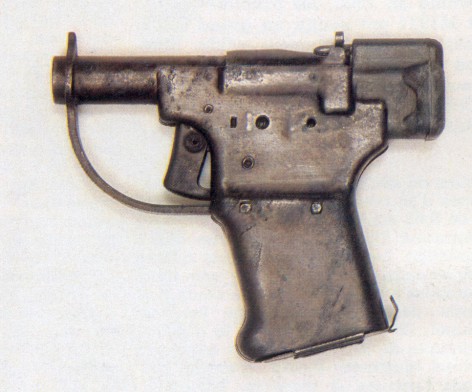
There is one more interesting single shot pistol which saw a lot of production during World War II. This was the FP-45 Liberator, which was produced in the United States during WW-II.


This pistol was designed in 1942 and hence it also has the designation M1942. The purpose of this design was to make a basic pistol that was very cheap to manufacture and easy to mass-produce and could be dropped in large quantities over Europe to arm the resistance forces. The Liberator was also designated as "Flare Projector" Caliber .45 (FP-45). The .45 was because it fired a standard 45 caliber pistol bullet (the same as that used by the Colt M1911 automatic pistol). The "Flare Projector" designation was deliberate misinformation, to disguise the purpose of this project and the fact that this weapon was mass-produced. The original design documents also had mislabeled parts to hide the true purpose of this device. For instance, in the original design documents, the barrel is called "a tube", the trigger is called "yoke, the firing pin is a "control rod" and trigger guard is a "spanner".

The pistol had only 23 parts, most of which were stamped or turned steel components, which made it very easy to manufacture. The barrel was completely unrifled, so it wasn't accurate beyond 10 meters or so. The pistol was packaged in a cardboard box along with 10 bullets and a comic-book style instruction sheet on how to use the weapon. There was also a wooden dowel included in each box to push out the fired cartridge case. It took approximately 10 seconds to load this pistol. Extra bullets could be stored in the handle of the pistol.

This weapon was never designed with regular troops in mind. It was designed to be mass produced and cheap, so that large quantities could be dropped over occupied Europe. It was also designed to be concealable. The idea behind this weapon was that a resistance fighter could use it at close range to surprise and shoot an enemy soldier and then take his weapons.

Manufacturing was outsourced to the Guide Lamp Division of General Motors. Guide Lamp Co. used to be an independent headlight manufacturer before it was bought by General Motors in 1928. During World War II, the Guide Lamp division also produced small arms, notably the famous M3A1 "Grease Gun" submachine gun. General Motors produced over one million of these pistols over a 6 month period, at an average cost of $2.40 per weapon (or about $30 in 2010 dollars). Actual production time in the 6 month period when this pistol was made was actually only 11 weeks and the entire weapon was produced at a rate of one every 7 seconds or so. This meant that this weapon had the dubious distinction of having a faster production time than the time taken to load it!

Despite its original intention, the weapons were not mass-dropped over Europe. More of these were dropped into China and the Philippines during World War II. The same concept was revived during the Vietnam war, when the Deer Gun (another low cost weapon made of Aluminium) was designed in 1964 for similar purposes. The Deer Gun was never distributed in large quantities though.

Even though the Liberator originally cost $2.40 to produce and there were over a million of them manufactured, it is something of an expensive weapon today in auction houses. In fact, a Liberator in its original box with instruction sheet can cost over $2000 at current day prices!

Monday, September 13, 2010

Actions: Recoil Action: Long Recoil Operation

In the last few posts, we talked about a particular type of recoil action called the short recoil operated action. In this post, we will talk about another type of recoil action, the long recoil operated action.

This action is actually one of the older recoil operated actions in existence, being over 100 years old at least. It is commonly used in naval guns or artillery, but not as mucsh seen with small arms. When it comes to small arms usage, it is mostly used by some well known semi-automatic and automatic shotgun designs. The long recoil action shotgun was originally designed by the famous gun designer, John Browning in 1898 and patented in 1900. This action is very rarely used for pistols and there is only one (Frommer pistol) that used it for a pistol.

In a long recoil operation, the bolt and barrel are allowed to recoil, similar to that of a short recoil operation. At the point when the bullet is fired, the bolt and barrel are locked together. As the weapon fires, the bolt and barrel move back together due to the recoil. They continue to move together backwards until they reach the back of the receiver and recock the hammer. At this point, the bolt is held in the back of the receiver by a catch. The barrel is then pushed forward by a barrel spring and returns completely forward, during which time the spent cartridge case is ejected. When the barrel has reached its fully forward position, the bolt is then released from the back and pushed foward by another spring. As the bolt moves forward, it picks up a new cartridge from the magazine and pushes it into the barrel chamber.


As you can see in the illustration above, the first image shows the bolt and barrel right after the bullet has been fired. Note that the bolt and barrel each have their own individual recoil springs. The second image shows the bolt and the barrel moving backwards due to the recoil until they reach the end of their travel, whereupon the bolt hooks on the catch and is left held there. Meanwhile, the barrel recoil spring uncompresses and pushes the barrel forward, as shown in the third image. When the barrel reaches its forward position, it releases the catch that is holding the bolt back in the third image and the bolt is then pushed forward by the bolt recoil spring.

Compared to the blowback actions we've studied previously, this type of action can handle much heavier loads.

Compared to the short recoil operated action, there are some significant differences.
  1. When the weapon is fired, the bolt and barrel move back together initially, just like in a short recoil operated action. However, in the short recoil operation, the two move back together only a few mm. at most, before the barrel stops while the bolt continues to move backwards. In the long recoil operated action, the separation of the bolt and barrel happen much later. In fact, in a long recoil operation, the bolt and barrel move all the way backwards until they reach the end of their travel in the back of the receiver.
  2. Short recoil actions tend to have only one return spring. Long recoil actions have separate return springs for the barrel and the bolt.
Since the bolt and barrel are much heavier than the bullet and since they move backwards together a long way compared to a short recoil operation, the cycle time of shooting and reloading is much slower compared to a short recoil action or a blowback action. On the other hand, the longer cycle time leads to slower, smoother operation.

The long recoil operated action was used in the John Browning designed Auto-5 shotgun, which was the first semi-automatic shotgun. This shotgun was originally designed in 1898. The Browning Auto-5 model was designed with the intention of making it suitable for mass production and the design was licensed out to various manufacturers, such as FN, Remington, Savage arms, Franchi etc. and remained in production until 1999. This makes this model one of the most successful shotguns in history.

Remington Model 11 shotgun, which uses the Browning designed long recoil action.
Public domain image.

When John Browning had originally designed the Auto-5, he intended to sell the design to the Winchester arms company, since he had already sold several designs to them previously. However, Winchester was not prepared to pay the amount of royalty that Browning demanded, so he went to Remington next. Tragically, the Remington deal fell through, as the president of the Remington company died of a heart attack during the negotiation period. Hence, John Browning went to Europe and licensed the design to Belgium's Fabrique Nationale (FN). Later on, Remington licensed the design again and used it with their Model 8, Model 11 and Sportsman model shotguns. The design was also later licensed to Savage Arms of the US, Franchi and Breda of Italy and Tula State Arsenal (TOZ) of Russia. The French designed Chauchat light machine gun of World War I also used a version of the Browning long recoil action mechanism. While the Chauchat was mostly a failure, the shotguns remained in use for a very long time indeed.

Sunday, July 4, 2010

Revolver: Modern Revolvers

When we last left off on revolver developments, we'd studied single and double action revolvers and the beginning of metallic cartridges replacing percussion caps.

Because of the rapid fire capability of the double-action mechanism, it became the mechanism of choice for new revolvers. Today, most modern revolvers are still double-action. Even Colt, the proponents of single-action pistols, switched to double-action models by the end of the 1800s with their Colt New Service Revolver. Models by Smith & Wesson, Remington, Webley etc. were very popular as well.

By the 1850s or so, metallic cartridges began to replace percussion cap technology. Some revolvers, such as the French-made Lefaucheux, were built to use pinfire cartridges. In 1857, Smith & Wesson introduced their first revolver which used a .22 short rimfire cartridge, also developed by Smith & Wesson. This model was a huge success in the market-place and was responsible for establishing the fame of Smith & Wesson. By the mid 1860s, centerfire cartridges became popular and revolvers began to use them as well (such as the Colt Peacemaker). Most of the early metallic cartridges still used black powder as their propellant, but more powerful smokeless powders started to become popular after 1886 or so and revolver manufacturers began to certify their weapons as safe to be used by smokeless powders as well. This meant using new metallurgical techniques of manufacturing weapons to withstand the higher pressures generated by smokeless powders.

As more powerful cartridges were developed, revolvers were built to fire them as well. In the 1950s, the .44 magnum cartridge, introduced by Elmer Keith and built by Remington, was used by the Sturm-Ruger Blackhawk and the Smith & Wesson Model 29 revolvers. Unusually, the Sturm-Ruger Blackhawk was a single-action revolver, rather than a double-action model. Ruger discovered that after Colt had pulled out its popular Colt Peacemaker (another single-action model) out of the market, there was still some demand for single-action weapons and went on to fill that demand. Company legend at Sturm-Ruger has it that Smith & Wesson were experimenting with the new .44 magnum cartridge in secret, but a Sturm-Ruger employee found the empty cartridge cases in a garbage pile and took one to Bill Ruger and the Blackhawk revolver beat Smith & Wesson's model 29 revolver to the market by several months. The S&W Model 29 didn't sell well initially, but in 1971, the movie "Dirty Harry" came out, with Clint Eastwood's character, "Dirty" Harry Callahan, describing the S&W Model 29 as the "most powerful handgun in the world". While this was not strictly true at this point (the .454 magnum was already developed), this line of movie dialog made the demand for the Model 29 to skyrocket, to the point that dealers were having trouble keeping the Model 29 in stock, even after selling them at triple-price! These days, there are revolvers built to fire even more powerful cartridges, such as the .454 and the .5oo magnum, but the Model 29 sales still remain high, 35 years after the movie came out.

Revolvers used to be the weapon of choice in military and police departments around the world, until modern semi-automatic pistols such as the Colt M1911 became more popular due to shorter reload time and higher capacity of cartridges. Police departments in the United States continued to use revolvers well into the early 1990s, when they began to be replaced by semi-automatic pistols. They are still popular in the civilian market as sporting or hunting weapons. In fact, many trainers recommend new shooters to start off with a revolver.