Showing posts with label Minie Bullet. Show all posts

Saturday, November 7, 2015

Early Cartridge Technologies: Paper Cartridges - II

In our last post, we looked at the earliest forms of paper cartridges. In today's post, we will look at more developments in that field.

As firearms technologies improved, smoothbore muskets began to be replaced by rifled barrels for greater accuracy. The invention of expanding bullets, such as the Minie bullet, made it possible for firearms to not only shoot accurately, but also improved the gas seal without the need for thicker wadding, because the bullet would expand and produce the gas seal itself. The main problems to solve here were to reduce the amount of fouling produced by the black powder and lead from the bullet, as well as to keep the cartridges from being affected by bad weather. The solution to both these issues was to provide a coating to the paper cartridge case, in the form of a mixture of beeswax and tallow. This coating allowed the cartridge to be somewhat water resistant, as well as provided lubrication to the bullet.

The lubricant made it easier to push the bullet down the barrel of the muzzle loader and also softened the residue inside the barrel, so that most of it could be pushed out of the way easily when reloading. This helped reduce the problem of powder fouling in the barrel, though it did not solve it.

Since the bullet expanded and provided the tight seal on firing, the paper needed to be thinner than previous paper cartridges, so it could fit between the bullet and the barrel properly. However, the thin paper could cause the body of the cartridge to not be sturdy enough. To get around this problem, cartridges were often made using multiple layers of paper, some thick and others thin. The following instructions and illustrations are taken from an instruction manual dating back to 1853 for the Enfield rifle. The manual explains that soldiers might find themselves in the position of having to make their own cartridges in the field, and therefore the manual shows how this was done.

Three separate papers used to manufacture an Enfield cartridge. Public domain image. 

Tools used to manufacture the Enfield cartridge. Public domain image.


The first image shows the different paper shapes used to make a single cartridge, along with their sizes. The paper shape on the right (labelled as "stiff paper") is made of a thicker paper material and forms the body of the cartridge and gives it the strength, so that the cartridge does not deform easily. The paper shape in the middle (labelled "inner envelope") is made of a thinner paper material. It wraps in a thin tube around the thicker paper and then blocks it on one end, thereby separating the powder from the bullet. The third piece of paper on the left (the "outer pattern") is also made of a thinner paper material. It wraps around the bullet and the other two tubes, thereby enclosing the bullet and powder in one packet.

To manufacture one of these cartridges, the instructions are as follows:
  1. Make the powder case: This is done by rolling the "stiff paper" pattern tightly around the mandrel around 2.5 times. The mandrel is laid opposite to the side AB, with the base of the mandrel head coinciding with AD. After the "stiff paper" is rolled around the mandrel, the "inner envelope" paper is placed on top of it and rolled around it. The second paper overlaps the first one, so the excess is pushed into the hollow at the base of the mandrel, making use of the point to adapt the paper to the cavity which is to receive the point of the bullet, being careful to secure the bottom of the powder case, so that no powder can escape from it.
  2. Attach the bullet to the powder case: Put the point of the bullet well into the cavity of the powder case. Then roll the "outer envelope" paper tightly around the bullet and powder case, with the mandrel still in it. Then twist or fold the overlapped paper as close as possible to the base of the bullet. Then place the base of the cartridge on the table and withdraw the mandrel carefully from the other end, by pressing the powder case with one hand, while pulling the mandrel with the other, the aim being to not separate the powder case from the bullet. The powder case must be kept as close to the bullet as possible, otherwise the cartridge will not be usable.
  3. Charge the cartridge case: Place a funnel at the mouth of the cartridge case and pour in about 2.5 drams of black powder, or a lesser quantity, according to the firearm used. Remove the funnel, being careful that none of the powder escapes between the inner and outer envelopes and then secure the charge by squeezing the tops of the two envelopes close to the top of the stiff paper of the powder case, and then giving them a slight twist with inward pressure, laying the ends on the side of the cartridge. Three slits are made in the outer envelope to facilitate its detachment when fired.
The next picture is in color and shows how these three papers combine together in a complete cartridge:

Internals of an Enfield cartridge from the 1850s. Click on the image to enlarge.
Public domain image courtesy of user Zerodamage at Wikipedia/
  1. Lubricate the cartridge: In this step, the base of the cartridge case is dipped up to the shoulder of the bullet, into a lubricating mixture composed of 5 parts of beeswax and 1 part of tallow.
A complete Enfield paper cartridge. Public domain image.


Cartridges were then packed in bundles of ten, and each packet was labelled as shown below.

The second line indicates that these cartridges are for the Enfield model 1853 rifle musket. The next line indicates that the bullet is of .55 inches in diameter. The word "wax" is to indicate the composition of the lubricant and the three horizontal lines after that indicate that the outer paper layer has the three cuts (as detailed in step 3). The next line indicates how much black powder is in each cartridge (2.5 drams) and the last line indicates that each bullet has a plug made of wood in its base and this plug enables the bullet to expand when the cartridge is fired.

The packets were then tied together with strong twine and packed into barrels, by placing the packets around the sides of the barrel, with a cylinder of percussion caps being placed in the center, with the ratio of 75 percussion caps for every 60 cartridges in the barrel.

To load such a cartridge into a rifle, the powder end of the cartridge is opened by tearing the thin outer paper envelope and the powder is then poured into the muzzle of the rifle. Then the bullet end is inserted into the muzzle, up to the level of the thick paper tube, which is then torn off and discarded. The bullet and the remains of the thin outer envelope are then pushed into the barrel using the ramrod and the rifle is then cocked and prepared for firing.

Interestingly, the use of lubricated paper cartridges was one of the causes of the Great Indian Mutiny of 1857. The sepoy soldiers of British India were required to bite on the cartridges to open them, as part of the loading procedure. A rumor spread that the cartridges were greased with beef fat (offensive to Hindus, who are forbidden to eat beef) and pig fat (offensive to Muslims, forbidden to eat pork). There were already rumors that the British authorities were trying to destroy the religions of the Indian people and the rumors of the content of the cartridge grease convinced sepoys of the Bengal regiment that their fears were justified. This was cited as one of the causes for the mutiny to start.

In our next article, we will look at further improvements to the paper cartridge, as we enter into the era of revolvers.


Monday, June 21, 2010

Bullets: Conical Expanding Bullets

In the 1800s, many people began to realize the advantages of rifling and started to make weapons that included rifled barrels. The problems associated with rifling were that if a bullet was too large, it would be difficult to insert it into a rifle and if it was too small, the gases would escape around the bullet and decrease its range.

The first breakthrough was by one Captain Norton who was stationed in India in the 1830s, who invented the first expanding bullet. He was followed in 1836 by Mr. William Greener, a well known Birmingham based gun-maker, who invented a compound bullet that could expand as it was fired. The British authorities paid little attention to their inventions and one of the reasons they rejected these bullets was because they were not spherical balls


In 1849, a Frenchman named Minie took the same idea and made a compound bullet called the Minie ball. We discussed all these three inventions earlier and the reader is invited to go back to that article and observe the pictures of the various bullets.

These were among the first conical shaped bullets that were used. Until then, the bullets were usually shaped as balls. A few years later, Mr. Joseph Whitworth, the pre-eminent mechanical engineer of his day was contracted to improve the rifle and he realized the value of elongating the bullet. The result was a new rifle that used polygonal bore and an elongated polygonal bullet to go with it:

We've also discussed the whitworth bullet in some detail in an earlier article and hence, we will not repeat that discussion here, other than to mention that these new bullets guaranteed better accuracy than the older spherical bullets. As a result of this, spherical bullets went out of fashion and the modern elongated bullet slowly started to gain in popularity.

Sunday, May 16, 2010

Rifling: Expanding Bullets and the Minie Rifle

In designs of weapons we've studied so far, one of the major problems as how to provide a tight seal for the bullet when it is fired. The solution for hundreds of years was to wrap the bullet in a greased cloth patch and ram it down the barrel. This worked reasonably well for smooth-bores, but was not an optimum solution for rifles because if the fit was too tight, it required a mallet to ram the bullet down the barrel and if the bullet was too loose, the expanding gases would escape around the rifling grooves and edges (This technical term is called windage). Then the concept of the expanding bullet was invented in the 1800s. In this method, the bullet has a hollow base and when fired, the hollow base expands and fills the bore of the barrel and engages the rifling grooves.

The first discovery in this direction was due to one Captain John Norton of the British 34th regiment, which was stationed in South India in the early 1830s. Captain Norton had observed that some of the tribes in South India used blow-pipes and he examined some of the darts that they used. He noticed an interesting fact that the base of these darts were made of an elastic pith (pith is the soft spongy wood found in the center of tree trunks). When the tribesman blew in the pipe, the pith base would expand and form a tight seal, thereby preventing air leaks and increasing the range of the weapon. Captain Norton decided to copy the same principle for bullets as well and invented a cylindrical bullet with a hollow base in 1832.

A few years later in 1836, Mr. William Greener, a well-known London gunmaker, improved on the Norton bullet by making a design known as the conoidal expanding bullet.


It consists of an oval shaped bullet where the longest diameter of the bullet exceeds the shortest diameter by a ratio of 1.5 : 1. One end of this bullet has a flat surface and a hole drilled into it, nearly through the length of the bullet. The hole is covered by a tapering conical plug with a round button shaped head, made of wood. The plug is fitted loosely into the hole and the bullet is put in the rifle with either end of the oval foremost. When the gun is fired, the plug is rammed home into the bullet and it expands and fills the bore of the rifle and the grooves and thereby prevents windage from happening (i.e. prevents gas from escaping around the sides of the bullet and via the grooves).

Unfortunately for Captain Norton and W. Greener, the British Ordnance Department rejected both their inventions and never developed any weapons using these bullets. The trial of W. Greener's bullet was conducted in August 1836 by the 60th rifles, and in spite of the trial proving that these bullets were as easy to load as spherical bullets on smoothbore weapons, the invention was rejected on the grounds that the bullet was a compound bullet.

However, W. Greener's idea was later abstracted by a Frenchman, one Monsieur Minie, who invented the Minie ball and the Minie rifle to go with it, in 1849. The Minie rifle was invented as a response to Algerian fighters who would regularly outrange French troops using their hand-made long rifles.


Images based off public domain images courtesy of wikipedia.com

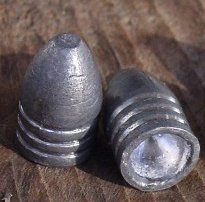
The minie ball or minie bullet consists of a conical-cylindrical bullet made of soft lead. The bullet is designed to be slightly smaller than the diameter of the rifle barrel, so it can easily slide into the barrel. Towards the base of the bullet are carved three or four belted grooves which are filled with grease. The base of the bullet is made of a hollow conical iron cup. When the bullet is fired, the iron cup drives into the base of the bullet thereby expanding the grooves outwards. The expanding grooves engage the rifling inside the barrel, thereby sealing it from gas leaks.

The Minie rifle that used this bullet was a muzzle-loading weapon with a percussion lock firing mechanism and a rifled barrel. Paper cartridges, each containing a minie ball and a pre-measured amount of gunpowder were issued with the weapon. To use the rifle, the user would pour the gunpowder into the barrel and push the minie bullet in through the top. Since the minie bullet is smaller in diameter than the barrel, it is easily pushed through, even if the barrel has some fouling and detritus in it. When the gun is fired, the expanding gases make the bullet deform and engage the grooves in the rifling. The rifling then serves to provide spin to the bullet, thereby providing more accuracy. The expansion also makes a tighter gas seal, which gives greater range and it also cleans the grooves of detritus as well.

When the minie rifle was tested in 1849, it penetrated two 17 mm. (0.66 inches) thick poplar wood boards separated by 50 cm. (19.68 inches) distance, from a range of 15 meters (16.4 yards). This led to a rumor that it could penetrate a soldier and his knapsack at 1100 meters (about 1200 yards) and also kill the person standing behind him, and at close ranges, it could kill 15 men standing in line.

The minie rifle and the minie bullet came to the notice of the British War Ministry in 1852. Hence, the British Government paid Monsieur Minie a sum of 20,000 pounds as a royalty for the right to use his bullet design for British rifles. This particular award enraged Mr. W. Greener whose earlier invention of 1836 was rejected by the British Ordnance board and he started several unsuccessful attempts against the British Government to be given some credit for his innovation. It took some lobbying by Mr. Scholefield, MP for Birmingham (the town where the W. Greener factory was located) to show the correspondence that occurred in 1836 between W. Greener and the British Ordnance board before the British Government finally admitted Mr. Greener's prior invention. In 1857, the British Government awarded W. Greener a smaller sum of 1,000 pounds, as well as the credit for "the first public suggestion of the principle of expansion, commonly called the Minie principle, in 1836."

The Minie rifle was used by both French and British troops in the Crimean war (1853-1855) against Russia. Other rifles using the Minie bullet principle were heavily used by both sides in the American Civil war, where it was the most common rifle used. The US versions of the bullet (adopted before the civil war) had three exterior grooves on the bullet instead of four. The US versions also had thinner walls near the base and omitted the iron cap at the base, as the pressure of the expanding gases was enough to deform the bullet by itself. The wounds caused by the Minie bullet were staggering and surgeons of the day often amputated limbs rather than trying to remove bone fragments and risk secondary infection.

The British adopted the Minie Pattern 1 between 1852 and 1855, where it was replaced by the newer Enfield Pattern 1853 rifle, which also used a Minie bullet. The Enfield Pattern 1853 rifle served the British empire between 1855-1867 and was one of the causes of the Indian mutiny of 1857. This rifle model was the one that was issued to troops of the East India company in 1857 and rumors were spread that the paper cartridges were greased with pig fat and cow fat, which were abhorrent to the sepoys for religious reasons.

The Minie rifle and its derivatives became obsolete around 1866 or so, when they were replaced by breech-loading rifles. One of the main disadvantages of all muzzle-loading rifles was that the soldier had to stand up to load the weapon, whereas a breech-loading weapon could be loaded from the prone position. Despite all improvements to muzzle-loading weapons, a breech-loading weapon could still be loaded much faster than a muzzle-loading one. The clear advantage of the breech loading Dreyse needle-gun used by the Prussians against the Austrians spelled the end of muzzle-loaders in general and the Minie rifle became obsolete along with other muzzle-loaders of the day. However, the concept of a bullet that deforms and engages the grooves of the rifled barrel has stayed with us to this present day and modern firearms still use this principle.