Showing posts with label rifle. Show all posts

Sunday, November 22, 2015

Early Cartridge Technologies: Linen Cartridges

A few weeks ago, we began to study an early form of cartridge: the paper cartridge. Where we left off, paper cartridges had advanced to the point where the paper was treated with chemicals to make it more combustible.

The main problems with paper cartridges are that they aren't very water resistant and the paper is somewhat fragile. As the bullet could be rather heavy, the weight of the bullet could cause the paper to tear as well. There was a need for a cartridge to be made of a more durable material and that's when the linen cartridge was born.

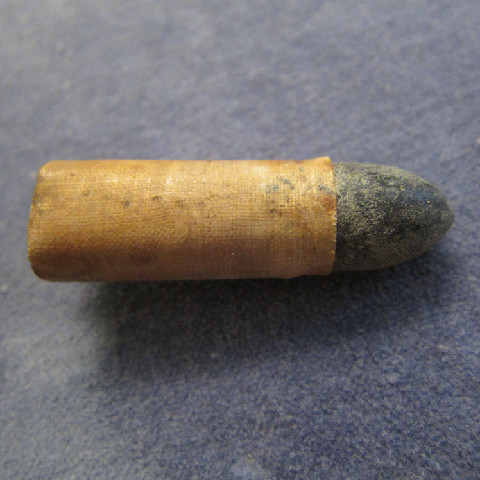
A .52 caliber linen cartridge for a Sharps rifle. Click on the image to enlarge.

In 1852, American inventor Christian Sharps invented a linen cartridge, to go with his Sharps rifle (which was earlier invented in 1848). The linen cartridge was a great improvement over the paper cartridge because it could withstand rough handling better, without breaking open. A linen cartridge also held its shape better than a paper cartridge could. The back of the linen cartridge had a piece of nitrated flash paper (which we studied in the last post) to provide the ignition. The linen used to make the cartridge body was treated with starch to make it stiffer. Linen cartridges were also treated with chemicals to make the linen more combustible, similar to that of paper cartridges that we studied earlier. Like the paper cartridges, the bullet was glued on top with sodium silicate glue.

For a while, cartridges were made for the Sharps rifle with both paper and linen, but the linen cartridge gradually started to find some backers. In the words of a Major W.A. Thornton:

"The making of Sharps Cartridges with paper must be abandoned and linen must be used in the formation of the cylinder. More care cannot be given in the making of cartridges than is bestowed in our laboratory. The fact is that the ball is too heavy for the paper, and worse than that -- the paper is sometimes softened by the lubric which causes it to break by the weight of the ball. From this date, I will make no more of paper, but I will make the powder cylinder of linen."

What the Major is describing are two flaws of the paper cartridges used by the Sharps rifles. The first is that the weight of the bullet is so great that a paper cartridge cannot hold its shape and often tears open by itself, due to the weight of the bullet. The second problem is that the lubricant (spelled in his letter as "lubric") also softens the paper and weakens it, thereby causing the paper to break. Since the lubricant is necessary to reduce the fouling inside the barrel, a stronger material must be used for the case body and this is why linen was used.

Linen cartridges were used by both the Sharps rifle and the Starr carbine during the Civil War.

In our next post, we will study another durable material that was also used to make cartridges during that period of time.


Saturday, November 14, 2015

Early Cartridge Technologies: Paper Cartridges - III

In our last post, we saw the advances in paper cartridge technology to handle expanding bullets. In today's post, we will study more advances in paper cartridge technology around the time that percussion caps and revolvers started becoming popular.

Early Colt Paterson revolvers. Click on the image to enlarge. Public domain image.

With the advent of percussion cap revolvers, such as the Colt Paterson models pictured above, most people loaded their revolvers from paper cartridges exclusively. The paper cartridges were therefore modified a bit to take advantage of these new developments in firearms.

In the picture above, note that the two Colt Paterson 1839 model revolvers have a loading lever under the barrel, whereas the 1836 model doesn't have this feature. We will see how that is used with the cartridges that we will study today.


Paper cartridges for a .36 caliber Colt revolver.; Click on the image to enlarge

As you can see in the images above, the bullet is now in the front of the cartridge (unlike the designs we studied in our last post). The bullet is attached to the cartridge with glue. Also, the shape of the cartridge has changed a bit, so that the paper part now forms a conical shape instead of a cylindrical shape. This was a deliberate design choice, so that it is easier for the user to insert the cartridge into the front of the cylinder. Unlike previous designs, there is no need to tear the paper and pour the powder into the chamber. Instead, the loading lever is used to ram the entire cartridge into the chamber. Because of the shape of the cartridge, the cartridge paper automatically tears open when it is compressed into the chamber. Some cartridges were equipped with a protective outer layer around the cartridge, to keep it safe from moisture, and these would have a tiny tear tab to remove the outer layer before loading the cartridge.

A glue made of sodium silicate was used by the Colt Manufacturing Company to hold the bullet to the cartridge, as well as seal the paper part. This was what was used by Colt between 1851 to 1873, until they started to produce brass cartridges in 1873. Sodium silicate has the advantages of resisting high temperatures, as well as being cheap and easily available. Sodium silicate was also used to cement the top wad of shotgun shells and was heavily used by American farmers who reloaded their own shells in the 1870s, as sodium silicate was the same material used to preserve eggs as well.

One more innovation made to these cartridges was to the paper material as well. In order to make the ignition of the powder more reliable, the paper was treated with chemicals to make it burn better. This paper is called nitrated paper, as it is manufactured by soaking it in a solution of potassium nitrate and then drying it. This treatment makes the paper much more flammable than ordinary paper. Such cartridges are called combustible cartridges, because the paper burns almost completely upon ignition. A properly nitrated paper leaves behind less ash and residue, thereby making it easier to clean and reload the weapon.

Another formula for making combustible paper used a solution of nitric and sulfuric acids and was used by both Colt Manufacturing and Dow Chemicals, as well as some other manufacturers in the 1800s. These are essentially the same chemicals used to produce guncotton, which we had studied a few years before. Paper that is treated this way is called flash paper. This paper also burns quickly and leaves very little ash behind, but it is much more unstable than nitrated paper, and in the early days, it was also prone to spontaneous combustion. This is why flash paper did not gain much popularity in the firearms industry. These days, the only people using flash paper are magicians, who use it to produce spectacular flames when performing magic tricks.

With the advent of metallic cartridge technologies, the use of paper cartridges started to reduce. However, there are still some applications for which paper is used. For instance, until about 1960 or so, many shotgun shells were made of paper bodies, with a brass base and rim. The reason for this was because it was cheaper and easier to make the body out of paper than to make the entire shotgun shell out of brass. Around 1960, shotgun shells started to use plastic bodies instead of paper, and a majority of modern shotshells today make use of plastic. Nevertheless, it is still possible to buy paper shotshells even today.


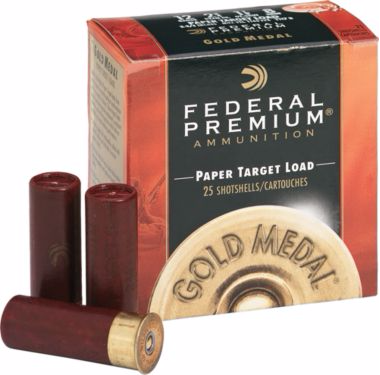
The bodies of these cartridges are made of a cardboard paper and are coated with wax to provide some resistance to moisture. They aren't as common as they were back before 1960, but there are still some manufacturers making them.


Saturday, November 7, 2015

Early Cartridge Technologies: Paper Cartridges - II

In our last post, we looked at the earliest forms of paper cartridges. In today's post, we will look at more developments in that field.

As firearms technologies improved, smoothbore muskets began to be replaced by rifled barrels for greater accuracy. The invention of expanding bullets, such as the Minie bullet, made it possible for firearms to not only shoot accurately, but also improved the gas seal without the need for thicker wadding, because the bullet would expand and produce the gas seal itself. The main problems to solve here were to reduce the amount of fouling produced by the black powder and lead from the bullet, as well as to keep the cartridges from being affected by bad weather. The solution to both these issues was to provide a coating to the paper cartridge case, in the form of a mixture of beeswax and tallow. This coating allowed the cartridge to be somewhat water resistant, as well as provided lubrication to the bullet.

The lubricant made it easier to push the bullet down the barrel of the muzzle loader and also softened the residue inside the barrel, so that most of it could be pushed out of the way easily when reloading. This helped reduce the problem of powder fouling in the barrel, though it did not solve it.

Since the bullet expanded and provided the tight seal on firing, the paper needed to be thinner than previous paper cartridges, so it could fit between the bullet and the barrel properly. However, the thin paper could cause the body of the cartridge to not be sturdy enough. To get around this problem, cartridges were often made using multiple layers of paper, some thick and others thin. The following instructions and illustrations are taken from an instruction manual dating back to 1853 for the Enfield rifle. The manual explains that soldiers might find themselves in the position of having to make their own cartridges in the field, and therefore the manual shows how this was done.

Three separate papers used to manufacture an Enfield cartridge. Public domain image. 

Tools used to manufacture the Enfield cartridge. Public domain image.


The first image shows the different paper shapes used to make a single cartridge, along with their sizes. The paper shape on the right (labelled as "stiff paper") is made of a thicker paper material and forms the body of the cartridge and gives it the strength, so that the cartridge does not deform easily. The paper shape in the middle (labelled "inner envelope") is made of a thinner paper material. It wraps in a thin tube around the thicker paper and then blocks it on one end, thereby separating the powder from the bullet. The third piece of paper on the left (the "outer pattern") is also made of a thinner paper material. It wraps around the bullet and the other two tubes, thereby enclosing the bullet and powder in one packet.

To manufacture one of these cartridges, the instructions are as follows:
  1. Make the powder case: This is done by rolling the "stiff paper" pattern tightly around the mandrel around 2.5 times. The mandrel is laid opposite to the side AB, with the base of the mandrel head coinciding with AD. After the "stiff paper" is rolled around the mandrel, the "inner envelope" paper is placed on top of it and rolled around it. The second paper overlaps the first one, so the excess is pushed into the hollow at the base of the mandrel, making use of the point to adapt the paper to the cavity which is to receive the point of the bullet, being careful to secure the bottom of the powder case, so that no powder can escape from it.
  2. Attach the bullet to the powder case: Put the point of the bullet well into the cavity of the powder case. Then roll the "outer envelope" paper tightly around the bullet and powder case, with the mandrel still in it. Then twist or fold the overlapped paper as close as possible to the base of the bullet. Then place the base of the cartridge on the table and withdraw the mandrel carefully from the other end, by pressing the powder case with one hand, while pulling the mandrel with the other, the aim being to not separate the powder case from the bullet. The powder case must be kept as close to the bullet as possible, otherwise the cartridge will not be usable.
  3. Charge the cartridge case: Place a funnel at the mouth of the cartridge case and pour in about 2.5 drams of black powder, or a lesser quantity, according to the firearm used. Remove the funnel, being careful that none of the powder escapes between the inner and outer envelopes and then secure the charge by squeezing the tops of the two envelopes close to the top of the stiff paper of the powder case, and then giving them a slight twist with inward pressure, laying the ends on the side of the cartridge. Three slits are made in the outer envelope to facilitate its detachment when fired.
The next picture is in color and shows how these three papers combine together in a complete cartridge:

Internals of an Enfield cartridge from the 1850s. Click on the image to enlarge.
Public domain image courtesy of user Zerodamage at Wikipedia/
  1. Lubricate the cartridge: In this step, the base of the cartridge case is dipped up to the shoulder of the bullet, into a lubricating mixture composed of 5 parts of beeswax and 1 part of tallow.
A complete Enfield paper cartridge. Public domain image.


Cartridges were then packed in bundles of ten, and each packet was labelled as shown below.

The second line indicates that these cartridges are for the Enfield model 1853 rifle musket. The next line indicates that the bullet is of .55 inches in diameter. The word "wax" is to indicate the composition of the lubricant and the three horizontal lines after that indicate that the outer paper layer has the three cuts (as detailed in step 3). The next line indicates how much black powder is in each cartridge (2.5 drams) and the last line indicates that each bullet has a plug made of wood in its base and this plug enables the bullet to expand when the cartridge is fired.

The packets were then tied together with strong twine and packed into barrels, by placing the packets around the sides of the barrel, with a cylinder of percussion caps being placed in the center, with the ratio of 75 percussion caps for every 60 cartridges in the barrel.

To load such a cartridge into a rifle, the powder end of the cartridge is opened by tearing the thin outer paper envelope and the powder is then poured into the muzzle of the rifle. Then the bullet end is inserted into the muzzle, up to the level of the thick paper tube, which is then torn off and discarded. The bullet and the remains of the thin outer envelope are then pushed into the barrel using the ramrod and the rifle is then cocked and prepared for firing.

Interestingly, the use of lubricated paper cartridges was one of the causes of the Great Indian Mutiny of 1857. The sepoy soldiers of British India were required to bite on the cartridges to open them, as part of the loading procedure. A rumor spread that the cartridges were greased with beef fat (offensive to Hindus, who are forbidden to eat beef) and pig fat (offensive to Muslims, forbidden to eat pork). There were already rumors that the British authorities were trying to destroy the religions of the Indian people and the rumors of the content of the cartridge grease convinced sepoys of the Bengal regiment that their fears were justified. This was cited as one of the causes for the mutiny to start.

In our next article, we will look at further improvements to the paper cartridge, as we enter into the era of revolvers.


Thursday, January 22, 2015

Are Rifle Calibers Getting Smaller?

In the last 50 years or so, there have been several arguments about the 5.56x45 mm. cartridge and its small bullet. Some argue that the larger bore 7.62x51 mm. cartridge is harder hitting and therefore better. Others argue that the 5.56x45 mm. cartridge is lighter, but hits adequately, therefore a person can carry more of them. This caliber debate has been going on for a while. Bear in mind that in the early 1950s, when the 7.62x51 mm. cartridge was first introduced, several people from that era thought that *it* was a smaller cartridge! This is because it replaced the larger .30-06 cartridge which was in service since about 1906. As we will soon see, the decrease in size of cartridge calibers has actually been going on for a lot longer.

In the early part of the 19th century, soldiers mounted on horses (cavalry) were still an important part of many armies. We hear accounts of several famous cavalry battles, such as the Charge of the Light Brigade (and the lesser known Charge of the Heavy Brigade at the same battle),  Pickett's charge, Battle of Little Bighorn etc. It was the opinion of military experts of that period, that the bore of an infantry musket must be large and the bullet heavy enough, to stop a charging cavalry soldier. It was believed at that time that a smaller bullet, even with greater velocity and equal momentum  compared to a larger bullet, would only wound the foe, but not instantly disable him. However, it was later found by experiment, that the increase in velocity of a bullet makes up for what it loses in mass, and a lighter bullet has greater range and a soldier can carry more of them, which makes the infantry man much more effective in the field. Therefore, since about 1850, as firearm technology gradually started moving towards rifles, the size of bullets have been decreasing with every advance in infantry weapon technology. The following table is largely transcribed from The Gun and its Development by W.W. Greener and lists the diameters of bullets from various military forces in Europe and America from 1850.

Year Country Firearm Caliber
1850EnglandBrown Bess (11 bore).750 inch (19.2 mm.)
1850EnglandBrown Bess (14 bore).693 inch (17.85 mm.)
1852EnglandEnfield.577 inch (14.8 mm.)
1854Austria28-bore rifle.550 inch (13.8 mm.)
1860Sweden40-bore rifle.488 inch (12.6 mm.)
1866France59-bore rifle.433 inch (11.0 mm.)
1867Austria62-bore rifle.420 inch (10.7 mm.)
1869Switzerland75-bore rifle.400 inch (10.4 mm.)
1871Germany, Spain and Holland58-bore rifle.433 inch (11.0 mm.)
1871England51-bore rifle.450 inch (11.43 mm.)
1874France58-bore rifle.433 inch (11.0 mm.)
1878Sweden76-bore rifle.396 inch (10.15 mm.)
1880Serbia76-bore rifle.396 inch (10.15 mm.)
1886France and Portugal150-bore rifle.315 inch (8.0 mm.)
1887Turkey.350 inch (9.5 mm.)
1887EnglandEnfield Martini.400 inch (10.25 mm.)
1888Germany156-bore rifle.311 inch (7.9 mm.)
1888Germany150-bore rifle.315 inch (8.0 mm.)
1889England172-bore rifle.303 inch (7.7 mm.)
1889Belgium173-bore rifle.303 inch (7.65 mm.)
1889Denmark150-bore rifle.315 inch (8.0 mm.)
1891Switzerland.295 inch (7.5 mm.)
1891Italy.256 inch (6.5 mm.)
1891Russia.300 inch (7.62 mm.)
1892Spain.276 inch (7.0 mm.)
1892Holland and Romania.256 inch (6.5 mm.)
1893USA.300 inch (7.62 mm.)
1895USA (US Navy only).236 inch (5.87 mm.)

As can be seen in the table, the diameter and size of the bullets has been decreasing for quite a while. As propellants improved and black-powder began to be replaced by more powerful smokeless powders, the sizes and weights of the bullets began to decrease as well.

Sunday, February 9, 2014

The Lorenzoni Repeater

In our last post, we looked at an early weapon that was capable of rapid reloading, the Kalthoff repeater. In today's post, we will look at another weapon's system from that era that attempted to solve the same problem, the Lorenzoni repeater.

As was mentioned in our previous post, the main issue with early firearms was that, after shooting a shot, the user would have to spend some time reloading the weapon, before he could fire again. Before the invention of technologies such as cartridges and breech-loading weapons, reloading was a process that took a minute or two. Since a firearm is useless unless it is loaded, gunsmiths were trying to reduce the reloading time as much as possible. One of these inventions was the Lorenzoni repeater.

The Lorenzoni repeating system was invented by a gunsmith named Michele Lorenzoni from Florence, Italy around 1660 or so. He used it for both muskets as well as pistols.

Click on images to enlarge.

It consists of a firearm which has two magazines located above the trigger. The top one holds bullets and the bottom one holds the gunpowder. There is a long lever located on the left side, which can be used to move a revolving breech drum. The drum has two chambers within it.

To reload this firearm, the user points the gun downwards and rotates the long lever forward and back. On the forward motion, a measured amount of gunpowder and a single ball fall from their respective magazines into their separate chambers in the revolving breech drum. As the lever is pushed to its forward most point, it also cocks the flintlock and closes the frizzen cover. Then as the lever is pushed back, the ball and gunpowder that were loaded into the revolving breech chambers earlier, fall into the firearm breech. A little extra gunpowder falls into the firing pan and the gun is now ready to fire.

A pistol using the Lorenzoni system. Click on image to enlarge.

The revolving breech block is very precisely made, so that it seals off the powder magazine when the long lever is moved back into position. This is so that when the weapon is fired, the flame does not travel backward into the powder magazine and ignite it. A typical weapon of this type holds about 6-10 shots and it only takes a few seconds to reload between shots. Therefore, this weapon gave its user an immense advantage over other firearms of that era.

Here's a video demonstrating how the system works from the Forgotten Weapons blog:


As with the Kalthoff system, a firearm using this system needed very skilled machinists to manufacture and repair it. Therefore, this was not used for mass produced firearms. Also, because black powder burns dirty, powder fouling becomes a problem after a few shots. Firearms using this system were of high quality and usually purchased by wealthy people.

Michele Lorenzoni is known to have made a few of these weapons using this system, but they are very rare today. His family continued to make weapons using this system, well into the 18th century. His invention was also used by other people. It is recorded that an English gunmaker named Abraham Hill appropriated and patented the Lorenzoni system in London on 3rd March 1664. The very next day, the famous English diarist, naval administrator and member of parliament, Samuel Pepys, recorded in his diary that "There were several people by trying a new-fashion gun brought my Lord this morning, to shoot off often, one after another, without trouble or danger, very pretty".

The Lorenzoni system also saw use in America, in the form of the Cookson gun, which we will study in the next post.

Monday, January 20, 2014

Is it a shotgun or a rifle? Drilling Guns

In our last few posts, we have studied several examples of guns designed to be used as shotguns and rifles simultaneously. In our last post, we studied Combination guns, which are over-and-under type firearms with one barrel rifled and another one smooth. In today's post, we will study another class of gun that is also designed to be used either as a shotgun or a rifle, the so-called Drilling gun.

In the case of combination guns, cape guns and paradox guns that we studied earlier, these are all double-barreled firearms. A drilling gun, on the other hand, has three barrels. Generally, two of these barrels are smooth and designed to be used with shotgun cartridges and the third barrel is rifled. However, some other combinations are possible as well, as we will see below soon.

The word "drilling" is actually a corruption of the German word "dreiling", which means "triplet" ("drei" means "three" in German). Several of the early guns of this class were made in German-speaking areas of Europe, for hunting purposes.

The reasons for developing a firearm like this were the same as for all the other firearms we have studied in the previous four posts (viz.) the hunter doesn't need to carry a separate shotgun and rifle, the hunter can be prepared for a wide variety of game, poorer hunters can purchase one weapon that can be used both as a rifle and a shotgun, instead of purchasing a separate rifle and a shotgun etc.

The most common variety of drilling gun has three barrels arranged in an inverted-triangle manner, with the upper two barrels being shotgun barrels of identical bore and the bottom barrel is rifled.


In the above two images, we see two guns where the upper two barrels are smooth and the lower barrel is rifled. This arrangement is called "common drilling" in English ("Normaldreiling" in German). Incidentally, we have already studied a firearm of this type on this blog many months ago, when we studied the TP-82 Russian space pistol.

Another fairly common variant has the barrels arranged as a triangle, where the bottom two barrels are shotgun barrels and the top barrel is rifled. In this configuration, the rifled barrel is generally pretty small caliber (something like .22 Long Rifle or .22 Hornet). This variant is called "Schienendrilling" in German.

A rarer variant is a gun that has two rifled barrels and one shotgun barrel. These are harder to construct because the rifle barrels must be carefully aligned during manufacturing, so that they shoot at the same point of aim at some given distance. This is the same process that is done to double-barreled shotguns as well, but shotguns have much short ranges and wider shot patterns, so a small misalignment are not so obvious with shotgun barrels. Due to the precision manufacturing processes required to make the rifled barrels, these firearms usually cost about twice as much as common-drilling firearms.


In the above image, we have a drilling gun where the top two barrels are rifled and the bottom barrel is a shotgun barrel. This arrangement is called "Dopplebuchs dreiling" in German (which means "double rifle drilling"). Note that the two rifled barrels in the above image are the same caliber. Some of the guns of this type can fit large rifle cartridges, such as .375 Magnum, .470 Nitro Express etc. and can be used to hunt dangerous game such as lions and elephants.

However, this is not the only possible arrangement, as some hunters prefer two different rifle calibers in their guns. In this case, the shotgun and one rifled barrel are placed in an over and under arrangement and a smaller-caliber rifle barrel is placed on one side:


In the above image, we see a firearm with three different barrel calibers. The two rifled barrels are designed to fire 8x57 JR and .22 Long and the shotgun barrel is 16 gauge. This variant of firearm is sometimes called "Bock Drilling". Firearms of this type generally cost more than twice that of the common-drilling type.

Another very less common variant has two shotgun barrels of the same caliber in an over-and-under arrangement, with a rifled barrel on one side.

This variant is referred to as "Bock-Doppelflinte mit seitlichem Kleinkaliberlauf" in German.

There is also a drilling arrangement where all three barrels are all arranged vertically. In this variant, the top barrel is a shotgun and the bottom two barrels are rifles of different calibers.
The above image shows an example of this type. This is a very rare configuration that is seldom encountered.

There are also variants that have three shotgun or three rifled barrels, but we won't talk about those here because they are not designed to be used as shotguns and rifles simultaneously.

Finally, we have a variant called "Vierling" in German, which is a four barreled weapon. The name comes from "Vier", the German word for "four". Firearms of this type have four barrels in a diamond shaped configuration:

Vierling barrels

The rifled barrels may be of the same caliber or different calibers, depending on the customer's requirements.

Drilling guns were usually made by smaller manufacturers and each maker generally picks whichever barrel configurations they like. Some of them will adjust the barrel configurations based on customer requirements. Many of the well known manufacturers of this class of firearms are German, and they were mostly originally located around the city of Suhl in Germany before World War II. After World War II, the city of Suhl went to East Germany and some of these companies were forced to move to other cities in West Germany and others were forced to close their doors. A large number of drilling hunting rifles were also confiscated and destroyed by Allied forces after World War II, as part of disarming the German population. Hence, some types of drilling guns are very rare now and command a high price among collectors. Some of the well-known manufacturers are Krieghoff, J.P. Sauer & Sohn, Eduard Kettner, Christoph Funk, Heym etc. and all of these, except for Christoph Funk, are still in business currently and manufacturing fine quality drilling guns even today.


Monday, January 13, 2014

Is it a shotgun or a rifle? Combination Guns

In the last few posts, we have studied several firearms that could be used both as shotguns and rifles. We will study another member of this family today, the Combination Gun.

In an earlier post, we had studied a particular type of firearm called the "Cape Gun". Basically, a cape gun is a double-barreled firearm with the two barrels attached side by side and one barrel is rifled, while the other one is smooth. This gun was popular with hunters in Southern Africa's Eastern Cape province.

The Combination gun is very similar in concept to the Cape gun, however the main difference is that the barrels of a combination gun are mounted one on top of the other. Like the Cape guns, these were first made for hunters in the latter part of the 19th century, for the same reasons -- this way, a hunter who expected to meet various types of game on the hunt, could be prepared to use either the rifle or the shotgun as needed. Also, poorer emigrants didn't need to buy two different guns (a shotgun and a rifle) separately, because a combination gun could perform both roles.


A Remington SPR94 combination gun

The above image is of a Remington SPR94 shotgun/rifle combination gun. It was manufactured by Baikal in Russia for Remington and this model was manufactured from 2005 to 2008.

Savage Arms model M24

The Savage M24 is one of the more popular combination gun models in the world and was made between 1949 and 1970. This particular model has one barrel rifled for .22 long rifle and the other is a .410 bore shotgun barrel.

Unlike some of the other types we have studied previously, combination guns are still being made today, e.g. Savage Arms Model 42.

Saturday, January 11, 2014

Is it a shotgun or a rifle? Oval Bores and the Colindian

In the last two posts, we looked at some examples of firearms that could be used as both rifles and shotguns. In today's post, we will look at another firearm of this ball and shot gun category, the "Colindian gun".

The Colindian gun was produced by Charles Lancaster, a famous British gunmaker in the 1800s. Mr. Lancaster was not only interested in small arms, but also larger cannons as well. In 1850, he came up with the idea of an oval shaped bore. The bore would be slightly oval shaped and would rotate throughout the length of the barrel and therefore, a tightly fitting projectile would come out spinning, just like a rifle bullet. Unlike a true rifle though, there are no grooves and therefore, no sharp rifling edges, which makes the bore easier to clean.


The above image shows the cross-sectional profile of an oval bore barrel. The image has the details slightly exaggerated though. In reality, the oval diameter was only slightly away from being perfectly round and imperceptible to the eye.

To prove that his idea could work, he constructed a 68-pounder cannon (which was the same as the largest cannon then in British military service), which he successfully demonstrated to the British government in 1851. In 1852, he decided to use the same principle in rifles and produced a few carbines bored with his special oval boring, which he submitted for evaluation by the British military. This carbine design was accepted by the Royal Engineers in 1855 and used until 1867. The Lancaster cannon design was also used in the British military, especially during the Crimean war.

In 1870, he took on an apprentice named Henry Thorn and when he passed away in 1878, Mr. Thorn continued to produce firearms under the Charles Lancaster name.

The Colindian gun was produced in the late 1800s for hunters in the British empire, using the same oval-bore principle. The name is an abbreviation of the words ,"Colonies" and "India". These could be loaded with either a shotshell loaded with buckshot, or a shell with a single .65 bore slug. In emergencies, it could also be loaded with a heavy 750 grain hardened conical bullet, to take on elephants and rhinoceros. The sights were of the folding type and could be adjusted for 50 or 100 yard ranges, or folded down so that it could be used as a short-ranged shotgun. The Colindian guns were rated to use both black powder and the newer cordite propellants.

Vintage advertisement for the Colindian gun. Click on image to enlarge. Public domain image.

Vintage advertisement for the Colindian gun. Click on image to enlarge. Public domain image.

Click on image to enlarge. Public domain image.

These guns were made in several bores and with multiple barrels as well.

Four-barreled Charles Lancaster gun. Click on image to enlarge.

The above magnificent gun is a four-barreled hammerless breech-loading rifle that was once owned by the Maharaja of Rewa in India. The four barrels are all oval-bore. The rear trigger is actually a cocking lever. Pulling the cocking lever for the first time makes the upper right barrel ready for firing. Each pull of the trigger and cocking lever fires each of the barrels in turn. The oval nature of the barrels is almost impossible to see, as the oval is only 0.006 inches out of round.

The Charles Lancaster company continued to produce oval bore rifles from the late 1800s to the early 1920s or so.


Monday, January 6, 2014

Is it a shotgun or a rifle? The Cape Gun

In our last post, we studied the Paradox gun, which could be used either as a shotgun, or as a rifle. The Paradox gun is one of the examples of a class of dual-purpose firearms. We will study another member of this family in today's post: the Cape Gun.

A cape gun is a long side-by-side double-barreled firearm, where one barrel is rifled and the other one is smooth. The user can use the rifled barrel to fire long range accurate shots against large game and use the smooth barrel to shoot shotgun shells at smaller animals. The gun has two triggers and allows the user to pull either one as needed. Cape guns were once very popular in South Africa, especially in the Eastern Cape province, but the guns themselves were mostly made in Europe. Cape guns made in Germany and Austria usually have the rifled barrel on the right side, whereas British made cape guns tend to have the rifled barrel on the left side.

Click on image to enlarge.

In the above image, we see a cape gun from the breech end. Note that the barrel on the left side has rifling visible and the barrel on the right side is smooth. This particular model is loaded from the breech, but there were many muzzle-loading models made as well. Hunters often used these in South Africa, where a wide variety of game could be expected.

Vintage advertisement for a Cape Gun by T. Bland and Sons

The author W.W. Greener, in his book, The Gun and its Development, mentions that these guns were much esteemed by South African sportsmen and that it was useful in countries, where the kind of game that may be encountered cannot be determined beforehand. It was also found useful by poorer emigrants, who could not afford two different kinds of firearms. On the other hand, he mentions that it also has some drawbacks: A cape gun is pretty heavy compared to ordinary shotguns and the balance is also somewhat affected, making wing shots more difficult. As a rifle, it is light compared to ordinary rifles and has a larger recoil, when used with heavy-load cartridges. Therefore he recommends getting a separate rifle and a double-barreled shotgun instead, if it is practical to do so. It must be mentioned though, that Greener also manufactured combination guns and choke-bored rifles, which we will study in the near future.

Cape guns were made by a large number of manufacturers and are still found in auctions today. In the next post, we will study some more types of combined rifles and shotguns.


Friday, December 27, 2013

Is it a shotgun or a rifle? The Paradox gun

In the 19th century, the British Empire spanned a large portion of the globe. This was a time when rich English sportsmen would undertake expeditions to remote parts of the world to hunt exotic birds and animals. To hunt small targets that could be approached at closer ranges (e.g. birds, rabbits etc.), the best weapon that hunters could use were shotguns and to hunt larger furry animals that needed to be shot at longer ranges (e.g. deer, buffalo, tigers etc.), hunters would use rifles.

However, this meant that sportsmen would need to carry two different kinds of firearms for their expeditions: shotguns and rifles. Bear in mind that rapid reloading technologies were not yet fully developed at that time and the standard method of hunting in these expeditions was for the hunter to carry one loaded firearm and have a few assistants (called "gun bearers") standing next to him, each carrying another loaded firearm or two. After the hunter had fired his weapon, one assistant would exchange his loaded firearm with the hunter, so that the hunter could continue firing at targets, while the assistant reloaded the other firearm. Also, because there was a chance of parts breaking in the field, a hunter would typically pack several rifles and shotguns for an expedition, so that he would not have to return early, if one firearm broke.

Sportsmen of that era, expected to hunt both birds and animals on a long expedition and hence, they would pack both shotguns and rifles for their journeys. This made their baggage heavier, since these are two different firearm types. This was the situation until 1885, when a British colonel named George Vincent Fosbery, invented a firearm that could be used as both a shotgun and a rifle. His invention consisted of a large shotgun with a mostly smooth barrel, but the last few inches of the barrel near the muzzle were rifled with a special "ratchet" style. The famous British firearm manufacturer, Holland & Holland, immediately bought the patent rights for this firearm and began to market it as the Paradox gun in 1886.


Patent document from 1885 showing the design of the Paradox gun's special barrel.
Click on image to enlarge. Public domain image.

Muzzle of a 12 bore Paradox gun showing the special rifling.
Click on image to enlarge. Image licensed under the Creative Commons Attribution-Share Alike 3.0 Unported license by user "Lord Mountbatten" at wikipedia.


19th century advertisement for the Paradox Gun. 
Click on image to enlarge. Public domain image.

The word "paradox" means a statement that apparently contradicts itself. The reason that Holland & Holland chose to market this firearm with this name was because the defining nature of a shotgun of that era was its smooth barrel, but this was a shotgun with rifling in the barrel, hence it was a paradox!

The hunter could now carry one gun and two different types of cartridges and load the appropriate cartridge type, depending upon the target. Holland & Holland built about 1500 Paradox guns of various sizes between 1886 and 1930. They were built for a variety of bores: 8, 10, 12, 16 and 20 gauge.

While Holland & Holland owned the trademark "Paradox gun", they were not the only manufacturer of this type of dual-use firearm. Other British manufacturers made them for sale under their own names or for other companies to sell under their brand names (e.g.) Westley Richards and G & S Holloway. Westley Richards started manufacturing these guns in 1905 and sold them under the trademarks "Explora" (for larger bore 12-gauge gun models) and "Fauneta" (for smaller bore 20 and 28 gauge gun models). Some of G & S Holloway's products were resold in India by P. Orr & Sons, a high end jeweler and watch dealer in Madras (now Chennai), India, so their products are marked with both G&S Holloway and P. Orr markings. Some of these firearms occasionally show up in firearm auctions. P. Orr & Sons are still in business, although they have stopped selling firearms since around 1970 and only sell clocks and watches now.

Vintage advertisement by Westley Richards for their Explora model gun. Click on image to enlarge

In 2006, Holland & Holland announced that they would start manufacturing Paradox guns again, after a break of over 70 years and they are currently selling new models.


Saturday, July 3, 2010

Revolver: Design Issues

With all these discussions about revolvers we've had in the last few posts, one significant factor has been common to all of them. The weapons and designs we've looked into have all been handguns! So why have there not been any revolving rifles, the astute reader asks.

Well, there have been some revolving rifles, but they were not very successful. The main issue (and this was also an issue for early revolvers) was a situation called a "chain fire".

Remember that the early revolvers, such as the Colt Paterson and the Walker Colt were using percussion cap technology. Upon firing the weapon, the gunpowder would burn in the chamber and propel the bullet out of the chamber and through the barrel. The flame would then spread out from the front face of the chamber and sometimes go into the next chamber. If the bullet in the next chamber was tight fitting, this wouldn't be a problem, but sometimes users would use a less tightly fitting bullet and there would be gaps between the bullet and the chamber wall. This would sometimes cause gunpowder to leak out of the chamber. As a result, the gunpowder in the next chamber would ignite as well and shoot out its bullet from the side of the revolver, not the barrel. If the user was unlucky enough and used loosely fitting bullets in all chambers, the flame would travel from chamber to chamber and ignite each one, thereby causing extra accidental discharges.

The same situation would sometimes occur if the user used larger (looser) percussion caps on the nipple. When the percussion cap was struck, the flame would travel through the nipple into the chamber and ignite the gunpowder. With a looser percussion cap, some of the flame would travel outside the nipple and through an uncapped nipple or through the loose percussion cap of the next nipple and ignite the gunpowder there.

The result of a chain fire is multiple discharges of the other chambers of a revolving weapon. With a revolver handgun, this is not as much of an issue, besides giving the firer a surprise, because the handgun is usually held at arms length and with one hand only, which is behind the cylinder of the weapon. As the extra chambers fire, the bullets leaving them don't travel as fast because they don't pass through the barrel. They also can't injure the firer, as his hand is behind the cylinder.

Click to enlarge.

On the other hand, with a revolving rifle (such as the 1855 Colt Root model above), the user holds the rifle with two hands and one of these hands is placed in front of the cylinder. So when a chain fire happens, there's a good chance that the user could get his forearm and hand injured by the other accidentally fired bullets. As a matter of fact, the Colt Root model was used for a while during the US civil war by a unit called Berdan's Sharp Shooters. Reports from that era indicate that a number of people set their sleeves on fire from chain fires and that you could tell how long a sharpshooter was in that unit by counting his remaining fingers. The Colt Root was even nicknamed "Colonel Colt's Revolving Wheel of Misfortune". Commanders attempted to counter this by telling their soldiers to hold the rifle in such a way that both hands were behind the cylinder, or by telling them to only load one chamber at a time to prevent chain fires. The 21st Ohio Volunteer Infantry used this rifle with some success in the Battle of Chickamauga, but the problems of chain fire caused the Army board to recommend dropping this weapon altogether.

Later revolving rifles used cartridge technology, where the problem of chain fire did not occur. As a result, revolving rifles made by D.B. Wesson (of Smith & Wesson fame), Remington, Colt Buntline etc. found some use. However, the problem of escaping hot gas from the front of the cylinder burning the user's forearm still remained and this is why they didn't become popular. Another big issue was keeping the weapon clean in combat conditions. Remember that a revolver design has some gaps between the cylinder and the barrel. With a handgun, the weapon can be kept relatively clean by storing it in a holster, when not in use. On the other hand, rifles are carried without a carrying case. In muddy and dusty conditions, keeping the internal mechanisms clean is a lot of work.

However, the idea hasn't entirely vanished. Some auto-cannons, such as the Mauser MK213 and the Aden auto-cannon use the same idea, but they are aircraft guns, not firearms. Some grenade launchers use the same concept as well.

Tuesday, May 18, 2010

Rifling: Breechloaders

In all the previous posts in this section, all the weapons have been muzzleloaders. We will now move on to discussing breechloading rifles. All muzzleloading weapons, by their very nature, require a user to stand up to load the weapon; and also require more steps to complete the loading procedure. This is where breechloaders have an advantage because the user can shoot much faster with a breechloader weapon.

The main problem with adopting breechloading technology was how to make the breech gas tight, so that it would not leak gases out of the sealed end of the barrel. One of the early breechloading weapons was actually a rifle -- The Ferguson Rifle, which we already discussed in the breechloading article linked above. However, it was not until the mid 19th century, when manufacturing technologies were sufficiently advanced, that the breechloader was considered again. We've also seen some of the 19th century breechloaders while discussing the needle gun cartridge. Both the Dreyse Needle Gun and the Chassepot were also rifled arms.

In breechloading weapons (including modern pistols, rifles etc.), the cartridge is loaded into a chamber at the breech (i.e.) close to the end of the barrel near the trigger. The chamber is somewhat larger than the bullet, so that the cartridge can be easily loaded into it. The chamber then narrows down to a throat which connects to the barrel. Normally, the diameter of the throat is roughly around the same diameter of the barrel with the grooves. The bullet is usually slightly larger in diameter than the diameter of the barrel with the grooves. When the weapon is fired, the bullet gets slightly deformed as it moves through the throat and enters the barrel. The deformation makes the bullet engage the grooves of the barrel and it starts to spin as it makes its way out of the barrel.

As black powder gave way to more powerful explosives such as cordite, the velocity of bullets increased and so it was no longer possible to manufacture them out of soft lead. Hence, we now have harder lead and copper jacketed bullets. These are made to prevent the bullet from being stripped by the grooves as it makes its way through the barrel.

As the bullets make their way out of the barrel, they tend to wear out the rifling. The maximum wear is usually around the chamber throat area where the chamber transits into the rifled barrel, as the pressure is highest in this area. Because heat can also wear out and deform the rifling, many light, medium and heavy machine guns have quick-change barrels, so that one barrel can be given sufficient time to cool down while another is used to fire the bullets.

Monday, May 17, 2010

Rifling: Polygonal Bore and the Whitworth Rifle

In our last post, we studied the principle of rifling with the expanding bullet. Now, we will study another system of rifling that has also stayed with us to this present day. We start our history with the Enfield 1853 rifle, which worked with an expanding bullet (the Minie ball concept) that we talked about in the previous post. While the original design was done by Enfield, the actual manufacturing of weapons wasn't always done by them, since they didn't have the facilities to produce the weapons at the rate that the British military needed them. Hence, several London based firearm manufacturers were subcontracted to manufacture the weapon to the Enfield design's specifications and the job of checking that each contractor manufactured to the same specifications fell to the Royal Armory at the Tower of London.

In 1852, the official Master of Ordinance and Arms, whose job it was to ensure that standards of weapons manufacture were met, was Sir Henry Hardinge, First Viscount Hardinge of Lahore. Indian readers of this blog might recognized the name because this is the same Hardinge who had earlier served a term as Governor General of the East India company, founded Roorkee University (now IIT Roorkee) and under whose term of rule, the first Anglo-Sikh war had taken place. He had returned to England after his term in India and had been promoted to the post of Master of Ordinance and Arms. Viscount Hardinge was engaged in the study of the comparative merits of the rifles manufactured by Government owned factories (such as Enfield Rifle works) and those made by private manufacturers. He was most distressed to find that there were such wide standards used in manufacturing that no two rifles shot alike and many parts could not be interchanged, even if the rifles were the same model.

In order to solve the problem, he recruited Mr. Joseph Whitworth (later Sir Whitworth), to improve the precision of manufacturing tools. Mr. Whitworth was arguably the foremost mechanical engineer of that time period and was already famous for manufacturing precision tools (such as the Whitworth lathe, shapers, planers, drills etc.) and establishing a standard for screw threads (The British Standard Whitworth (BSW) thread standard, which is still used to this day. E.g. look at the base of any camera where you attach a stand and that's a whitworth screw thread). After some research, Mr. Whitworth came to the conclusion that the fault was really in the design of the rifle rather than the production techniques, and was commissioned by the British Government to improve the rifle design altogether. He was built an extensive test facility for this purpose, which became operational in 1855. Meanwhile, Mr. Whitworth had already built a cannon using a polygonal bore in 1854 and decided to adopt this same principle to firearms. He also worked to determine the best form of bullet.

At that point, the bullet that was being used by the Enfield Model 1853 rifle was cylindro-conoidal and on attempting to elongate the bullet, he discovered that it had a tendency to tumble over in flight. He determined that this was due to the slow spiral of the rifling (the Enfield had a 39 inch barrel with three threads, each making one turn in 78 inches) and tried out every combination from 1 turn in 5 inches to 1 turn in 78 inches to find the best possible combination. He eventually settled on a rifling of 1 turn in 20 inches, which he determined gave the bullet enough stability in flight to not tumble over, but also kept the forward velocity of the bullet high enough.

Whitworth was already known for inventing Engineer's Blue, which was useful for machining perfectly plane surfaces (i.e. flat surfaces), and several precision planers. Hence, he determined that instead of a round rifled barrel, he was going to manufacture one using several plane surfaces (i.e. flat surfaces). The reason for this was because he could machine flat surfaces much more precisely and thereby increase the tightness of fit of the bullet. The bullet could be made of harder lead material as it did not need to deform to engage the rifling. In the process, Whitworth elongated the bullet (at that point, Minie balls were still more round than tapered) and made it more like the modern bullets of today. He also discovered that with each variation of bore, the charge and size of the bullet had to be modified as well and determined that 0.450 inch diameter was the optimum for the amount of gunpowder and weight of lead that he was restricted to (the restriction was that the weight of gunpowder could not exceed 70 grains and the weight of the bullet could not exceed 530 grains)

First, we will look at the competing Enfield bullet and rifle bore:


The Enfield 1853 rifle is a muzzle-loading weapon that has a barrel that is circular in cross-section and is 39 inches long with 3 grooves in it. Each groove is cut so that it would make a complete turn every 78 inches, which means that each groove makes one 1/2 turn through the length of the 39-inch barrel. The bore of the Enfield is 0.577 inches and the length of the bullet is 1.8 times its diameter. The bullet is cylindro-conoidal in shape and has a wooden plug at the base. The bullet is wrapped in greased paper before being inserted into the barrel. Firing mechanism is a percussion lock and upon firing the weapon, the bullet expands and engages the three grooves of the rifling. In order for the expansion to happen properly, the lead is required to be very pure and soft.

Now we look at the new Whitworth design:


The Whitworth rifle is also a muzzle-loader with a percussion lock firing mechanism. Like the Enfield 1839, this model also has a 39 inch long barrel, but it has a smaller bore of 0.451 inches, since Whitworth's experiments proved that this was the best caliber for the gunpowder amount and bullet weight requirements. The rifling is much tighter, being one turn in 20 inches, which means the bullet makes almost 2 turns by the time it comes out of the barrel. The cross section of the barrel is hexagonal instead of circular and the smallest diameter is 0.451 inches and the widest diameter is 0.490 inches. The bullet itself is smaller in width and is also hexagonal shaped in cross-section. However, it is much longer than the Enfield bullet, with the length to width ratio being 3 : 1. The bullet can be dropped into the barrel much easier than the Enfield bullet. Since expansion of the bullet is not critical to engage the rifling, it is possible to use bullets made of harder materials, e.g. tin-lead alloys or hardened steel! An expanding bullet made of soft pure lead may also be used as well.

It was argued that the tighter rifling of the Whitworth rifle (1 in 20 inches) reduced the velocity of the bullet, but a test conducted in 1857 at Government School of Musketry at Hythe showed that the Whitworth rifle penetrated fifteen elm planks to the Enfield's six, with the same amount of gunpowder in each. A hardened bullet on the Whitworth penetrated 35 planks, whereas the Enfield, which could only shoot soft lead bullets, only managed to penetrate 12 planks. The rifles were also put to accuracy tests by taking ten shots each at targets at various ranges. The following table and diagram illustrate clearly the results that were obtained during the trial (figures reproduced from W.W. Greener's The Gun and its Development, Second Edition):

RifleRange
(Yards)
Elevation
(Degrees)
Deviation
(Feet)
Whitworth
Enfield
500
500
1.1
1.32
0.37
2.24
Whitworth
Enfield
800
800
2.22
2.45
1.0
4.11
Whitworth
Enfield
1,100
1,100
3.45
4.12
2.41
8.04
Whitworth
Enfield
1,400
1,400
5.0
6.20 to 7.0
4.62
No hits
Whitworth
Enfield
1,800
1,800
6.40
--
11.62
Shooting was so wild that Enfield was not even considered.


As you can see from the figures and the bullet holes above, the Whitworth rifle clearly outperformed the Enfield 1853, which was the premier rifle of its day. Until the Whitworth came out, the best recorded deviation from the center for any rifle at 500 yard ranges was 27 inches (2.24 feet). The Whitworth rifle at 500 yards had a mean deviation of only 4.5 inches! At 1400 yards range, the Enfield could not even hit the target square which was 14x14 feet in size.
The committee, while acknowledging the Whitworth's superiority in accuracy, also noted that the barrel tended to foul up easily due to the quality of black powder used in those days. They also expressed doubts about how the hexagonal bullets could be manufactured in bulk and had concerns about whether these rifles could be manufactured with equal mechanical perfection. At that time, the British tactics relied on mass-rapid fire and less on accuracy and the Whitworth rifle also cost 4 times more than the Enfield to manufacture. As a result, the Whitworth rifle was rejected by the British Government as non-suitable for their order of battle. There was a trial held in England in 1860 at the National Rifle Association, but since Whitworth was not a gunmaker of experience, his rifle had ignition problems due to faulty percussion-lock design. On the other hand, rival gunmakers learned from his methods and produced weapons of similar caliber, using the same rifling, but better firing mechanisms. The Henry rifle which won the competition had many of the features pioneered by the Whitworth rifle. One more problem with the Whitworth was that it was a muzzle-loader and hence shared the defects of all muzzle-loaders (i.e.) took longer to load than a breech-loader and the user had to stand up to reload the weapon.

However, this did not spell the doom of the Whitworth rifle. There were other people who were interested in accurate weapons -- quite a few Whitworth rifles were purchased by the Confederate Army of America and were used in the US Civil War with deadly accuracy. The Confederates were fighting against an Union force that was vastly larger and had better artillery. To counter the artillery of the Union army, the Confederates created a unit called the Whitworth Sharpshooters which was designed to harass the artillery batteries. In fact, this unit was the birth of the first dedicated modern sniper unit and the Whitworth is one of the original sniper rifles!

Traditional rifling is still used for many sharpshooter weapons, but polygonal rifling has the advantage of higher velocities, less wear and tear than conventional rifling and less lead and copper buildup in the barrel, which makes cleaning easier.

Due to the success of the polygonal bore, many manufacturers still manufacture weapons using this technique. While the polygonal bore idea fell out of fashion between 1890 and 1940, the Germans brought the concept back with the MG-42 machine gun in WW-II. The well-known Heckler and Koch G3 assault rifle also has polygonal rifling (from the G3A3 model upwards), as does their PSG-1/MSG90 sniper rifle. Polygonal rifling is also used on some handguns made by Glock, Heckler & Koch, Ceska Zbrojovka (CZ), Kahr arms, Desert Eagle and others.
Sunday, May 16, 2010

Rifling: Expanding Bullets and the Minie Rifle

In designs of weapons we've studied so far, one of the major problems as how to provide a tight seal for the bullet when it is fired. The solution for hundreds of years was to wrap the bullet in a greased cloth patch and ram it down the barrel. This worked reasonably well for smooth-bores, but was not an optimum solution for rifles because if the fit was too tight, it required a mallet to ram the bullet down the barrel and if the bullet was too loose, the expanding gases would escape around the rifling grooves and edges (This technical term is called windage). Then the concept of the expanding bullet was invented in the 1800s. In this method, the bullet has a hollow base and when fired, the hollow base expands and fills the bore of the barrel and engages the rifling grooves.

The first discovery in this direction was due to one Captain John Norton of the British 34th regiment, which was stationed in South India in the early 1830s. Captain Norton had observed that some of the tribes in South India used blow-pipes and he examined some of the darts that they used. He noticed an interesting fact that the base of these darts were made of an elastic pith (pith is the soft spongy wood found in the center of tree trunks). When the tribesman blew in the pipe, the pith base would expand and form a tight seal, thereby preventing air leaks and increasing the range of the weapon. Captain Norton decided to copy the same principle for bullets as well and invented a cylindrical bullet with a hollow base in 1832.

A few years later in 1836, Mr. William Greener, a well-known London gunmaker, improved on the Norton bullet by making a design known as the conoidal expanding bullet.


It consists of an oval shaped bullet where the longest diameter of the bullet exceeds the shortest diameter by a ratio of 1.5 : 1. One end of this bullet has a flat surface and a hole drilled into it, nearly through the length of the bullet. The hole is covered by a tapering conical plug with a round button shaped head, made of wood. The plug is fitted loosely into the hole and the bullet is put in the rifle with either end of the oval foremost. When the gun is fired, the plug is rammed home into the bullet and it expands and fills the bore of the rifle and the grooves and thereby prevents windage from happening (i.e. prevents gas from escaping around the sides of the bullet and via the grooves).

Unfortunately for Captain Norton and W. Greener, the British Ordnance Department rejected both their inventions and never developed any weapons using these bullets. The trial of W. Greener's bullet was conducted in August 1836 by the 60th rifles, and in spite of the trial proving that these bullets were as easy to load as spherical bullets on smoothbore weapons, the invention was rejected on the grounds that the bullet was a compound bullet.

However, W. Greener's idea was later abstracted by a Frenchman, one Monsieur Minie, who invented the Minie ball and the Minie rifle to go with it, in 1849. The Minie rifle was invented as a response to Algerian fighters who would regularly outrange French troops using their hand-made long rifles.


Images based off public domain images courtesy of wikipedia.com

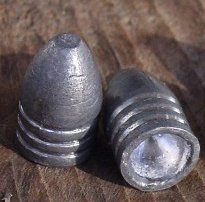
The minie ball or minie bullet consists of a conical-cylindrical bullet made of soft lead. The bullet is designed to be slightly smaller than the diameter of the rifle barrel, so it can easily slide into the barrel. Towards the base of the bullet are carved three or four belted grooves which are filled with grease. The base of the bullet is made of a hollow conical iron cup. When the bullet is fired, the iron cup drives into the base of the bullet thereby expanding the grooves outwards. The expanding grooves engage the rifling inside the barrel, thereby sealing it from gas leaks.

The Minie rifle that used this bullet was a muzzle-loading weapon with a percussion lock firing mechanism and a rifled barrel. Paper cartridges, each containing a minie ball and a pre-measured amount of gunpowder were issued with the weapon. To use the rifle, the user would pour the gunpowder into the barrel and push the minie bullet in through the top. Since the minie bullet is smaller in diameter than the barrel, it is easily pushed through, even if the barrel has some fouling and detritus in it. When the gun is fired, the expanding gases make the bullet deform and engage the grooves in the rifling. The rifling then serves to provide spin to the bullet, thereby providing more accuracy. The expansion also makes a tighter gas seal, which gives greater range and it also cleans the grooves of detritus as well.

When the minie rifle was tested in 1849, it penetrated two 17 mm. (0.66 inches) thick poplar wood boards separated by 50 cm. (19.68 inches) distance, from a range of 15 meters (16.4 yards). This led to a rumor that it could penetrate a soldier and his knapsack at 1100 meters (about 1200 yards) and also kill the person standing behind him, and at close ranges, it could kill 15 men standing in line.

The minie rifle and the minie bullet came to the notice of the British War Ministry in 1852. Hence, the British Government paid Monsieur Minie a sum of 20,000 pounds as a royalty for the right to use his bullet design for British rifles. This particular award enraged Mr. W. Greener whose earlier invention of 1836 was rejected by the British Ordnance board and he started several unsuccessful attempts against the British Government to be given some credit for his innovation. It took some lobbying by Mr. Scholefield, MP for Birmingham (the town where the W. Greener factory was located) to show the correspondence that occurred in 1836 between W. Greener and the British Ordnance board before the British Government finally admitted Mr. Greener's prior invention. In 1857, the British Government awarded W. Greener a smaller sum of 1,000 pounds, as well as the credit for "the first public suggestion of the principle of expansion, commonly called the Minie principle, in 1836."

The Minie rifle was used by both French and British troops in the Crimean war (1853-1855) against Russia. Other rifles using the Minie bullet principle were heavily used by both sides in the American Civil war, where it was the most common rifle used. The US versions of the bullet (adopted before the civil war) had three exterior grooves on the bullet instead of four. The US versions also had thinner walls near the base and omitted the iron cap at the base, as the pressure of the expanding gases was enough to deform the bullet by itself. The wounds caused by the Minie bullet were staggering and surgeons of the day often amputated limbs rather than trying to remove bone fragments and risk secondary infection.

The British adopted the Minie Pattern 1 between 1852 and 1855, where it was replaced by the newer Enfield Pattern 1853 rifle, which also used a Minie bullet. The Enfield Pattern 1853 rifle served the British empire between 1855-1867 and was one of the causes of the Indian mutiny of 1857. This rifle model was the one that was issued to troops of the East India company in 1857 and rumors were spread that the paper cartridges were greased with pig fat and cow fat, which were abhorrent to the sepoys for religious reasons.

The Minie rifle and its derivatives became obsolete around 1866 or so, when they were replaced by breech-loading rifles. One of the main disadvantages of all muzzle-loading rifles was that the soldier had to stand up to load the weapon, whereas a breech-loading weapon could be loaded from the prone position. Despite all improvements to muzzle-loading weapons, a breech-loading weapon could still be loaded much faster than a muzzle-loading one. The clear advantage of the breech loading Dreyse needle-gun used by the Prussians against the Austrians spelled the end of muzzle-loaders in general and the Minie rifle became obsolete along with other muzzle-loaders of the day. However, the concept of a bullet that deforms and engages the grooves of the rifled barrel has stayed with us to this present day and modern firearms still use this principle.