Showing posts with label percussion lock. Show all posts

Sunday, December 6, 2015

Early Cartridge Technologies: Skin Cartridges

In our last post, we looked at tinfoil cartridges, which was one way to make cartridges more resistant to water. In today's post, we will look at another material that was also used to make cartridges more water resistant: animal skin. We will study skin cartridges today.

Skin cartridges

First, the name is somewhat misleading because skin cartridges were not really made of skin. They were actually made of animal gut, mostly cattle, sheep and pig intestines. The intestines were first soaked in a weak solution of potassium hydroxide (i.e. lye solution), which would remove the fat and inner mucous membrane from the gut and prevent further putrefaction. The intestines were then beaten thin and stretched over formers made of wood or metal to dry out. After drying out, the intestines would form seamless cases that could be filled with black powder. The cases were formed as conical shapes, so that they could be easily dropped into the chambers of a revolver or a rifle for faster loading. The cases were then treated with combustible chemicals such as potassium nitrate, so that they would burn during ignition and leave very little residue behind in the chamber. After filling the cases and adding the bullets, the cartridges were then treated with a little shellac varnish to make them water resistant.

Skin cartridges were used mainly in Colt revolvers and also in the Sharps rifle. They were famously used by Colonel Berdan's sharpshooters during the Civil war.

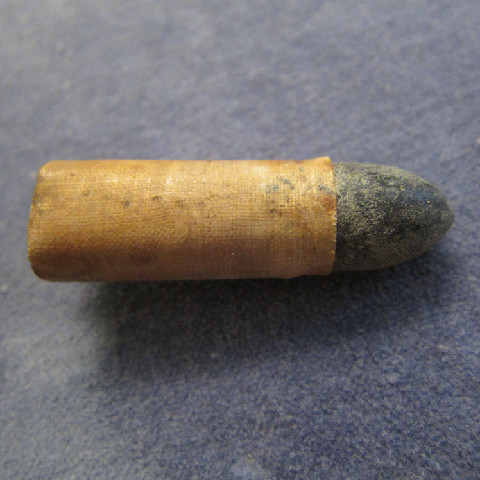
Skin cartridges made by D.C. Sage. Click on the image to enlarge.

Two inventors, William Mont Storm and Julius Hotchkiss developed separate patents to improve skin cartridges. An example of cartridges made using Hotchkiss' patent is shown above. The Mont Storm patent shows an improved way to make cases, as well as using gutta-percha dissolved in rectified naphtha or chloroform, instead of shellac to provide the waterproof varnish. The Hotchkiss patent uses a different technique to improve the toughness of the animal gut so that it doesn't split easily and it also dispenses with the thread wrapping that was sometimes used by others to strengthen their cases.

Over in England, Captain John Montagu Hayes of the Royal Navy received British patent # 2059 of 1856, for a skin cartridge. The patent specification reads in part, "A skin or membrane (prepared from the gut of animals, as pigs, or birds, or reptiles) is used instead of paper for cartridges, which are made without a seam. A covering or network of thread may be used to strengthen the cartridge." (this thread wrapping is what was improved by the Hotchkiss patent in the previous paragraph)

 A skin cartridge of British manufacture, made by Eley Brothers. Click on the image to enlarge.

The above images shows a skin cartridge made by the British cartridge manufacturer, Eley Brothers, who we learned about in our last post. Like the tinfoil cartridges we studied previously, this cartridge partly uses the Colt-Eley patent: it has an outer wrapper made of paper, with a tape to quickly pull the cartridge out of its outer paper wrapper. The paper wrapper is clearly visible in the image and the skin casing is inside it.


The above image shows five American made skin cartridges for .36 caliber revolvers. From left to right, we have cartridges for Remington, Savage, Colt Navy, Colt Navy and Colt Pocket revolvers. 

In America, major manufacturers of these cartridges were Johnston & Dow, Hazard Powder Company, Elam O. Potter and D.C. Sage.


Skin cartridges made by different American manufacturers. Click on the images to enlarge.

Like the other combustible types of cartridges, skin cartridges rapidly fell out of fashion when the first metallic cartridges were invented.


Saturday, November 28, 2015

Early Cartridge Technologies: Tinfoil Cartridges

In our last post, we studied linen cartridges. In today's post, we will study cartridges made of a more exotic material: tinfoil. Yes, there really were tinfoil cartridges made at one point.

Tinfoil cartridges were originally made by Samuel Colt for his revolvers. During this period, paper cartridges were common, but if the paper got wet, it would ruin the black powder. The idea behind using tinfoil was to make a cartridge that was not affected by water as much.

At the time that Colt first started working on tinfoil cartridges, his first company that he had set up to manufacture Colt Paterson revolvers was not doing so well (it soon went bankrupt in 1842, due to lack of sales.) He initially experimented using rubber as the material, before switching to tinfoil. Soon after, the US Government got interested in his developments. In April 1840, the Secretary of War and the Secretary of the Navy asked a mixed board of officers from the Army, Navy and Marine Corps to make experiments and evaluate Colt's tinfoil cartridges. The officers were: Colonel G. Croghan of the Army, Captain C.S. McCauley of the Navy and Lieutenant J.G. Reynolds of the Marines. They met at Washington Arsenal and performed several experiments and wrote a report of the results, an abridgement of which is below:

The board relying upon the correctness of the experiments as above recited, are unanimously of the opinion that in reference to the usual incidents of our service, naval as well as military, the cartridge now in use is greatly to be preferred to the tin-foil cartridge submitted by Mr. Colt. It appears evident from the facts set forth by the foregoing experiments that the tin-foil is entirely unsuited for cannon service; yet from its imperviousness to water, the tin-foil cartridges for small arms might be found useful in certain cases. The board would, therefore, recommend the partial adoption of the tin-foil cartridge for small arms.

The tests that they performed for these cartridges may be of interest to readers:

"Experiment 1, April 10, 1840: Twenty six cartridges of tin-foil and as many of paper, were fired from well cleaned muskets, no difference was perceptible."

"Experiment 3, April 20, 1840: Four 6-pounder and thirty musket cartridges, all of tin-foil, which had been immersed in water from the 10th instant, were taken therefrom; two of the 6-pounder cartridges appeared to have been injured by accident, the other two were fired and appeared not to have been injured by the water; a dry sponge was used in these firings, and it was burned each time by the contents left in the gun. The musket cartridges were then examined; sixteen of them were selected for firing, seven of which only could be discharged"

"April 21: In order to test the relative strength of the tin-foil and cartridge paper, strips of each were tested; the foil could not support a weight of forty pounds, whilst the paper did not break with the weight of eighty pounds"

Most of the remaining tests correspond to use in cannon and the tin-foil cartridges left more residue globules in cannon, which is why the board recommended to only use the cartridges for small arms and only partially.

The US Army purchased a few thousand more tinfoil cartridges for further evaluation and in 1843, they placed a large order for 250,000 tinfoil musket cartridges, for the purpose of trying them in field service. This large order was an unexpected gift for Colt, since his revolver manufacturing factory in Paterson had gone bankrupt shortly before in 1842. The funds from the US Army were used by Colt to fund research for his "New and improved revolver" and he attempted to start a new Colt's Patent Manufacturing Company with this money. He also used some of the money to produce a waterproof telegraph cable for his friend, Samuel Morse (the inventor of Morse code and inventor of the single-wire telegraph). Then came the order from Samuel Walker for the Walker Colt revolver and the profits were large enough for Colt to go back into the firearms manufacturing business in 1847. A few years later, Colt also established a factory in London in 1853.

While Samuel Colt was in London, he met a gentleman named William T. Eley, who was in the business of making cartridges in England. William T. Eley was the son of William Eley and nephew of Charles Eley, who had founded the Eley Brothers cartridge manufacturing company in London in 1828 (Eley Brothers later became the largest ammunition manufacturer in the world and the brand name is still used for cartridges today). Together, they developed a new tinfoil cartridge that was granted British patent #1324 in 1855.


The powder container was made of tinfoil and the lap joint sealed with waterproof cement. The case was then filled with powder and the bullet was inserted to the top and then the end of the tinfoil case was crimped into the base groove of the bullet and then greased, to produce a waterproof cartridge. The cartridge was then enclosed in a paper wrapper, from which it could be easily removed before loading. Due to the shape of the bore of the nipple in Colt's revolvers, the flame from a percussion cap would pierce the foil and ignite the powder, without the need to tear open the foil.

In the above image, the cartridge on the right is of .31 caliber. The one on the left is also a .31 caliber cartridge, but it is enclosed in an additional protective paper case. The one in the middle, is a .28 caliber cartridge in a sectioned case. The case has a tape to pull the cartridge out, which was later copied by other ammunition makers. The side of the case visible to us says "COLT'S" and has a picture of a colt in the bottom, the other side has the word "PATENT".

Another image of a Colt tinfoil cartridge is shown below:


To manufacture these cartridges in the US, Colt set up a separate building, situated about a half mile away from his other factory in Hartford. In this cartridge manufacturing factory, no fire was allowed anywhere near it and the factory was heated by piping in steam, which was generated in a different building outside.

Women doing the dangerous work of assembling Colt's gunpowder cartridges at the Cartridge Works. From United States Magazine, 1857
Click on the image to enlarge. Public domain image.

Most of the labor in this factory was performed by women, with the only men around being a foreman, an engineer and a charger.

In our next post, we will study more cartridges made of other materials.


Sunday, November 22, 2015

Early Cartridge Technologies: Linen Cartridges

A few weeks ago, we began to study an early form of cartridge: the paper cartridge. Where we left off, paper cartridges had advanced to the point where the paper was treated with chemicals to make it more combustible.

The main problems with paper cartridges are that they aren't very water resistant and the paper is somewhat fragile. As the bullet could be rather heavy, the weight of the bullet could cause the paper to tear as well. There was a need for a cartridge to be made of a more durable material and that's when the linen cartridge was born.

A .52 caliber linen cartridge for a Sharps rifle. Click on the image to enlarge.

In 1852, American inventor Christian Sharps invented a linen cartridge, to go with his Sharps rifle (which was earlier invented in 1848). The linen cartridge was a great improvement over the paper cartridge because it could withstand rough handling better, without breaking open. A linen cartridge also held its shape better than a paper cartridge could. The back of the linen cartridge had a piece of nitrated flash paper (which we studied in the last post) to provide the ignition. The linen used to make the cartridge body was treated with starch to make it stiffer. Linen cartridges were also treated with chemicals to make the linen more combustible, similar to that of paper cartridges that we studied earlier. Like the paper cartridges, the bullet was glued on top with sodium silicate glue.

For a while, cartridges were made for the Sharps rifle with both paper and linen, but the linen cartridge gradually started to find some backers. In the words of a Major W.A. Thornton:

"The making of Sharps Cartridges with paper must be abandoned and linen must be used in the formation of the cylinder. More care cannot be given in the making of cartridges than is bestowed in our laboratory. The fact is that the ball is too heavy for the paper, and worse than that -- the paper is sometimes softened by the lubric which causes it to break by the weight of the ball. From this date, I will make no more of paper, but I will make the powder cylinder of linen."

What the Major is describing are two flaws of the paper cartridges used by the Sharps rifles. The first is that the weight of the bullet is so great that a paper cartridge cannot hold its shape and often tears open by itself, due to the weight of the bullet. The second problem is that the lubricant (spelled in his letter as "lubric") also softens the paper and weakens it, thereby causing the paper to break. Since the lubricant is necessary to reduce the fouling inside the barrel, a stronger material must be used for the case body and this is why linen was used.

Linen cartridges were used by both the Sharps rifle and the Starr carbine during the Civil War.

In our next post, we will study another durable material that was also used to make cartridges during that period of time.


Saturday, November 14, 2015

Early Cartridge Technologies: Paper Cartridges - III

In our last post, we saw the advances in paper cartridge technology to handle expanding bullets. In today's post, we will study more advances in paper cartridge technology around the time that percussion caps and revolvers started becoming popular.

Early Colt Paterson revolvers. Click on the image to enlarge. Public domain image.

With the advent of percussion cap revolvers, such as the Colt Paterson models pictured above, most people loaded their revolvers from paper cartridges exclusively. The paper cartridges were therefore modified a bit to take advantage of these new developments in firearms.

In the picture above, note that the two Colt Paterson 1839 model revolvers have a loading lever under the barrel, whereas the 1836 model doesn't have this feature. We will see how that is used with the cartridges that we will study today.


Paper cartridges for a .36 caliber Colt revolver.; Click on the image to enlarge

As you can see in the images above, the bullet is now in the front of the cartridge (unlike the designs we studied in our last post). The bullet is attached to the cartridge with glue. Also, the shape of the cartridge has changed a bit, so that the paper part now forms a conical shape instead of a cylindrical shape. This was a deliberate design choice, so that it is easier for the user to insert the cartridge into the front of the cylinder. Unlike previous designs, there is no need to tear the paper and pour the powder into the chamber. Instead, the loading lever is used to ram the entire cartridge into the chamber. Because of the shape of the cartridge, the cartridge paper automatically tears open when it is compressed into the chamber. Some cartridges were equipped with a protective outer layer around the cartridge, to keep it safe from moisture, and these would have a tiny tear tab to remove the outer layer before loading the cartridge.

A glue made of sodium silicate was used by the Colt Manufacturing Company to hold the bullet to the cartridge, as well as seal the paper part. This was what was used by Colt between 1851 to 1873, until they started to produce brass cartridges in 1873. Sodium silicate has the advantages of resisting high temperatures, as well as being cheap and easily available. Sodium silicate was also used to cement the top wad of shotgun shells and was heavily used by American farmers who reloaded their own shells in the 1870s, as sodium silicate was the same material used to preserve eggs as well.

One more innovation made to these cartridges was to the paper material as well. In order to make the ignition of the powder more reliable, the paper was treated with chemicals to make it burn better. This paper is called nitrated paper, as it is manufactured by soaking it in a solution of potassium nitrate and then drying it. This treatment makes the paper much more flammable than ordinary paper. Such cartridges are called combustible cartridges, because the paper burns almost completely upon ignition. A properly nitrated paper leaves behind less ash and residue, thereby making it easier to clean and reload the weapon.

Another formula for making combustible paper used a solution of nitric and sulfuric acids and was used by both Colt Manufacturing and Dow Chemicals, as well as some other manufacturers in the 1800s. These are essentially the same chemicals used to produce guncotton, which we had studied a few years before. Paper that is treated this way is called flash paper. This paper also burns quickly and leaves very little ash behind, but it is much more unstable than nitrated paper, and in the early days, it was also prone to spontaneous combustion. This is why flash paper did not gain much popularity in the firearms industry. These days, the only people using flash paper are magicians, who use it to produce spectacular flames when performing magic tricks.

With the advent of metallic cartridge technologies, the use of paper cartridges started to reduce. However, there are still some applications for which paper is used. For instance, until about 1960 or so, many shotgun shells were made of paper bodies, with a brass base and rim. The reason for this was because it was cheaper and easier to make the body out of paper than to make the entire shotgun shell out of brass. Around 1960, shotgun shells started to use plastic bodies instead of paper, and a majority of modern shotshells today make use of plastic. Nevertheless, it is still possible to buy paper shotshells even today.


The bodies of these cartridges are made of a cardboard paper and are coated with wax to provide some resistance to moisture. They aren't as common as they were back before 1960, but there are still some manufacturers making them.


Sunday, September 15, 2013

Unusual Firearms: Key Guns

In our last article about unusual firearms, we looked at the Greener police shotgun. In today's post, we will look at a very unusual class of firearms, a combination of a key and a gun, the so-called Key Gun.

Key guns were apparently used in the 17th and 18th century, but they are pretty rare. They were apparently intended to be used by jailers for self-defense purposes, when they were making their daily inspections of the prison cells. The idea being that the jailer could use the same object to open the cell door and also defend himself, in case the prisoner inside tried to escape.


Key guns were initially incredibly primitive devices. The example above is merely a tube sealed on one end, with a touch-hole on top. Note the lack of any firing mechanism. The jailer would have carried a lit cigarette or cigar in his mouth. To discharge this weapon, the jailer would touch his cigar on the touch-hole and light the powder within the key.

Some other examples had actual firing mechanisms. For instance, we have a model that uses a matchlock firing mechanism, one using a flintlock and another one using percussion cap technology.


Click on images to enlarge.

Whether these weapons were actually practical or not is a completely different matter. These are all small-caliber and short range firearms with low stopping-power and it isn't quite clear how usable one of these is once the jailer has started turning the key, because the gun can no longer point at the prisoner and the jailer can't put his finger on the trigger while turning the key. No wonder then that these weren't very popular.


Monday, August 26, 2013

Corrosive Ammunition

Many months ago, we talked about the development of the percussion lock. This was where the idea of striking a shock-sensitive substance with a hammer to ignite the main charge of propellant was originally developed. In that article, we had mentioned that mercury fulminate was originally used as the primer and was later replaced by potassium chlorate. This idea of using a shock sensitive priming material is still used in today's centerfire cartridges. However, there were some issues with using such primer materials and we'll study about them in this post.

In our discussion about the percussion lock previously, we'd mentioned that the inventor (the Rev. Alexander Forsyth) had used mercury fulminates to set off the main charge. Mercury fulminates continued to be used in priming caps for early centerfire cartridges as well, into the end of the 19th century. However, when people started to switch to using smokeless powders, they began to discover the downsides of mercury fulminate. One of the issues was that mercury fulminate tended to degrade when kept in storage. This was not really an issue when using black powder cartridges, because black powder ignites a lot easier than smokeless powders. However, once people started to switch to smokeless powders for extra power, they found that keeping the cartridges in storage would cause the mercury fulminate primers to degrade so much that they could not reliably ignite the smokeless powder, causing misfires and hang fires. One more problem with mercury fulminates was that in conjunction with smokeless powders, it tended to form copper and zinc amalgams in the brass cases of cartridges, thereby making them unsuitable for reloading.

Due to this, the US Army switched to using potassium chlorate primers in 1898. Some other manufacturers used sodium chlorate instead. While these primers did not degrade as much as mercury fulminate, there were some other problems that came with them. When fired, these primers would decompose and leave a residue of potassium chloride (or sodium chloride) behind in the barrel. Those of you who remember your chemistry lessons in school might remember that sodium chloride is the scientific name for common salt. Potassium chloride is also another corrosive salt. These salts are highly hygroscopic (i.e.) they tend to attract water, especially when in humid conditions. Guess what happens when you have salt and water applied to an iron or steel surface -- that's right, it rusts. Therefore, if the barrel and action are not cleaned after firing such cartridges, there's a good chance that they could rust soon after. Swabbing the surfaces with oil will not prevent these salts from attracting water and rusting the metal.

As a result of this, primers using non-corrosive chemicals were developed in the 1920s, but these were generally used in civilian ammunition only, as the early non-corrosive primers did not last as well in storage as corrosive primers. Due to this, military ammunition tended to use corrosive primers and this was indeed the case for US military ammunition until the 1950s or so. Some other countries (e.g. former Soviet Union, China, Yugoslavia, Bulgaria etc.) continued to use corrosive primers in their cartridges for much longer than this, well into the 1970s and 1980s. Therefore, depending on the source and the age of the ammunition, the user must be wary lest the ammunition is corrosive.

So how does a user ensure that his firearm doesn't rust after using corrosive ammunition. The good news is that this is fairly easy to handle. It turns out that these corrosive salts dissolve in water. Therefore, cleaning the firearm thoroughly using water or a water based lubricant should do the trick. Some people use hot soapy water, others use plain water, still others swear by windex glass cleaner (which is largely water based). After washing off the residue, the firearm should then be dried, then cleaned with normal bore cleaning solution and oiled, as per the normal cleaning procedures.

The firearm should be thoroughly cleaned as soon as possible after firing the corrosive ammunition, to ensure that the corrosive chemicals are removed before they can damage the firearm. While this may seem like a bit of extra work, it is well worth it because there is no way to restore a barrel or chamber back to perfect condition, once it has started to rust. Therefore, the user should go through the extra effort if the ammunition is suspected to use corrosive primers.

As it turns out, the price of surplus ammunition using corrosive primers is often much lower than other types and it is also widely available in the market. So how does a user identify if the ammunition is corrosive or not? One way is by looking at the markings on the cartridges and the manufacturer of the ammunition. For instance, if it is surplus ammunition from certain countries such as the former Soviet Union, Yugoslavia or China, there is a good chance it uses corrosive primers, especially if it is manufactured before the 1980s. US-made ammunition has markings that can give a good clue as to whether the primers are corrosive or not. In case of doubt, there's an easy way to find this out. The user can take a cartridge, pull out the bullet from the front and empty out the powder from the cartridge and only leave the primer behind. Then. the user fires the empty cartridge onto a mild steel plate from a distance of about 1 inch from the muzzle, so that the primer chemicals are deposited on the plate. The user also fires another primer that is known to be non-corrosive onto another section of the steel plate. After firing the two cartridges, the user cleans the firearm as detailed in the procedure above, in case the suspect ammo is indeed corrosive. Then the user simply keeps the steel plate in a warm humid area for a few days. If the section where the suspect primer is fired over shows substantial rusting, then it uses corrosive chemicals.

Another way is to use bright common nails (which are nails made of mild steel with no coating) and pop a primers over one of these nails. If the nail rusts within a couple of days, then the primer is corrosive. The following video shows how this is done, using simple household tools:


Interestingly, the box of suspect ammunition actually says that it is non-corrosive on the box, but it turns out to be corrosive after all. Happy viewing!


Monday, March 11, 2013

History of the American Rifle - II

In our last post, we left off at the beginnings of a rifle designed for American frontiersmen. We will continue our study in this post.

As was mentioned in our last post, the first true rifle designed for the American frontier came out of Pennsylvania around 1738-1739. The area around Lancaster county, Pennsylvania, is regarded as the birth-place of such firearms and for a long time, it was the Pennsylvania Germans (also called the "Pennsylvania Dutch", even though they didn't speak Dutch!) who dominated the manufacturing of rifles in America. From them, the knowledge spread to the frontiersmen of New York, Maryland, Virginia, Kentucky and North Carolina and by 1750, it was widespread among all the frontier areas of the Allegheny Mountain range.

It is commonly believed that these rifles were first used in war during the American revolution, but this is not the case. The first time they were used in war was by Pennsylvania frontiersmen against the French fort of Louisburg, on Cape Breton Island.

In New England, these rifles were practically unknown until two groups of men from Pennsylvania and Virginia arrived at the siege of Boston, during the American revolution. The first troops raised by Continental Congress was six companies of men from Pennsylvania, two companies from Maryland and two from Virginia. These men all brought their own firearms along with them. In fact, it wasn't until much later that the United States Government officially started manufacturing rifles for its army. These rifles were popularly known as the Kentucky rifle, even though the design was originally from Pennsylvania.

Soon after the American revolution, the Rev. Alexander Forsyth invented the percussion lock system over in England. It took a while for the mechanism to reach American shores, but once it got here in around 1835 or so, it was quickly adopted here in America. It was also around this time (1840s or so) when the exploration of the American West started.


American long rifles. Licensed under the Creative Commons Attribution-Share Alike 2.0 Generic License from Wikipedia.
The top rifle is a percussion lock and the bottom is a flintlock.


This created two forms of the American long rifle. For the Eastern frontiersman, the Kentucky rifle design called for a smaller bore weapon, because the Eastern rifleman normally carried his ammunition in his own backpack and usually made his long journeys on foot. These rifles were sometimes called "pea rifles" because they fired .32 to .38 caliber balls, about the size of a pea. Usually, these rifles started out as .32 caliber and as they got older and wore down, they would be taken back to a gunsmith to be rebored and that would increase their caliber. The barrel was long and heavy and the total weight of the rifle was around 12-15 pounds or so. The butt-plate and patch box were made of brass and usually engraved.

In contrast, a person hunting or exploring in the Western United States demanded a different kind of firearm. For one, they needed something of bigger bore to hunt larger animals like moose, elk, buffalo, grizzly bear etc.  Also, the Western hunter found long barrels somewhat more inconvenient to use on horse back. Finally,  the weight of ammunition was not a problem because the Westerner carried his ammunition boxes on his mule rather than on his back. So they used .40 to .60 caliber ammunition and a shorter barrel, the other features of the rifle being retained from the Kentucky rifle design.

We will study more in subsequent posts.


Thursday, January 17, 2013

The Maynard Tape Primer

After all the geeky stuff we've studied in the last few posts, it might be a good idea to study a piece of history instead. We will study the Maynard Tape Primer system in today's post.

First, let us go way back to one of the earliest posts on this blog, which was posted around 2 weeks after this blog started. We're talking about the percussion lock system, which was invented by the Reverend Alexander Forsyth. While he did invent the firing system, it wasn't widely adopted by other manufacturers until the patent rights expired around 1840 or so.

While the percussion lock was a big improvement over the flintlock in that it fired quicker and wasn't as affected by damp weather as a flintlock, reloading was still a slow process, especially for muzzle loading weapons. In the era of single shot firearms, any scheme to reduce the number of steps needed to reload a firearm was definitely a time saver.

The classic percussion cap muzzle loader requires the user to pour some powder down the muzzle, then ram a ball and cloth patch down the barrel, then pull the hammer back and place a copper percussion cap filled with a fulminate (such as mercury fulminate or potassium chlorate) on the nipple, before preparing to fire. Dr. Edward Maynard, a dentist with an interest in firearms design, figured out how to remove one of these steps.

Dr. Maynard's solution was to replace the copper percussion cap with a different system. His idea was to take a thin strip of paper, embed pellets of fulminating materials on it and then glue a second thin strip of paper on top to hold the pellets in place. Then, the paper tape is rolled up and attached to the side of the firearm, near the chamber. Every time the hammer is cocked, a feeding mechanism advances the paper tape so that the next pellet is moved in front of the nipple. When the hammer drops, it not only detonates the pellet, but also cuts the used part of the paper tape.

The Maynard Tape Primer System. Public domain image.

This system was cheaper and quicker to manufacture, since paper is much cheaper and easier to handle than copper. With this system in place, the user would only need to pour in the powder, load the ball and cloth patch and then cock the hammer and the firearm is ready to fire. There is no need to place a percussion cap onto the nipple or cone, which makes the reloading process faster. Dr. Maynard patented this system in 1845 (it was his first firearm patent) and it was used by some commercial manufacturers and attracted the attention of the US government.

The US Army's Ordnance board was initially hesitant about adopting this design, but it got the enthusiastic backing of the then Secretary of War, Mr. Jefferson Davis (who later went on to become the President of the Confederate States of America). Therefore, this mechanism was adopted in the Springfield Model 1855 rifle-musket, which was issued to the US Army. The US government paid Dr. Maynard a royalty of $1.00  for every Model 1855 rifle-musket that was manufactured. If this seems a small amount of money, bear in mind that at that time, the cost of manufacturing the entire Model 1855 musket was $18.00, so this invention made him a very rich man. Dr. Maynard went on to develop various other firearm inventions and registered a total of 23 different firearms related patents during his life.

Springfield Model 1855 musket. Click on image to enlarge. Public domain image.

In the above image, note the dark gray part between the hammer and the nipple, which is the Maynard tape primer system.

So why did we not see this system continue to be used very much afterwards? There were multiple reasons: While the system worked well under clean controlled conditions, it was a different story when used outdoors. British cavalry troops who were armed with Greene carbines (which used the Maynard tape system) during the Crimean war, found them unreliable on the battle field. Tests conducted by the US army in the field between 1859 and 1861 showed that about half the primers misfired and the tape feed springs also didn't work well. The mechanism was also unreliable in muddy conditions and fouled easily. The biggest drawback was that though this system was advertised as waterproof, it didn't actually work well in damp conditions. An attempt was made to use foil instead of paper to make the tapes, in order to solve the problems with damp weather. In spite of this improvement, the Ordnance department dropped the Maynard system and went back to the old percussion cap mechanism with the Springfield Model 1861.

Springfield Model 1855s were used by both sides during the American Civil War, as they were available in greater numbers than the Springfield Model 1861, especially during the beginning of the war

While no real firearms today use the Maynard tape primer system currently, variants of his system are still used for toy roll cap pistols today!


As you can see from the above video, the feed system is somewhat unreliable and doesn't fire on every trigger pull. This and the fact that it is affected by dirt and damp weather spelled the doom for the Maynard Tape Primer in real firearms and only toys use it these days.


Monday, February 14, 2011

Shotguns: Actions and Designs

The early history of true shotguns begins in the 1800s, when people began to use them to hunt birds. During that time, the flintlock firing mechanism was the ignition system of choice and hence, it should be no surprise to know that early shotguns used them. The problem with such mechanisms is that there is a noticeable delay between pulling the trigger and the weapon actually discharging. The Rev. Alexander Forsythe, a Scottish clergyman and an avid hunter, noticed that the local birds would see the flame in the pan and immediately change direction and thereby escape. Hence, he set about inventing the percussion lock, which was the next big development in firearms technology and was also used by other firearms besides shotguns. The percussion lock was eventually replaced by modern cartridges, which we use to this day.

Shotguns come in both single barrel and double-barrel types. Double-barreled shotguns have two triggers, one to discharge each barrel. Of the double barreled shotguns, there are two types: "side by side" type and "over and under" type. What this means is how the two barrels are positioned. In "side by side" types, the barrels are placed beside one another, whereas "over and under" types have one barrel positioned on top of another.
"Side by Side" type shotgun

"Over and Under" type shotgun

Double barrel shotgun barrels are never attached parallel to each other, but instead set so that their shot will converge at some point (usually at 40 yards distance). In some shotguns, one of the two barrels may be made different from the other. For instance, one may have rifling and the other is smoothbore, or one barrel may be choked for closer shooting. In other cases, both barrels may be made as identical as possible.

Of all the actions, the break-open action, such as the two images above, is the most common type and has been around for a long time. This is a breech-loading mechanism. It was realized in 1875 that the movement of opening the action could also be used to cock the weapon at the same time. The first such cocking mechanism was pioneered by Anson and Deerley for their hammerless shotgun and it is still used almost unchanged to this day. Break-open actions are the most common type used for shotguns.

Another action that was invented in the mid 1800s and rare today, is the side-motion action. In this type of action, the barrels are mounted on the edge of a metal disc. A lever in the bottom of the stock rotates this disc, which causes the barrels to move in an eccentric motion, where they can be reloaded.

Another action that was invented in the 1800s, but is rare now, is the sliding barrel action shotgun. There are only a few manufacturers around that make this type currently and it was never as popular in the 1800s either.

Sliding Barrel Action Shotgun

Lever action shotguns were popular in the 1880s. The Winchester model M1887 was designed by John Browning and became a best-seller for the company. This was the first truly successful model of a repeating shotgun. This action allowed for users to load multiple cartridges into the weapon, not just one or two cartridges. Their popularity waned after the design that we're about to study in the next paragraph was introduced, and we don't see too many lever action shotguns these days.


Lever-action

The action that replaced the lever action design is the pump action shotgun design. The first popular ones of this type were the Winchester M1893 and M1897 models, which were designed by John Browning! It must be noted that when Winchester originally asked Browning to design a repeating shotgun in the 1880s, he had argued that a pump-action mechanism shotgun would be the most appropriate design, but Winchester was a lever-action manufacturing company, so they persuaded him to design a lever-action shotgun, which was the M1887 model described above. However, they did later manufacture his pump-action design as the Winchester model M1893, which was later improved to the model M1897. It must be noted that the M1897 shotgun gained so much popularity that it was used by US soldiers in World War I, where it was found very useful for trench fighting. Its quick shooting speed and massive stopping power made it a very effective weapon for US soldiers to have. In fact, the German troops feared this weapon greatly and the German High Command even attempted to have it outlawed in combat, by citing Geneva convention laws (this coming from the same people that allowed the use of poison gas!). The pump-action shotgun design is still popular to this day.

Pump Action shotgun

There are also semi-automatic shotguns, where some of the force generated by the firing cartridge is used to eject the old cartridge, cock the action and load a new cartridge. Semi-automatic shotguns use a variety of mechanisms: long recoil action, inertia operated action or gas-operated action. The first successful semi-automatic shotgun was the Auto-5 (or A-5) action first designed in 1898 by (surprise, surprise) John Browning! The Auto-5 model remained in production until 1998!

Semi-automatic Remington Model 11 shotgun using long-recoil action

Bolt-action shotguns also exist in the wild, though they are not common. One particular model was manufactured in .410 caliber by the Ishapore arsenal of India, based on the Lee-Enfield SMLE Mark III model.
Ishapore .410 caliber bolt action shotgun. Click on image to enlarge.

In the next post, we will look into more about shotguns.

Tuesday, April 20, 2010

Percussion Lock or Caplock Mechanism

So far, we've covered firing mechanisms all the way to the flintlock. The flintlock was a major advancement in firing technology and it stayed active for over one hundred years. One of the disadvantages of it (and all previous technologies, the matchlock, snaplock, wheel-lock etc.) is that when firing the weapon, the basic principle in all these weapons is to light some gunpowder in a firing pan which is attached to the barrel, but located outside the barrel and have the pan connected to the main gunpowder charge inside the barrel by a touch hole. The flame first lights in the firing pan and then travels through the touch hole and lights the main charge of gunpowder, which then ejects the bullet. Because of this, there is a noticeable delay from when the flame lights in the pan to when the gun actually fires.

The next big advance was due to a Scottish clergyman, one Rev. Alexander Forsyth. The good clergyman was also an avid hunter and liked to go bird hunting in the marshes. While hunting, he noticed that the birds would often spot the flame from the pan and immediately change direction. Since there is a delay between when the contents of the pan light up and when the gun discharges, this delay was long enough for many birds to escape. Rev. Forsyth made several experiments and finally settled on using mercury fulminate as his ignition mechanism. His patent application (granted April 11th 1807) reads as follows:

"I do make use of some one of the compounds of combustible matter, such as sulphur or sulphur and charcoal, with an oxymuriatic salt; for example, the salt formed of delphlogisticated marine acid and potash (oxymuriatic of potassium), or of fulminating metallic compounds, as fulminate of mercury or of common gunpowder, mixed in due quantity with any of the aforementioned substances, or with an oxymuriatic salt as aforesaid."

The specification is pretty broad and doesn't reveal too much, so we'll study what this means. First, we determine what a fulminate is. Ordinary black gunpowder and some other explosive materials have the property that they may be ignited by striking them with some force between two metal faces. However, the resulting explosion doesn't provide any more force than if they were lit with a flame. A fulminating substance is one that is reliably ignited by percussive force and the resulting explosion is more energetic than if it were lit by a flame or by any other means. The most well-known fulminate is potassium chlorate. Some readers might have played with a roll-cap toy pistol as kids, where the tiny caps explode when struck under pressure. There are other fulminates such as mercury fulminate, silver fulminate, gold fulminate etc.

The earliest research into these substances was made by a Frenchman named Peter Bolduc, prior to 1700. There were several reports published between 1712 and 1714 by the Royal Academy of Sciences, of experiments by Nicholas Lemery. Bayen, the chief physician of King Louis XV discovered mercury fulminate in 1774, Fourcroy studied them in 1785, Vauquelin in 1787, and Berthollet discovered silver fulminate in 1788. Until then, no one thought of using fulminates to firearms. The first few experiments by Berthollet ended in failure because the material was deemed too sensitive and he finally gave up after a couple of close calls. An Englishman named Howard invented a new priming gunpowder in 1800 using the research of Fourcroy and Vauquelin, but it was also not too popular. Finally, it was left to Rev. Forsyth to make the necessary discoveries and get the patent. In his patent application, he also reveals his firing mechanism:

"Instead of permitting the touch-hole, or vent, of the species of artillery, fire-arms, mines etc. to communicate with the open air, and instead of giving fire by a lighted match, or flint or steel, or by any other matter in a state of actual combustion, applied to a priming in an open pan, I do so close the touch-hole or vent by means of a plug or a sliding-piece as to exclude the open air, and to prevent an sensible escape of the blast, or explosive gas or vapour, outwards, or from the priming or charge; and, as much as it is possible, to force the said priming to go in the direction of the charge, and to set fire to the same, and not to be wasted in the open air."

The basic idea of his patent ran like this:

Public domain image courtesy of wikipedia
It consists of a small metal nipple sticking out in the back of the barrel, with a hole that leads into the barrel. The main charge of gunpowder is loaded into the barrel. To the nipple is placed a small copper cap containing a percussion sensitive explosive such as mercury fulminate or potassium chlorate. The hammer is pulled back against spring pressure. When the trigger is pulled, the hammer is released and hits the copper cap covering the nipple with sufficient force to detonate the mercury fulminate (or potassium chlorate or whatever). The flame from the resulting explosion travels into the barrel and ignites the main gunpowder charge.

With this invention, there is very little delay from when the trigger is pulled to when the gun discharges. It is also not affected by weather and was more reliable than some of the previous systems. While Mr. Forsyth did get his patent and win a significant case of patent infringement in 1819 (Forsyth vs. Reveire), he did not pursue his invention very further and went back to his pastoral duties in his church. As a result, some manufacturers found creative ways to evade his patent and others waited for his patent to expire before making weapons that used this system.

Future firing mechanisms such as cartridges also use this same basic idea (i.e.) use a tiny amount of pressure sensitive explosive to detonate the main charge of explosive. In fact, this principle is still used in the majority of weapons to this present day.