Showing posts with label centerfire cartridge. Show all posts

Saturday, May 2, 2015

More Developments in Lever Actions - The Birth of Two American Legends

Where we left off in our last post, the company formed by Horace Smith and Daniel Wesson was off to a bad start, as the lever action firearms that they made did not sell very well. Their chief financier, Courtlandt Palmer, had reorganized Smith & Wesson into the new Volcanic Army Company and managed to convince another group of investors (including Oliver Winchester) to buy their company. After this, Courtlandt Palmer got out of the firearms business completely, Horace Smith went back to his home in Springfield, Massachusetts, after selling his remaining shares in the company. Daniel Wesson stayed on as a factory manager at Volcanic Arms for 8 more months, before leaving as well. Benjamin Tyler Henry also left and went back to his old job at Robbins & Lawrence.

After this, Oliver Winchester moved the Volcanic factory to New Haven, Connecticut, where he already had a successful shirt manufacturing business. The Volcanic company nearly went bankrupt in 1857, due to poor sales. Oliver Winchester managed to acquire the remaining shares of the company and reorganized its assets under a new company called the New Haven Arms company. Meanwhile, he kept the patent rights of the Volcanic Arms company under his own name and licensed the rights to manufacture them to the New Haven Arms company. He also managed to convince 11 other investors to invest in this new company (7 of these investors owned shares in Volcanic as well), while retaining a controlling majority of shares.

In the beginning, sales were rather slow and the company was mainly kept running, due to personal funding by Oliver Winchester and his partner in the New Haven Shirt Manufacturing company, John M. Davies. Around April or May 1858, he managed to convince Benjamin Tyler Henry, who had gone back to Robbins & Lawrence, to rejoin and become the new factory superintendent. Henry had worked with Horace Smith and Daniel Wesson at various stages of development of the previous Jennings and Smith-Jennings rifles, so he was fully aware of the advantages and disadvantages of their products. He was convinced that while the lever-action principle was a good idea, the ammunition could be improved. Therefore, with the backing of Oliver Winchester, Henry set upon improving the metallic cartridge and initially produced a better cartridge in .38 caliber in 1859 and produced a few sample carbines and pistols using this cartridge.

Click on the image to enlarge.

However, Oliver Winchester decided that .38 caliber firearms would probably not sell very well and wanted a bigger cartridge. He also recognized that the future of lever-action firearms lay with rifles rather than pistols and therefore directed the company to concentrate on rifle development. With Winchester's backing, Henry came up with a .44 caliber rimfire cartridge and a rifle to fire it, in 1860.


Due to Oliver Winchester and John Davies expanding their shirt manufacturing factory in the beginning of 1860, they could not fund the re-tooling of the New Haven Arms factory to immediately manufacture the Henry design. Instead, they settled on making 3000 Walch pocket revolvers in .31 caliber for the Walch Arms company owned by Cyrus Manville of New York. By April 1861, Winchester's finances had improved so that he could fund the re-tooling process and the company started to deliver the new Henry rifles by 1862.

A Henry Rifle. Click on the image to enlarge.
Image licensed under the Creative Commons Attribution-Share Alike 3.0 Unported by Hmaag

Sales were initially slow, but then the Civil War started and demand for the Henry rifle increased. It is interesting to note that the US Government only purchased about 3140 Henry rifles before the war and 1731 Henry rifles during the war, but more of them were purchased by the soldiers privately, using their own money. The official repeating rifle of the US military was the Spencer rifle, which was also a repeating lever-action weapon and much more sturdy than the Henry rifle. However, despite the relative fragility of the Henry rifle and its lesser power than the Spencer rifle, it had two big advantages over the Spencer rifle:
  1. It had a larger magazine capacity (16 cartridges, compared to the Spencer's 7 cartridge capacity)
  2. It had a faster rate of fire. Manipulating the lever on the Henry ejected the old cartridge, loaded the new cartridge and also cocked the rifle, all in one motion. The Spencer rifle, by contrast, required the user to cock the rifle separately.
Therefore, individual soldiers in the Union Army saved up to buy Henry rifles, using their own money and they purchased more rifles than the US Government did. To the Confederate soldiers who were armed with slow single shot muzzleloading rifles, a Union soldier armed with a fast firing 16-shot repeating rifle was a deadly opponent. In fact, confederate soldiers called the Henry rifle as "the damned Yankee rifle that they load on Sunday and shoot all week!"

While the Henry rifle sold well, it had some flaws that made it somewhat unsuitable as a military weapon (such as mud and dust entering the open magazine slot and causing it to not feed cartridges properly), so the New Haven Arms company worked to improve the design. Meanwhile, the shirt manufacturing business owned by Oliver Winchester and John M. Davies started doing so well that they retired from that company on January 1st, 1865 and left it to their respective sons to run, so that they could concentrate their efforts on managing the New Haven Arms company. Shortly afterwards, Oliver Winchester went on a trip to Europe, to try and market the Henry rifle to European countries. While he was travelling in Europe, Benjamin Tyler Henry was angered by what he thought was inadequate payment for developing the rifle, and attempted to acquire the rights of the New Haven Arms company (which he still owned shares in), in collaboration with the company secretary, Charles Nott. They petitioned the Connecticut state legislature to change the name of the company to the Henry Arms company. When Oliver Winchester heard about this in May 1865, he immediately sent a telegram to John M. Davies to present the Henry Arms company with all the debts that the New Haven Arms company owed him. Meanwhile, he hurried back to the US and tried to prevent the New Haven Arms company from operating under its new name. Since he could not prevent this, he decided to form his own Winchester Firearms company

The formation of this new company was not that hard, since it turned out one of New Haven Arms factories in Bridgeport was actually leased under Oliver Winchester's name and not the company. He had also paid to equip this factory personally, and not the New Haven Arms company. Therefore, he had a factory already equipped to manufacture firearms and could reduce the New Haven Arms company's production by over 50% immediately. On top of that, he owned many of the machinery used for production, therefore many of the other shareholders voted to keep him as president of the New Haven Arms company. Nevertheless, he formed Winchester and set about producing an improved version of the Henry rifle, which became the Winchester Model 1866. This used the same .44 caliber cartridge, but improved the magazine to prevent the jamming issues, by making a closed magazine that could be loaded via a hinged gate at the bottom of the receiver. The design was modified sufficiently to prevent Benjamin Henry and the Henry Arms company from suing Winchester. From this came the birth of one of American's leading firearm companies.

Meanwhile, at the beginning of this article, we had mentioned that Horace Smith had gone back to his home in Springfield, after the sale of the Volcanic Arms company to Oliver Winchester, and 8 months later, Daniel Wesson had left the company as well. Neither of them had been idle after they left the Volcanic Arms company. While Samuel Colt had a patent on revolvers, his revolver patent was due to expire in 1856. Anticipating this, Daniel Wesson began working on a new revolver design. At that time, most revolvers were percussion cap fired and the user would have to pour black powder into each of the six chambers of the cylinder, then push a bullet into each chamber, and then load the percussion caps on the rear of the cylinder, making the whole reloading process cumbersome. Daniel Wesson began working on a design that would use metallic cartridges to load the revolver, thereby speeding up the whole loading process. To do this, he needed to develop a revolver design where the cylinder was bored through and could be loaded from the breech. While he was doing this research, he realized that this concept had already been developed by a former Colt employee named Rollin White, who held the patent for the design. Immediately, Daniel Wesson went to Springfield, Massachusetts and contacted his old friend, Horace Smith. Together, they formed a new Smith & Wesson company to manufacture revolvers and approached Rollin Smith for his patent. Rather than make him a partner in their new company, they offered him a royalty of $0.25 for every revolver manufactured by them. This meant that they were free to manufacture revolvers, while the job of defending the patent from other infringers was White's responsibility. Due to this arrangement, Rollin White lost a lot of money battling court cases, while Smith & Wesson prospered.

Smith & Wesson Revolver Model 1. Click on the image to enlarge. Public domain image.

The new revolvers were an immediate success and sold very well that by 1860, Smith & Wesson had to expand into a new factory. The US Civil war only increased the demand as Smith & Wesson revolvers were purchased privately by many soldiers on both sides. Rollin White even started a separate factory to supply revolvers to Smith & Wesson, to keep up with the demand. Other manufacturers also started to manufacture similar revolvers and therefore, Rollin White sued them in court. He won many of these cases and therefore, the offending companies were forced to stamp "Manufactured for Smith & Wesson" on the revolvers that they made. Despite winning many of these cases, Rollin White did not make much money himself, as he spent most of his earnings on paying lawyers.

After the end of the Civil War, Smith & Wesson started manufacturing revolvers suitable for the American west and also started selling to the US Army, Russia, Australia etc.

So there you have it, from the Walter Hunt rocket ball patent to the birth of two US firearms giants, Winchester and Smith & Wesson.

Tuesday, April 28, 2015

The Volcanic Repeating Arms Company

In our last post, we studied about rocket ball cartridges, the Volition repeating rifle and the Jennings rifle. As we saw previously, the Volition was the first lever action rifle and it used an innovative metallic cartridge, but its inventor, Walter Hunt, could not market the rifle successfully. The patent was improved by Lewis Jennings, who invented and marketed the Jennings rifle between 1849 and 1852. While the Jennings design was also not very successful commercially, it led to the formation of a couple of legendary American firearm manufacturers, who we will study about in today's post, as we study the further developments of the Volition and Jennings rifles.

Both Jennings and Hunt were employed by Mr. George A. Arrowsmith, who could not fund the development of both rifles, so he transferred the patent rights of both inventors to Mr. Courtlandt C. Palmer for $10,000. Courtlandt Palmer was a wealthy businessman from New York City, who was a former railroad president and a leading hardware merchant, but he had no manufacturing experience in firearms himself. Therefore, he subcontracted the manufacture of 5000 Jennings rifles to the Robbins & Lawrence Firearms Company in Vermont, which was the largest non-government firearm manufacturer in the US at that time. The shop foreman of Robbins & Lawrence was a gentleman by the name of Benjamin Tyler Henry, who we will hear about again soon. In order to help work out the production problems of the Jennings rifle, Mr. Palmer hired an experienced inventor named Horace Smith, as head of development for the Jennings Rifle at Robbins & Lawrence. Horace Smith and Benjamin Tyler Henry worked together to improve the design. Some of the innovations made by Horace Smith went into a design called the Smith-Jennings rifle.

As it turns out, another inventor named George Leonard from Massachusetts, had invented an innovative pepperbox pistol in 1849 and had hired another experienced gunsmith named Daniel B. Wesson to help him work out production issues. The Leonard pepperbox pistol was not a commercial success either and George Leonard sold his company and all the patent rights to the Robbins & Lawrence company in 1850 and Daniel Wesson was hired as the superintendent of the Leonard Pistol Works, a division of Robbins & Lawrence, to manufacture the pepperbox pistols. Due to these coincidences, Horace Smith, Daniel Wesson and Benjamin Tyler Henry were all working in the same building at the Robbins & Lawrence factory in 1850.

Despite these superstars all working in the building, there were problems with both products. Even though the Walter Hunt patent claimed that that the rocket ball was self cleaning (as noted in our last post), it didn't work nearly as well in real world situations. While the Jennings rifle could fire up to twenty times a minute, Mr. Lawrence himself noted that the result of firing twenty shots from the gun was that the rocket balls leaded the barrel to such an extent that a 50 caliber bore would be reduced to a hole of 25 caliber! Apart from this, the rocket ball only held a small amount of propellant and was significantly underpowered compared to other firearms. On top of that, the Jennings rifle was heavy, expensive to manufacture and determined to be "too complicated" by the Ordnance department and several of them were converted from repeating rifles to single shot models. At this point, the Jennings rifle was also still dependent on an external primer cap being loaded by the user separately and it wasn't self-cocking yet either. The improvements made by Smith in the Smith-Jennings rifle also shared the issues of underpowered rocket ball ammunition and separate priming. By 1852, all development of Jennings and Smith-Jennings rifles had ceased.

A Jennings rifle. Click on the image to enlarge.

A Smith-Jennings rifle

The Leonard pepperbox pistol was a fairly good product, however it failed for a very different reason. This pistol used cap and ball ammunition technology, which was fairly common for that era. It was comfortable to hold and shoot, was faster to load than other pistols, didn't use a very complicated mechanism and was a breechloading firearm. In short, it was a pretty decent practical firearm. The only problem was that Samuel Colt had recently invented his revolvers a little earlier and Colt's products were lighter, faster, more powerful, more accurate and therefore, many more people bought them. Hence, by 1854, the production of the Leonard pepperbox pistol was abandoned as well.

Leonard Patent Pepperbox pistol. Click on the images to enlarge.

It is commonly accepted that Horace Smith and Daniel Wesson had conversed with each other about the failures of both designs, while working at the Robbins & Lawrence factory. In 1851, Horace Smith was sent to Europe by Courtlandt Palmer, to attend the London Great Exhibition and meet European gunsmiths to investigate their new innovations in firearms technology. There, he met the French inventor, Louis Flobert, and learned about his developments in self-contained brass cartridges and rimfire ammunition. Horace Smith and Daniel Wesson determined that the Flobert cartridge was also underpowered, but they could make an improved self-contained rimfire cartridge based on Flobert's ideas. Therefore, they began working on the new cartridge and a new pistol, shortly after Smith's return from Europe.

In 1853, they filed patent applications for a new cartridge and pistol model and the patents were granted in 1854. Horace Smith and Daniel Wesson formed a new company to manufacture these products and named their company after themselves as "Smith & Wesson". They also persuaded Courtlandt Palmer to finance their new company as well and he gave them around $10,000 to purchase tools and machinery. The manufacturing took place at Horace Smith's shop in Norwich, Connecticut. Soon after, they hired away Benjamin Tyler Henry from the Robbins & Lawrence factory, to be the shop superintendant of their new company.

The new cartridge that they invented initially had a metallic case, tapering outward near its base. Priming material was spread on the inside of the cartridge head and then a metal disc was placed on it to hold the primer in place and act as an anvil. Hitting the metal disc anywhere on the head would cause it to detonate the primer, therefore this new cartridge could act as both a rimfire and a centerfire cartridge. However, the latest machinery available of this time could not produce this cartridge economically. Therefore, they reworked the Walter Hunt rocket ball design and used a mercury fulminate primer cap in a glass cup in the bullet cavity. The glass cup rested on an iron anvil and the back was sealed  with a cork wad. Later experiments showed that this cork caused malfunctions, so it was replaced by a copper base cap, which was later changed to brass. The iron anvil was also replaced by a brass one. Unlike the Hunt rocket ball, the innovation of Smith & Wesson was to include the primer in the cartridge.

Like the earlier Volition repeating rifle and the Jennings rifle, the pistols they made to fire this new cartridge, used the ideas of the lever action principle and a tubular magazine located under the barrel. Unlike the Volition and Jennings rifles, these pistols didn't need separate priming caps, as they were already included inside the new cartridges.

Early Smith & Wesson Lever Action pistols. Public domain image.


However, this version of the Smith & Wesson company only lasted around 17 months before the funding as exhausted. The performance of the pistols wasn't all that good and they didn't sell that well initially. The ammunition suffered from misfires, poor extraction, corrosion and fouling and was still relatively underpowered as well, even though it was a more advanced version of the rocket ball ammunition.

Courtlandt Palmer began looking for ways to recover his investment and reorganized the company as the Volcanic Repeating Arms Company in 1855 and persuaded a group of investors to pool their funds in this new company. One of the investors was a wealthy shirt manufacturer named Oliver F. Winchester, who became the new Vice President of the company. Courtlandt Palmer sold all his shares in the Volcanic Repeating Arms Company and got out of the firearms business entirely. Horace Smith and Daniel Wesson were also paid $65,000 in cash and 2,800 shares of stock for their ownership of the company. Horace Smith left the company and went back to his home in Springfield, Massachusetts, while Daniel Wesson stayed on as a factory manager for another 8 months. Benjamin Tyler Henry also went back to his old job at Robbins & Lawrence.

Lever action carbine and pistols made by the Volcanic Repeating Arms Company

In 1856, Oliver Winchester moved the Volcanic Repeating Arms Company to New Haven, Connecticut, since he already had his men's clothing business there as well. By this time, both Smith and Wesson were no longer working for this company.

The rifles and pistols didn't have good sales because of the poor performance of the Volcanic cartridges and this company nearly went out of business in February 1857. However, Oliver Winchester still believed in the lever action principle and he purchased all the assets of this company from the remaining stockholders for $40,242.51 on March 15th 1857. By April 1857, he reorganized and renamed the company as the New Haven Arms company.

The interesting thing about his buyout was that the amount he bought it for was barely enough to pay off all the creditors that Volcanic owed money to, so the other stockholders got practically nothing for their shares. In addition, the debt courts awarded all the assets of the Volcanic Repeating Arms Company to Oliver Winchester, which included the patents of Walter Hunt, Lewis Jennings, Horace Smith and Daniel Wesson. The way he organized the new firearms company was by selling all the assets of Volcanic to the New Haven Arms company, with the exception of the patents, which he still kept under his control. Therefore, he only sold to New Haven, the rights to produce the firearms and ammunition described in his patents, but kept the rights for the patents with himself. In effect, the New Haven Arms Company would be manufacturing the Volcanic Repeating Arms products, but paying him for the rights to do it!

Shortly after this is when Oliver Winchester finally got a lucky break. The Robbins & Lawrence Arms company was facing financial difficulties in their business and Benjamin Tyler Henry was looking for a new job. Oliver Winchester jumped at the chance and re-hired him immediately. He put Henry in full control of developing a new cartridge for the New Haven Arms company. Henry had seen all the cartridge experiments being done by Smith and Wesson and had excellent knowledge of all the production issues of the earlier rifles. He began to tinker with the .22 caliber rimfire cartridge that Daniel Wesson had originally produced for a pistol and made it larger and more appropriate to be used by a rifle. We will study what happened as a result of his experiments in the next post.

Meanwhile, Daniel Wesson and Horace Smith had also not been idle and they had plans of their own as well.

In the next post, we will study the birth of a couple of American giants, the Winchester Arms company and the new Smith & Wesson.

Saturday, April 25, 2015

Rocket Balls and the Volition Repeating Rifle

We have looked into several developments for metallic cartridges in the last few posts. In today's post, we will look at a very early development in metallic cartridge history. The cartridge we will study today is Walter Hunt's Rocket Ball cartridge and the rifle that was built to fire it, the Volition Repeating Rifle.

A long time ago, we had studied about expanding bullets and the Minie ball. These were bullets produced with a hollow conical cup fitted at the base of each bullet. When the rifle was fired, the cup would move up and expand the base of the bullet, so that it would engage the rifling grooves and also make a tighter gas seal, so that the gases would mostly use their energy to push the bullet out of the barrel, instead of escaping out around the sides of the bullet. However, expanding bullets like the Minie ball were used with muzzle loading rifles. This meant that a user would pour in gunpowder first, then drop in the bullet, then ram everything down the barrel, then cock the weapon and add a percussion cap, all this before the user could pull the trigger. This meant loading took a while.

In 1848, a gentleman named Walter Hunt from New York, invented a new type of metallic cartridge that he called the Rocket Ball. A copy of his patent claim (US 5701) is available online,

Patent for the Rocket Ball Cartridge
Click on the image to enlarge. Public domain image.

Like the Minie ball, this bullet also has a deep hollow in the base. This hollow serves the same purpose as the Minie ball, (i.e.) it serves to expand the base of the bullet when it is fired and makes a tighter gas seal. However, the design also has a second use for that hollow space -- Walter Hunt also filled the hollow with gunpowder and sealed the base with a cap with a small round hole in its base for ignition. In the above diagram, A is the cap in figure 1, shown attached to the bullet. In figure 3, the cap A is shown disassembled from the bullet. In figures 3 and 4, you can also see the small hole in the middle of the cap, represented by F. The gunpowder was packed into the cavity D. The line GG represents a thin waterproof seal, through which the priming flame could penetrate to ignite the gunpowder in D. The seal prevented the powder from getting spoiled by moisture, or falling out from the back of the cartridge.

Upon firing the gunpowder, the base of the bullet would expand and separate from the cap, which would also expand and seal the breech from the back. The bullet would be pushed out of the barrel, leaving the cap behind resting on the breech plug. Upon loading the next cartridge from the breech, the cap would be pushed forward and end up in front of the next bullet. Upon firing the next cartridge, the old cap would leave the barrel ahead of the next bullet fired, thereby wiping the barrel on the way out and cleaning some of the powder fouling.


Therefore, this was not only one of the early metallic cartridges invented, it was also an early type of caseless ammunition! Unlike the Minie ball, loading this new ammunition was much faster because bullet and gunpowder were all contained in a single package and the user only needed to add the percussion cap.

To fire this new type of ammunition, Walter Hunt also developed a firearm called the Volition Rifle. It was one of the first lever action weapons invented. The rifle was somewhat complicated to build and contained a number of small delicate parts. Therefore, it was not a commercial success and only a few examples were built.

However, the idea of a lever action repeating rifle firing a self-contained cartridge was picked up by other people, notably a gentleman named Mr. Lewis Jennings, who invented a better lever action rifle called the Jennings rifle, which was manufactured between 1849 and 1852, Like the Volition rifle, this was also fired by an external percussion cap. While Lewis Jennings took care of marketing the rifle, the manufacturing was subcontracted to a company called Robbins & Lawrence Arms Company in Vermont.


A Jennings Rifle. Click on the image to enlarge.


It is interesting to note that the foreman of the Robbins & Lawrence Company factory during this time, was a gentleman named Benjamin Tyler Henry. He worked with two other employees of the factory, Horace Smith and Daniel Wesson, to improve the rifle design. We will read more about these three employees and their further inventions in the next article.

The Jennings rifle was only manufactured for three years before production stopped in 1852, resulting in heavy losses for the company's investors. However, the Volition and the Jennings rifles showed the concept of a rapid-firing repeating rifle was possible. We will study further developments in the next article.


Monday, April 20, 2015

What is Season Cracking?

In our last few posts, we studied the process of manufacturing brass cartridges, as it was done in the 19th century and in modern times. In today's post, we will study a topic related to brass cartridges, a phenomenon called Season Cracking.

Quite often, older brass cartridges may be seen to develop cracks in the case, such as the examples shown below:

.35 Remington cartridge case split by "season cracking". 
Image licensed under Creative Commons Attribution 3.0 Unported license by DrHenley at wikipedia.

Click on the image to enlarge. Public domain image.

The presence of a crack like this means that the cartridge case is unsafe to use. The first reports of this phenomenon came from British forces stationed in India in the 1800s. They noticed that brass cartridges tended to crack after the end of the monsoon season. At that time, they were not sure why this was happening, only that it seemed to happen a lot after the monsoon season ended and dry weather returned. Therefore, they attributed this problem to the change of seasons and called it "season cracking".

It was not until 1921 that the real reason for the cracked cases was explained. As it happened, monsoons in India were the worst time of year for military operations to be conducted, as the rain storms were often very strong and the ground would get very muddy and unsuitable for travel and transport. Therefore, armies would stay in their barracks and try to keep their ammunition supplies dry during the monsoon season. British forces would often store their ammunition in horse stables during this time and this was where the problem started.

You see, urine contains ammonia and when horses were kept inside the stables for a long time, they had a lot of horse urine to go around. The ammonia reacts with the copper in the brass, to form a cuprammonium ion, which happens to be soluble in water. The high humidity in the air causes the cuprammonium ions to dissolve and wash away, which causes cracks to form.

Examples of brass cracking due to ammonia reacting with the copper in the brass.
Click on the image to enlarge. Public domain image.

Once the cracks start to form, the residual stresses from drawing the cartridge cases during manufacture cause the cracks to widen. Once the cracks reach a certain size, the case can suddenly fracture. One way to reduce this problem is to remove the residual stresses from the cartridge cases by annealing them after the drawing process, which we studied earlier.

The correct explanation for this problem was first given by H. Moore, S. Beckinsale and C.E. Mallinson in 1921.

As it happens, this problem was first found with brass cartridge cases, but it can happen to any alloy that contains a good amount of copper (e.g. bronze, copper etc.). Therefore, it could happen to copper jacketed bullets or bronze parts etc.

Also, it doesn't happen only because of horse urine, but can happen anywhere that ammonia is present. This means it can happen with cat urine, dog urine etc., as well as common household cleaning chemicals that contain ammonia, such as Windex glass cleanerBrasso polish etc. So, if the ammunition is stored next to a cat litter-box, or near cleaning fluids that contain ammonia, this could cause the cases to form cracks. The first image in this post shows a cracked .35 Remington cartridge and the photographer states that he had cleaned the cartridges with Brasso and then stored them in a place with high humidity for some years.

Sunday, April 12, 2015

Manufacturing Cartridges: More Modern Methods

In our last four posts, we looked at how cartridges were made in the Kynoch factory in the 19th century. We will briefly look at how cartridges are made now. It is interesting to note that while technologies have improved to where machines can do the work previously done by humans, many of the principles still remain the same.

First, we look at the process of cartridge case forming, as it is done in a factory today:

Click on the image to enlarge.


The image above shows the process of drawing the brass case gradually and annealing it at multiple stages, until it reaches the required length (steps 1 - 5). Then it is trimmed to size in step 6 and the case head (the base) is shaped (step 7) and then the neck is formed (step 8). Finally the rim and mouth are machined to the final cartridge specification.

During the process of shaping the case head, a tool called a headstamp bunter punch is used to shape the base and form the primer pocket, as well as add manufacturer information to it.


Base of a 8x68 mm. rifle cartridge made by RWS. Click on the image to enlarge.
Image licensed under Creative Commons Attribution-Share Alike 3.0 Unported License by BreTho at wikipedia.

Headstamp bunter punches. 

A headstamp bunter punch has a cylindrical protrusion to make the primer pocket and has raised lettering on its face to stamp the manufacturer information onto the base of the cartridge. Typically, the information lists the manufacturer and the caliber of the cartridge. Some cases, especially those used by military forces, also have the year of manufacture stamped as well. Some military cartridges may even have a code indicating the location of the factory, as well as the month that the cartridge was made. In the above image, we see that the cartridge is made by RWS (a German manufacturer) and it is a 8x68 mm. S cartridge.

Now, let us look at some videos of manufacturing processes at various factories around the world. The first video was produced in the 1940s by British Pathe and shows a factory in South Africa:


In this particular factory, they cast their own brass billets from scratch. Note that some of the processes used in this factory were still manual and done by humans. However, the really dangerous processes of loading the primers and the propellants have been automated by this time.

The next video is from Silver State Armory and is a slideshow of their manufacturing process. Note that the process is pretty similar to what was described in the previous posts.


This video is more of a slide show and describes the various stages of manufacture, but does not show the actual machines involved.

The next video is produced by the NRA and shows ammunition being made by Hornady (for non-US readers, Hornady is a well-known manufacturer of ammunition in the US):


This video shows more of the manufacturing process, as well as some of the machinery used. Hornady uses mechanical force to form bullet jackets, rather than heating and molding them. The video shows the complete process, including testing, quality control and packaging the cartridges.

The next video shows ammunition being manufactured at Winchester:


The video shows the process starting from melting the raw materials to make brass and explains the process, along with showing some of the machinery used to manufacture cartridges. The video also shows the manufacture of shotgun shells as well.

Finally, here's a long video from Field Sports (a British channel), showing the process of cartridge manufacture at RWS (a large manufacturer from southern Germany):


At 22 minutes long, this is a bit longer than the other videos, but it also covers the manufacturing process in pretty good detail.

Happy viewing!


Wednesday, April 8, 2015

Manufacturing Cartridges in the 19th Century - Part IV

In our last few posts, we saw how they manufactured cartridge cases, primer caps and bullets in the 19th century. In today's post, we will see how these components were combined together to form the finished cartridges. As before, this is the process that was followed at Kynoch, a large British manufacturer of ammunition and the equipment they used was the latest available for that era.

Since Kynoch manufactured large quantities of cartridges daily, they used machinery to help load the cartridges. The process started by placing a bunch of cartridge cases in frames of up to 100 cartridge cases per frame. Each frame was then taken to a loading room to be filled with gunpowder.

For safety reasons, only minimal personnel were allowed into each loading room. The gunpowder was placed in a container  that was attached to the wall outside of the loading room. The container had a rubber pipe attached to the bottom of it, and the other end of the pipe ran into the loading room. The other end of the pipe also had an accurate measuring device attached to its end that allowed it to dispense a precise amount of powder each time. A worker would use one hand to move the pipe from case to case and the other hand to work the measuring device and dispense a measured quantity of powder in each case. Each worker could easily fill around 30,000 cartridge cases per shift.

After the cases were filled, the frames were then taken to another room, where wads were added to the cartridges. The purpose of a wad is to reduce the air pocket between the bullet and the gunpowder in a cartridge case. Each wad was placed on top of the cartridge case and then pushed into the case using a hand rammer tool.

After adding with wads, each cartridge case had a bullet placed in the mouth and then, each bullet was pushed in. After that, the whole cartridge was inserted into a swedge, which would close the lip of the case and crimp it. This was done to make the case fit the bullet and prevent it from slipping out from the cartridge case. The finished cartridges were then packed in boxes and shipped out from the factory.

Cartridges made with this process could be placed under water for a fortnight and still work fine. Leading manufacturers like Kynoch could manufacture ammunition that was far superior to cartridges produced by hand by amateurs and low-end gunsmiths, and at a much faster rate as well.

While this process involves some human labor, Kynoch was working on making machinery to fully automate the loading process.

For loading .303 ammunition, Kynoch also made machinery for weighing, cutting and loading the strings of cordite.

In the next post, we will look at some modern methods of manufacturing cartridges.

Sunday, April 5, 2015

Manufacturing Cartridges in the 19th Century - Part III

In our last couple of posts, we studied how the cartridge cases and primers were manufactured during the middle of the 19th century. In today's post, we will study how the bullets for the cartridges were made. As before, we will study how the process was done at Kynoch, a large British manufacturer of ammunition, which was using the latest technologies and machinery available during that era.

While we have studied cast lead bullets in the past, by the 19th century, the casting method was considered too slow for mass production. Therefore, bullets were made in quantity using machinery. We will see how this was done in that era.

The first order of business was to prepare the lead for bullet making. Pure lead was not used for bullet manufacture as it is too soft. Instead, lead was melted and then, zinc or tin were mixed with the lead to harden it. This lead alloy was then forced out into long round ropes of metal, which were then coiled and loaded onto bullet-making machines.

The bullet-making machines at Kynoch were marvels of mechanical technology at that time. The best machines were capable of measuring out a length of metal, cutting it from the rope, feeding the cut piece into a die shaped like a conical bullet, forcing it in with a conoidal punch and then ejecting the finished bullet into a box. The bullets were then regulated in a press, to ensure that they were as cylindrical as possible. Each bullet was then placed in a lathe and wrapped with a paper patch, which was cut off and twisted while the bullet was revolving in the lathe. The paper patches were then waxed on to the bullet and the bullets were now ready to be loaded.

There were a few advantages of making bullets this way, versus the old casting process. For one, it was faster to manufacture bullets using this method. The bullets were also much more uniform in size, shape and weight than cast bullets. In addition to this, the possibility of casting defects, such as air pockets and hairline cracks, did not occur on these machine-made bullets.

The factory at Kynoch not only made lead bullets, but also made composite bullets (e.g.) jacketed bullets. To make these, the outer jacket was made of a copper alloy. The Kynoch factory used an alloy of 80% copper, 20% nickel, with small quantities of manganese, iron and silicon. This alloy was chosen because it is tough and hard and produces a shiny surface that doesn't tarnish easily. The alloy has a tensile strength of 27 tons per square inch. The alloy was rolled into sheets of 0.04 inches thickness. These sheets were then made into jackets using a process similar to how cartridge cases were made, which we studied earlier (i.e.) the round blanks are punched out from the sheet, then each blank is cut out and made into a cup and then passed to a drawing machine, where the jacket is drawn out gradually to the required length by multiple drawing operations. Unlike making the cartridge cases, annealing and pickling in acid were not necessary between each drawing stage and seven drawing operations were sufficient to elongate the blank into a outer jacket for a .303 bullet. The inner part of the bullets (the cores) were made of a lead alloy. Lead was mixed with 2% antimony and squirted into rods of the required diameter. These rods were cut into pieces of the length desired and each piece was placed into a jacket by hand. The composite bullet was then forced into a die, so that the edge of the jacket was turned down over the base. The final finishing processes consisted of adjusting the diameters of the bullet, trimming and adding the rings at the base.

It may interest the reader to know that some jacketed bullets are still made today, using a similar process. Here's a video showing how Hornady makes jacketed bullets today:


In the next post, we will study how the cases, primers and bullets were brought together to load a complete cartridge. Until then, happy viewing!

Tuesday, March 31, 2015

Manufacturing Cartridges in the 19th Century - Part II

In our last post, we studied how metallic centerfire cartridge cases were manufactured in large factories in the 19th century. We will continue our study of the manufacturing process in today's post.

Where we last left off, we'd just studied how the brass cases were shaped. The next step is to attach primers to the cases. In the 19th century, primers were made of copper caps. The process worked as follows:

The copper caps are made by punching blanks from copper sheets and then formed into small cups (similar to the cartridge cases in the previous post). A bunch of these caps are placed onto a plate with indentations in it to hold the caps in place. Then, this plate is covered by two other plates, which have holes drilled into them, corresponding to the positions of the caps, when all three plates are placed on the loading frame. The top plate can move horizontally for a short distance and when it is moved, the holes on this plate move clear of the holes in the middle plate, and thus it forms a bottom to the holes of the top plate. The shock-sensitive priming material is made damp with water and carefully spread over the top plate, so that it fills all the holes drilled into it. The surplus priming powder is brushed off. Then the top plate is moved back into position, where its holes correspond to the holes in the middle plate and the caps in the bottom plate. The priming material thus falls through the holes into the priming caps. The caps are then moved to a press and a tinfoil disk is pressed on to the priming powder and then varnished over with spirit varnish, to make the caps waterproof.

Manufacturing the priming powder and filling the caps were both considered as dangerous operations in the 19th century. Therefore, the British parliament passed a law that specified that only one person was allowed into the room where the priming powder was made and the room where the caps were filled. This law was to ensure that if there was an accident, there would be minimum casualties.

The caps are placed on the bases of the cartridge cases prepared in the previous post and then they are pushed into place by a descending rammer and are now ready to receive the propellant powder and the bullets.

In our next post, we will study how the bullets were made and the propellants loaded in the 19th century manufacturing process.

Sunday, March 29, 2015

Manufacturing Cartridges in the 19th Century

In today's post, we will look at how brass centerfire cartridges were manufactured in the 19th and early 20th centuries. The process we will look at was what was used at Kynoch, a large British manufacturer of ammunition. The brand name "Kynoch" is still used today to sell cartridges, even though they have been merged into a larger company.

The Kynoch factory during this time period, was located in Witton, an inner city area of Birmingham, England.  The factory had several hundreds of machines in a single building, turning out cartridges of many shapes and sizes. The machinery used there can be considered as the latest technology for that era.

The process we will study today is what was used to manufacture solid-drawn brass cartridge cases. The first step in the process is to make flat sheets of a type of brass called "cartridge brass". The brass sheet metal is then taken to a machine that punches out circular blanks from the sheet.

Public domain image.

The image above shows a blank to be used to manufacture cartridges for a Mauser rifle. The next step is to put the blank through a drawing machine, where it is forced through a die with a tapering aperture by a ram under high pressure. This produces an object that is shaped somewhat like a cup or a thimble, as shown below:

Public domain image.

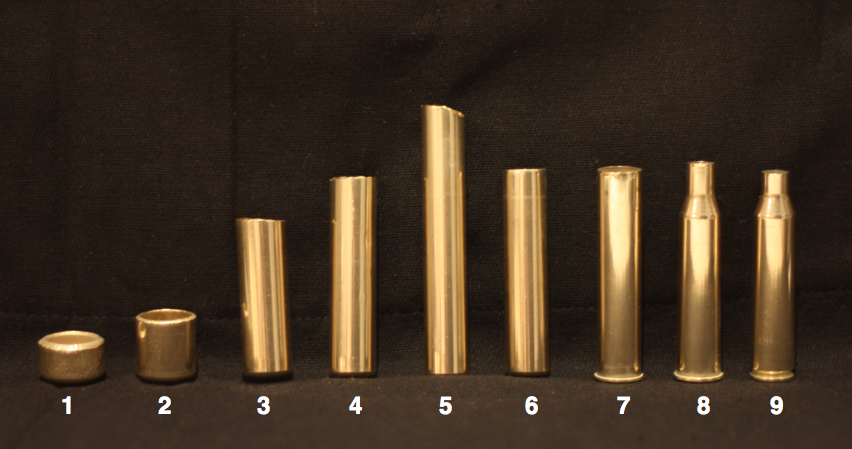
Naturally, the pressure applied when shaping the cups puts stress on the metal. Therefore, the cups are then annealed. Annealing is a process of heating the object until it is glowing hot and maintaining the temperature for a while and then rapidly cooling it by quenching in water (a previous version of this post incorrectly mentioned "letting it cool back slowly to room temperature in a room with no breeze blowing". Brass can be annealed by cooling rapidly with no ill effects. Steel, on the other hand, has to be annealed by letting it cool slowly. Cooling steel rapidly hardens it instead of softening it, whereas brass can be cooled rapidly.) The process of annealing softens the metal and removes the internal stresses caused by the shaping process. After annealing, the cups are then pickled in sulfuric acid to clean them. They are then forced through the drawing machine again to increase the length of the cartridge case (as shown in step 3 in the image below). The process of annealing, cleaning in acid and then forcing through the drawing machine is repeated multiple times, depending on the type of cartridge case, and the cartridge case is elongated each time until it reaches the size as shown in step 4 of the image below.

Public domain image.

Then the neck is formed by pushing the cartridge case through a press to give it the bottle-necked shape, as shown in step 5 in the image above. The base of the cartridge and the rim are formed by a powerful horizontal punching machine, which forces the empty case into a die to form the base and the cap chamber, as shown in step 5 and 6 in the image above. Finally, two tiny holes ("flash holes") are pierced through the cap chamber, as shown in step 6.

The cartridge cases are then trimmed to the required length and the rims are machined to remove sharp edges  and then, a primer cap is applied to the base of each case by a descending rammer and they are ready for loading. We will study exactly how this was done in the next post.

These days, many cartridge manufacturers use an extrusion process to form the cartridge cases, as it is faster and  more economical (we will study that shortly). However, there are a few manufacturers around, such as Norma, Lapua and RWS, that still use the traditional process to make premium quality brass cases.


Monday, August 26, 2013

Corrosive Ammunition

Many months ago, we talked about the development of the percussion lock. This was where the idea of striking a shock-sensitive substance with a hammer to ignite the main charge of propellant was originally developed. In that article, we had mentioned that mercury fulminate was originally used as the primer and was later replaced by potassium chlorate. This idea of using a shock sensitive priming material is still used in today's centerfire cartridges. However, there were some issues with using such primer materials and we'll study about them in this post.

In our discussion about the percussion lock previously, we'd mentioned that the inventor (the Rev. Alexander Forsyth) had used mercury fulminates to set off the main charge. Mercury fulminates continued to be used in priming caps for early centerfire cartridges as well, into the end of the 19th century. However, when people started to switch to using smokeless powders, they began to discover the downsides of mercury fulminate. One of the issues was that mercury fulminate tended to degrade when kept in storage. This was not really an issue when using black powder cartridges, because black powder ignites a lot easier than smokeless powders. However, once people started to switch to smokeless powders for extra power, they found that keeping the cartridges in storage would cause the mercury fulminate primers to degrade so much that they could not reliably ignite the smokeless powder, causing misfires and hang fires. One more problem with mercury fulminates was that in conjunction with smokeless powders, it tended to form copper and zinc amalgams in the brass cases of cartridges, thereby making them unsuitable for reloading.

Due to this, the US Army switched to using potassium chlorate primers in 1898. Some other manufacturers used sodium chlorate instead. While these primers did not degrade as much as mercury fulminate, there were some other problems that came with them. When fired, these primers would decompose and leave a residue of potassium chloride (or sodium chloride) behind in the barrel. Those of you who remember your chemistry lessons in school might remember that sodium chloride is the scientific name for common salt. Potassium chloride is also another corrosive salt. These salts are highly hygroscopic (i.e.) they tend to attract water, especially when in humid conditions. Guess what happens when you have salt and water applied to an iron or steel surface -- that's right, it rusts. Therefore, if the barrel and action are not cleaned after firing such cartridges, there's a good chance that they could rust soon after. Swabbing the surfaces with oil will not prevent these salts from attracting water and rusting the metal.

As a result of this, primers using non-corrosive chemicals were developed in the 1920s, but these were generally used in civilian ammunition only, as the early non-corrosive primers did not last as well in storage as corrosive primers. Due to this, military ammunition tended to use corrosive primers and this was indeed the case for US military ammunition until the 1950s or so. Some other countries (e.g. former Soviet Union, China, Yugoslavia, Bulgaria etc.) continued to use corrosive primers in their cartridges for much longer than this, well into the 1970s and 1980s. Therefore, depending on the source and the age of the ammunition, the user must be wary lest the ammunition is corrosive.

So how does a user ensure that his firearm doesn't rust after using corrosive ammunition. The good news is that this is fairly easy to handle. It turns out that these corrosive salts dissolve in water. Therefore, cleaning the firearm thoroughly using water or a water based lubricant should do the trick. Some people use hot soapy water, others use plain water, still others swear by windex glass cleaner (which is largely water based). After washing off the residue, the firearm should then be dried, then cleaned with normal bore cleaning solution and oiled, as per the normal cleaning procedures.

The firearm should be thoroughly cleaned as soon as possible after firing the corrosive ammunition, to ensure that the corrosive chemicals are removed before they can damage the firearm. While this may seem like a bit of extra work, it is well worth it because there is no way to restore a barrel or chamber back to perfect condition, once it has started to rust. Therefore, the user should go through the extra effort if the ammunition is suspected to use corrosive primers.

As it turns out, the price of surplus ammunition using corrosive primers is often much lower than other types and it is also widely available in the market. So how does a user identify if the ammunition is corrosive or not? One way is by looking at the markings on the cartridges and the manufacturer of the ammunition. For instance, if it is surplus ammunition from certain countries such as the former Soviet Union, Yugoslavia or China, there is a good chance it uses corrosive primers, especially if it is manufactured before the 1980s. US-made ammunition has markings that can give a good clue as to whether the primers are corrosive or not. In case of doubt, there's an easy way to find this out. The user can take a cartridge, pull out the bullet from the front and empty out the powder from the cartridge and only leave the primer behind. Then. the user fires the empty cartridge onto a mild steel plate from a distance of about 1 inch from the muzzle, so that the primer chemicals are deposited on the plate. The user also fires another primer that is known to be non-corrosive onto another section of the steel plate. After firing the two cartridges, the user cleans the firearm as detailed in the procedure above, in case the suspect ammo is indeed corrosive. Then the user simply keeps the steel plate in a warm humid area for a few days. If the section where the suspect primer is fired over shows substantial rusting, then it uses corrosive chemicals.

Another way is to use bright common nails (which are nails made of mild steel with no coating) and pop a primers over one of these nails. If the nail rusts within a couple of days, then the primer is corrosive. The following video shows how this is done, using simple household tools:


Interestingly, the box of suspect ammunition actually says that it is non-corrosive on the box, but it turns out to be corrosive after all. Happy viewing!


Sunday, February 24, 2013

How did they name cartridges - II

When we left off in our last post, we saw that cartridges like .45-70 and .50-90 were named based on their caliber and the amount of black powder in it (e.g. .45-70 has a bullet of .45 inches in diameter and 70 grains of black powder). We also saw that if two different bullet weights were available for the same cartridge, then a 3 number scheme was used (e.g. .45-70-405 and .45-70-500, where the 405 or 500 indicates the weight of the bullet in grains). We will continue our discussion in this post.

With the invention of newer smokeless powders, cartridges still retained the same two digit naming scheme as before: e.g. the famous .30-30 Winchester rifle, .32-20 Winchester or the .30-40 Krag, which replaced the .45-70 in US military service. As before, the first number indicates the caliber (e.g. 0.30 inches diameter) and the second number indicates the amount of smokeless powder in grains.

After some years, people began to drop the amount of grains and use the year that the cartridge was introduced instead. For instance, the Springfield .30-06 cartridge. This cartridge's diameter is 0.30 inches and it was introduced in 1906 (from which we get 06) and therefore it was named as .30-06. The .30-06 actually replaced the .30-03, which was, predictably, adopted in 1903.

Some years after that, people began to drop the second number altogether and simply name the cartridge after the caliber and the company that introduced it  (e.g.) .44 Colt introduced by Colt firearms, .32 S&W invented by Smith and Wesson etc. Sometimes they were named after a specific product (e.g.) .45 ACP where ACP stands for Automatic Colt Pistol. Sometimes they were named after specific attributes (e.g.) .38 Special, .44 Magnum, .577 Express etc., where the words Special, Magnum or Express indicate that these cartridges have extra power.

By the 1950s, people also started to name the first number by the groove diameter of the rifle, rather than the bore diameter of the bullet (at least in America). For instance, .308 Winchester, where the bore diameter is 0.300 inches, but the groove diameter is 0.308 inches.

Over in Europe (except for the UK), people generally use the metric system and name cartridges with two sets of numbers separated by an "x". e.g. 7.62x51, 5.56x45 etc. The first number is the bore diameter of the bullet in millimeters (e.g. 7.62 mm., 5.56 mm. etc.) and the second number is the length of the case in millimeters (e.g. 51 mm., 45 mm. etc.). Note that the first number is the bore diameter, not the groove diameter. Therefore, what we call the .308 Winchester in America actually has a bore diameter of 0.300 inches and a groove diameter of .308 inches and the Europeans take the 0.300 inch measurement and convert that into millimeters (7.62 mm.) and use that in their cartridge nomenclature. This system is generally used in the rest of the world as well (Asia, Africa, South America, Oceania etc.)

The British tend to name their cartridges in American fashion, e.g. .244 H&H Magnum (where H&H stands for Holland and Holland, a famous British firearms firm), .455 Webley (invented by Webley, another British firearms manufacturer) .700 Nitro Express etc. The numbers indicate the diameter of the bullet rather than the groove diameter though.

These are generally the naming schemes in vogue these days, but there are exceptions to the rule. American manufacturers in particular, tend to add names that sound good to consumer ears: e.g. .22 Hornet, .221 Fireball, .224 Rocket etc. Also, there are cartridges such as the .280 Remington (which actually has a bore diameter of 0.277 inches and groove diameter of 0.284 inches) and the .260 Remington (which actually has a bore diameter of 0.256 inches and groove diameter of 0.264 inches). Remington's marketing people decided that customers like numbers that end in zero better, so they named then .280 and .260 instead.

As you can see, these are several ways how cartridges have been named throughout history.


Wednesday, February 20, 2013

How did they name cartridges - I

In the world of firearms history, we often see famous cartridge names like .30-30 Winchester, .45 ACP, .30-06 Springfield etc. So how exactly do cartridges get named and is there some meaning behind their naming convention. We will study those in this post.

Bear in mind that cartridges are not always referred by the same name throughout history. For example, when Smith & Wesson produced their first revolver model, they made it fire a .22 cartridge, which was then referred to as a ".22" or a ".22 caliber" in 1857, since there were no other cartridges with the same caliber bullet. This cartridge contained 4 grains of black powder in it and a bullet weighing 29 grains (or 2 grams in the metric system) and measuring .222 inches in diameter. In 1871, Smith & Wesson produced another cartridge in .22 caliber diameter. This cartridge used the same 29 grain bullet as its predecessor, but the case was a bit longer than the older one and contained more black powder (5 grains), in order to produce extra power. Therefore, they began to refer to the old .22 cartridge as ".22 Short" and the new one as ".22 Long". Both these cartridges were used for revolvers. Soon afterwards, Remington, Stevens, Winchester etc. started producing the ".22 Extra Long" for rifles and revolvers. This cartridge used a 40 grain (3 gm.) bullet and a longer case that contained 6 grains of black powder in it. Then, the Stevens Arms and Tool Company combined the case of the .22 Long with the 40 grain bullet of the .22 Extra Long to produce the ".22 Long Rifle" (a.k.a. ".22 LR" cartridge).

Public domain image of different .22 caliber cartridges.

The .22 LR became very successful and still remains the most popular cartridge in the present day. Therefore when someone talks about ".22 caliber" in today's world, they are almost certainly referring to the .22 LR cartridge. However, back between 1857 and 1871, when someone said ".22 caliber" they would have been referring to what we now call ".22 short". So you can see how common cartridge designations have changed over the years.

For some early cartridges, they were named with two sets of numbers. For instance, right after the US Civil War, the US government issued the ".50-70 Government" cartridge for use with the Springfield Model 1866 rifle. This was later replaced by the ".45-70 Government" cartridge in 1873. So what do the numbers .50-70 and .45-70 mean? For a ".50-70", it means that the cartridge has a .50 caliber bullet and 70 grains of black powder. Similarly, a ".45-70" has a .45 caliber bullet and 70 grains of black powder. This naming scheme was also used for other cartridges such as the ".50-90 Sharps", ".50-100 Sharps", ".50-110 Winchester" etc.

In some situations, these cartridges were also referred to with three sets of numbers, such as ".50-70-450" and ".45-70-405" where the third number indicated the weight of the bullet in grains. This was done as cartridges of the same size, but with different bullet weights, became common. For instance,  the .45-70 cartridge case was used for two different bullet weights and to tell them apart, the two cartridges were called .45-70-405 and .45-70-500, when the 500-grain-bullet variant was invented in 1884.

In the next section, we will look more into the conventions used to name cartridges.

Saturday, July 21, 2012

Reloading Ammunition: Procedures

In the last few posts in the series, we've talked about all the equipment needed for reloading. Now we will discuss how the process of reloading works. At this stage, it might be a good idea to state a few points:

  1. While reloading ammunition is legal in the United States and Canada and some other countries, it is also illegal in some countries around the world. In some countries (e.g. Germany), people need to take a course and pass a state exam before they're allowed to reload legally. In other countries, reloading is completely banned. If you are from one of these countries, you should probably stop reading now.
  2. Many firearms manufacturers will refuse to honor warranty if non-standard loads are used.
  3. Some lawyers recommend against using reloaded ammunition for home defensive use. This depends on jurisdiction though, so it is best to check if it is an issue in your area or not.
  4. Don't always believe everything you read on the Internet (including this blog). If you want to get into reloading, it is best to consult an experienced person on the subject face-to-face.
With that said, let's look into all the equipment used for reloading. If you'd been reading the previous few blog posts carefully, you should have no trouble identifying the equipment in the movie below, and the purposes for which they are used:


The above post shows some of the basic equipment that a reloader needs, along with an explanation of what each tool does. The movie basically goes over what we covered in the last few blog posts.

The next video also goes over equipment (although much more quickly) and shows the process of reloading:


This gives a fairly good idea of the reloading process with a single stage press.

In the next video, we see another person reloading using a more advanced press and tools.


Happy viewing!


Wednesday, July 18, 2012

Reloading Ammunition: Equipment: Reloading Kits

In the last few posts in this series, we looked at various individual tools and materials needed to reload cartridges. For many of these tools and materials, we looked at the prices at which they could be purchased. However, it must be noted that if a beginner were to start reloading and purchase these items individually, they would cost a considerable sum of money. Not to worry though: many manufacturers also sell reloading kits, which contain the basic tools that a beginner would need to do some reloading.  Buying one of these is a lot cheaper than purchasing the individual parts.

At  the low-end, we have hand-reloading kits for specific pistol and rifle calibers:

A basic 9 mm. reloading kit from Lee Precision Inc.

This is a cheap loading kit designed for reloading 9 mm. Luger ammunition only, that sells for about $38.00. Note that it doesn't come with any reloading press, the powder measure is a simple scoop and it comes with a couple of tools that look like long screwdrivers to perform decapping and capping operations. A couple of dies are included to size the case and load the bullet. The user is expected to purchase a rubber mallet to use with this kit, as there is no press. There is also an included instruction manual that gives step-by-step instructions on how to use this kit, along with information about powder types and loads that should be used with it. Lee Precision claims that a user can load about 50 cartridges an hour with this kit, which is probably a little on the high side.

Lee sells a number of these kits at the same price (about $38.00), each one designed for a specific pistol or rifle cartridge caliber, e.g. 9 mm. Luger, .44 magnum, .357 magnum, .45 ACP, 30/30 Winchester, 303 British etc. In many of these kits, Lee Precision does state that some considerable force will need to be applied for reloading larger cartridges, which means that these kits are not easy for everyone to use. Still, these are the cheapest type of reloading kit available.

The next step up is a reloading kit that can be used to reload various types of ammunition. Such a kit comes with a single-stage press:

Lee Precision Breech Lock Challenge Kit. Click on image to enlarge.

This kit comes with a single-stage "O" press, an automatic powder measure, a set of powder scales, a powder funnel, a hand operated spring-loaded priming tool, a set of shell holders that will fit 115 popular cartridge types, case cutter and deburring tool (case-length gauges for specific calibers can be ordered with this kit for an additional $6 per gauge). Included also are a case lubrication kit and a couple of primer pocket cleaning tools.

If the above parts are purchased separately, they would cost around $215 in total. However, buying this kit costs only $172. Of course, the user will also need to purchase sets of dies corresponding to the cartridge calibers that they need to reload, which cost an additional $40 per set. Additional tools would include calipers, some cleaning brushes, a reloading data book etc.

A single stage reloading kit from RCBS

The above image is another single-stage loading kit from RCBS Inc. This one also has a single stage "O" Press, a set of powder scales, a powder funnel, case lubrication kit, a loading block, primer tray, case cleaning brushes, deburring tool and a reloading manual written by Speer (for non-American readers, Speer is a well-known ammunition manufacturing company in America). A kit like this costs about $180. As with the above Lee kit, this one also needs the user to purchase sets of dies corresponding to the cartridge calibers that need to be reloaded, which cost about $40 per set. In addition, the user will also need to purchase some shell holders corresponding to the cartridge calibers being reloaded, calipers etc.

Single stage kits like these allow the user to reload about 250 rounds per hour.

Next up, we have turret press kits, such as the one below:


This value turret press kit costs about $115 and just requires 4 pulls of the lever to complete a cartridge. It comes with a turret press, auto powder measure, scale, case cutting tools, primer pocket cleaner and deburring tool. All that is needed is a set of dies for that caliber and optionally, calipers and loading blocks. This particular kit is only suitable for handgun cartridges though.


Turret Press reloading kits by Lee Precision and RCBS. Click on images to enlarge

The next two images are turret press reloading kits geared towards reloading both pistol and rifle ammunition. These kits are in the $300 - $400 range and contain all the common tools needed for reloading. The manuals that are supplied with these kits contain instructions to load a very wide variety of cartridges. The user only needs to additionally purchase die sets and shell holders for the cartridge calibers to be reloaded + calipers if needed.

These kits are easily capable of loading about 250 cartridges an hour

Finally, we have kits that contain progressive presses.


Hornady Lock N' Load Ammo Plant reloading kit. Click on image to enlarge

A kit like this costs about $1200 - $1400 and comes with a progressive press, automatic bullet feeder, automatic case feeder, die bushings, cartridge catchers, primer pickup tubes, a monitor to ensure that it will warn when the hopper runs out of gunpowder etc.  The only things left to purchase are shell holders, dies and perhaps some additional die bushings (if the ones that are already supplied with the kit don't fit), a set of scales and calipers.

RCBS Progressive reloading kit. Click on image to enlarge

The above kit costs about $900 and comes with a progressive press, automated priming and powder dispensing systems, case trimmer and cutter, deburring tool, case lubrication kit, brushes and cleaning tools and a Speer reloading manual among others. Note that the scale is electronic and can be used to measure the powder as well as the completed cartridges. The kit also comes with a set of calipers, so the only thing that the user needs to purchase is a set of dies and shell holders.

One last thing to mention is that many of the prices mentioned in this article and the previous ones are new equipment prices, as of time of writing of the article. It is possible to buy many of these tools in used condition from gun shows, at much reduced prices. Some tools like presses or dies generally tend to last a very long time, so a used press may perform very similar to a new one, but only cost $20 - $30 whereas the same model in brand-new condition could cost $70 - $80. Similarly, dies tend to last a very long time, so used dies can be purchased for much cheaper than new ones and while the used set may have some minor scratches and blemishes, it could still perform as well as a brand-new set.