Showing posts with label cartridge. Show all posts

Sunday, December 6, 2015

Early Cartridge Technologies: Skin Cartridges

In our last post, we looked at tinfoil cartridges, which was one way to make cartridges more resistant to water. In today's post, we will look at another material that was also used to make cartridges more water resistant: animal skin. We will study skin cartridges today.

Skin cartridges

First, the name is somewhat misleading because skin cartridges were not really made of skin. They were actually made of animal gut, mostly cattle, sheep and pig intestines. The intestines were first soaked in a weak solution of potassium hydroxide (i.e. lye solution), which would remove the fat and inner mucous membrane from the gut and prevent further putrefaction. The intestines were then beaten thin and stretched over formers made of wood or metal to dry out. After drying out, the intestines would form seamless cases that could be filled with black powder. The cases were formed as conical shapes, so that they could be easily dropped into the chambers of a revolver or a rifle for faster loading. The cases were then treated with combustible chemicals such as potassium nitrate, so that they would burn during ignition and leave very little residue behind in the chamber. After filling the cases and adding the bullets, the cartridges were then treated with a little shellac varnish to make them water resistant.

Skin cartridges were used mainly in Colt revolvers and also in the Sharps rifle. They were famously used by Colonel Berdan's sharpshooters during the Civil war.

Skin cartridges made by D.C. Sage. Click on the image to enlarge.

Two inventors, William Mont Storm and Julius Hotchkiss developed separate patents to improve skin cartridges. An example of cartridges made using Hotchkiss' patent is shown above. The Mont Storm patent shows an improved way to make cases, as well as using gutta-percha dissolved in rectified naphtha or chloroform, instead of shellac to provide the waterproof varnish. The Hotchkiss patent uses a different technique to improve the toughness of the animal gut so that it doesn't split easily and it also dispenses with the thread wrapping that was sometimes used by others to strengthen their cases.

Over in England, Captain John Montagu Hayes of the Royal Navy received British patent # 2059 of 1856, for a skin cartridge. The patent specification reads in part, "A skin or membrane (prepared from the gut of animals, as pigs, or birds, or reptiles) is used instead of paper for cartridges, which are made without a seam. A covering or network of thread may be used to strengthen the cartridge." (this thread wrapping is what was improved by the Hotchkiss patent in the previous paragraph)

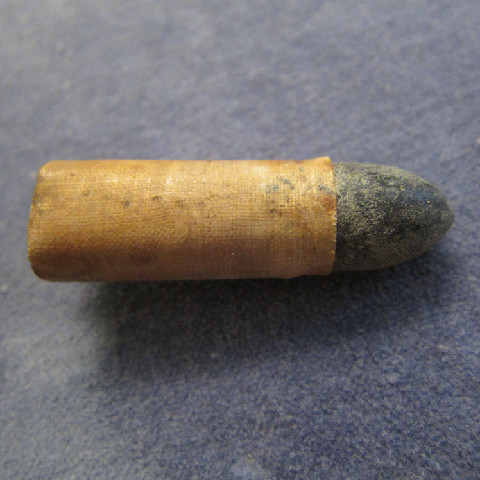
 A skin cartridge of British manufacture, made by Eley Brothers. Click on the image to enlarge.

The above images shows a skin cartridge made by the British cartridge manufacturer, Eley Brothers, who we learned about in our last post. Like the tinfoil cartridges we studied previously, this cartridge partly uses the Colt-Eley patent: it has an outer wrapper made of paper, with a tape to quickly pull the cartridge out of its outer paper wrapper. The paper wrapper is clearly visible in the image and the skin casing is inside it.


The above image shows five American made skin cartridges for .36 caliber revolvers. From left to right, we have cartridges for Remington, Savage, Colt Navy, Colt Navy and Colt Pocket revolvers. 

In America, major manufacturers of these cartridges were Johnston & Dow, Hazard Powder Company, Elam O. Potter and D.C. Sage.


Skin cartridges made by different American manufacturers. Click on the images to enlarge.

Like the other combustible types of cartridges, skin cartridges rapidly fell out of fashion when the first metallic cartridges were invented.


Saturday, November 28, 2015

Early Cartridge Technologies: Tinfoil Cartridges

In our last post, we studied linen cartridges. In today's post, we will study cartridges made of a more exotic material: tinfoil. Yes, there really were tinfoil cartridges made at one point.

Tinfoil cartridges were originally made by Samuel Colt for his revolvers. During this period, paper cartridges were common, but if the paper got wet, it would ruin the black powder. The idea behind using tinfoil was to make a cartridge that was not affected by water as much.

At the time that Colt first started working on tinfoil cartridges, his first company that he had set up to manufacture Colt Paterson revolvers was not doing so well (it soon went bankrupt in 1842, due to lack of sales.) He initially experimented using rubber as the material, before switching to tinfoil. Soon after, the US Government got interested in his developments. In April 1840, the Secretary of War and the Secretary of the Navy asked a mixed board of officers from the Army, Navy and Marine Corps to make experiments and evaluate Colt's tinfoil cartridges. The officers were: Colonel G. Croghan of the Army, Captain C.S. McCauley of the Navy and Lieutenant J.G. Reynolds of the Marines. They met at Washington Arsenal and performed several experiments and wrote a report of the results, an abridgement of which is below:

The board relying upon the correctness of the experiments as above recited, are unanimously of the opinion that in reference to the usual incidents of our service, naval as well as military, the cartridge now in use is greatly to be preferred to the tin-foil cartridge submitted by Mr. Colt. It appears evident from the facts set forth by the foregoing experiments that the tin-foil is entirely unsuited for cannon service; yet from its imperviousness to water, the tin-foil cartridges for small arms might be found useful in certain cases. The board would, therefore, recommend the partial adoption of the tin-foil cartridge for small arms.

The tests that they performed for these cartridges may be of interest to readers:

"Experiment 1, April 10, 1840: Twenty six cartridges of tin-foil and as many of paper, were fired from well cleaned muskets, no difference was perceptible."

"Experiment 3, April 20, 1840: Four 6-pounder and thirty musket cartridges, all of tin-foil, which had been immersed in water from the 10th instant, were taken therefrom; two of the 6-pounder cartridges appeared to have been injured by accident, the other two were fired and appeared not to have been injured by the water; a dry sponge was used in these firings, and it was burned each time by the contents left in the gun. The musket cartridges were then examined; sixteen of them were selected for firing, seven of which only could be discharged"

"April 21: In order to test the relative strength of the tin-foil and cartridge paper, strips of each were tested; the foil could not support a weight of forty pounds, whilst the paper did not break with the weight of eighty pounds"

Most of the remaining tests correspond to use in cannon and the tin-foil cartridges left more residue globules in cannon, which is why the board recommended to only use the cartridges for small arms and only partially.

The US Army purchased a few thousand more tinfoil cartridges for further evaluation and in 1843, they placed a large order for 250,000 tinfoil musket cartridges, for the purpose of trying them in field service. This large order was an unexpected gift for Colt, since his revolver manufacturing factory in Paterson had gone bankrupt shortly before in 1842. The funds from the US Army were used by Colt to fund research for his "New and improved revolver" and he attempted to start a new Colt's Patent Manufacturing Company with this money. He also used some of the money to produce a waterproof telegraph cable for his friend, Samuel Morse (the inventor of Morse code and inventor of the single-wire telegraph). Then came the order from Samuel Walker for the Walker Colt revolver and the profits were large enough for Colt to go back into the firearms manufacturing business in 1847. A few years later, Colt also established a factory in London in 1853.

While Samuel Colt was in London, he met a gentleman named William T. Eley, who was in the business of making cartridges in England. William T. Eley was the son of William Eley and nephew of Charles Eley, who had founded the Eley Brothers cartridge manufacturing company in London in 1828 (Eley Brothers later became the largest ammunition manufacturer in the world and the brand name is still used for cartridges today). Together, they developed a new tinfoil cartridge that was granted British patent #1324 in 1855.


The powder container was made of tinfoil and the lap joint sealed with waterproof cement. The case was then filled with powder and the bullet was inserted to the top and then the end of the tinfoil case was crimped into the base groove of the bullet and then greased, to produce a waterproof cartridge. The cartridge was then enclosed in a paper wrapper, from which it could be easily removed before loading. Due to the shape of the bore of the nipple in Colt's revolvers, the flame from a percussion cap would pierce the foil and ignite the powder, without the need to tear open the foil.

In the above image, the cartridge on the right is of .31 caliber. The one on the left is also a .31 caliber cartridge, but it is enclosed in an additional protective paper case. The one in the middle, is a .28 caliber cartridge in a sectioned case. The case has a tape to pull the cartridge out, which was later copied by other ammunition makers. The side of the case visible to us says "COLT'S" and has a picture of a colt in the bottom, the other side has the word "PATENT".

Another image of a Colt tinfoil cartridge is shown below:


To manufacture these cartridges in the US, Colt set up a separate building, situated about a half mile away from his other factory in Hartford. In this cartridge manufacturing factory, no fire was allowed anywhere near it and the factory was heated by piping in steam, which was generated in a different building outside.

Women doing the dangerous work of assembling Colt's gunpowder cartridges at the Cartridge Works. From United States Magazine, 1857
Click on the image to enlarge. Public domain image.

Most of the labor in this factory was performed by women, with the only men around being a foreman, an engineer and a charger.

In our next post, we will study more cartridges made of other materials.


Sunday, November 22, 2015

Early Cartridge Technologies: Linen Cartridges

A few weeks ago, we began to study an early form of cartridge: the paper cartridge. Where we left off, paper cartridges had advanced to the point where the paper was treated with chemicals to make it more combustible.

The main problems with paper cartridges are that they aren't very water resistant and the paper is somewhat fragile. As the bullet could be rather heavy, the weight of the bullet could cause the paper to tear as well. There was a need for a cartridge to be made of a more durable material and that's when the linen cartridge was born.

A .52 caliber linen cartridge for a Sharps rifle. Click on the image to enlarge.

In 1852, American inventor Christian Sharps invented a linen cartridge, to go with his Sharps rifle (which was earlier invented in 1848). The linen cartridge was a great improvement over the paper cartridge because it could withstand rough handling better, without breaking open. A linen cartridge also held its shape better than a paper cartridge could. The back of the linen cartridge had a piece of nitrated flash paper (which we studied in the last post) to provide the ignition. The linen used to make the cartridge body was treated with starch to make it stiffer. Linen cartridges were also treated with chemicals to make the linen more combustible, similar to that of paper cartridges that we studied earlier. Like the paper cartridges, the bullet was glued on top with sodium silicate glue.

For a while, cartridges were made for the Sharps rifle with both paper and linen, but the linen cartridge gradually started to find some backers. In the words of a Major W.A. Thornton:

"The making of Sharps Cartridges with paper must be abandoned and linen must be used in the formation of the cylinder. More care cannot be given in the making of cartridges than is bestowed in our laboratory. The fact is that the ball is too heavy for the paper, and worse than that -- the paper is sometimes softened by the lubric which causes it to break by the weight of the ball. From this date, I will make no more of paper, but I will make the powder cylinder of linen."

What the Major is describing are two flaws of the paper cartridges used by the Sharps rifles. The first is that the weight of the bullet is so great that a paper cartridge cannot hold its shape and often tears open by itself, due to the weight of the bullet. The second problem is that the lubricant (spelled in his letter as "lubric") also softens the paper and weakens it, thereby causing the paper to break. Since the lubricant is necessary to reduce the fouling inside the barrel, a stronger material must be used for the case body and this is why linen was used.

Linen cartridges were used by both the Sharps rifle and the Starr carbine during the Civil War.

In our next post, we will study another durable material that was also used to make cartridges during that period of time.


Saturday, November 14, 2015

Early Cartridge Technologies: Paper Cartridges - III

In our last post, we saw the advances in paper cartridge technology to handle expanding bullets. In today's post, we will study more advances in paper cartridge technology around the time that percussion caps and revolvers started becoming popular.

Early Colt Paterson revolvers. Click on the image to enlarge. Public domain image.

With the advent of percussion cap revolvers, such as the Colt Paterson models pictured above, most people loaded their revolvers from paper cartridges exclusively. The paper cartridges were therefore modified a bit to take advantage of these new developments in firearms.

In the picture above, note that the two Colt Paterson 1839 model revolvers have a loading lever under the barrel, whereas the 1836 model doesn't have this feature. We will see how that is used with the cartridges that we will study today.


Paper cartridges for a .36 caliber Colt revolver.; Click on the image to enlarge

As you can see in the images above, the bullet is now in the front of the cartridge (unlike the designs we studied in our last post). The bullet is attached to the cartridge with glue. Also, the shape of the cartridge has changed a bit, so that the paper part now forms a conical shape instead of a cylindrical shape. This was a deliberate design choice, so that it is easier for the user to insert the cartridge into the front of the cylinder. Unlike previous designs, there is no need to tear the paper and pour the powder into the chamber. Instead, the loading lever is used to ram the entire cartridge into the chamber. Because of the shape of the cartridge, the cartridge paper automatically tears open when it is compressed into the chamber. Some cartridges were equipped with a protective outer layer around the cartridge, to keep it safe from moisture, and these would have a tiny tear tab to remove the outer layer before loading the cartridge.

A glue made of sodium silicate was used by the Colt Manufacturing Company to hold the bullet to the cartridge, as well as seal the paper part. This was what was used by Colt between 1851 to 1873, until they started to produce brass cartridges in 1873. Sodium silicate has the advantages of resisting high temperatures, as well as being cheap and easily available. Sodium silicate was also used to cement the top wad of shotgun shells and was heavily used by American farmers who reloaded their own shells in the 1870s, as sodium silicate was the same material used to preserve eggs as well.

One more innovation made to these cartridges was to the paper material as well. In order to make the ignition of the powder more reliable, the paper was treated with chemicals to make it burn better. This paper is called nitrated paper, as it is manufactured by soaking it in a solution of potassium nitrate and then drying it. This treatment makes the paper much more flammable than ordinary paper. Such cartridges are called combustible cartridges, because the paper burns almost completely upon ignition. A properly nitrated paper leaves behind less ash and residue, thereby making it easier to clean and reload the weapon.

Another formula for making combustible paper used a solution of nitric and sulfuric acids and was used by both Colt Manufacturing and Dow Chemicals, as well as some other manufacturers in the 1800s. These are essentially the same chemicals used to produce guncotton, which we had studied a few years before. Paper that is treated this way is called flash paper. This paper also burns quickly and leaves very little ash behind, but it is much more unstable than nitrated paper, and in the early days, it was also prone to spontaneous combustion. This is why flash paper did not gain much popularity in the firearms industry. These days, the only people using flash paper are magicians, who use it to produce spectacular flames when performing magic tricks.

With the advent of metallic cartridge technologies, the use of paper cartridges started to reduce. However, there are still some applications for which paper is used. For instance, until about 1960 or so, many shotgun shells were made of paper bodies, with a brass base and rim. The reason for this was because it was cheaper and easier to make the body out of paper than to make the entire shotgun shell out of brass. Around 1960, shotgun shells started to use plastic bodies instead of paper, and a majority of modern shotshells today make use of plastic. Nevertheless, it is still possible to buy paper shotshells even today.


The bodies of these cartridges are made of a cardboard paper and are coated with wax to provide some resistance to moisture. They aren't as common as they were back before 1960, but there are still some manufacturers making them.


Saturday, November 7, 2015

Early Cartridge Technologies: Paper Cartridges - II

In our last post, we looked at the earliest forms of paper cartridges. In today's post, we will look at more developments in that field.

As firearms technologies improved, smoothbore muskets began to be replaced by rifled barrels for greater accuracy. The invention of expanding bullets, such as the Minie bullet, made it possible for firearms to not only shoot accurately, but also improved the gas seal without the need for thicker wadding, because the bullet would expand and produce the gas seal itself. The main problems to solve here were to reduce the amount of fouling produced by the black powder and lead from the bullet, as well as to keep the cartridges from being affected by bad weather. The solution to both these issues was to provide a coating to the paper cartridge case, in the form of a mixture of beeswax and tallow. This coating allowed the cartridge to be somewhat water resistant, as well as provided lubrication to the bullet.

The lubricant made it easier to push the bullet down the barrel of the muzzle loader and also softened the residue inside the barrel, so that most of it could be pushed out of the way easily when reloading. This helped reduce the problem of powder fouling in the barrel, though it did not solve it.

Since the bullet expanded and provided the tight seal on firing, the paper needed to be thinner than previous paper cartridges, so it could fit between the bullet and the barrel properly. However, the thin paper could cause the body of the cartridge to not be sturdy enough. To get around this problem, cartridges were often made using multiple layers of paper, some thick and others thin. The following instructions and illustrations are taken from an instruction manual dating back to 1853 for the Enfield rifle. The manual explains that soldiers might find themselves in the position of having to make their own cartridges in the field, and therefore the manual shows how this was done.

Three separate papers used to manufacture an Enfield cartridge. Public domain image. 

Tools used to manufacture the Enfield cartridge. Public domain image.


The first image shows the different paper shapes used to make a single cartridge, along with their sizes. The paper shape on the right (labelled as "stiff paper") is made of a thicker paper material and forms the body of the cartridge and gives it the strength, so that the cartridge does not deform easily. The paper shape in the middle (labelled "inner envelope") is made of a thinner paper material. It wraps in a thin tube around the thicker paper and then blocks it on one end, thereby separating the powder from the bullet. The third piece of paper on the left (the "outer pattern") is also made of a thinner paper material. It wraps around the bullet and the other two tubes, thereby enclosing the bullet and powder in one packet.

To manufacture one of these cartridges, the instructions are as follows:
  1. Make the powder case: This is done by rolling the "stiff paper" pattern tightly around the mandrel around 2.5 times. The mandrel is laid opposite to the side AB, with the base of the mandrel head coinciding with AD. After the "stiff paper" is rolled around the mandrel, the "inner envelope" paper is placed on top of it and rolled around it. The second paper overlaps the first one, so the excess is pushed into the hollow at the base of the mandrel, making use of the point to adapt the paper to the cavity which is to receive the point of the bullet, being careful to secure the bottom of the powder case, so that no powder can escape from it.
  2. Attach the bullet to the powder case: Put the point of the bullet well into the cavity of the powder case. Then roll the "outer envelope" paper tightly around the bullet and powder case, with the mandrel still in it. Then twist or fold the overlapped paper as close as possible to the base of the bullet. Then place the base of the cartridge on the table and withdraw the mandrel carefully from the other end, by pressing the powder case with one hand, while pulling the mandrel with the other, the aim being to not separate the powder case from the bullet. The powder case must be kept as close to the bullet as possible, otherwise the cartridge will not be usable.
  3. Charge the cartridge case: Place a funnel at the mouth of the cartridge case and pour in about 2.5 drams of black powder, or a lesser quantity, according to the firearm used. Remove the funnel, being careful that none of the powder escapes between the inner and outer envelopes and then secure the charge by squeezing the tops of the two envelopes close to the top of the stiff paper of the powder case, and then giving them a slight twist with inward pressure, laying the ends on the side of the cartridge. Three slits are made in the outer envelope to facilitate its detachment when fired.
The next picture is in color and shows how these three papers combine together in a complete cartridge:

Internals of an Enfield cartridge from the 1850s. Click on the image to enlarge.
Public domain image courtesy of user Zerodamage at Wikipedia/
  1. Lubricate the cartridge: In this step, the base of the cartridge case is dipped up to the shoulder of the bullet, into a lubricating mixture composed of 5 parts of beeswax and 1 part of tallow.
A complete Enfield paper cartridge. Public domain image.


Cartridges were then packed in bundles of ten, and each packet was labelled as shown below.

The second line indicates that these cartridges are for the Enfield model 1853 rifle musket. The next line indicates that the bullet is of .55 inches in diameter. The word "wax" is to indicate the composition of the lubricant and the three horizontal lines after that indicate that the outer paper layer has the three cuts (as detailed in step 3). The next line indicates how much black powder is in each cartridge (2.5 drams) and the last line indicates that each bullet has a plug made of wood in its base and this plug enables the bullet to expand when the cartridge is fired.

The packets were then tied together with strong twine and packed into barrels, by placing the packets around the sides of the barrel, with a cylinder of percussion caps being placed in the center, with the ratio of 75 percussion caps for every 60 cartridges in the barrel.

To load such a cartridge into a rifle, the powder end of the cartridge is opened by tearing the thin outer paper envelope and the powder is then poured into the muzzle of the rifle. Then the bullet end is inserted into the muzzle, up to the level of the thick paper tube, which is then torn off and discarded. The bullet and the remains of the thin outer envelope are then pushed into the barrel using the ramrod and the rifle is then cocked and prepared for firing.

Interestingly, the use of lubricated paper cartridges was one of the causes of the Great Indian Mutiny of 1857. The sepoy soldiers of British India were required to bite on the cartridges to open them, as part of the loading procedure. A rumor spread that the cartridges were greased with beef fat (offensive to Hindus, who are forbidden to eat beef) and pig fat (offensive to Muslims, forbidden to eat pork). There were already rumors that the British authorities were trying to destroy the religions of the Indian people and the rumors of the content of the cartridge grease convinced sepoys of the Bengal regiment that their fears were justified. This was cited as one of the causes for the mutiny to start.

In our next article, we will look at further improvements to the paper cartridge, as we enter into the era of revolvers.


Wednesday, November 4, 2015

Early Cartridge Technologies: Paper Cartridges - I

Since we were discussing cartridge rim types in our recent series of posts, your humble editor decided to go back in time to the first cartridges. We had already discussed paper cartridges some time back when this blog first started, but it might be nice to revisit that topic in detail.

A paper cartridge is simply a cylinder or conical shaped object made of paper and filled with a bullet, some black powder and sometimes, a lubricating substance (such as wax or lard). The paper was often of a thicker type. In later years, a special type of paper, called cartridge paper, was specially developed for this purpose. From a firearms perspective, one of the biggest advantages of paper cartridges was that it allowed the users to reload their firearms quicker than before.

According to W.W. Greener's book, The Gun and its Development, the use of paper cartridges has been going on for a while. It was stated that the soldiers of Christian I, Elector of Saxony (currently in modern Germany), were using paper cartridges in 1586. Interestingly, Christian I of Saxony was from the House of Wettin, some of whose descendants are the Royal family of the UK. Greener also states that in the Dresden museum, there are Patronenstocke and other evidence to show that cartridges were in use, as early as 1591 (since the book was written in the early 1900s and Dresden was bombed heavily in World War II, your humble editor is not certain if the specimens still exist there). Finally, an author named Capo Bianco wrote in 1597, that cartridges had long been in use among Neapolitan soldiers. In England, the British Patent office has a record from 1777, when one William Rawle patented several "instruments for carrying soldiers' cartridges". Therefore, we can see that paper cartridges have been in use for quite a while.

A typical paper cartridge. Public domain image.

As we studied a long time ago, most of the early firearms were muzzle-loading, with no rifling at all. Early cartridges for such weapons simply consisted of a paper tube with three pieces of thread: two threads tied on each end to seal the packet and a third thread somewhere in the middle to divide the paper tube into two compartments, such as the one in the image above.

The first compartment (the smaller one) contained the bullet (or bullets), which were spherical shaped because the muskets didn't have rifling. The second compartment (the larger compartment) contained a pre-measured quantity of black powder.

To load the musket, the user would use the following process:

  1. Hold the musket level and open the cover of the flash pan.
  2. Bite open the cartridge on the side containing the powder and pour a small quantity of the powder into the flash pan to prime it. Then close the cover of the flash pan.
  3. Turn the musket up vertically and pour the remaining powder into the barrel.
  4. Crumple up the paper and insert the ball and paper into the muzzle of the musket.
  5. Use the ramrod to push the ball and paper down the barrel of the musket.
  6. Prepare the musket for firing by cocking the flintlock mechanism.
Since the quantity of black powder in the cartridge is already measured in advance, this eliminates the  need for the user to measure the proper amount of powder during reloading. Also, since the bullet ball is already wrapped in the packet, the user doesn't need to search around in a separate bag to find a ball for reloading. As smoothbore muskets of the era were loaded with lead balls that were smaller than the diameter of the barrel, the cartridge paper also served as a patch to provide a good gas seal in the barrel.

Paper cartridges of this early type were generally designed with thicker paper, so that they could withstand rough handling.

It must be mentioned that black powder leaves a lot of residue in the barrel, therefore it becomes harder to push the ball in after every shot, until the barrel is properly cleaned. Also, black powder does not like damp conditions very much.

In the next part, we will look at some developments in paper cartridge technology that solved some of these problems, as well as handling newer firearm technologies, such as rifling.


Saturday, October 31, 2015

Cartridges Rims: Rimmed vs. Semi-Rimmed vs. Rimless vs. Belted vs. Rebated - Part III

In our last couple of posts, we looked at a few cartridge rim types: the rimmed cartridge, semi-rimmed and rimless types. We will look at a couple more rim types in today's post: the belted type and the rebated rim type.

As we noted in our previous post, the basic problem with rimmed cartridges was reliable feeding from box magazines, as the cartridge rims would interfere with each other in this type of magazine. One way to solve this was to reduce the diameter of the rim, as we saw with the semi-rimmed type of cartridge. Of course, the smaller rim made it trickier to headspace the cartridge in the chamber properly. Around the same time, another type of cartridge was introduced in 1905 to solve both issues: the belted cartridge.

The belted cartridge design originated in England and was designed by the famous sporting gun manufacturer, Holland & Holland. A belted cartridge is similar to a rimless cartridge in that the rim is around the same diameter as the cartridge case and there is an extractor groove in front of the rim for the extractor claw to fit in and pull out a spent cartridge. The belted cartridge differs in that in front of the extractor groove, there is a raised ring in front of the extractor groove.


The belt acts similar to the rim for the purpose of headspacing the cartridge in the chamber properly. This design allows smooth feeding through box magazines, but also has the advantage of providing positive headspacing, just like a rimmed design. Most belted type cartridges are designed for high-powered hunting rifles.

Headspacing on a belted cartridge. Click on the image to enlarge. Public domain image.

The origin of this type of cartridge had to do with when black powder was being replaced by smokeless powders, specifically cordite. As we saw in the linked article about cordite previously, cordite is composed of long strings of a light brown color, which are packed into a cartridge case in bundles like spaghetti. The prevailing production method of these cartridges in England consisted of inserting small bundles of cordite into a straight-walled case, which was then necked down to the final shape and the bullet was seated. Because of the long strings of cordite, cartridge cases using this propellant tend to have long sloping shoulders.

A .375 Holland & Holland magnum belted cartridge

When these cordite cartridges were first developed, most rifles were still single shot designs, so they were designed as rimmed cartridges. However, as the bolt-action rifles started to become popular, there began a demand for proper feeding from box magazines and hence, the belted cartridge was developed. The first belted cartridge was the .400/375 Holland & Holland Belted Nitro Express cartridge, and it was specifically developed to compete against the German 9.5x57mm Mannlicher-Schonauer cartridge, which was being adopted by Holland & Holland competitor in England, Westley Richards. However, soon after, a German gunmaker named Otto Bock designed the 9.3x62 mm Mauser cartridge. This cartridge was made to be fired out of the Mauser M1898 rifle, which was designed to be mass-produced and cheaper than most British rifles at that time. The cartridge and rifle rapidly became popular with African hunters, because of its all-round capability to be used against animals ranging from the smallest antelopes to the largest elephants. In response to this, Holland & Holland developed the .375 Magnum Belted cartridge in 1912. The belted design allowed cases to feed and extract reliably in the tropical environments found in India and Africa. The .375 H&H Magnum rapidly became one of the most popular all-round hunting cartridges in the world, and in many regions of the world, it is considered to be the legal minimum caliber allowed to be used to hunt large animals.

Interestingly, in the US, the belted cartridge has become synonymous with the word "magnum" and there are several calibers of belted cartridges available, such as: .257 Weatherby Magnum, .300 Weatherby Magnum, .375 Winchester Magnum, .350 Remington Magnum etc.

Rebated cartridge: In this type of cartridge, the rim of the cartridge has a noticeably smaller diameter than the body of the cartridge case. The rim is only used for extraction purposes, and proper headspacing is achieved by using the cartridge mouth or bottleneck body shape. The rationale behind this type of cartridge is to offer increased case capacity (and therefore, more power), without changing the bolt face of the weapon and thereby, keeping most of the other parts of the weapon unchanged.

For instance, in the 1980s it was desired to increase the power of police pistols which use 9x19mm parabellum cartridge. In response to this, Evan Whildin, a vice-president of Action Arms, designed the .41 Action Express cartridge.

A .41 Action Express cartridge on the left, compared to a 9x19mm Parabellum cartridge on the right.
Click on the image to enlarge. Public domain image.

The image above shows a .41 Action Express (.41 AE) cartridge on the left, compared to a 9x19 mm. Parabellum cartridge on the right. The reader will immediately notice that the cartridge on the left is fatter and longer, but what is interesting to note is that the two cartridges have the same sized rims at the bottom. In the case of the .41 AE, since the case body is fatter, the rim is actually smaller diameter than the case body.

The idea behind the .41 AE was that it allows converting a 9 mm. pistol to use this cartridge, merely by replacing the barrel, mainspring and magazine. Since it has the same sized rim as the 9x19 mm., the other parts of the pistol, such as the extractor claw, bolt, firing mechanism etc., can be reused and therefore, it keeps the total cost of converting the weapon relatively low.

However, when it was introduced, many of the ammunition manufacturers backed the .40 S&W cartridge, which had similar performance, and therefore the .41 AE cartridge didn't become popular. Nevertheless, the idea of using a rebated rim cartridge to interchange with another weapon stayed on. For instance, the .50 Action Express (.50 AE) cartridge is designed to be used with the American/Israeli Desert Eagle pistol. The rim of the .50 AE is the same diameter as the .44 Remington Magnum cartridge, which was the most common caliber cartridge used by the Desert Eagle. By interchanging only the barrel and magazine, a Desert Eagle originally designed for .44 magnum, can be used to fire the .50 AE cartridge.

Other cartridges that use a rebated rim design include Winchester Short Magnum, Remington Ultra Magnum, Winchester Super Short Magnum, Remington Short Action Ultra Magnum, the .50 Beowulf etc. The .50 Beowulf has the same sized rim as the 7.62x39mm cartridge used by AK-47 and AKM rifles and is designed to be used by modified AR-15 rifles.

Happy Halloween everyone and stay safe!


Monday, October 26, 2015

Cartridges Rims: Rimmed vs. Semi-Rimmed vs. Rimless vs. Belted vs. Rebated - Part II

In our last post about various cartridge rim types, we looked at the rimmed cartridge. As we noted in the last post, rimmed cartridges are some of the earliest metallic cartridges developed and they work very well with revolvers and shotguns and rifles with tubular magazines, but not so well with box magazines. There are ways to work around this problem by carefully placing the cartridges in the magazine, as was done by the Lee Enfield and Mosin-Nagant rifles, which we saw in the last post, but these rifles have relatively small sized box magazines with less capacity.

Since box magazines can fit more cartridges in a smaller package than tubular magazines or revolvers, by the end of the 19th century, more and more weapons (especially military weapons) began to feature them and with increasing magazine capacities as well. Therefore, the cartridge rim type needed to be fixed to work well with larger capacity box magazines. There were two different cartridge rim types that were developed to fix this issue:
  1. Semi-rimmed type
  2. Rimless type
Semi-rimmed cartridge: This was one of the first attempts to fix the issue with rimmed cartridges and box magazines. The diameter of the rim is slightly larger than the case diameter, but only marginally so. 

Click on the image to enlarge. Public domain image.

The rim is still used for headspacing the cartridge to the proper depth in the chamber. However, since the diameter of the rim is barely larger than the case, there is less interference with the rim of the next cartridge in the magazine. The rim is wide enough that it is also used by the extractor to pull the cartridge out of the chamber. Examples of semi-rimmed cartridge include the .38 ACP (as illustrated above), the 6.5x50 mm. Arisaka cartridge, the .401 Winchester etc. This type of cartridge is not seen much since the rimless type of cartridge (which we will see below) was developed, but there are still some new cartridges of this type, for instance the .500 S&W Magnum cartridge developed in 2003.

A .500 S&W Magnum cartridge. Click on the image to enlarge.
Image licensed under the Creative Commons Attribution-Share Alike 3.0 Unported by Peter Gnanapragasam

The .500 S&W Magnum rim is used to headspace the cartridge properly in a revolver, but it can also be used in other magazine types because it is a semi-rimmed cartridge.

As manufacturing technologies for cartridges improved, it became possible to manufacture cartridges accurately enough to headspace off the case mouth (for straight cartridge cases) or case shoulder (for bottlenecked cartridge cases). This led to the development of another cartridge type: the rimless type.

Rimless cartridge: Despite the name, rimless cartridges do have a rim. However, in this type of cartridge, the diameter of the rim is almost the same as that of the cartridge case body. There is only one purpose of the rim: it is used by the extractor to pull the cartridge out of the chamber. There is a groove between the rim and the case body, into which the lip of the extractor can engage to pull the cartridge out,

Since the diameter of the rim is the same as that of the case, obviously we cannot use the rim for headspacing the cartridge in the chamber. So how does it work for these cartridges? The following images show us how this is done:

In the case of straight cartridge cases, the case mouth is not crimped onto the bullet, as is done with revolver cartridges. This leaves a little projection in the case mouth that can be used to headspace the cartridge in the chamber correctly:

Click on the image to enlarge. Public domain image.

The above image shows a .45 ACP cartridge loaded into the chamber. Since the cartridge rim is the same diameter as the case body, this cartridge is headspaced against the throat of the cartridge.

Another way to do it is to shape the cartridge into a bottle-neck shape. For this type, the headspacing happens against the shoulder of the cartridge.

Click on the image to enlarge. Public domain image.

As you can see in the image above, the contact point at the shoulder of the cartridge ensures that the cartridge fits into the chamber at the proper depth.

As manufacturing technologies of cartridges improved in the late 1890s, it became possible to mass produce rimless cartridges that would headspace correctly. The rimless cartridge type quickly became the most popular type of cartridge and has remained so to the current day. Since it has no protrusions to complicate the feeding process, the rimless cartridge type has become well suited for most higher capacity modern magazine types, e.g. box magazines, drum magazines, ammunition belts etc. The easier feeding process also made it possible to produce modern rapid-firing weapons, such as machine guns, sub machine guns etc. Some early rimless cartridges include the 9x19 mm. Parabellum pistol cartridge (Luger cartridge), the .30-03 cartridge from 1903, followed by the .30-06 from 1906, the .45 ACP designed by John Browning in 1904 etc. All these cartridges are still widely used currently, along with more modern designs, such as the 7.62x51 mm. NATO / .308 Winchester and 5.56x45 mm. NATO / .223 Remington cartridges.

In our next post, we will study a couple more types of cartridge rims.


Sunday, October 25, 2015

Cartridges Rims: Rimmed vs. Semi-Rimmed vs. Rimless vs. Belted vs. Rebated - Part I

In the next few posts, we will study different types of cartridges by a specific part of the cartridge: the rim. We will discuss five different types of cartridge rim types: Rimmed, Semi-Rimmed, Rimless, Belted and Rebated rims. We will study the features and differences and the reasons that these were manufactured throughout history.

So, first let's start with the definition of a rim. If you look at the back part of any metallic cartridge case (the end opposite the bullet), you will see a sort of a flange at the base of the cartridge. This flange is called a "rim" and has existed ever since the first metallic cartridge was invented. It serves multiple purposes:

  • During manufacturing the cartridge, it helps hold the case in position while the propellant and bullet are being loaded into the case.
  • It provides a place for the firearm's extractor to latch on to, to pull out a fired cartridge case out of the chamber.
  • In some cartridge types, it helps to headspace the cartridge (i.e.) place it into position in the chamber at the correct depth.
  • In a particular type of cartridge called rimfire cartridge, the rim contains the priming compound that serves to ignite the propellant of the cartridge, when struck on the rim.
Rims can be added to a cartridge case by various methods: stamping, pressing, casting, molding etc.

With that said, let us look at various rim types. The first one we will study today is the Rimmed cartridge.

This is the oldest type of cartridge and dates back to the time when metallic cartridges were first invented. These cartridges have a rim that is quite a bit larger in diameter than the base diameter of the cartridge. The image below shows a rimmed cartridge.

A rimmed .22 LR cartridge. Click on the image to enlarge. Public domain image

Back in the old days when metallic cartridges were invented, mass manufacturing technologies were not so precise and cartridges of the same caliber would have varying lengths. Therefore, there needed to be some way to hold the cartridge to the proper depth in the chamber so that the firing pin could impact it. Providing a rim larger than the diameter of the cartridge case proved to be a simple solution to this problem, since it could be manufactured cheaply.

Click on the image to enlarge. Public domain image.

As you can see in the above figure, the rim of the cartridge is what prevents it from sliding all the way down through the barrel, since it is significantly larger than the hole in the barrel. Therefore, the rim provides positive headspacing. Since the cartridge headspaces on the rim, the overall length of the cartridge is not critical. Back when cartridge manufacturing technologies were fairly basic, you can see how rims solved the problem of seating the cartridges in the chamber correctly.

The rim also provides a secondary function. Firearms such as shotguns and revolvers need to have some way to easily extract the cartridge cases. The rims provide the means for the extractor to hook on to them and pull out the cartridges from the cylinder (for a revolver) or chamber (for a shotgun):


Most revolvers and shotguns still use rimmed cartridges to this day.

For the .22 LR cartridge (which is the most popular cartridge in the world), the rim also serves a third function. The .22 LR belongs to a family of cartridges called the rimfire cartridges. The patent for rimfire cartridges date back to 1831. The idea is that the priming compound is placed on the entire rim and the rim is designed of thin material. When the rim is struck, it ignites the primer, which burns along the entire rim and ignites the main propellant. Back when black powder was not so high-quality, this provided a reliable source of ignition. The .22 LR is only one of a family of rimfire cartridges, but it is the most popular cartridge in the world and has been in production since 1887.

One more interesting thing about rimmed cartridges is that since they headspace on the rim, it is possible for a firearm that is designed to fire longer cartridges to safely fire shorter cartridges if they have the same sized rim. For instance: 

From left to right: .22 CB, .22 Short and .22 Long Rifle (.22 LR) cartridges
Public domain image.

The above three cartridges are of different lengths, but the cartridge case diameters and the bullet diameters are the same and they all have the same sized rims. This means that a firearm that is designed to fire the longest one of the three (the .22 LR) can also fire the lesser powered cartridges, the .22 CB  and .22 Short. This is because the three cartridges all headspace to the same depth in the chamber because their rims are all the same size.

Similarly, .38 Special cartridges may be fired from a revolver designed for .357 Magnum because the two cases share the same rim diameter (and the .357 revolver is designed to fire higher pressures than what the .38 Special cartridge produces).

A word of warning: While different sized cartridges may fit into chambers designed for other cartridges, it is not always a good idea to try this out. For instance, .38 Long Colt, .38 Special and .357 Magnum cartridges all headspace the same, but firing a .38 Special or a .357 Magnum out of a revolver designed for .38 Long Colt is a bad idea, since the revolver is not built to the pressure that these cartridges can produce.

In the metric system of naming cartridges, a capital "R" added to the end of the cartridge designation indicates that this is a rimmed cartridge. For example, 7.62x54mmR is a cartridge that has a 7.62 mm. diameter bullet and the "R" at the end indicates that this is a rimmed cartridge case. The same is true with the 5.6x35mmR (known in the US as .22 Hornet), 7.7x56mmR (a.k.a .303 British), 9x33mmR (a.k.a. the .357 Magnum) etc.

Rimmed cartridges work very well with revolvers and shotguns, as well as some early repeating rifles that loaded from tubular magazines. Unfortunately, they don't work so well with firearms using box magazines, because the rims tend to interfere with each other during the reload cycle. Since the rims don't ride easily over each other, the rim of the cartridge being chambered often tries to strip the round beneath it in the box magazine. However, certain rifles (notably the British .303 Lee Enfield and the Soviet Mosin-Nagant) solve this problem by carefully arranging the cartridges when the magazine is initially loaded, so that the rim of each case is loaded ahead of the round beneath it. If this arrangement of the cartridges is not done properly, there will be misfeeds and jams with box magazines. We will study how this was solved in the next post, when we study about semi-rimmed and rimless cartridges. 

Thursday, September 3, 2015

How to Measure the Chamber Dimensions

Assume that you've just purchased a firearm and brought it home and found that you don't know what cartridges the firearm takes. This could be because the firearm was manufactured a long time ago, when manufacturers did not stamp the cartridge dimensions on the outside of the weapon. Or, the previous owner could have a custom barrel made for the firearm. Perhaps a previous owner liked to experiment with wildcat cartridges. Or perhaps, you would like to measure the dimensions of the chamber to make sure it isn't too worn out.

As you can see, there are plenty of reasons why someone might need to measure the dimensions of a firearm chamber. So how is it done? We will study that in this post.

One of the most common and reliable ways of measuring chamber dimensions is to use a metal alloy called "cerrosafe chamber casting alloy". This is an alloy made of 42.5% bismuth, 37.7% lead, 11.3% tin and 8.5% cadmium. Cerrosafe alloy was originally used to produce castings of toy soldiers and because of its low melting point, it was also used for fuse links in fire sprinkler heads.

A bar of cerrosafe alloy. Click on the image to enlarge. Public domain image.

Cerrosafe has some properties that make it very useful for the job of measuring chamber dimensions:

  1. It is relatively cheap to buy and easily available. A bar of cerrosafe weighing 1 lb. (0.45 kg.) can be purchased for prices ranging from $25 to $45 or so, from various sources.
  2. It is generally reusable, unless the user overheats it too much. Therefore, the alloy can be reused multiple times for many years.
  3. It has a low melting point and melts at temperatures between 158 to 190 degrees Fahrenheit (or 70 to 87.77 degrees centigrade). Note that this is below the boiling point of water (212 degrees Fahrenheit or 100 degrees centigrade). This means it can be melted by using devices commonly found in every kitchen or garage (e.g.) stoves, hot plates, blow torches, small lamps, a double boiler etc. This also means that hobbyists can use it without purchasing any special equipment.
  4. An unusual property of cerrosafe is the way it shrinks and expands as it cools down. Initially, the cerrosafe shrinks slightly during the first few minutes of cooling, just like any other normal metal or alloy does. This makes it easier to remove from a firearm chamber. However, after about 30 minutes have passed, it starts to expand while cooling. After about an hour or so, it returns back to about the original dimensions of the chamber and after about 4 days (96 hours), it expands to slightly larger than the dimensions of the chamber it was cast in (it expands about 0.0025 inches per inch of size after 96 hours).
  5. One more useful property of cerrosafe is that it does not bond itself to the barrel metal like plain lead or tin do. This also makes it easier to extract out of the barrel.
In case the user thinks that cerrosafe is too expensive, there is another product made by Rotometals Inc., called Rotometals chamber casting alloy. This is practically the same composition as cerrosafe, but doesn't come in a nice stamped bar with letters on it, but is sold as a conical ingot instead. However, it has identical properties as cerrosafe, but costs about 50% less (A 1 lb. ingot of  Rotometals chamber casting alloy only costs about $15 to $20 from various sources).

An ingot of Rotometals chamber casting alloy. Click on the image to enlarge.

The following table shows how cerrosafe (or rotometals) chamber alloy's dimensions change with time, as it gradually solidifies.

Time Contraction/Expansion per inch
2 minutes-0.0004 inches
6 minutes-0.0007 inches
30 minutes-0.0009 inches
1 hour0.0000 inches
2 hours+0.0016 inches
5 hours+0.0018 inches
10 hours+0.0019 inches
24 hours / 1 day+0.0022 inches
96 hours / 4 days+0.0025 inches
200 hours+0.0025 inches
500 hours+0.0025 inches

As you can see, the alloy initially shrinks for the first 30 minutes or so, then it starts to slowly expand. After approximately 1 hour, it returns back to the original dimensions of the chamber and the alloy continues to expand, until about 4 days later, when it reaches its maximum size.

So how does the user measure the dimensions of a chamber using this alloy then?
  1. First the user disassembles the firearm as needed, to get access to the chamber of the firearm.
  2. Next, the user cleans the barrel and puts a small amount of oil in the chamber and then pushes a cleaning patch into the barrel so that it is just ahead of the throat of the barrel. The cleaning patch serves to block the barrel after the chamber.
  3. The cerrosafe (or rotometals) bar is heated until it melts. It is only necessary to ensure that the bar is not directly heated by open flame. This means it can be heated in a small iron ladle or coffee can, using a stove, electric hot plate, propane torch, oil lamp, candle etc. It can also be heated by placing a small container containing the cerrosafe into a larger container of water and then boiling the water. Remember that the melting point of cerrosafe is well below that of the boiling point of water.
  4. The molten cerrosafe is then poured into the chamber of the firearm, until the chamber is full. Since the melting point of cerrosafe is so low, it doesn't affect the barrel or the cleaning patch that is blocking the barrel on the other side of the chamber. The cerrosafe alloy is then allowed to cool until it turns a shiny silver color. As soon as the alloy has cooled enough that it is no longer a liquid, it can be pushed out of the chamber using a cleaning rod or wooden dowel (remember that cerrosafe initially shrinks slightly as it cools for the first few minutes, which makes it easier to push out).
  5. After about an hour, the casting expands back to the original dimensions of the chamber. It is then carefully measured at various points to determine the exact dimensions of the chamber, using a vernier caliper or a dial gauge. The user can then use these measurements to figure out what cartridge size the firearm was designed to use. Reference books that list the exact dimensions of various cartridge types are readily available, therefore the exact cartridge model may be easily determined. A good reference book that is commonly used is "Cartridges of the World".
After this, the casting can be stored somewhere until it is needed to measure the chamber of a different firearm, as the alloy can be remelted and reused multiple times.

One of the nice things about this process is that the user doesn't need to be very experienced to do this and the tools are also generally available and cheap.

Here's a movie from the one and only Mr. Larry Potterfield, showing how to use cerrosafe to measure a chamber.


Happy viewing!


Saturday, May 2, 2015

More Developments in Lever Actions - The Birth of Two American Legends

Where we left off in our last post, the company formed by Horace Smith and Daniel Wesson was off to a bad start, as the lever action firearms that they made did not sell very well. Their chief financier, Courtlandt Palmer, had reorganized Smith & Wesson into the new Volcanic Army Company and managed to convince another group of investors (including Oliver Winchester) to buy their company. After this, Courtlandt Palmer got out of the firearms business completely, Horace Smith went back to his home in Springfield, Massachusetts, after selling his remaining shares in the company. Daniel Wesson stayed on as a factory manager at Volcanic Arms for 8 more months, before leaving as well. Benjamin Tyler Henry also left and went back to his old job at Robbins & Lawrence.

After this, Oliver Winchester moved the Volcanic factory to New Haven, Connecticut, where he already had a successful shirt manufacturing business. The Volcanic company nearly went bankrupt in 1857, due to poor sales. Oliver Winchester managed to acquire the remaining shares of the company and reorganized its assets under a new company called the New Haven Arms company. Meanwhile, he kept the patent rights of the Volcanic Arms company under his own name and licensed the rights to manufacture them to the New Haven Arms company. He also managed to convince 11 other investors to invest in this new company (7 of these investors owned shares in Volcanic as well), while retaining a controlling majority of shares.

In the beginning, sales were rather slow and the company was mainly kept running, due to personal funding by Oliver Winchester and his partner in the New Haven Shirt Manufacturing company, John M. Davies. Around April or May 1858, he managed to convince Benjamin Tyler Henry, who had gone back to Robbins & Lawrence, to rejoin and become the new factory superintendent. Henry had worked with Horace Smith and Daniel Wesson at various stages of development of the previous Jennings and Smith-Jennings rifles, so he was fully aware of the advantages and disadvantages of their products. He was convinced that while the lever-action principle was a good idea, the ammunition could be improved. Therefore, with the backing of Oliver Winchester, Henry set upon improving the metallic cartridge and initially produced a better cartridge in .38 caliber in 1859 and produced a few sample carbines and pistols using this cartridge.

Click on the image to enlarge.

However, Oliver Winchester decided that .38 caliber firearms would probably not sell very well and wanted a bigger cartridge. He also recognized that the future of lever-action firearms lay with rifles rather than pistols and therefore directed the company to concentrate on rifle development. With Winchester's backing, Henry came up with a .44 caliber rimfire cartridge and a rifle to fire it, in 1860.


Due to Oliver Winchester and John Davies expanding their shirt manufacturing factory in the beginning of 1860, they could not fund the re-tooling of the New Haven Arms factory to immediately manufacture the Henry design. Instead, they settled on making 3000 Walch pocket revolvers in .31 caliber for the Walch Arms company owned by Cyrus Manville of New York. By April 1861, Winchester's finances had improved so that he could fund the re-tooling process and the company started to deliver the new Henry rifles by 1862.

A Henry Rifle. Click on the image to enlarge.
Image licensed under the Creative Commons Attribution-Share Alike 3.0 Unported by Hmaag

Sales were initially slow, but then the Civil War started and demand for the Henry rifle increased. It is interesting to note that the US Government only purchased about 3140 Henry rifles before the war and 1731 Henry rifles during the war, but more of them were purchased by the soldiers privately, using their own money. The official repeating rifle of the US military was the Spencer rifle, which was also a repeating lever-action weapon and much more sturdy than the Henry rifle. However, despite the relative fragility of the Henry rifle and its lesser power than the Spencer rifle, it had two big advantages over the Spencer rifle:
  1. It had a larger magazine capacity (16 cartridges, compared to the Spencer's 7 cartridge capacity)
  2. It had a faster rate of fire. Manipulating the lever on the Henry ejected the old cartridge, loaded the new cartridge and also cocked the rifle, all in one motion. The Spencer rifle, by contrast, required the user to cock the rifle separately.
Therefore, individual soldiers in the Union Army saved up to buy Henry rifles, using their own money and they purchased more rifles than the US Government did. To the Confederate soldiers who were armed with slow single shot muzzleloading rifles, a Union soldier armed with a fast firing 16-shot repeating rifle was a deadly opponent. In fact, confederate soldiers called the Henry rifle as "the damned Yankee rifle that they load on Sunday and shoot all week!"

While the Henry rifle sold well, it had some flaws that made it somewhat unsuitable as a military weapon (such as mud and dust entering the open magazine slot and causing it to not feed cartridges properly), so the New Haven Arms company worked to improve the design. Meanwhile, the shirt manufacturing business owned by Oliver Winchester and John M. Davies started doing so well that they retired from that company on January 1st, 1865 and left it to their respective sons to run, so that they could concentrate their efforts on managing the New Haven Arms company. Shortly afterwards, Oliver Winchester went on a trip to Europe, to try and market the Henry rifle to European countries. While he was travelling in Europe, Benjamin Tyler Henry was angered by what he thought was inadequate payment for developing the rifle, and attempted to acquire the rights of the New Haven Arms company (which he still owned shares in), in collaboration with the company secretary, Charles Nott. They petitioned the Connecticut state legislature to change the name of the company to the Henry Arms company. When Oliver Winchester heard about this in May 1865, he immediately sent a telegram to John M. Davies to present the Henry Arms company with all the debts that the New Haven Arms company owed him. Meanwhile, he hurried back to the US and tried to prevent the New Haven Arms company from operating under its new name. Since he could not prevent this, he decided to form his own Winchester Firearms company

The formation of this new company was not that hard, since it turned out one of New Haven Arms factories in Bridgeport was actually leased under Oliver Winchester's name and not the company. He had also paid to equip this factory personally, and not the New Haven Arms company. Therefore, he had a factory already equipped to manufacture firearms and could reduce the New Haven Arms company's production by over 50% immediately. On top of that, he owned many of the machinery used for production, therefore many of the other shareholders voted to keep him as president of the New Haven Arms company. Nevertheless, he formed Winchester and set about producing an improved version of the Henry rifle, which became the Winchester Model 1866. This used the same .44 caliber cartridge, but improved the magazine to prevent the jamming issues, by making a closed magazine that could be loaded via a hinged gate at the bottom of the receiver. The design was modified sufficiently to prevent Benjamin Henry and the Henry Arms company from suing Winchester. From this came the birth of one of American's leading firearm companies.

Meanwhile, at the beginning of this article, we had mentioned that Horace Smith had gone back to his home in Springfield, after the sale of the Volcanic Arms company to Oliver Winchester, and 8 months later, Daniel Wesson had left the company as well. Neither of them had been idle after they left the Volcanic Arms company. While Samuel Colt had a patent on revolvers, his revolver patent was due to expire in 1856. Anticipating this, Daniel Wesson began working on a new revolver design. At that time, most revolvers were percussion cap fired and the user would have to pour black powder into each of the six chambers of the cylinder, then push a bullet into each chamber, and then load the percussion caps on the rear of the cylinder, making the whole reloading process cumbersome. Daniel Wesson began working on a design that would use metallic cartridges to load the revolver, thereby speeding up the whole loading process. To do this, he needed to develop a revolver design where the cylinder was bored through and could be loaded from the breech. While he was doing this research, he realized that this concept had already been developed by a former Colt employee named Rollin White, who held the patent for the design. Immediately, Daniel Wesson went to Springfield, Massachusetts and contacted his old friend, Horace Smith. Together, they formed a new Smith & Wesson company to manufacture revolvers and approached Rollin Smith for his patent. Rather than make him a partner in their new company, they offered him a royalty of $0.25 for every revolver manufactured by them. This meant that they were free to manufacture revolvers, while the job of defending the patent from other infringers was White's responsibility. Due to this arrangement, Rollin White lost a lot of money battling court cases, while Smith & Wesson prospered.

Smith & Wesson Revolver Model 1. Click on the image to enlarge. Public domain image.

The new revolvers were an immediate success and sold very well that by 1860, Smith & Wesson had to expand into a new factory. The US Civil war only increased the demand as Smith & Wesson revolvers were purchased privately by many soldiers on both sides. Rollin White even started a separate factory to supply revolvers to Smith & Wesson, to keep up with the demand. Other manufacturers also started to manufacture similar revolvers and therefore, Rollin White sued them in court. He won many of these cases and therefore, the offending companies were forced to stamp "Manufactured for Smith & Wesson" on the revolvers that they made. Despite winning many of these cases, Rollin White did not make much money himself, as he spent most of his earnings on paying lawyers.

After the end of the Civil War, Smith & Wesson started manufacturing revolvers suitable for the American west and also started selling to the US Army, Russia, Australia etc.

So there you have it, from the Walter Hunt rocket ball patent to the birth of two US firearms giants, Winchester and Smith & Wesson.