Monday, May 4, 2015

Queen Anne Pistols

In today's post, we will look at a type of pistol that was around in the late seventeenth and eighteenth centuries: the Queen Anne pistols (otherwise called turn-off pistols). These were generally in use from around 1650 to 1780 AD.

First, we will investigate the origin of the name. The first models of this type of pistol date back to around 1650 or 1660 AD in England, but they really started becoming popular during the reign of Queen Anne of England (she was born in 1665 AD and ruled England from 1702 to 1714 AD). This is why they are popularly called as Queen Anne pistols.

So what makes these pistols different from other pistols of the era? There were several features unique to these pistols which we will study:

  1. The breech and lock of a Queen Anne pistol were forged together as a single piece, a feature that did not become common in firearms until the middle of the nineteenth century.
  2. Unlike most weapons of this era which were loaded from the muzzle, most Queen Anne pistols were loaded from the breech.
  3. The barrel of a Queen Anne pistol was screwed on to the chamber. This was one of the key distinguishing features of a Queen Anne pistol.
  4. The barrel was tapered from the breech to the muzzle.
  5. The caliber of the bullet ball was made larger than the bore of the barrel. Since these pistols were loaded from the breech, there was no need to use a ramrod or wadding, unlike most other firearms of the era.
  6. Though early model barrels were smoothbores, later models featured rifled barrels for better accuracy.
Like most firearms of that era, these pistols used flintlock firing mechanisms. The barrels of most models of Queen Anne pistols were shaped like miniature cannon barrels. 

A Queen Anne Pistol. Click on the image to enlarge.
Image is  licensed under the Creative Commons Attribution-Share Alike 3.0 Unported license by Trulock at Wikipedia

Queen Anne type pistol made by Galliard in Lausanne, Switzerland around 1760. Click on the image to enlarge.
Image is  licensed under the Creative Commons Attribution-Share Alike 2.0 France license.

To load this type of pistol, the user would first unscrew the barrel from the chamber (this is why they are also called turn-off pistols). The chamber is designed to be long and narrow, with a cup on top. After unscrewing the barrel, the user would load some black powder into the chamber and then place a bullet ball on to the cup. Then the user would screw the barrel back in place and tighten it with a key. Notice that the barrel is tapered from the breech to the muzzle. This is a deliberate feature. The diameter of the bullet is larger than the diameter of the barrel at the breech, therefore it cannot roll out through the barrel. The bullet stays in place on the cup and holds the black powder in the chamber, without using any wadding.

When the user pulls the trigger, the flintlock mechanism ignites the black powder in the chamber, which burns and produces high-pressure gas in the chamber. The hot gases push the bullet out of the cup and through the barrel. Since the barrel is tapered from the breech to the muzzle, the bullet is deformed as it is pushed out of the barrel. The bullet forms such a tight seal within the barrel that the high pressure gas gives the bullet much more velocity than muzzle loaders of that era.

In some early models, the barrels were smoothbore, but later models began to feature rifling in the barrel, in order to improve accuracy. This meant that they had higher velocity and better accuracy than most other pistols of that era. Although some infantry officers carried them for close range fighting, these were not used much as military weapons, because they took longer to load than muzzle loaders and could not be easily re-loaded in the middle of combat. Therefore, the majority of purchases were by civilians. 

These pistols originated in England, but also spread to France, Switzerland etc. Several of them were used by Americans during the American Revolution. It is thought that most of these came into American hands after the Siege of Boston. 

The nice thing about such pistols was that most of them were made in sizes that could be easily stowed in a coat pocket, or tucked into a belt, thereby allowing them to be easily concealed. This is why they became popular among civilians as a self-defense weapon. Many were owned by rich people and therefore, quite a few examples are highly decorated with silver and gold engravings.

These pistols were also popular with pirates, The infamous pirate, Edward Teach, better known to the world as "Blackbeard", has been depicted in several portraits, carrying a number of these pistols around his body.

The pirate captain Edward Teach, alias "Blackbeard". Notice the pistols tucked into his belt.

The character, Jack Sparrow, in the Pirates of the Caribbean series of movies, also carries a Queen Anne type pistol and hands it to Angelica in the movie, Pirates of the Caribbean: On Stranger Tides.

Now, we present a small movie showing the features of this pistol:


Happy viewing!


Saturday, May 2, 2015

More Developments in Lever Actions - The Birth of Two American Legends

Where we left off in our last post, the company formed by Horace Smith and Daniel Wesson was off to a bad start, as the lever action firearms that they made did not sell very well. Their chief financier, Courtlandt Palmer, had reorganized Smith & Wesson into the new Volcanic Army Company and managed to convince another group of investors (including Oliver Winchester) to buy their company. After this, Courtlandt Palmer got out of the firearms business completely, Horace Smith went back to his home in Springfield, Massachusetts, after selling his remaining shares in the company. Daniel Wesson stayed on as a factory manager at Volcanic Arms for 8 more months, before leaving as well. Benjamin Tyler Henry also left and went back to his old job at Robbins & Lawrence.

After this, Oliver Winchester moved the Volcanic factory to New Haven, Connecticut, where he already had a successful shirt manufacturing business. The Volcanic company nearly went bankrupt in 1857, due to poor sales. Oliver Winchester managed to acquire the remaining shares of the company and reorganized its assets under a new company called the New Haven Arms company. Meanwhile, he kept the patent rights of the Volcanic Arms company under his own name and licensed the rights to manufacture them to the New Haven Arms company. He also managed to convince 11 other investors to invest in this new company (7 of these investors owned shares in Volcanic as well), while retaining a controlling majority of shares.

In the beginning, sales were rather slow and the company was mainly kept running, due to personal funding by Oliver Winchester and his partner in the New Haven Shirt Manufacturing company, John M. Davies. Around April or May 1858, he managed to convince Benjamin Tyler Henry, who had gone back to Robbins & Lawrence, to rejoin and become the new factory superintendent. Henry had worked with Horace Smith and Daniel Wesson at various stages of development of the previous Jennings and Smith-Jennings rifles, so he was fully aware of the advantages and disadvantages of their products. He was convinced that while the lever-action principle was a good idea, the ammunition could be improved. Therefore, with the backing of Oliver Winchester, Henry set upon improving the metallic cartridge and initially produced a better cartridge in .38 caliber in 1859 and produced a few sample carbines and pistols using this cartridge.

Click on the image to enlarge.

However, Oliver Winchester decided that .38 caliber firearms would probably not sell very well and wanted a bigger cartridge. He also recognized that the future of lever-action firearms lay with rifles rather than pistols and therefore directed the company to concentrate on rifle development. With Winchester's backing, Henry came up with a .44 caliber rimfire cartridge and a rifle to fire it, in 1860.


Due to Oliver Winchester and John Davies expanding their shirt manufacturing factory in the beginning of 1860, they could not fund the re-tooling of the New Haven Arms factory to immediately manufacture the Henry design. Instead, they settled on making 3000 Walch pocket revolvers in .31 caliber for the Walch Arms company owned by Cyrus Manville of New York. By April 1861, Winchester's finances had improved so that he could fund the re-tooling process and the company started to deliver the new Henry rifles by 1862.

A Henry Rifle. Click on the image to enlarge.
Image licensed under the Creative Commons Attribution-Share Alike 3.0 Unported by Hmaag

Sales were initially slow, but then the Civil War started and demand for the Henry rifle increased. It is interesting to note that the US Government only purchased about 3140 Henry rifles before the war and 1731 Henry rifles during the war, but more of them were purchased by the soldiers privately, using their own money. The official repeating rifle of the US military was the Spencer rifle, which was also a repeating lever-action weapon and much more sturdy than the Henry rifle. However, despite the relative fragility of the Henry rifle and its lesser power than the Spencer rifle, it had two big advantages over the Spencer rifle:
  1. It had a larger magazine capacity (16 cartridges, compared to the Spencer's 7 cartridge capacity)
  2. It had a faster rate of fire. Manipulating the lever on the Henry ejected the old cartridge, loaded the new cartridge and also cocked the rifle, all in one motion. The Spencer rifle, by contrast, required the user to cock the rifle separately.
Therefore, individual soldiers in the Union Army saved up to buy Henry rifles, using their own money and they purchased more rifles than the US Government did. To the Confederate soldiers who were armed with slow single shot muzzleloading rifles, a Union soldier armed with a fast firing 16-shot repeating rifle was a deadly opponent. In fact, confederate soldiers called the Henry rifle as "the damned Yankee rifle that they load on Sunday and shoot all week!"

While the Henry rifle sold well, it had some flaws that made it somewhat unsuitable as a military weapon (such as mud and dust entering the open magazine slot and causing it to not feed cartridges properly), so the New Haven Arms company worked to improve the design. Meanwhile, the shirt manufacturing business owned by Oliver Winchester and John M. Davies started doing so well that they retired from that company on January 1st, 1865 and left it to their respective sons to run, so that they could concentrate their efforts on managing the New Haven Arms company. Shortly afterwards, Oliver Winchester went on a trip to Europe, to try and market the Henry rifle to European countries. While he was travelling in Europe, Benjamin Tyler Henry was angered by what he thought was inadequate payment for developing the rifle, and attempted to acquire the rights of the New Haven Arms company (which he still owned shares in), in collaboration with the company secretary, Charles Nott. They petitioned the Connecticut state legislature to change the name of the company to the Henry Arms company. When Oliver Winchester heard about this in May 1865, he immediately sent a telegram to John M. Davies to present the Henry Arms company with all the debts that the New Haven Arms company owed him. Meanwhile, he hurried back to the US and tried to prevent the New Haven Arms company from operating under its new name. Since he could not prevent this, he decided to form his own Winchester Firearms company. 

The formation of this new company was not that hard, since it turned out one of New Haven Arms factories in Bridgeport was actually leased under Oliver Winchester's name and not the company. He had also paid to equip this factory personally, and not the New Haven Arms company. Therefore, he had a factory already equipped to manufacture firearms and could reduce the New Haven Arms company's production by over 50% immediately. On top of that, he owned many of the machinery used for production, therefore many of the other shareholders voted to keep him as president of the New Haven Arms company. Nevertheless, he formed Winchester and set about producing an improved version of the Henry rifle, which became the Winchester Model 1866. This used the same .44 caliber cartridge, but improved the magazine to prevent the jamming issues, by making a closed magazine that could be loaded via a hinged gate at the bottom of the receiver. The design was modified sufficiently to prevent Benjamin Henry and the Henry Arms company from suing Winchester. From this came the birth of one of American's leading firearm companies.

Meanwhile, at the beginning of this article, we had mentioned that Horace Smith had gone back to his home in Springfield, after the sale of the Volcanic Arms company to Oliver Winchester, and 8 months later, Daniel Wesson had left the company as well. Neither of them had been idle after they left the Volcanic Arms company. While Samuel Colt had a patent on revolvers, his revolver patent was due to expire in 1856. Anticipating this, Daniel Wesson began working on a new revolver design. At that time, most revolvers were percussion cap fired and the user would have to pour black powder into each of the six chambers of the cylinder, then push a bullet into each chamber, and then load the percussion caps on the rear of the cylinder, making the whole reloading process cumbersome. Daniel Wesson began working on a design that would use metallic cartridges to load the revolver, thereby speeding up the whole loading process. To do this, he needed to develop a revolver design where the cylinder was bored through and could be loaded from the breech. While he was doing this research, he realized that this concept had already been developed by a former Colt employee named Rollin White, who held the patent for the design. Immediately, Daniel Wesson went to Springfield, Massachusetts and contacted his old friend, Horace Smith. Together, they formed a new Smith & Wesson company to manufacture revolvers and approached Rollin Smith for his patent. Rather than make him a partner in their new company, they offered him a royalty of $0.25 for every revolver manufactured by them. This meant that they were free to manufacture revolvers, while the job of defending the patent from other infringers was White's responsibility. Due to this arrangement, Rollin White lost a lot of money battling court cases, while Smith & Wesson prospered.

Smith & Wesson Revolver Model 1. Click on the image to enlarge. Public domain image.

The new revolvers were an immediate success and sold very well that by 1860, Smith & Wesson had to expand into a new factory. The US Civil war only increased the demand as Smith & Wesson revolvers were purchased privately by many soldiers on both sides. Rollin White even started a separate factory to supply revolvers to Smith & Wesson, to keep up with the demand. Other manufacturers also started to manufacture similar revolvers and therefore, Rollin White sued them in court. He won many of these cases and therefore, the offending companies were forced to stamp "Manufactured for Smith & Wesson" on the revolvers that they made. Despite winning many of these cases, Rollin White did not make much money himself, as he spent most of his earnings on paying lawyers.

After the end of the Civil War, Smith & Wesson started manufacturing revolvers suitable for the American west and also started selling to the US Army, Russia, Australia etc.

So there you have it, from the Walter Hunt rocket ball patent to the birth of two US firearms giants, Winchester and Smith & Wesson.

Tuesday, April 28, 2015

The Volcanic Repeating Arms Company

In our last post, we studied about rocket ball cartridges, the Volition repeating rifle and the Jennings rifle. As we saw previously, the Volition was the first lever action rifle and it used an innovative metallic cartridge, but its inventor, Walter Hunt, could not market the rifle successfully. The patent was improved by Lewis Jennings, who invented and marketed the Jennings rifle between 1849 and 1852. While the Jennings design was also not very successful commercially, it led to the formation of a couple of legendary American firearm manufacturers, who we will study about in today's post, as we study the further developments of the Volition and Jennings rifles.

Both Jennings and Hunt were employed by Mr. George A. Arrowsmith, who could not fund the development of both rifles, so he transferred the patent rights of both inventors to Mr. Courtlandt C. Palmer for $10,000. Courtlandt Palmer was a wealthy businessman from New York City, who was a former railroad president and a leading hardware merchant, but he had no manufacturing experience in firearms himself. Therefore, he subcontracted the manufacture of 5000 Jennings rifles to the Robbins & Lawrence Firearms Company in Vermont, which was the largest non-government firearm manufacturer in the US at that time. The shop foreman of Robbins & Lawrence was a gentleman by the name of Benjamin Tyler Henry, who we will hear about again soon. In order to help work out the production problems of the Jennings rifle, Mr. Palmer hired an experienced inventor named Horace Smith, as head of development for the Jennings Rifle at Robbins & Lawrence. Horace Smith and Benjamin Tyler Henry worked together to improve the design. Some of the innovations made by Horace Smith went into a design called the Smith-Jennings rifle.

As it turns out, another inventor named George Leonard from Massachusetts, had invented an innovative pepperbox pistol in 1849 and had hired another experienced gunsmith named Daniel B. Wesson to help him work out production issues. The Leonard pepperbox pistol was not a commercial success either and George Leonard sold his company and all the patent rights to the Robbins & Lawrence company in 1850 and Daniel Wesson was hired as the superintendent of the Leonard Pistol Works, a division of Robbins & Lawrence, to manufacture the pepperbox pistols. Due to these coincidences, Horace Smith, Daniel Wesson and Benjamin Tyler Henry were all working in the same building at the Robbins & Lawrence factory in 1850.

Despite these superstars all working in the building, there were problems with both products. Even though the Walter Hunt patent claimed that that the rocket ball was self cleaning (as noted in our last post), it didn't work nearly as well in real world situations. While the Jennings rifle could fire up to twenty times a minute, Mr. Lawrence himself noted that the result of firing twenty shots from the gun was that the rocket balls leaded the barrel to such an extent that a 50 caliber bore would be reduced to a hole of 25 caliber! Apart from this, the rocket ball only held a small amount of propellant and was significantly underpowered compared to other firearms. On top of that, the Jennings rifle was heavy, expensive to manufacture and determined to be "too complicated" by the Ordnance department and several of them were converted from repeating rifles to single shot models. At this point, the Jennings rifle was also still dependent on an external primer cap being loaded by the user separately and it wasn't self-cocking yet either. The improvements made by Smith in the Smith-Jennings rifle also shared the issues of underpowered rocket ball ammunition and separate priming. By 1852, all development of Jennings and Smith-Jennings rifles had ceased.

A Jennings rifle. Click on the image to enlarge.

A Smith-Jennings rifle

The Leonard pepperbox pistol was a fairly good product, however it failed for a very different reason. This pistol used cap and ball ammunition technology, which was fairly common for that era. It was comfortable to hold and shoot, was faster to load than other pistols, didn't use a very complicated mechanism and was a breechloading firearm. In short, it was a pretty decent practical firearm. The only problem was that Samuel Colt had recently invented his revolvers a little earlier and Colt's products were lighter, faster, more powerful, more accurate and therefore, many more people bought them. Hence, by 1854, the production of the Leonard pepperbox pistol was abandoned as well.

Leonard Patent Pepperbox pistol. Click on the images to enlarge.

It is commonly accepted that Horace Smith and Daniel Wesson had conversed with each other about the failures of both designs, while working at the Robbins & Lawrence factory. In 1851, Horace Smith was sent to Europe by Courtlandt Palmer, to attend the London Great Exhibition and meet European gunsmiths to investigate their new innovations in firearms technology. There, he met the French inventor, Louis Flobert, and learned about his developments in self-contained brass cartridges and rimfire ammunition. Horace Smith and Daniel Wesson determined that the Flobert cartridge was also underpowered, but they could make an improved self-contained rimfire cartridge based on Flobert's ideas. Therefore, they began working on the new cartridge and a new pistol, shortly after Smith's return from Europe.

In 1853, they filed patent applications for a new cartridge and pistol model and the patents were granted in 1854. Horace Smith and Daniel Wesson formed a new company to manufacture these products and named their company after themselves as "Smith & Wesson". They also persuaded Courtlandt Palmer to finance their new company as well and he gave them around $10,000 to purchase tools and machinery. The manufacturing took place at Horace Smith's shop in Norwich, Connecticut. Soon after, they hired away Benjamin Tyler Henry from the Robbins & Lawrence factory, to be the shop superintendant of their new company.

The new cartridge that they invented initially had a metallic case, tapering outward near its base. Priming material was spread on the inside of the cartridge head and then a metal disc was placed on it to hold the primer in place and act as an anvil. Hitting the metal disc anywhere on the head would cause it to detonate the primer, therefore this new cartridge could act as both a rimfire and a centerfire cartridge. However, the latest machinery available of this time could not produce this cartridge economically. Therefore, they reworked the Walter Hunt rocket ball design and used a mercury fulminate primer cap in a glass cup in the bullet cavity. The glass cup rested on an iron anvil and the back was sealed  with a cork wad. Later experiments showed that this cork caused malfunctions, so it was replaced by a copper base cap, which was later changed to brass. The iron anvil was also replaced by a brass one. Unlike the Hunt rocket ball, the innovation of Smith & Wesson was to include the primer in the cartridge.

Like the earlier Volition repeating rifle and the Jennings rifle, the pistols they made to fire this new cartridge, used the ideas of the lever action principle and a tubular magazine located under the barrel. Unlike the Volition and Jennings rifles, these pistols didn't need separate priming caps, as they were already included inside the new cartridges.

Early Smith & Wesson Lever Action pistols. Public domain image.


However, this version of the Smith & Wesson company only lasted around 17 months before the funding as exhausted. The performance of the pistols wasn't all that good and they didn't sell that well initially. The ammunition suffered from misfires, poor extraction, corrosion and fouling and was still relatively underpowered as well, even though it was a more advanced version of the rocket ball ammunition.

Courtlandt Palmer began looking for ways to recover his investment and reorganized the company as the Volcanic Repeating Arms Company in 1855 and persuaded a group of investors to pool their funds in this new company. One of the investors was a wealthy shirt manufacturer named Oliver F. Winchester, who became the new Vice President of the company. Courtlandt Palmer sold all his shares in the Volcanic Repeating Arms Company and got out of the firearms business entirely. Horace Smith and Daniel Wesson were also paid $65,000 in cash and 2,800 shares of stock for their ownership of the company. Horace Smith left the company and went back to his home in Springfield, Massachusetts, while Daniel Wesson stayed on as a factory manager for another 8 months. Benjamin Tyler Henry also went back to his old job at Robbins & Lawrence.

Lever action carbine and pistols made by the Volcanic Repeating Arms Company

In 1856, Oliver Winchester moved the Volcanic Repeating Arms Company to New Haven, Connecticut, since he already had his men's clothing business there as well. By this time, both Smith and Wesson were no longer working for this company.

The rifles and pistols didn't have good sales because of the poor performance of the Volcanic cartridges and this company nearly went out of business in February 1857. However, Oliver Winchester still believed in the lever action principle and he purchased all the assets of this company from the remaining stockholders for $40,242.51 on March 15th 1857. By April 1857, he reorganized and renamed the company as the New Haven Arms company.

The interesting thing about his buyout was that the amount he bought it for was barely enough to pay off all the creditors that Volcanic owed money to, so the other stockholders got practically nothing for their shares. In addition, the debt courts awarded all the assets of the Volcanic Repeating Arms Company to Oliver Winchester, which included the patents of Walter Hunt, Lewis Jennings, Horace Smith and Daniel Wesson. The way he organized the new firearms company was by selling all the assets of Volcanic to the New Haven Arms company, with the exception of the patents, which he still kept under his control. Therefore, he only sold to New Haven, the rights to produce the firearms and ammunition described in his patents, but kept the rights for the patents with himself. In effect, the New Haven Arms Company would be manufacturing the Volcanic Repeating Arms products, but paying him for the rights to do it!

Shortly after this is when Oliver Winchester finally got a lucky break. The Robbins & Lawrence Arms company was facing financial difficulties in their business and Benjamin Tyler Henry was looking for a new job. Oliver Winchester jumped at the chance and re-hired him immediately. He put Henry in full control of developing a new cartridge for the New Haven Arms company. Henry had seen all the cartridge experiments being done by Smith and Wesson and had excellent knowledge of all the production issues of the earlier rifles. He began to tinker with the .22 caliber rimfire cartridge that Daniel Wesson had originally produced for a pistol and made it larger and more appropriate to be used by a rifle. We will study what happened as a result of his experiments in the next post.

Meanwhile, Daniel Wesson and Horace Smith had also not been idle and they had plans of their own as well.

In the next post, we will study the birth of a couple of American giants, the Winchester Arms company and the new Smith & Wesson.

Saturday, April 25, 2015

Rocket Balls and the Volition Repeating Rifle

We have looked into several developments for metallic cartridges in the last few posts. In today's post, we will look at a very early development in metallic cartridge history. The cartridge we will study today is Walter Hunt's Rocket Ball cartridge and the rifle that was built to fire it, the Volition Repeating Rifle.

A long time ago, we had studied about expanding bullets and the Minie ball. These were bullets produced with a hollow conical cup fitted at the base of each bullet. When the rifle was fired, the cup would move up and expand the base of the bullet, so that it would engage the rifling grooves and also make a tighter gas seal, so that the gases would mostly use their energy to push the bullet out of the barrel, instead of escaping out around the sides of the bullet. However, expanding bullets like the Minie ball were used with muzzle loading rifles. This meant that a user would pour in gunpowder first, then drop in the bullet, then ram everything down the barrel, then cock the weapon and add a percussion cap, all this before the user could pull the trigger. This meant loading took a while.

In 1848, a gentleman named Walter Hunt from New York, invented a new type of metallic cartridge that he called the Rocket Ball. A copy of his patent claim (US 5701) is available online,

Patent for the Rocket Ball Cartridge
Click on the image to enlarge. Public domain image.

Like the Minie ball, this bullet also has a deep hollow in the base. This hollow serves the same purpose as the Minie ball, (i.e.) it serves to expand the base of the bullet when it is fired and makes a tighter gas seal. However, the design also has a second use for that hollow space -- Walter Hunt also filled the hollow with gunpowder and sealed the base with a cap with a small round hole in its base for ignition. In the above diagram, A is the cap in figure 1, shown attached to the bullet. In figure 3, the cap A is shown disassembled from the bullet. In figures 3 and 4, you can also see the small hole in the middle of the cap, represented by F. The gunpowder was packed into the cavity D. The line GG represents a thin waterproof seal, through which the priming flame could penetrate to ignite the gunpowder in D. The seal prevented the powder from getting spoiled by moisture, or falling out from the back of the cartridge.

Upon firing the gunpowder, the base of the bullet would expand and separate from the cap, which would also expand and seal the breech from the back. The bullet would be pushed out of the barrel, leaving the cap behind resting on the breech plug. Upon loading the next cartridge from the breech, the cap would be pushed forward and end up in front of the next bullet. Upon firing the next cartridge, the old cap would leave the barrel ahead of the next bullet fired, thereby wiping the barrel on the way out and cleaning some of the powder fouling.


Therefore, this was not only one of the early metallic cartridges invented, it was also an early type of caseless ammunition! Unlike the Minie ball, loading this new ammunition was much faster because bullet and gunpowder were all contained in a single package and the user only needed to add the percussion cap.

To fire this new type of ammunition, Walter Hunt also developed a firearm called the Volition Rifle. It was one of the first lever action weapons invented. The rifle was somewhat complicated to build and contained a number of small delicate parts. Therefore, it was not a commercial success and only a few examples were built.

However, the idea of a lever action repeating rifle firing a self-contained cartridge was picked up by other people, notably a gentleman named Mr. Lewis Jennings, who invented a better lever action rifle called the Jennings rifle, which was manufactured between 1849 and 1852, Like the Volition rifle, this was also fired by an external percussion cap. While Lewis Jennings took care of marketing the rifle, the manufacturing was subcontracted to a company called Robbins & Lawrence Arms Company in Vermont.


A Jennings Rifle. Click on the image to enlarge.


It is interesting to note that the foreman of the Robbins & Lawrence Company factory during this time, was a gentleman named Benjamin Tyler Henry. He worked with two other employees of the factory, Horace Smith and Daniel Wesson, to improve the rifle design. We will read more about these three employees and their further inventions in the next article.

The Jennings rifle was only manufactured for three years before production stopped in 1852, resulting in heavy losses for the company's investors. However, the Volition and the Jennings rifles showed the concept of a rapid-firing repeating rifle was possible. We will study further developments in the next article.


Monday, April 20, 2015

What is Season Cracking?

In our last few posts, we studied the process of manufacturing brass cartridges, as it was done in the 19th century and in modern times. In today's post, we will study a topic related to brass cartridges, a phenomenon called Season Cracking.

Quite often, older brass cartridges may be seen to develop cracks in the case, such as the examples shown below:

.35 Remington cartridge case split by "season cracking". 
Image licensed under Creative Commons Attribution 3.0 Unported license by DrHenley at wikipedia.

Click on the image to enlarge. Public domain image.

The presence of a crack like this means that the cartridge case is unsafe to use. The first reports of this phenomenon came from British forces stationed in India in the 1800s. They noticed that brass cartridges tended to crack after the end of the monsoon season. At that time, they were not sure why this was happening, only that it seemed to happen a lot after the monsoon season ended and dry weather returned. Therefore, they attributed this problem to the change of seasons and called it "season cracking".

It was not until 1921 that the real reason for the cracked cases was explained. As it happened, monsoons in India were the worst time of year for military operations to be conducted, as the rain storms were often very strong and the ground would get very muddy and unsuitable for travel and transport. Therefore, armies would stay in their barracks and try to keep their ammunition supplies dry during the monsoon season. British forces would often store their ammunition in horse stables during this time and this was where the problem started.

You see, urine contains ammonia and when horses were kept inside the stables for a long time, they had a lot of horse urine to go around. The ammonia reacts with the copper in the brass, to form a cuprammonium ion, which happens to be soluble in water. The high humidity in the air causes the cuprammonium ions to dissolve and wash away, which causes cracks to form.

Examples of brass cracking due to ammonia reacting with the copper in the brass.
Click on the image to enlarge. Public domain image.

Once the cracks start to form, the residual stresses from drawing the cartridge cases during manufacture cause the cracks to widen. Once the cracks reach a certain size, the case can suddenly fracture. One way to reduce this problem is to remove the residual stresses from the cartridge cases by annealing them after the drawing process, which we studied earlier.

The correct explanation for this problem was first given by H. Moore, S. Beckinsale and C.E. Mallinson in 1921.

As it happens, this problem was first found with brass cartridge cases, but it can happen to any alloy that contains a good amount of copper (e.g. bronze, copper etc.). Therefore, it could happen to copper jacketed bullets or bronze parts etc.

Also, it doesn't happen only because of horse urine, but can happen anywhere that ammonia is present. This means it can happen with cat urine, dog urine etc., as well as common household cleaning chemicals that contain ammonia, such as Windex glass cleaner, Brasso polish etc. So, if the ammunition is stored next to a cat litter-box, or near cleaning fluids that contain ammonia, this could cause the cases to form cracks. The first image in this post shows a cracked .35 Remington cartridge and the photographer states that he had cleaned the cartridges with Brasso and then stored them in a place with high humidity for some years.

Sunday, April 12, 2015

Manufacturing Cartridges: More Modern Methods

In our last four posts, we looked at how cartridges were made in the Kynoch factory in the 19th century. We will briefly look at how cartridges are made now. It is interesting to note that while technologies have improved to where machines can do the work previously done by humans, many of the principles still remain the same.

First, we look at the process of cartridge case forming, as it is done in a factory today:

Click on the image to enlarge.


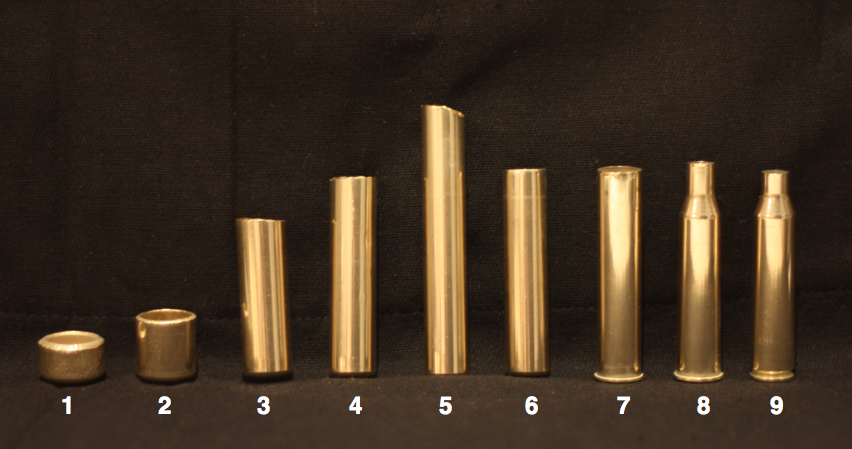
The image above shows the process of drawing the brass case gradually and annealing it at multiple stages, until it reaches the required length (steps 1 - 5). Then it is trimmed to size in step 6 and the case head (the base) is shaped (step 7) and then the neck is formed (step 8). Finally the rim and mouth are machined to the final cartridge specification.

During the process of shaping the case head, a tool called a headstamp bunter punch is used to shape the base and form the primer pocket, as well as add manufacturer information to it.


Base of a 8x68 mm. rifle cartridge made by RWS. Click on the image to enlarge.
Image licensed under Creative Commons Attribution-Share Alike 3.0 Unported License by BreTho at wikipedia.

Headstamp bunter punches. 

A headstamp bunter punch has a cylindrical protrusion to make the primer pocket and has raised lettering on its face to stamp the manufacturer information onto the base of the cartridge. Typically, the information lists the manufacturer and the caliber of the cartridge. Some cases, especially those used by military forces, also have the year of manufacture stamped as well. Some military cartridges may even have a code indicating the location of the factory, as well as the month that the cartridge was made. In the above image, we see that the cartridge is made by RWS (a German manufacturer) and it is a 8x68 mm. S cartridge.

Now, let us look at some videos of manufacturing processes at various factories around the world. The first video was produced in the 1940s by British Pathe and shows a factory in South Africa:


In this particular factory, they cast their own brass billets from scratch. Note that some of the processes used in this factory were still manual and done by humans. However, the really dangerous processes of loading the primers and the propellants have been automated by this time.

The next video is from Silver State Armory and is a slideshow of their manufacturing process. Note that the process is pretty similar to what was described in the previous posts.


This video is more of a slide show and describes the various stages of manufacture, but does not show the actual machines involved.

The next video is produced by the NRA and shows ammunition being made by Hornady (for non-US readers, Hornady is a well-known manufacturer of ammunition in the US):


This video shows more of the manufacturing process, as well as some of the machinery used. Hornady uses mechanical force to form bullet jackets, rather than heating and molding them. The video shows the complete process, including testing, quality control and packaging the cartridges.

The next video shows ammunition being manufactured at Winchester:


The video shows the process starting from melting the raw materials to make brass and explains the process, along with showing some of the machinery used to manufacture cartridges. The video also shows the manufacture of shotgun shells as well.

Finally, here's a long video from Field Sports (a British channel), showing the process of cartridge manufacture at RWS (a large manufacturer from southern Germany):


At 22 minutes long, this is a bit longer than the other videos, but it also covers the manufacturing process in pretty good detail.

Happy viewing!


Wednesday, April 8, 2015

Manufacturing Cartridges in the 19th Century - Part IV

In our last few posts, we saw how they manufactured cartridge cases, primer caps and bullets in the 19th century. In today's post, we will see how these components were combined together to form the finished cartridges. As before, this is the process that was followed at Kynoch, a large British manufacturer of ammunition and the equipment they used was the latest available for that era.

Since Kynoch manufactured large quantities of cartridges daily, they used machinery to help load the cartridges. The process started by placing a bunch of cartridge cases in frames of up to 100 cartridge cases per frame. Each frame was then taken to a loading room to be filled with gunpowder.

For safety reasons, only minimal personnel were allowed into each loading room. The gunpowder was placed in a container  that was attached to the wall outside of the loading room. The container had a rubber pipe attached to the bottom of it, and the other end of the pipe ran into the loading room. The other end of the pipe also had an accurate measuring device attached to its end that allowed it to dispense a precise amount of powder each time. A worker would use one hand to move the pipe from case to case and the other hand to work the measuring device and dispense a measured quantity of powder in each case. Each worker could easily fill around 30,000 cartridge cases per shift.

After the cases were filled, the frames were then taken to another room, where wads were added to the cartridges. The purpose of a wad is to reduce the air pocket between the bullet and the gunpowder in a cartridge case. Each wad was placed on top of the cartridge case and then pushed into the case using a hand rammer tool.

After adding with wads, each cartridge case had a bullet placed in the mouth and then, each bullet was pushed in. After that, the whole cartridge was inserted into a swedge, which would close the lip of the case and crimp it. This was done to make the case fit the bullet and prevent it from slipping out from the cartridge case. The finished cartridges were then packed in boxes and shipped out from the factory.

Cartridges made with this process could be placed under water for a fortnight and still work fine. Leading manufacturers like Kynoch could manufacture ammunition that was far superior to cartridges produced by hand by amateurs and low-end gunsmiths, and at a much faster rate as well.

While this process involves some human labor, Kynoch was working on making machinery to fully automate the loading process.

For loading .303 ammunition, Kynoch also made machinery for weighing, cutting and loading the strings of cordite.

In the next post, we will look at some modern methods of manufacturing cartridges.