Saturday, September 10, 2016

Black Powder XXIV - Pebble Powders

A couple of posts ago, we saw why larger grain black powders were more suitable for larger guns and artillery, and studied two powders that were developed to handle this: compressed powder and prismatic powder. In today's post, we will study another type of black powder designed for larger calibers, which was in use in the 19th century. Today's object of study will be pebble powders.

Pebble powders were generally made in two grades: the P type (which were cubes of approximately 1/2 to 5/8 inches in size) and the P2 type (which were 1.5 inch cubes).

The process of manufacturing pebble powders started off similar to manufacturing other finer grain powders, until the process of pressing the powder into cakes. The pressed cakes were formed into slabs of about 15 inches x 30 inches and thickness depending on whether P type or P2 type was being made (i.e. 1/2, 5/8 or 1.5 inches).

For P type powders, the pressed cake slabs were then fed into a cutting machine:

A cutting machine for manufacturing P type pebble powders. Click on the image to enlarge. Public domain image.

The exploded view of the machine above was invented by a Major Morgan and was in use at the Royal Gunpowder Mill in Waltham Abbey, England. It consists of two pairs of phosphor-bronze rollers which are at right angles to each other and at different heights. Each roller has knives attached to its circumference, with spaces between the knives corresponding to the required size of the powder cubes. The pressed cake enters the first pair of rollers and is cut into long thin strips and these strips then fall on to a conveyor belt which carries them to the second pair of rollers, which are at right angles to the first pair. The second pair of rollers cut the long strips into cubes.

It may be seen that if a first pair of rollers were fixed, then the second long strip cut would fall onto the first and the third one on to the second and so on and the result would be long strips piling up in one location on the lower conveyor belt. To avoid this, the upper pair of rollers are mounted on a board which is arranged to move back and forth, the basic mechanism of which is shown below.


The bottom of the board has a fixed slotted bar. The chain has a pin on one of its links that engages the slotted bar. As the chain moves along its two rollers, it pulls the board above it in a back and forth motion. This results in the long strips cut from the first set of rollers falling side by side instead of one above the other.

For P2 type powders, the cubes were generally cut by hand, by using lever-knives (i.e.) knives hinged at one end, with an handle at the other, much like a modern day paper trimmer. The press cakes were cut into long strips and then cut across into cubes.

After this, both P and P2 type powders were sent through a glazing and dusting process, to ensure that edges and corners of the cubes were rounded off and sharp edges removed. This ensured that the cubes would have a harder surface and would not produce dust or waste when being stored or transported around.

The powder was then dried similar to the process of drying the smaller grain powders, except that the temperature of drying was lower and the drying period was correspondingly longer. The drying process was slower to avoid forming cracks on the cubes. After this, a finishing process followed, with the powder being run in wooden barrels, which combined sifting the powder along with a finish glaze. A small quantity of graphite powder was introduced into the finishing barrels to give the grains a glossy finish and render them less hygroscopic.

In our next post, we will look at pellet powders.

Monday, September 5, 2016

Black Powder XXIII - Prismatic Powder

In our last post, we studied the invention of compressed black powder by General Thomas Rodman of the US Army. While this idea had sound theoretical fundamentals and also could be demonstrated successfully in trials, there were some practical difficulties encountered when manufacturing this powder in bulk and deploying the compressed powder cakes in the field. The main issues were that it was hard to press such large, heavy cakes of powder in the presses of the time and the large perforated cakes of powder also had structural integrity problems and tended to break up into smaller grains during transport, or while being handled in a battlefield.

A solution to this problem was proposed by another American, Professor Robert Ogden Doremus, a professor of chemistry, and a co-founder of New York Medical College.

Robert Ogden Doremus. Click on the image to enlarge. Public domain image.

Doremus' idea was that instead of pressing together a large cake of powder equal to the bore of the cannon, he suggested manufacturing them into hexagonal prisms of a smaller size, with comparatively smaller holes running through them. This powder was called prismatic powder.


The number of holes in each prism could be less in number (usually between 1 and 7) and these could be stacked together to form a rigid cartridge, much less liable to break up during manufacturing and transport. Due to their smaller sizes, it was easier to manufacture a number of smaller hexagonal cakes, rather than one large cake weighing several pounds in weight.

Another idea also due to Professor Doremus was to make different sections of a cartridge with different densities of powder, whereby the density would affect the rate of combustion and maintain a higher average pressure. The idea was to pack the first part of the cartridge under high pressure, then make two more layers on the same cartridge under lower pressures.

During the Civil War, a Russian military commission visited the United States and were greatly impressed by the results shown by Doremus' prismatic powder and undertook to develop and use prismatic powder in their large guns as well. Doremus also visited Paris and impressed the French with his new powder and was authorized by the French ministry of war to modify the machinery at a French powder factory to produce his prismatic powder. In fact, a large portion of the Frejus Rail Tunnel between France and Italy was blasted away with "la poudre comprimée". Pretty soon, many European countries (Italy, Germany, France, UK etc.) started to manufacture prismatic powder as well.

The cakes were generally made from granulated powder, which was then compressed under pressure, either using a press driven by gears, cams and pistons, or by a press driven by hydraulic pressure.

A cam-press for making prismatic powder.
This press was built by the Grunsonwerk of Buckau, Germany. 
Click on the image to enlarge. Public domain image.

A hydraulic press for making prismatic powder.
This press was manufactured by Taylor and Challen of Birmingham for the Royal Gunpowder Factory, Waltham Abbey, England
Click on the image to enlarge. Public domain image,


To make this powder, granulated powder containing about 4% moisture was put into the hopper of the press. The more moist the powder, the easier it is to press it into shape, but the powder can't be too moist, otherwise the saltpeter will migrate to the powder's surface while drying. The powder was filled into several molds, the height of which was adjusted depending on the moisture content of the powder and the moisture content in the air that day. Then, the press was activated and pressure was applied to the powder in the molds, to form prisms of the required shape and size. The sizes and densities of the prisms varied by country. For instance, in England, the prisms were about 1.5 inches high and had a desnity of 1.78, whereas in Germany, the prisms were about 1 inch high and 1.575 inches over the angles, with the weight being about 1.41 ounces and density of 1.66. Hydraulic presses were generally used in England, Germany and France towards the latter part of the nineteenth century, but cam-presses were still in use in some parts.

After pressing, the prisms were dried in special drying-houses using trays. The trays were made of narrow wooden strips, with enough gaps between them to let air pass through, but not big enough to let the powder fall through. At Waltham Abbey, the drying process was done slowly for 140 hours and the dried powder contained less than 1% moisture. At Spandau, Germany, they would dry the powder at a faster rate by using air at a temperature of 122 °F for about 48 hours, after which the powder would contain less than 0.75% moisture.

In our next post, we will look into another type of powder called "pebble powder", which was manufactured in the 19th century.

Friday, September 2, 2016

Black Powder XXII - Compressed Powder

In today's post, we will look at a form of powder that was used during the Civil War, called compressed powder. The origin of this powder has to do with larger guns rather than firearms, but is still an interesting point of study, since it leads down to prismatic and pebble powders later down the line.

General Thomas J. Rodman. Public domain image.

The first breakthrough into compressed powders was due to a career US Army officer named Thomas Jackson Rodman. He was an inventive man with an interest in artillery, and early in his career, he was appointed as a brevet second lieutenant in the US Army Ordnance Department, where he started working at improving cannons.

At around 1856, he noted that ordinary service powder could not be used in larger guns, because the initial gas pressure developed was sometimes high enough to cause the gun to be destroyed. The range of the gun was also reduced. The reasons are as follows:

If a fine grained powder is used for a large gun, a large portion of it is burned at the moment of ignition, due to its larger surface area (remember that black powder is surface burning and the larger the outer surface area of the powder, the faster it burns). Therefore, this causes a very high maximum pressure to be generated at the beginning and then tapers off as the rest of the powder burns, which leads to a lower average force, compared to the initial force. In fact, the initial pressure may be high enough to cause the cannon to explode with disastrous results. Therefore, the rate of combustion of the gunpowder had to be reduced somehow.

Rodman found from his experiments that he could considerably reduce this initial pressure in the gun by using disks of compressed powder, perforated by holes. The disks were made of a diameter equal to that of the bore of the cannon and between 1 and 2 inches in thickness and perforated with a number of holes.


With this type of powder, the surface area of the powder is smaller initially and only develops enough pressure to overcome the inertia of the cannon ball. Consequently, the projectile properly engages the rifling and gets pushed out with a regular motion, which is very important because accuracy depends on uniform movement of the projectile in the barrel

Surface area comparison of ordinary powder (green) vs. Rodman's compressed powder (red cylinder). Click on the image to enlarge. Public domain image.

As the powder burns more, the surface area exposed increases due to the constant enlargement of the holes bored through the compressed powder. Due to the constant increase of the area of the burning surface, this causes a corresponding constant increase in the rate of production of the burning gases. This results in a longer and more consistent burn time inside the bore of the barrel. Therefore, the average pressure generated is higher and this increases the range of the gun significantly, without making the pressure rise to dangerous levels initially.

Rodman first published his discoveries in a scientific paper in 1861 ("Properties of Metals for Cannon and Qualities of Cannon Powder") and his ideas were put into practice in the Civil War. His special compressed powder was produced under the name "mammoth powder" and other inventors also benefited from his breakthrough, as we'll see in our next few posts.

As a result of his work, Rodman was promoted to brevet brigadier general at the end of the Civil War. He remained in the military for the rest of his life, being promoted to the permanent rank of lieutenant colonel in the US Army. Incidentally, in 1865, he was sent to Rock Island, Illinois and put in charge of supervising the construction of a new military facility, which became the Rock Island Arsenal, which still exists and is one of the largest government-owned weapons manufacturing factories in the United States.


Tuesday, August 30, 2016

Black Powder XXI - Damaged Powder

In our last post, we saw how black powder that had absorbed some moisture in the field, could be reworked to become useful again. However, this reworking process only worked if the black powder had absorbed a smaller amount of moisture from the air (< 7% by weight). Unfortunately there were situations where the powder could absorb a lot more than this. In today's post, we will discuss what they did with the powder in the 19th century when this happened.

Remember that black powder was not always stored indoors in a warehouse under dry conditions. It may have been transported in the cargo compartment of a ship, or perhaps it was shipped by cart to some distant battlefield. There were plenty of situations where the barrels could have been exposed to a lot of water (e.g.) water frequently seeped into cargo compartments inside the ships and had to be periodically pumped out, carts could be driven through thunderstorms, the barrels could have been frequently opened and closed in wet conditions in the field etc. In such situations, the barrels could absorb a lot more moisture than 7% by weight and the powder was considered damaged. Armies and Navies would typically send this damaged powder back to the factory, where they would deal with it.

At the factory, they would first figure out how much moisture the powder contained, using the method we studied in our previous post. If it was well below 7% by weight, it could be dried and recovered, as we pointed out in our previous post. Another technique was to take a small amount of the damaged powder and mix it with a barrel of newly manufactured powder, so that the overall moisture content of this mixed powder was within tolerable limits. For instance, the mix could consist of about 10% damaged powder and 90% new powder and would have pretty much the same propulsive force.

However if the powder was too badly damaged by moisture, then they would usually try to recover the potassium nitrate from the mixture, as it was the most valuable ingredient. Remember that saltpeter (the source of nitrates) was a hard-to-obtain substance for many centuries and England controlled the source of most of the world's supply for decades. Therefore, many countries found it worthwhile to try and extract as much nitrate as possible from the damaged powder. For instance, in the Confederate States, they had a Damaged Powder Works in Augusta, Georgia, to which all damaged powder from the field was sent to.

At the Damaged Powder Works, they would empty 8 barrels (800 lbs.) of powder into a large copper vessel and then add about 200-240 gallons of water. The vessel was then heated until its contents began to boil. The boiling water would dissolve the potassium nitrates in the powder, while the sulfur and charcoal remained undissolved. After this, the hot water was pumped out of the vessel through a double filter arrangement and poured into shallow crystallizing pans, where the liquid would cool and form nitrate crystals. The crystallizing pans would be shaken while the liquid was cooling, so that the nitrate crystals formed would be of small size. Since charcoal and sulfur don't dissolve in water, they remain behind in the vessel and filters. This method could recover over 95% of the nitrate content in the damaged powder. The recovered nitrate crystals were then sent back to the gunpowder factory to be used to make black powder again.

In the case of lightly damaged powders, the Damaged Powder Works often reworked it to make blasting powder, which is a low-grade black powder with a lower percentage of niter and more dust. To do this, they would take the damaged powder and add more sulfur and charcoal, so that the percentage of niter was reduced. The mixture would then be incorporated for a short time and then granulated to form blasting powder.

The Damaged Powder Works not only recovered nitrates from damaged powder, they also tried to recover it from byproducts of the manufacturing process as well, since niter was such a precious substance. They would try to recover saltpeter from the sacks that it was shipped in, from sweepings from the factory floor of the powder mill and even from washing the workers' clothes. The remnants of the mother liquor from the niter refineries were also sent over, so that they could extract the last possible bit of nitrates from there.


Monday, August 29, 2016

Black Powder XX - Reworking and Re-Shaking

In our last post, we looked at different types of containers that black powder was shipped in, in the 19th century.

A stack of powder barrels. Click on the image to enlarge.

Now, it must be remembered that black powder is hygroscopic in nature, which means it tends to absorb water from the air. Despite the best efforts to provide a tight seal to the barrels, there is a chance that the powder inside may still absorb some moisture over a period of time, especially if there is a lot of relative humidity in the air. If the black powder absorbs sufficient moisture, then this reduces the burning rate and strength of the black powder. Moisture can also cause caking in the powder. Water also causes the potassium nitrate to separate out of the black powder and can cause corrosion of metal gun parts. Therefore, it was not a good idea to leave barrels stored in the warehouse untouched for many years. We will study some methods that were in use in the 19th century to handle the problem of the black powder absorbing water in today's post.

To handle the caking issue, barrels were generally filled to 90% of their capacity. For instance, in the above image, we see that the barrel holds 100 lb. of powder. The barrel is actually capable of holding about 110 lbs. of powder or so, but it is only filled with 100 lb. of powder, which leaves a little room available for the powder to move around. Therefore, the contents of the barrel are free to move during transport of the powder and this helps break up any large lumps. In England, they would roll the barrels every year over a copper plate on the floor of the magazine, with the idea that this redistributes the contents inside and prevent caking.

In many countries, it was standard procedure to examine the barrels after a certain amount of time had elapsed (which is why the date/year of manufacture was stamped on every barrel). For instance, in France, they examined the barrels once a year for moisture damage. First, they would put each barrel on its side and roll it on a floor covered with hair rugs. If the sound coming out of the barrel was uniform, that meant the powder was good. Any uneven sounds meant that there was likely some moisture absorbed and caked powder inside. In this case, they would open the barrel and determine the moisture content of the powder before deciding how to proceed.

To determine the moisture content in the powder, they would take three samples of powder, one from the top, one from the bottom and one from the middle of the barrel. The samples would be carefully mixed and then 5 grams of powder would be carefully extracted from this sample. This powder would then be subject to a drying process, like the ones we studied previously. After this, it would be weighed again and the difference in weight indicates the percentage of moisture content in the sample.

If the moisture content of the sample was found to be below 7%, then all the powder was simply taken out of the barrel and dried, either by using the sun, or by using an artificial drying process like the ones we studied a few posts before. The barrel was also dried separately. Then the powder was subjected to a dusting process and then re-packed into the barrel. If the powder inside the barrel was found to have clumps in it, then these were broken by hand and was put back into a dry barrel and re-shaken to break up any smaller lumps. 

If the moisture content of the sample was found to be greater than 7%, or if the saltpeter had begun to migrate out of the powder, then the powder was subjected to a chemical analysis to check if the proportions of the three ingredients were still within acceptable limits and if so, the powder was sent back to the mill to repeat the stamping process that we studied about a month ago.

Any barrel found to contain moisture was not put back to its original place in the warehouse after the reworking process. Instead, its position was swapped with another barrel from the stack of barrels, so that those that were in the bottom of the pile would now be on top and vice-versa. 

In Germany, they would expose the powder to sunlight at regular periods, whether the powder contained moisture or not. The Prussian procedure was to do this every two years, which later changed to every 8-10 years, if the barrels were located inside a dry powder magazine.

In our next post, we will study what was done if the powder was found to be in a damaged state. 

Sunday, August 28, 2016

Black Powder XIX - More on Packing

In our last post, we talked about the packing process of black powder in the 19th century. However, that post went a little easy on details about the containers used, so we will discuss those in today's post.

Black powder was generally shipped in boxes (cases) or cylindrical containers. Barrels were used because they were designed to hold goods without risk of leakage and were used for centuries for this purpose. On the other hand, boxes are easier to stack on top of each other than barrels and waste less room.

The boxes were usually made of copper and had powder loaded in a linen bag, or they were made of wood (which was cheaper) and had a slightly smaller box inside, into which the powder was loaded. Boxes varied in size, depending on the country, the type of powder etc. For instance, in England, some cases were about 2 feet long, 2 feet wide and 6 inches high. In the Confederate States, their boxes were about one foot long, one foot wide and 2.5 feet long. In Austria, their boxes were big enough to contain about 64 lbs. of powder. For sea duty, the boxes were generally made of copper. While boxes cannot be rolled around easily like barrels, they can be packed together more tightly than barrels can, which is why some factories started to switch from barrels to boxes towards the end of the nineteenth century.

Containers generally came in multiple sizes: Barrels, Kegs and Canisters.

Barrels are generally the largest of these containers. Typical barrels of the nineteenth century were about 2 feet high and about 1 to 1.5 feet in diameter. Capacity of the barrels varied by country, but most could usually hold about 110-120 lbs. of powder. However, these barrels were usually only filled to about 90% of the capacity (e.g. they would only fill about 100 lbs. of powder to a barrel capable of holding 110 lbs.). This was done so that the powder would have room to move inside the barrel during transport and wouldn't get caked.

A stack of powder barrels made in England. Click on the image to enlarge.

Another stack of powder barrels. Click on the image to enlarge.

Most barrels would have a hole of about 1.5 to 2 inches diameter drilled to the top of the barrel, which would then be plugged with a wooden screw. This way, if someone wanted to access the powder inside the barrel, they only needed to remove the screw instead of the entire top of the barrel. A leather washer soaked in wax and turpentine would be placed under the screw head, which served to keep moisture out. The image below shows an example of this:

Notice the screw at the top of the barrel. Click on the image to enlarge.

Kegs were generally built on the same principle as barrels, but were much smaller in size, typically holding about 25 lbs. of powder. Also, instead of having an opening on top, most kegs had an opening in the middle to access the powder.

An example of a powder keg

Kegs are much easier to transport than barrels on account of their lesser weight and were favored in places where there wasn't much room to move around in (e.g. on board ships).


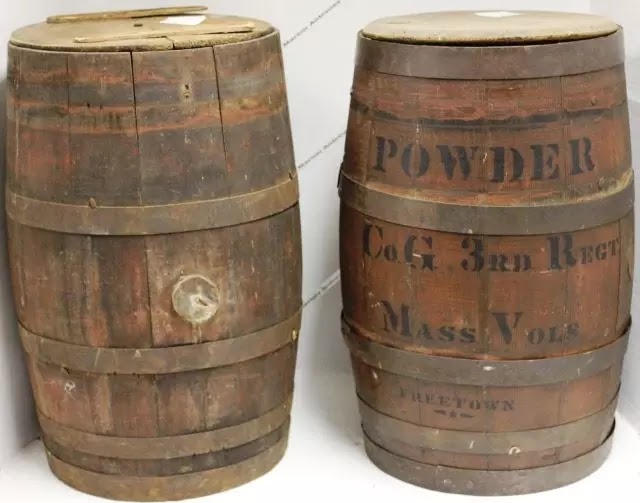
A couple of Civil War era powder kegs. Click on the image to enlarge.

Finally, we have canisters. Unlike barrels and kegs, these were generally made of metal and had the least capacity of the three container types.

A black powder canister. Click on the image to enlarge.

Powder canisters typically held about 0.5 to 1 lb. of powder. The above example is a canister made by the Eureka Powder Works of New Durham, New Hampshire. It is made of steel, is about 4.75 x 4 x 1.75 inches in size and has a paper covering on the outside with hunting scenes printed on it. Due to their small size and capacity, these are much lighter than the other containers we have studied above and are easy to transport. Unlike barrels and kegs, these were intended to be sold to private individuals rather than military units.


Thursday, August 25, 2016

Black Powder XVIII - Packing

In the last few posts, we have studied the process of manufacturing corned black powder in the nineteenth century. Today, we will study the process of packing the black powder in the nineteenth century.

Black powder from the factories was usually packed in barrels or cases.

 Powder cases were usually made of copper and the powder was put in a linen bag and placed in the case. Alternatively, the case was made of wood, with a second inner box also made of wood.

Barrel making was an art that was well developed over several centuries, and by the 19th century, people already knew how to make barrels able to hold liquids without leaking. However, powder manufacturers usually put the powder in a linen bag and then placed it in the barrel, or in some places (such as France), they used a second inner barrel. For military purposes, some manufacturers coated the inside of the barrel with paper to make it leak-resistant.


In the 17th and 18th centuries, it was the custom in the German-speaking states of Europe, to coat the barrels on the inside with linseed oil. This was done to protect the powder from moisture.

There was a good reason to use a cloth bag inside the barrel: In order to fill the barrel, the upper hoops have to be loosened, so that the top of the barrel can be removed. Because of this, the staves expand a bit and the openings may fill up with some powder grains as the powder is poured into the barrel. Then when closing the barrel, the grains in the openings will get crushed. If something harder than wood, such as a grain of sand or a piece of metal, get into the openings, then a small impact, such as a blow from a wooden hammer, could cause the powder to ignite. For this reason the powder was first put in a bag, which was then put inside the barrel.

A powder keg made by American Powder Mills in the 19th century. Click on the image to enlarge.

The barrels were closed using about six to eight hoops. Experiments made in the 19th century showed that hoops made from barked willow or hazel-wood, preferably cut in winter time, worked better than unbarked wood, because they didn't suffer from wood rot. The bags were usually made of loosely-woven linen cloth.

Each barrel was placed on a scale and weighed before filling and then the barrel was kept on the scale as powder was poured in using a copper funnel, until the desired weight of powder was filled in. The weight of powder put into the barrel depended upon the type, the size of the barrel, the country of manufacture etc. The barrels were usually filled to about 90% of their capacity, because it was believed that rolling the barrels occasionally prevented the powder inside from caking. After this, each barrel had a label attached to it, containing details such as the type of powder, the year that it was manufactured, the name of the manufacturer and factory location, the number of the supply, the weight of powder and the seal of the person that examined the barrel. In many places, the color of the label also indicated the type of powder contained in the barrel.

In 17th century France, they used the linen bag inside the barrel method of packing. Towards the beginning of the 18th century, they used the method of one barrel packed inside another barrel. The inner barrel (called the baril) was lined with cloth and filled with about 110 lbs. of powder and then placed inside a larger outer barrel (called the chape). The outer barrel contained details such as the year and place of manufacture, powder type, average range and average muzzle velocity etc. Instead of barrels, they sometimes also used wooden boxes lined with sheet zinc, which were filled and then put inside a second wooden case. For transport in ships, copper cases enclosed in wooden cases were used.


Powder keg made by American manufacturer Laflin & Rand. Click on the images to enlarge.

The above two images show a wooden powder keg made by the Laflin & Rand Powder Company of New York. This company was once a major competitor to Dupont in 19th century America. The top of the keg has a stopper (visible in the second image) and has the markings "FF" to indicate that the contents of the barrel are of a grain size suitable for use with rifles. The bottom of the keg has the marking, "Laflin & Rand Powder Co. New York", indicating the manufacturer name and factory location.