Sunday, May 16, 2010

Rifling: Expanding Bullets and the Minie Rifle

In designs of weapons we've studied so far, one of the major problems as how to provide a tight seal for the bullet when it is fired. The solution for hundreds of years was to wrap the bullet in a greased cloth patch and ram it down the barrel. This worked reasonably well for smooth-bores, but was not an optimum solution for rifles because if the fit was too tight, it required a mallet to ram the bullet down the barrel and if the bullet was too loose, the expanding gases would escape around the rifling grooves and edges (This technical term is called windage). Then the concept of the expanding bullet was invented in the 1800s. In this method, the bullet has a hollow base and when fired, the hollow base expands and fills the bore of the barrel and engages the rifling grooves.

The first discovery in this direction was due to one Captain John Norton of the British 34th regiment, which was stationed in South India in the early 1830s. Captain Norton had observed that some of the tribes in South India used blow-pipes and he examined some of the darts that they used. He noticed an interesting fact that the base of these darts were made of an elastic pith (pith is the soft spongy wood found in the center of tree trunks). When the tribesman blew in the pipe, the pith base would expand and form a tight seal, thereby preventing air leaks and increasing the range of the weapon. Captain Norton decided to copy the same principle for bullets as well and invented a cylindrical bullet with a hollow base in 1832.

A few years later in 1836, Mr. William Greener, a well-known London gunmaker, improved on the Norton bullet by making a design known as the conoidal expanding bullet.


It consists of an oval shaped bullet where the longest diameter of the bullet exceeds the shortest diameter by a ratio of 1.5 : 1. One end of this bullet has a flat surface and a hole drilled into it, nearly through the length of the bullet. The hole is covered by a tapering conical plug with a round button shaped head, made of wood. The plug is fitted loosely into the hole and the bullet is put in the rifle with either end of the oval foremost. When the gun is fired, the plug is rammed home into the bullet and it expands and fills the bore of the rifle and the grooves and thereby prevents windage from happening (i.e. prevents gas from escaping around the sides of the bullet and via the grooves).

Unfortunately for Captain Norton and W. Greener, the British Ordnance Department rejected both their inventions and never developed any weapons using these bullets. The trial of W. Greener's bullet was conducted in August 1836 by the 60th rifles, and in spite of the trial proving that these bullets were as easy to load as spherical bullets on smoothbore weapons, the invention was rejected on the grounds that the bullet was a compound bullet.

However, W. Greener's idea was later abstracted by a Frenchman, one Monsieur Minie, who invented the Minie ball and the Minie rifle to go with it, in 1849. The Minie rifle was invented as a response to Algerian fighters who would regularly outrange French troops using their hand-made long rifles.

Images based off public domain images courtesy of wikipedia.com

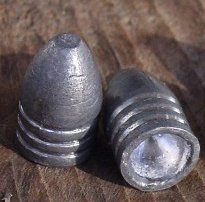
The minie ball or minie bullet consists of a conical-cylindrical bullet made of soft lead. The bullet is designed to be slightly smaller than the diameter of the rifle barrel, so it can easily slide into the barrel. Towards the base of the bullet are carved three or four belted grooves which are filled with grease. The base of the bullet is made of a hollow conical iron cup. When the bullet is fired, the iron cup drives into the base of the bullet thereby expanding the grooves outwards. The expanding grooves engage the rifling inside the barrel, thereby sealing it from gas leaks.

The Minie rifle that used this bullet was a muzzle-loading weapon with a percussion lock firing mechanism and a rifled barrel. Paper cartridges, each containing a minie ball and a pre-measured amount of gunpowder were issued with the weapon. To use the rifle, the user would pour the gunpowder into the barrel and push the minie bullet in through the top. Since the minie bullet is smaller in diameter than the barrel, it is easily pushed through, even if the barrel has some fouling and detritus in it. When the gun is fired, the expanding gases make the bullet deform and engage the grooves in the rifling. The rifling then serves to provide spin to the bullet, thereby providing more accuracy. The expansion also makes a tighter gas seal, which gives greater range and it also cleans the grooves of detritus as well.

When the minie rifle was tested in 1849, it penetrated two 17 mm. (0.66 inches) thick poplar wood boards separated by 50 cm. (19.68 inches) distance, from a range of 15 meters (16.4 yards). This led to a rumor that it could penetrate a soldier and his knapsack at 1100 meters (about 1200 yards) and also kill the person standing behind him, and at close ranges, it could kill 15 men standing in line.

The minie rifle and the minie bullet came to the notice of the British War Ministry in 1852. Hence, the British Government paid Monsieur Minie a sum of 20,000 pounds as a royalty for the right to use his bullet design for British rifles. This particular award enraged Mr. W. Greener whose earlier invention of 1836 was rejected by the British Ordnance board and he started several unsuccessful attempts against the British Government to be given some credit for his innovation. It took some lobbying by Mr. Scholefield, MP for Birmingham (the town where the W. Greener factory was located) to show the correspondence that occurred in 1836 between W. Greener and the British Ordnance board before the British Government finally admitted Mr. Greener's prior invention. In 1857, the British Government awarded W. Greener a smaller sum of 1,000 pounds, as well as the credit for "the first public suggestion of the principle of expansion, commonly called the Minie principle, in 1836."

The Minie rifle was used by both French and British troops in the Crimean war (1853-1855) against Russia. Other rifles using the Minie bullet principle were heavily used by both sides in the American Civil war, where it was the most common rifle used. The US versions of the bullet (adopted before the civil war) had three exterior grooves on the bullet instead of four. The US versions also had thinner walls near the base and omitted the iron cap at the base, as the pressure of the expanding gases was enough to deform the bullet by itself. The wounds caused by the Minie bullet were staggering and surgeons of the day often amputated limbs rather than trying to remove bone fragments and risk secondary infection.

The British adopted the Minie Pattern 1 between 1852 and 1855, where it was replaced by the newer Enfield Pattern 1853 rifle, which also used a Minie bullet. The Enfield Pattern 1853 rifle served the British empire between 1855-1867 and was one of the causes of the Indian mutiny of 1857. This rifle model was the one that was issued to troops of the East India company in 1857 and rumors were spread that the paper cartridges were greased with pig fat and cow fat, which were abhorrent to the sepoys for religious reasons.

The Minie rifle and its derivatives became obsolete around 1866 or so, when they were replaced by breech-loading rifles. One of the main disadvantages of all muzzle-loading rifles was that the soldier had to stand up to load the weapon, whereas a breech-loading weapon could be loaded from the prone position. Despite all improvements to muzzle-loading weapons, a breech-loading weapon could still be loaded much faster than a muzzle-loading one. The clear advantage of the breech loading Dreyse needle-gun used by the Prussians against the Austrians spelled the end of muzzle-loaders in general and the Minie rifle became obsolete along with other muzzle-loaders of the day. However, the concept of a bullet that deforms and engages the grooves of the rifled barrel has stayed with us to this present day and modern firearms still use this principle.

Rifling: Brunswick Rifle

In the last post, we studied some early rifled firearms, including the Baker rifle. These rifles were all of the muzzle-loading type and used flintlock firing mechanisms. The invention of the percussion lock in the early 1800s made the firing mechanism much more reliable than the old flintlock system. The growing popularity of the percussion lock finally caught the eye of George Lovell, an employee of Enfield rifles, who was experimenting with ignition mechanisms, and also trying to improve the accuracy of rifles. The first model prototype of the Brunswick rifle had a percussion lock, with eleven rifling grooves in the barrel instead of the usual seven of the Baker rifle. The metal parts were all blued or case-hardened so as to not shine and give the user's position away. The rifle also had a fixed rear sight for 200 yards with a folding leaf for ranges beyond 300 yards.

This rifle was experimental and still not named the Brunswick rifle yet. Mr. Lovell submitted it to an evaluation competition for the rifle brigade in 1836. Meanwhile, another competing rifle was submitted by a Mr. Seabright, who was acting on behalf of the Duke of Brunswick. This rifle was invented by one Captain Berners, who was then serving as a Field Adjunant under the Duke of Brunswick's forces. This rifle had two very wide grooves which made a complete turn inside the barrel. The rifle was complemented by a bullet shaped like a ball with a straight belt running around its surface. Such a bullet was called a "belted-ball".


The idea of using a ball with a belt around it was not new. There was a Spanish rifle from 1725 that used the same idea. Nevertheless, the committee found some objections to the Brunswick submitted entry, mainly that a cartridge could not be used with this rifle, it had complicated sights and weighed more (almost 11 lbs.) than other competing weapons. It was also harder to load than the competition, due to the problem of aligning the ball's groove to the barrel. However, it was noted that this rifle shot as well than the competition at short ranges and shot much more accurately than everything else at long ranges. It also required less cleaning than its rivals and suffered less wear and tear than the grooved rifles at that point.

The decision was made in 1837, to use the general Enfield rifle design (for its lightness, less complicated sights, easier to handle, percussion lock and no shiny parts) but to change it from using its eleven groove barrel and use the belted ball and groove design from the Duke of Brunswick's rifle entry, which had much better accuracy. The new weapon was to be called the Brunswick rifle as well, even though most of its parts were from the Enfield design. The job of designing the new weapon also fell onto Mr. Lovell and the Enfield company.

The new entry submitted by Mr. Lovell in late 1837 also removed a few of the objections of the committee from the previous competition. This rifle now weighed only 9 lbs. and also had two semicircular notches at the end of the barrel, which made aligning the bullet while loading much more easier. The image below shows the end of the barrel with the new design.


The resulting rifle also had a longer bayonet than the older Baker rifle and also moved the bayonet attachment bar slightly back from the front-end of the rifle, so that when the bayonet was attached, the bayonet guard was not in front of the barrel -- a fault of the older Baker rifle.

The first order of 1000 rifles was given in October 1837 and it became quickly apparent that 600 of these rifles were urgently required by the Rifle brigade and that Enfield would not be able to complete these in the time required. Hence, the manufacture of the first batch of these rifles was outsourced to many gunmakers in and around London, many of whom were in the process of completing their final orders of Baker flintlocks for the British army!

Public domain image courtesy of wikipedia.com

Troops were issued with two kinds of ammunition for this rifle. One was a loose ball with a greased calico patch cloth and a separate blank paper cartridge that contained a pre-measured charge of gunpowder. This type produced the best effect in terms of accuracy. The other type consisted of a greased paper cartridge that contained the belted-ball and the pre-measured gunpowder charge all in one packet. This type was intended for rapid firing. Troops could also use the older paper-cartridges with the round ball and ammunition in case of an emergency.

Mr. Lovell had brought into production 3 new weapons: a carbine, a smoothbore musket and a rifle. The carbine was named the Victoria carbine in honor of Queen Victoria and the musket was named the Lovell Pattern musket. Mr. Lovell wrote to the board requesting that the rifle be named after him as the "Lovell Two-Groove Pattern Rifle", but the board refused him saying that his rifle was a modification of the Duke of Brunswick's rifling design and hence should be called "Lovell's Improved Brunswick Rifle". This later began to be popularly called the "Brunswick Rifle" for short, even though George Lovell had more to do with the overall design!

Like the earlier Baker rifle (and its direct ancestor, the German Jaeger rifle), this rifle also had a patch box on the side of the stock which contained cleaning tools and greased patches. The original design by Mr. Lovell was simply a box to contain patches, an improvement by one Major Boileau led to the following design:

In the above design, the patch box is divided into two sections. The left section has a screw in the middle of it with a large T-shaped head. This section is used to store small cleaning tools and brushes and the T head prevents them from accidentally falling out when the patch box is opened. The right section is circular-shaped and used to store greased calico cloth patches and a small rag to wipe the barrel.

In 1841, a second version of this rifle was issued. This rifle had some minor changes done to the percussion lock design. The bayonet attachment bar was also changed from having a hook design at the end, to a more centrally located notch, as can be seen in the figure below.


A third version of the rifle made in 1848 further improved the lock design to a lighter side-lock and made more changes to the bayonet catch.

By 1850, new ideas were coming into rifle design, including a design using a new expanding bullet called the Minie ball, and hence weapons like the Brunswick rifle were becoming outdated. However a new batch of 4000 Brunswick rifles were ordered with the understanding that this would be the last batch to be manufactured for the British troops. After 1853, British troops started to replace their Brunswick rifles with the newer breech-loading Enfields using the Minie ball.

Nevertheless, Brunswick rifles continued to be used in other parts of the British Empire for many years to come. In fact, the manufacturing line was reopened in the 1860s specifically for use by soldiers in India. The picture below illustrates a Brunswick rifle used by the Sikh regiment.

As can be seen from the picture above, there is a marking "1865 Tower" on the lock plate. This indicates that this particular rifle was manufactured in 1865. The word "Tower" indicates that the rifle meets the specification standards of the British armory (i.e. the so-called "Tower" proof mark -- the Royal Armory that enforced these standards was located in the Tower of London) Also interesting is that the rifle has an additional marking that consists of the letter I with an arrow above it. This marking indicates that the rifle was manufactured for use in India. Additional markings to indicate that this was used by the Sikh regiment are found in the butt-plate at the end of the rifle butt.

Tuesday, May 11, 2010

Rifling: History

The inventor of a rifled barrel is alleged to be one of two inventors, both of them German-speaking. According to The Gun and its Development, one was Gaspard Kollner of Vienna, sometime in the 15th century, others allege that his grooves were straight in nature and the first spiral grooves came from Augustus Kotter of Nuremberg in 1520. Regardless, a lot of the early rifling development came from German speaking areas. The Germans already had a history of manufacturing crossbows that would spin their bolts in flight (either by shaping the arrow head, arranging the feathers of the arrow slightly off center, or by passing the arrow through a tube with grooves in it to impart spin), so they were aware of the basics of rifling and its benefits, even before they started manufacturing firearms. So while the British military took until the 1850s to start issuing rifles to their forces (British troops used the venerable Brown Bess smoothbore musket for a very long time), the forces of the Landgraf of Hesse were already using rifled weapons by 1631 and Maximilian I, Elector of Bavaria, had several troops using rifled arquebuses by 1640. In the early days, most infantry commanders of other countries did not like rifling because it was harder to clean gunpowder recidue which got into the grooves.

During the American war of Independence, British troops found to their peril that American militias using their trusty Kentucky long rifles had much more deadlier aim that the Brown Bess. The Kentucky rifles actually originated in the Pennsylvania area (hence, they are also called Pennsylvania rifles) and were copies of German Jaeger (a German word meaning "hunter") rifles, whose designs were brought over to America by German immigrants. Some British units such as the Hessians, also had rifles like the Americans. The Hessians were German mercenaries from Hesse and some of them were equipped with their own Jaeger rifles as well. The Ferguson rifle was also briefly used by British forces during the American revolution. The British also issued some Baker rifles in the early 1800s to select troops alone. The Baker rifles were also based on the Jaeger rifle and its inventor, Ezekiel Baker, was handed a Jaeger rifle and asked to clone it! It was alleged that the Duke of Wellington was the one that prevented rifles from being adopted earlier by the British. After he'd won the battle of Waterloo, he obstinately refused to consider any new small-arms technology. It must be noted that the Enfield rifle was issued to British troops shortly after his death.

The Kentucky/Pennsylvania rifle and the Baker rifle are both based on the Jaeger rifle and hence share many of its characteristics. The rifles were all muzzleloaders since these were cheaper to manufacture. The bullets were a size smaller than the barrel diameter, but they were wrapped in plenty of cloth wadding to provide a tight fit in the barrel. The rifle barrels had 7 to 8 spiral grooves cut into them and the barrels were between 30-36 inches in length, depending upon model. American Kentucky rifles had longer barrels from 36 to 48 inches or so. Overall length of the rifle was around 45 to 50 inches or so, except for the Kentucky rifles, which could be as long as 60-65 inches long. In general, gunsmiths made the rifles not exceed the height of the chin of the customer, so that he could see inside the barrel while loading it. The stock of the rifle was usually made of walnut or curly maple, since these woods tends not to warp as much in different weather conditions, thereby maintaining accuracy. As an extra bonus, these woods also have a beautiful appearance and are pretty durable in nature. A distinct feature of these rifles was that on the side of the wooden stock was attached a built-in metal patch box, sometimes carved with beautiful scroll work. The lid of this patch box was usually hinged in the back and was about 6-7 inches long. Inside here would be stored greased cloth patches to wrap bullets in before inserting them into the rifle. The patch box was also used to store cleaning tools for the rifle. Other distinct features were a brass trigger guard with scrolling for better grip and a raised metal cheek-rest on the wooden stock to better facilitate aiming. Typical firing mechanism was flintlock, which was state-of-the-art at that time. Since making the flintlock mechanism needed some really specialized technical skills (such as spring making and metallurgy) not usually available on the American frontier, American gunsmiths often imported the firing mechanisms in bulk from English gunsmiths and attached them to their rifles. These weapons were accurate to at least 400-500 yards or so, though there are documented instances of skilled marksmen hitting their targets at a range of 800 yards.


(Click image to enlarge)
The above image is an example of a beautiful Jaeger rifle. Note its distinctive long patch box (A) which is embedded into side of the the stock of the rifle. The hinge of the patch box is located roughly where the letter A is on the figure and the lid of the patch box has a beautiful carved brass inlay (shaped as <==>) attached to it. The heel plate of this rifle is also brass. The elaborate trigger guard (B) is also made of brass and is shaped to provide a comfortable grip to the user. The firing mechanism (C) is a flintlock as is typical of weapons of this type. The firing mechanism is antique blued to prevent rusting. The wooden stock is made of fine European walnut, characterized by the dark black streaks in the deep brown wood. The wooden stock and the firing mechanism are covered with elaborate carvings and etchings, which characterizes a fine rifle of this type. While this is a presentation quality weapon, it is still capable of deadly accurate shooting as well and is made to last for years.

The next image below is a Baker rifle


public domain image courtesy of wikipedia.com

As this is a British military rifle, it doesn't have the elaborate carvings and scroll-work of the presentation quality jaeger rifle. This saves on cost of manufacturing the weapon. However, you can still see its jaeger heritage in the design by noting the distinctive patch box on the side, the elaborate trigger guard and the antique blued flintlock mechanism. The wood is English walnut which has the same hardness, durability and resistance to weather as European walnut, but only lacks the rich reddish brown color of European walnut. Note the distinct black streaks in the brown wood that are characteristics of walnut wood.

The last example we have here is an American Kentucky long rifle (or Pennsylvania rifle):

Image courtesy the State Museum of Pennsylvania. Click on image to enlarge.


Though some of these weapons were customized works of art, this particular specimen is more utilitarian because a typical American backwoodsman traditionally cared more for the durability and functionality of the weapon than for beautiful engravings and inlays. You can see its jaeger heritage by the brass patch box in the stock, the distinct brass trigger guard and its flintlock firing mechanism. This particular specimen has a stock made of curly maple wood, since this wood was far more commonly available in North America than walnut. This wood has similar qualities to walnut and is also very durable, weather resistant and beautiful.

Rifling: Basics

Rifling is the process of cutting grooves into a barrel, usually in a spiral form. The aim of rifling is to impart spin on the bullet as it leaves the barrel. The concept is very simple: if a bullet is simply ejected out of the barrel at high speed, any irregularities in its surface will cause the bullet to wobble and create turbulence in the air. This turbulence will quickly make the bullet deviate from a straight line and head off in some random direction. However, if a bullet rotates about its axis when flying in the air, the effect of any irregularities on its surface will be somewhat nullified due to its rotation and hence it will maintain a much straighter flight path.

Watch an NFL quarterback throw a football to a receiver and you'll notice he imparts a spin on the football as he throws it. A football thrown with a lot of spin will fly smoothly in the air and hit its intended target. On the other hand, if he doesn't put a spin on the ball, it will wobble in the air and tend to move in a random direction and is much harder to catch. It is the same principle.

The difference between a smoothbore weapon such as a musket and a rifle is the presence of rifling (i.e. the grooves) cut into the barrel. This is what gives the rifle its name. Rifling is not restricted to rifles alone. Pistols and revolvers may also have rifled barrels and almost all modern ones do. The only modern small-arms that don't have rifling these days are some shotgun models.

Note that rifling doesn't make a bullet travel in a straight line, but it gives it a known predictable drift, which is almost as good as travelling in a straight line. For instance, if you can reliably predict that a bullet shot out of your gun will drift between 2 to 3 cm to the right, at a distance of 100 meters, then you can adjust your sights accordingly to compensate.

Rifling is done by forcing a cutter into the barrel, to cut grooves to the desired angle, pitch and shape. The parts of the barrel that are untouched by the cutter are called the "lands". It is not necessary for a rifle barrel to contain only a single groove. In fact, 4, 6, 8, 12 grooves etc. are much more common. For instance, AK-47s usually have 4 right-hand turning grooves with 1 complete turn every 235 mm, M-16A2 has 6 right-hand grooves with 1 turn every 7 inches (178 mm) etc.

The amount of rifling that a barrel has, has to do with the weight and shape of the bullets that the gun is commonly expected to fire. The rule of thumb is that the longer and heavier that a bullet is, the more spin it needs to keep it stable in the air. To make it spin more, a faster rate of twist is required. For instance, the M-16 A1 model had a barrel that made 1 turn every 12 inches. This was sufficient for the bullet from the US M109 cartridge that it was originally designed for. However, NATO wanted a cartridge that had better penetration against new body armors, so they designed a SS109 cartridge that was the same external dimensions as the M109, but a slightly differently shaped, longer and heavier bullet with a steel tip. Unfortunately, the M-16 A1 barrel could not keep the bullet from the SS109 stable in flight beyond 90 meters, since it needed to spin this bullet faster (1 turn in 9 inches was required for SS109). The M16 also needed to fire the NATO L110 tracer bullet cartridge from the same rifle and this bullet needed an even faster rate of spin than the SS109. Hence, when they redesigned the rifle (the M-16A2) they changed the barrel's rate of twist along with adding some other features to the new rifle. This new rifle got a barrel that was 1 turn in 7 inches and could shoot the SS109 and L110, as well as the older M109 cartridge.

On the other hand, putting too much twist on the rifle barrel makes it wear out faster. Faster twist barrels also have more friction and drag and hence slow down the bullet a bit more. Also with high velocity bullets spinning too much, the bullets can literally tear themselves apart in flight, due to the centrifugal forces. Hence, the correct rate of rifling twist strikes a balance between these various factors.

Monday, May 10, 2010

Exotic Firing Mechanisms: Electrical

One of the more exotic firing mechanisms around is the electrical firing mechanism. Mr. W.W. Greener, in his book, The Gun and Its Development, mentions an electric gun that was developed around the 1860s or so by "a French Baron living in Prague".


In this gun (which was a muzzle-loading weapon), a large bichromate battery A is stored in the butt of the gun. To remove the battery, one must remove the plug B and the heel-plate C at the end of the butt to access the battery. An induction coil D is connected to A to step up the voltage. Because the coil vibrates a lot during operation, a small magnet F is placed inside the coil to minimize the vibrations. When the user pulls trigger K, this causes the nut J to partially turn and withdraws the rod H to the guide L and comes to rest at stop O. The circuit at OPR is now complete and generates a spark which fires the priming charge, which in turn fires the main charge, which fires the weapon.

Another weapon invented by Henri Pieper of Liege, Belgium, also had an electrical firing mechanism. This weapon was a breechloader and was invented around 1883.


The user carried the batteries in the pocket of his coat. A special pad was fastened to the shoulder of the jacket or shooting coat of the user and this pad was connected to the batteries in the user's coat pocket. When the user placed the gun on his shoulder, a metal conductor on the heel of the rifle butt would contact the special pad and allow electricity to flow through the weapon. The cartridges of this weapon were also special as shown below:


Each cartridge was made of metal. To one side was a metal stud A, another metal contact point B, and a connection C made of thin wire, which connected A and B. Upon pulling the trigger of the gun, electricity flows from A to B via the wire C which sparks up and triggers the primer and thereby ignites the gunpowder. This weapon was claimed to have a battery life of two weeks and could fire about a 1000 shots before needing to recharge the batteries.

These weapons never really caught on because they could not provide a mechanism that was more reliable than a centerfire cartridge. Making the cartridges was also relatively more complicated. However, this wasn't the end of line for an electric firing mechanism.

With the advent of caseless cartridge technology, at least two different companies, Voere of Austria and Metal Storm of Australia, manufacture weapons that use electronic ignition systems. Another weapon is the Remington EtronX that uses centerfire cartridges with an electronic ignition system. This weapon has a couple of 9 volt batteries in the butt, that supply the current to fire the weapon.

Electrical systems haven't caught on much yet because of a number of reliability issues, e.g. what happens if the weapon is accidentally dropped into water. However, it has the advantage of reacting faster than mechanical systems, so some research does still continue in this area of technology.

Sunday, May 9, 2010

Cartridges: Caseless Cartridge

In the previous few posts of this blog, we've studied several types of metallic cartridges: The pin-fire cartridge, the rimfire cartridge and the centerfire cartridge. All these types of cartridges have the common feature that the cartridge case is made of metal (usually brass or steel). When the weapon is fired, the gunpowder in the cartridge is consumed and turns into gas and pushes the bullet, which flies out of the gun, leaving the brass (or steel) cartridge case behind. Hence, after the weapon is fired, the spent cartridge case needs to be removed from the weapon first, before a new cartridge can be inserted. These days, modern automatic weapons use some of the force of the burning powder in the cartridge to automatically open the chamber and cock the weapon. Ejecting the spent cartridge is done by providing a mechanism which pushes out the old cartridge casing out when the chamber is opened and pushes a new cartridge in place. Thus, all the user has to do is hold down the trigger.

However, this limits the firing rate of the weapon, because opening and closing the chamber needs to be done at a certain speed so that the old case can eject out of the port before the chamber closes. This means that the bolt return spring has to be designed and manufactured so that this happens correctly. It was reasoned then that if the case could be eliminated from the cartridge, there would be no need to go through this ejection cycle.

We've actually seen a weapon already where there is no need to pull out the old casing after the weapon is fired. Matter of fact, it was invented in the early 1820s and perfected in 1836 and was one of the first widely-used breech-loading military rifles. We're talking about the Dreyse Needle Gun and its Needle Gun Cartridge. The needle gun cartridge was made of paper, but it was also coated with a greasy substance that provided lubrication to the weapon. When the gun was fired, the gunpowder would burn and shoot the bullet out of the tube. Since the primer was attached to the back of the bullet, the priming cap would also leave the gun with the bullet. The burning gunpowder would also burn up the cartridge case, so when the user opened the breech to load another bullet, often there was very little ash left behind to clear and nothing else.

An attempt was made in 1846 to provide a caseless cartridge by making a very hollow bullet and putting the gunpowder in that hollow. This was called the Rocket Ball. The Volcanic Repeating Arms company modified this idea by putting a primer cap at the base of the bullet. These ideas were not very successful though, as the main drawback was that the length of the bullet limited the amount of gunpowder that could be used. This meant the firearms using this ammunition were extremely underpowered.

The Germans attempted to make caseless ammunition during WW-II, so that they could avoid using metal (which was in short supply during the war) for their cartridge cases. However their attempts during the war were not very successful.

A German company did successfully invent a caseless cartridge weapon in the 1970s though. Messrs. Heckler and Koch of Germany developed a military rifle, the G11, which uses caseless ammunition. The cartridge is a stick of nitrocellulose with a bullet glued on one end, and a primer glued on the other end. The G11 can provide a much higher rate of fire due to the fact that it doesn't need to eject any spent cartridges. Hence it can fire at over 2000 rounds/minute, when a conventional automatic assault rifle like the AK-47 tops out at 650 rounds/minute. The G11 uses a complicated mechanism to feed the ammunition at this rate. Unusually for cartridges, these are square in cross-section. The link here shows a picture of a caseless G11 cartridge (courtesy of wikipedia.com)

One of the early problems encountered by the G11 was the tendency of the ammunition to "cook-off". One of the secondary features of a metallic cartridge case is that it acts as a heat-sink, i.e. it draws off some of the heat from the burning gunpowder and keeps the chamber from getting extra hot. Also when a new cartridge is inserted into the hot chamber, the metallic case keeps the gunpowder inside the cartridge relatively cool so that it does not ignite automatically from the heat. Without a cartridge case around, the G11 chamber gets very hot after a few rounds have been fired. Due to this, it had a tendency for the remaining cartridges to automatically fire without pulling the trigger, since they were getting fired by the heat in the chamber. This is the reason why the G11 was pulled off the NATO trials of 1979. To solve this, Heckler & Koch had to team up with Dynamit Nobel of Sweden to produce a new propellant instead of nitrocellulose. This new propellant had a much higher ignition temperature.

A secondary problem was how to pull out an unfired/misfired cartridge. With a metallic case around a cartridge, it is pretty easy to pull the cartridge out by its raised rim. With a caseless cartridge, this is much harder and thus the firing mechanism needs to be designed to take this into account. As a result, the G11 firing and feed mechanism is much more complicated.

However, the G11 never reached much popularity because of the earlier cook-off tendencies and the fact that the firing mechanism was very complicated and made the weapon very expensive. Hence it was replaced by the lower cost H&K G-36 weapon which was much cheaper to manufacture and used a conventional centerfire cartridge.

Another approach to solving the cook-off problem was pioneered by the Austrian company Voere. In their Voere VEC-91 rifle, instead of a hammer or a firing pin striking the primer, they use an electrical system to ignite the primer. Power is provided via two 15-volt batteries in the weapon's grip and allow it to fire upto 5000 rounds before replacing the batteries. An Australian company called Metal Storm also produces weapons that use caseless ammunition and electrical ignition. Neither of these has had much commercial success, however research does continue into caseless cartridge technology.

Cartridges: Centerfire cartridge

In the last post of this blog, we studied the rimfire cartridge. Now we will study another development: the centerfire cartridge (a.k.a the central-fire cartridge). Like the needle-gun cartridge, the pinfire and the rimfire cartridge, this cartridge also works on the same broad principle as the percussion lock (i.e.) use a hammer or firing pin to strike a blow on some shock-sensitive priming material (such as mercury fulminate or potassium chlorate) which then ignites and lights the main gunpowder charge. Since the case is metallic, it slightly expands due to the heat generated when the cartridge fires and thereby prevents gas from escaping from that side of the barrel.

The centerfire cartridge was invented by one Monsieur Clement Pottet of Paris and improvements were made by Monsieur Francois E. Schneider, also of Paris. The centerfire cartridge was introduced to England in 1861 by Mr. George H. Daw who owned a rifle manufacturing company and bought the English patent rights from Monsieur Schneider. However Mr. Daw quickly lost the patent rights in a case brought on by Messrs. Eley Brothers, a rival manufacturer of cartridges and small revolvers, owing to the fact that the patent was not kept in force in France, where the invention was originally protected. Centerfire cartridges began to quickly replace rimfire cartridges in many applications where higher pressures were required. In fact, centerfire cartridges are the most common cartridge type in use today and are used in most modern weapons currently.

In a centerfire cartridge, there is a small copper or brass cap in the center of the cartridge, which contains a shock-sensitive priming material. The rest of the cartridge case is filled with gunpowder and there is a bullet attached to the other end.

To fire this, one must strike the primer cap with a sharp blow. This detonates the shock-sensitive primer which ignites the gunpowder and thereby discharges the bullet.

In a typical centerfire weapon, a spring-loaded hammer is pulled back against spring pressure. When the user pulls the trigger, the hammer forces a firing pin to forcefully strike the primer cap and discharges the weapon. The firing pin is aligned to strike the cartridge at the center of its base, where the primer cap is located.

There are two forms of primers that are in use today. The one that is commonly used in many European (and Asian) made cartridges is the Berdan and the one used in American made cartridges is the Boxer. Ironically, the Berdan system was invented by Hiram Berdan, an American, while the Boxer system was invented by Colonel Boxer, an Englishman! Note that centerfire weapons can fire cartridges using either the Berdan or the Boxer system, as long as the cartridge sizes are the same.

In the Berdan system (patented in the US, March 20th 1866), the cartridge has a small bump in the bottom of the case, with a couple of vent holes. This is called the "anvil" of the cartridge. The priming material is placed in a small metal cup that is placed on top on the anvil and sits flush with the base of the cartridge. The hammer or firing pin hits the metal cup, which crushes the primer into the anvil and detonates it. The vent holes in the anvil allow the flash of the primer to reach the inside of the case and ignites the gunpowder. The Berdan system allows reloading the cartridge, but needs some specialized tools and a bit of patience. The used primer must be removed, usually using hydraulic pressure or a special tool, to remove the primer from the bottom. Then a new metal cap containing primer is carefully positioned in the bottom of the cartridge and the rest is filled with gunpowder and bullet. The Berdan primer is hard to remove from the cartridge case without damaging the anvil. This is why it is used by many European (especially Eastern-bloc) and Asian manufacturers to discourage reloading of cartridges. However, many a guerrilla has patiently reloaded Berdan cartridges using a match head and a piece of tin for the primer.

In the Boxer system (patented in the UK on Oct. 20th 1866 and in the US on June 29th 1869), the principle is similar to the Berdan system, except that the anvil is not part of the cartridge case. Instead the anvil is a separate part that sits on top of the primer cup and it has a large hole in the center. This makes it vastly simpler to reload the cartridge, since the primer can be easily removed by pushing a thin metal rod into the hole and pulling out the anvil and used primer. A new priming cup with the anvil on top is then pushed into the base of the case. Then the gunpowder and bullet are added and the cartridge is ready for re-use. Most manufacturers sell the anvil and primer cap as one part, even though they are really two different parts. Cartridges using the Boxer system were originally more complex to manufacture, due to the fact that the primer has two parts (anvil and priming cap). However, automated machine manufacturing techniques have completely removed this issue and the cartridge itself is simpler to manufacture even if the priming system is more complex. Since reloading these cartridges is much easier, this system became more popular in the United States, almost completely replacing the Berdan system. The United States Government does not discourage cartridge reloading and a user can save over 80% of the cost of a cartridge by reloading it.

It is impossible to tell whether a centerfire cartridge is using the Berdan system or the Boxer system of priming just by looking at it. The difference can only be told after the cartridge is fired, because one can look at the base of the cartridge case and see if it has two smaller vent holes (Berdan system) or a larger single hole (Boxer system). The same weapon can fire cartridges using either system.

Military ammunition from European and Asian manufacturers usually use the Berdan system because it is cannot be reloaded easily and is slightly cheaper to manufacture. They also often use corrosive compounds for the primer, in order to keep costs even lower. This means that the weapon needs to be cleaned after firing, to prevent the corrosive materials from affecting the firing mechanism. In contrast, modern American-made cartridges often use non-corrosive primer caps, though older ammunition still used corrosive primers.

Advantages:
  1. User can speedily reload ammunition. Much more convenient than the ammunition used from matchlock days.
  2. Ammunition is not affected that much by weather and can be stored for a long time.
  3. The metal cartridge expands slightly due to the heat generated when the cartridge fires. As a result, this provides a very tight seal and gas does not escape from the back of the weapon as much. This makes the cartridge highly efficient for its size.
  4. Cartridge doesn't need to be specially positioned in the weapon, unlike a pinfire cartridge. This makes it faster to reload.
  5. Can also be used with high-powered weapons, unlike a rimfire cartridge which can only be used with low-powered weapons. This is because it can be made with a thicker case, unlike a rimfire cartridge which requires thinner metal around its rim by its nature.
  6. Cartridges can also be easily refilled (at least those using Boxer primers), unlike a rimfire cartridge. Bullet, gunpowder and primer are three separate components and can be easily separated in a centerfire cartridge. By contrast, rimfire cartridges are deformed at the rim upon firing and need replacement of the entire case.
Due to its general purpose use and overwhelming advantages, center-fire cartridges form the bulk of modern ammunition for small-arms today.